

Accredited continuing education generated 57.5 million learner interactions in 2025, up from 57.0 million in 2024, according to the ACCME 2025 Data Report. Every one of those interactions sits at the end of a long chain of operational records that begins months before a single attendee scans a badge. Behind a continuing education certificate or a published conference schedule is an interconnected trail of abstract submissions, reviewer scores, committee decisions, room assignments, speaker disclosures, and attendance logs.
That volume plays out across a shifting global event calendar. A summary of international meetings statistics notes that the Union of International Associations tracked roughly 9,000 to 10,000 international association meetings per year in 2023 and 2024 after a pre-pandemic peak of nearly 15,000 events annually around 2018 and 2019, while the International Congress and Convention Association recorded more than 11,000 international association meetings worldwide in 2024, about 76% of pre-COVID event levels. When event volume swings up or down across years, association teams can't rely on ad-hoc spreadsheets or inbox searches to explain how a program was built or why a learner earned credit.
Strong conference data management turns those scattered files into a single, verifiable evidence chain. When every stage links cleanly to the one before it, program committees can trace any session back to its peer reviews, and education teams can hand accreditors clean proof without rebuilding history by hand.
Table of Contents
- What Conference Data Management Covers
- Abstract Review Timelines and Benchmarks
- Reviewer Assignments, Conflicts and Audit Trails
- How to Build a Session Program from Accepted Abstracts
- Registration and Speaker Records That Feed Later Stages
- How Disclosure, Evaluation and Credit Records Connect
- Privacy, Accessibility and Access Control for Records
- Choose Your Data Model Before the Next Call Opens
What Conference Data Management Covers
Conference data management is the practice of capturing every record a conference creates, linking those records to one another, and keeping their timestamps and status reliable from the first call for abstracts to the final certificate. It's like a regional train timetable. Each stop depends on the arrival before it, and a single missing departure time breaks every connection down the line.
Many teams mistake electronic form collection for data management. Collecting an abstract through a web form, exporting a CSV for reviewers, emailing decisions, and pasting accepted titles into a scheduling sheet breaks the chain at every handoff. Without persistent links, you lose the thread connecting an author to an abstract, the abstract to the reviewers who scored it, the committee decision to a session slot, and the session to the speaker preparing slides.
Why Persistent Identifiers Matter Across Stages
The same individual routinely wears multiple hats at a scientific or medical meeting. One clinician might submit an abstract in January, review seven submissions in February, moderate a breakout room in May, and claim continuing education credit in June. If each tool stores that person as a fresh text entry with a name and email address, a minor spelling variation or institutional email change splits one person into three disconnected records.
Good record design assigns one persistent person identifier that stays attached to every role an individual takes on. That same discipline shows up in any shift-based coordination work, such as organizing handoffs around a postpartum overnight care job listing where caregiver credentials, scheduled hours, and care notes have to stay tied to the same profile across consecutive nights so nothing drops between shifts.
Mapping the Seven Conference Workflow Stages
Every scientific or educational meeting moves through seven core stages. Each stage creates specific records that must point back to an earlier parent record and carry a reliable timestamp for auditing.
| Workflow stage | Core records | Linked to | Timestamp to keep |
|---|---|---|---|
| Call and submission | Call, abstract, author, submission rules such as word limits | Author and call records | Submission date |
| Review | Reviewer, assignment, scores, review completion | Abstract record | Assignment and due date |
| Decision | Decision, combined score, revision history | Abstract and review scores | Decision date |
| Program building | Session, presenter, room, time slot | Accepted abstract | Placement change date |
| Speaker preparation | Tasks, disclosures, presentation files, correspondence | Speaker and session | Task deadline and completion date |
| Education and credit | Evaluation, participation, credit, certificate | Activity and participant | Completion and issue date |
| Post-event publication | Handouts, access settings | Session and file | Publish and withdrawal date |
Treat this table as an operational blueprint. Every failure that surfaces during event week, whether a missing slide deck, an undisclosed financial tie, or a contested credit certificate, usually traces back to a missing link or an unrecorded timestamp in one of these seven rows.
Abstract Review Timelines and Benchmarks
Timing drives almost every structural choice in conference operations. According to Fourwaves' abstract submission statistics, an aggregated and anonymized dataset covering academic conferences from October 2024 through September 2026 shows that peer-reviewed calls received abstracts a median of 14 weeks before the conference and recorded decisions a median of 10 weeks before the event. That narrow four-week window is when the highest density of review records gets created, edited, reassigned, and audited.
The infographic below highlights that core 14-week lead time and the dataset window behind these peer-review benchmarks.
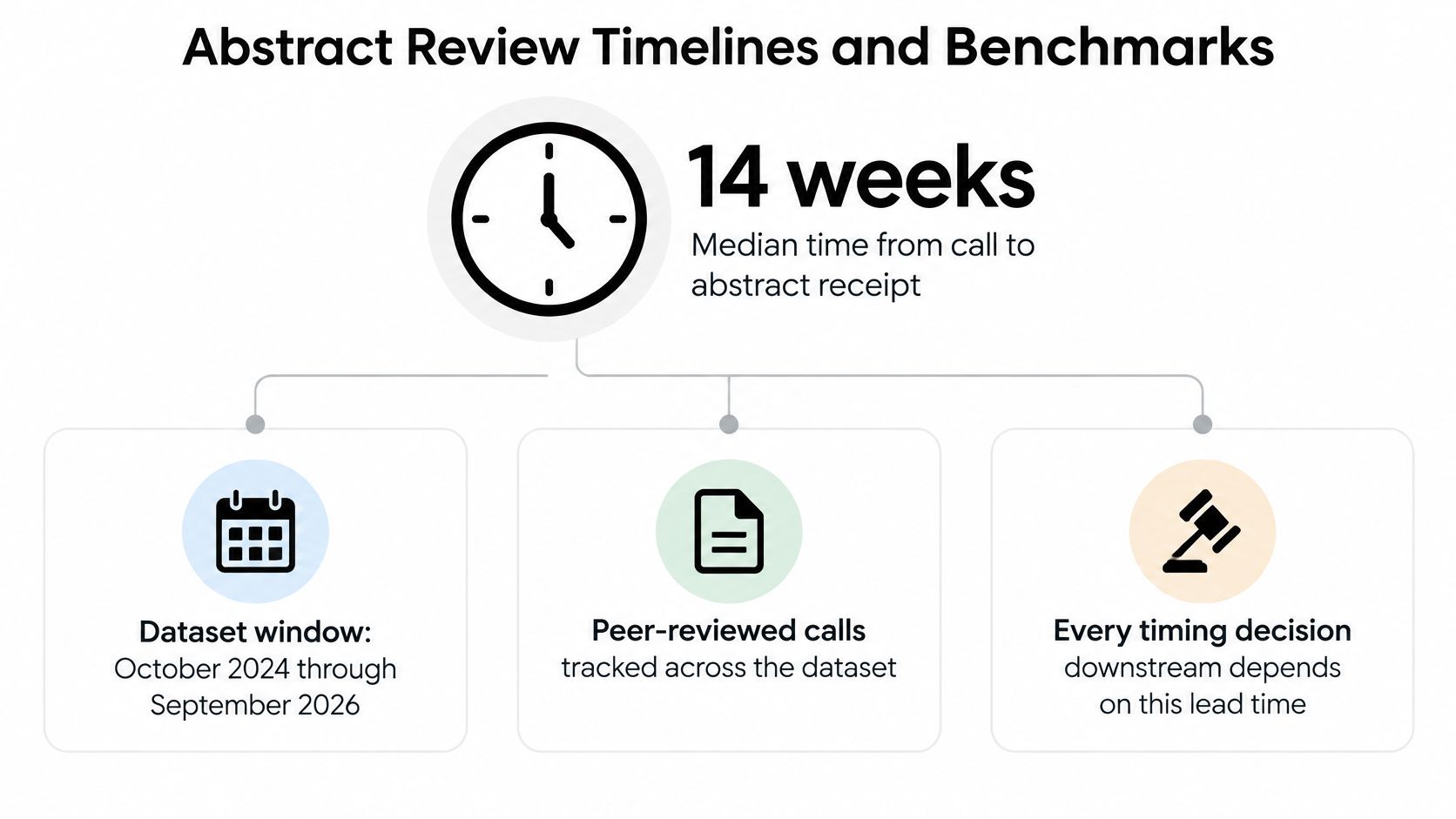
Because review work compresses into a few short weeks across dozens or hundreds of volunteer reviewers, accurate timestamps and workflow status fields matter more during review than they do when printing the final program guide. If a program chair can't see which assignments are overdue on day ten, the decision deadline slips for the entire conference.
Peer-Review Benchmarks and What Your System Must Store
The same conference dataset establishes concrete operational benchmarks for reviewer workload, scoring variation, acceptance rates, and format rules. Every benchmark points directly to a specific field your database needs to preserve.
| Measure | Value | What to store |
|---|---|---|
| Abstracts received before the conference | 14 weeks median | Submission window start date |
| Decisions recorded before the conference | 10 weeks median | Decision timestamp |
| Reviews per abstract | 2 median | Each review as its own record |
| Abstracts per reviewer | 7 median | Workload count per reviewer |
| Review delay after assignment | 9 days median | Due date and completion status |
| Reviewers completing no assigned reviews | 1 in 7 | Completion flag and reminder log |
| Calls using double-blind review | 41% of calls with peer review | Blinding rule per call |
| Score gap between two reviewers | 12 points median on a 100-point scale | Separate score per reviewer |
| Abstracts accepted | 92% median | Acceptance decision per abstract and rate per call |
| Most common presentation slot | 15 minutes | Session time limit field |
| Abstract word limit | 300 words median | Submission rule stored with the call |
What Workload Math and Scoring Spread Mean for Record Design
Look closely at the interaction between reviewer load and non-completion. When each reviewer handles a median of seven abstracts, turns reviews around in a median of nine days, and one reviewer in seven finishes none of their assignments, a single unresponsive volunteer stalls seven submissions at once. If assignments live in a static spreadsheet, coordinators won't notice the bottleneck until a week before committee sign-off. Storing live completion flags, assignment dates, and reminder logs lets staff reassign stalled abstracts early enough to protect the decision schedule.
Scoring disagreement creates a second architectural requirement. Because two reviewers evaluating the exact same abstract differ by a median of 12 points on a 100-point scale, overwriting individual evaluations with a single averaged number destroys vital context. Your data model has to store each reviewer's score as its own child record linked to the abstract, separate from the committee's final acceptance decision. That separation lets chairs flag wide scoring splits for a tie-breaking third review without losing the original evaluations.
Finally, storing submission rules alongside the scholarly content prevents silent drift across conference cycles. When a call enforces a 300-word limit, uses double-blind review, accepts 92% of submissions, and assigns 15-minute presentation slots, those parameters aren't just text on a marketing webpage. Keeping validation rules, blinding flags, and slot lengths inside the call record ensures your system enforces limits at intake and explains historical acceptance trends years later.
Reviewer Assignments, Conflicts and Audit Trails
Even well-timed review schedules break down when reviewer governance lives outside the database. A 2024 ACM SIGMOD community survey collected 345 responses from approximately 1,200 people with relevant reviewing experience and identified five persistent operational problems: high reviewer load, low-quality reviews, weak reviewer engagement, unethical reviewing, and undeclared or under-declared conflicts of interest.
None of those problems disappears through polite reminder emails alone. Each one requires a specific structural control inside your conference records so that staff and committee chairs can enforce fair peer-review processes automatically rather than policing them by hand.
Pairing Operational Problems with Data Controls
- High reviewer load needs live assignment tracking: Store every reviewer's active assignment cap and current abstract count as structured fields. Assignment tools can then balance submissions across the full reviewer pool instead of overloading a handful of reliable senior members.
- Conflicts of interest need structured declarations: Collect co-author relationships, institutional ties, and mentorship conflicts as queryable data rather than free-text email replies. Automated assignment checks can block a reviewer from seeing a submission where a conflict exists before the abstract ever reaches their queue.
- Weak engagement needs deadline and completion logs: Track the exact assignment date, due date, automated reminders sent, and current review status for every abstract-reviewer pair. Committee leads can spot stalled assignments early and redistribute work with a clear record of why the change happened.
- Unethical reviewing and anomalous scores need immutable audit histories: Whenever a score is edited or a decision is overridden, log the original value, the revised value, the user who made the change, and the exact timestamp. Program committees can then investigate contested outcomes directly from the database instead of reconstructing evidence from scattered email chains.
Why Linked Tables Beat Copied Spreadsheets
Research on peer-review archives points to a normalized relational model as the cleanest way to hold these pieces together. Submissions, authors, reviewers, conflicts, scores, and committee decisions should live in linked tables connected by stable IDs, not as duplicated rows copied across departmental spreadsheets. When an author updates an affiliation or withdraws a submission, a normalized model propagates that change everywhere without leaving stale copies behind.
For each reviewer record, your team should verify six baseline elements before review opens:
- Reviewer ID: A unique identifier tied to the person's master profile across roles and years.
- Assigned abstracts: Linked submission IDs showing total active workload and topic match.
- Declared conflicts with dates: Specific author or institutional conflicts recorded before assignment begins.
- Review status: Live state showing invited, accepted, in progress, completed, or reassigned.
- Submitted scores with timestamps: Individual criterion scores and written comments logged at the moment of submission.
- Revision log: Any post-submission edits to scores or status, including who authorized the change and when.
Audit check: Pick any accepted or rejected abstract at random. If the program committee can't explain who scored it, confirm that no reviewer had a conflict, and trace every score change using the stored record alone, the data model still has a gap.
How to Build a Session Program from Accepted Abstracts
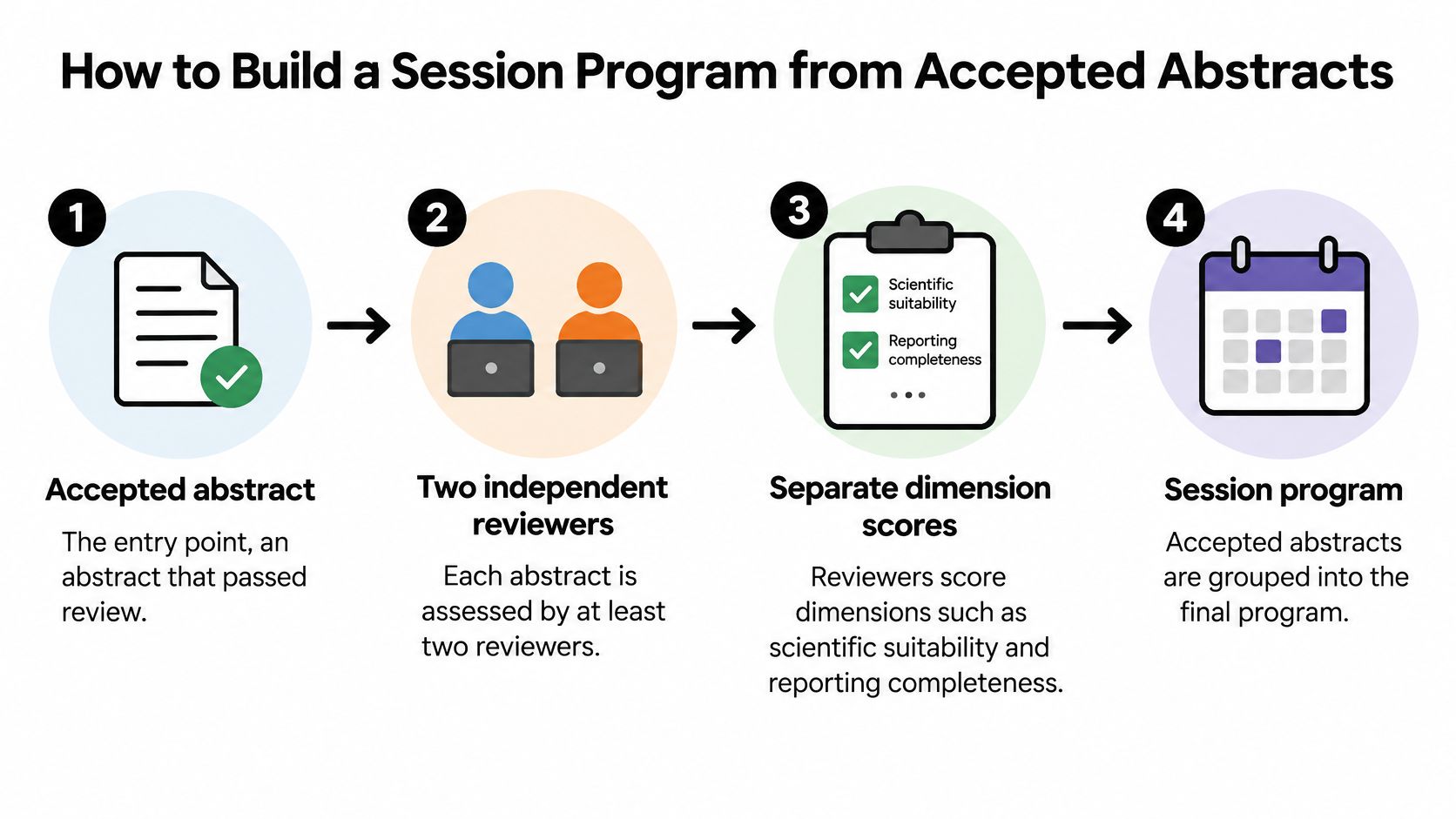
Moving from peer review to a finalized conference schedule is where disconnected systems fail most visibly. According to Planstone's abstract submission reviewing guidance, a defensible review process evaluates every submitted abstract through at least two independent reviewers who score distinct dimensions, including scientific suitability, reporting completeness, and alignment across objectives, methods, results, and conclusions. Acceptance generally requires a combined score of at least 6 out of 10 after those two reviews.
The visual workflow below outlines how accepted work moves from independent multi-dimensional scoring into a structured session schedule.
Once acceptance thresholds are met, the scheduling mechanics begin. Every placement decision modifies linked records, so organizers should follow a strict sequence when building the conference program.
Seven Steps from Accepted Abstract to Archived Program
- Verify the acceptance gate and log the decision date. Before any abstract enters the scheduling workspace, confirm that at least two independent reviews are complete and the combined score meets the 6-out-of-10 mark. Recording the decision date locks in the moment the abstract became eligible for placement, preventing unreviewed or borderline submissions from slipping into draft sessions by accident.
- Filter accepted records by topic and format into draft sessions. Group related research together using the topic taxonomy and presentation type captured at intake. Keep the original abstract ID permanently attached to every session slot so changes to titles or author lists stay synchronized with the submission record.
- Run presenter availability and conflict checks across the grid. Verify that no presenter is booked into two overlapping sessions and that speaker travel constraints or blackout windows are respected. Checking conflicts against persistent presenter IDs catches double-bookings that text-only name matching misses when an author lists a middle initial on one paper and omits it on another.
- Fit each presentation within room and session time limits. Compare every talk's assigned duration against the session's total minutes, leaving buffer time for transitions and audience Q&A. If space constraints force a talk to convert into a poster, record that format change directly on the abstract record so downstream speaker tasks and room counts stay accurate.
- Generate speaker task lists with explicit due dates. As soon as placement stabilizes, link each presenter to their required preparation items: presentation file upload, financial disclosure form, bio confirmation, and formal correspondence. Attaching due dates to individual speaker records gives staff a single dashboard for follow-up instead of chasing attachments through inbox folders.
- Send placement notices and archive the correspondence. Notify authors of their session title, date, time, and final presentation format, and store the sent message against the abstract record. Logging outbound notices settles disputes quickly when a presenter later questions whether they were told about a format switch or a morning start time.
- Publish and archive the numbered program version. Save the finalized schedule with a version number and timestamp before pushing feeds to mobile apps, web guides, or print layouts. When late cancellations force last-minute swaps, versioned archives keep every adjustment traceable back to the original accepted abstract.
Watch how a coordinated workflow handles session sorting and scheduling in practice in the walkthrough below.
Each step in this sequence builds a dependency for the next team in line. If someone drags a title into a word-processing schedule without preserving the link at step two, that broken connection surfaces weeks later as a speaker with no assigned room at the printing deadline or an accepted poster missing from the event app.
Registration and Speaker Records That Feed Later Stages
Program schedules tell you what's supposed to happen in each room. Registration and speaker records tell you who's participating and whether they're ready when the doors open. Both record sets feed directly into continuing education compliance and post-event reporting, so their structure matters just as much as the abstract database.
Registration Fields and the Attendance Separation Rule
A clean registration record holds seven core fields that downstream stages consume: attendee ID, registration type and payment status, session selections, attendance evidence, accommodation requests, communication preferences, and consent flags.
The most common architectural mistake here is treating a session selection as proof of attendance. Selecting a workshop during online sign-up only records intent, much like how workflows for collecting tournament entries and payments separate a confirmed, paid registration from the actual check-in record showing who took the court on match day. For conferences, badge scans, virtual room join-and-leave timestamps, or signed attendance logs must live as separate participation events linked to the attendee ID and session ID. Credit workflows depend entirely on that separation because accreditors audit actual participation, not registration receipts.
Accommodation requests need similar precision. Instead of dumping accessibility notes into an open comment box on the registration form, store each request in structured fields:
- Accommodation category: Standardized labels such as captioning, wheelchair access, ASL interpretation, or accessible print materials.
- Linked session or service: The specific rooms, streams, or handouts affected by the request.
- Authorized staff role: Permissions defining which operations personnel can view the requirement.
- Fulfilment status and review date: Tracking that confirms vendors or venue staff verified delivery before the session starts.
Structuring requests this way lets audiovisual teams schedule live captioners and venue planners adjust seating layouts without ever exposing sensitive medical details to peer reviewers, session chairs, or fellow speakers.
Speaker Records and a Worked Late-Change Scenario
Every accepted presenter should carry a linked speaker record tied directly to their accepted abstract ID and master person ID. That record anchors four operational elements: a task checklist with due dates, presentation file versions with review status, financial disclosure request status, and a complete correspondence log capturing dates and recipients.
Consider what happens when a speaker asks to convert an accepted lecture into an interactive workshop two weeks after the program goes live. Without linked records, an operations coordinator updates the room sheet, forgets to alert the audiovisual team, and leaves the old slide template in the speaker portal. With a linked data model, changing the session format triggers updates across the same audit trail: the session record updates from lecture to workshop, the room assignment shifts to a flat-floor layout, the speaker's file-upload task resets for the new workshop handout version, audiovisual specs adjust for breakout microphones, and any accommodation requests tied to that session flag for re-verification.
When registration and speaker records stay cleanly structured, three critical inputs flow automatically into the next stage: confirmed faculty identities tied to specific sessions for pre-activity disclosures, verified participation events for credit eligibility, and approved presentation files ready for controlled handout publishing.
How Disclosure, Evaluation and Credit Records Connect
Accredited medical and scientific conferences operate under two strict timing gates. Disclosure is a pre-activity control that must finish before a single learner enters the room. Credit is a post-activity gate that never opens because someone registered or scanned a badge at the door. Modeling both gates as linked, time-stamped records is the difference between a routine accreditation review and a stressful manual audit.
Pre-Activity Financial Disclosure Workflows
Under the ACCME rule on relevant financial relationships, providers must collect information from every planner, faculty member, and other person who controls educational content about all financial relationships with ineligible companies during the previous 24 months. The rule applies regardless of whether the individual thinks a relationship is relevant, and ACCME sets no minimum financial threshold: every relationship must be reported.
The ACCME Standards Toolkit further specifies that individuals must name each ineligible company and describe the nature of each financial relationship, regardless of the dollar amount involved. Providers then determine which relationships are relevant to the educational content, mitigate those relevant relationships to prevent commercial bias, and disclose the presence or absence of relevant relationships to learners before the activity begins.
A simple yes-or-no checkbox fails this standard completely. Your disclosure table needs distinct fields for the person ID, each ineligible company name, nature of the relationship, 24-month date range covered, relevance determination, mitigation action taken, and learner-facing disclosure status. Operationally, the workflow moves in six tracked steps: sending the disclosure request with a deadline, firing automated reminders, running a completeness check that blocks forms with blank company names, routing completed declarations to staff or clinical reviewers for adjudication, documenting the chosen mitigation step (such as peer review of slides), and generating the final learner-facing disclosure tied to that specific activity and faculty member.
Watch out for a common failure pattern in conference operations. Say a faculty member submits a clean disclosure form in week one, then adds new trial data to their slide deck in week six that touches a company they previously listed as unrelated. If your disclosure record isn't linked to presentation file versions and session topics, nobody catches that the content shift changed relevance, and unmitigated slides reach the podium.
Post-Activity Evaluation and Credit Gates
Once the session concludes, credit administration must run as a gated evidence workflow rather than a batch mail merge. According to the ACCME CME for MOC Program Guide, activities offering Maintenance of Certification credit must include an evaluation assessing changes in learner competence, performance, or patient outcomes. Providers must also set a participation threshold, deliver learner feedback, and report individual completion data through PARS.
For physician credit specifically, the AMA PRA Category 1 Credit booklet requires that certificates, transcripts, and credit documentation show the actual number of credits claimed by the physician, and notes a concrete poster rule assigning five AMA PRA Category 1 Credits per poster. Because rules vary by accreditor, certifying board, and learner type, your system must store every qualifying step as a time-stamped event before releasing a certificate.
| Requirement | Record to keep | Example |
|---|---|---|
| Participation threshold | Attendance or participation evidence per learner | Threshold met before any credit is calculated |
| Evaluation completion | Responses linked to activity objectives | Competence, performance or patient outcome change assessed |
| Credit calculation | Credit amount, rule version, calculation date | AMA PRA Category 1 Credit: five credits per poster under the cited guidance |
| Certificate issue | Issue date, credits claimed, learner ID | Certificate shows the actual credits claimed |
| Later correction | Time-stamped correction event | Original and corrected credit both retained |
Linking evaluation responses directly to activity objectives does more than pass audits. It allows education directors to run longitudinal analyses across annual meetings instead of staring at anonymous satisfaction averages disconnected from learning outcomes.
Trace one faculty member from their initial financial declaration to the learner-facing disclosure slide, and trace one attendee from session check-in and evaluation completion to their issued certificate. If you can finish both traces without leaving the database or opening an email inbox, your compliance chain holds.
Privacy, Accessibility and Access Control for Records
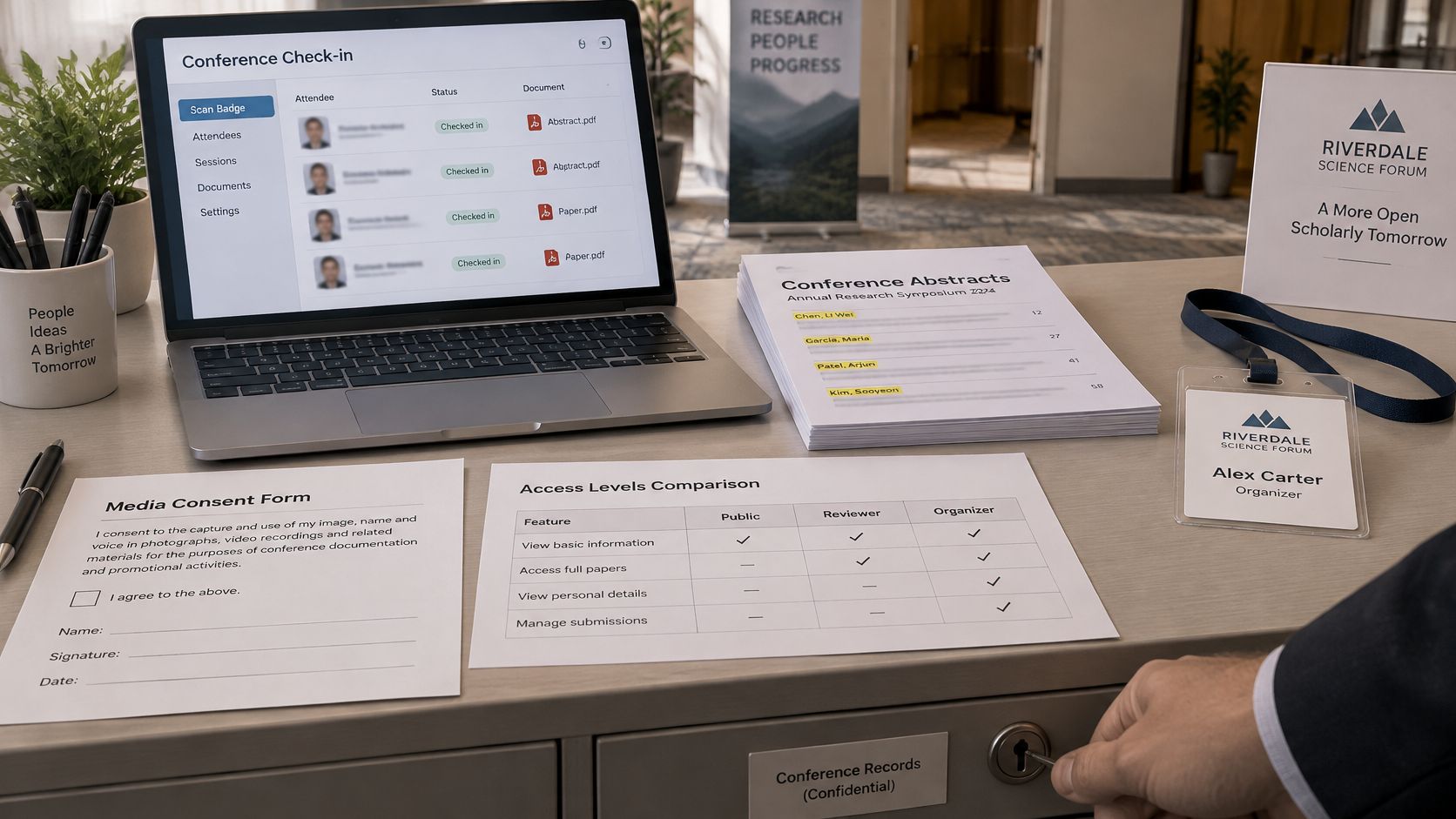
Many event teams treat privacy as a one-time administrative checkbox: add a consent tick-box to the submission form, link a privacy notice in the footer, and tell authors not to upload patient names. In scientific and medical conferences, that checkbox approach leaves wide operational gaps because abstracts, case reports, and slide decks frequently contain sensitive information organizers never intended to collect.
For example, the CSI Congress data privacy notice explicitly warns European scientific-conference submitters not to include personal data and notes that health-related data may require authorization under GDPR Article 9, while also informing authors that accepted abstracts and posters may be viewed or downloaded by event participants. Notice the tension that creates. A written disclaimer doesn't answer who's legally accountable if an author accidentally uploads an identifiable patient scan, how consent gets verified across international borders, what happens when a submitter withdraws an abstract after publication, or how access gets revoked across third-party apps and recordings.
Moving from Privacy Notices to Operational Controls
Centralizing conference records cuts down on messy duplicates, yet putting all files in one hub also concentrates privacy risk if everyone sees everything. The practical solution is controlled interoperability: share only the minimum necessary fields at each handoff and assign clear ownership across every tool.
- Field-level access controls: Restrict sensitive fields, such as health-related notes, dietary restrictions, or unblinded author identities, so only authorized staff roles can view them.
- Record-specific retention schedules: Define how long each data category stays live. Continuing education credit records may need multi-year retention for board audits, while temporary badge-scan logs or draft reviewer comments can be purged on a shorter schedule.
- Documented withdrawal workflows: Build an explicit takedown checklist that removes or restricts a withdrawn abstract from the web guide, strips associated handouts, clears cached mobile app feeds, and logs the withdrawal timestamp and operator ID.
- Clear controller and processor boundaries: Document data-sharing responsibilities before handing exports or API feeds to audiovisual vendors, mobile event apps, streaming platforms, or cross-border hosting partners.
Governing Accessibility Data with the Same Discipline
Accessibility belongs inside the exact same data-governance framework. Participants at the 4th International Conference Accessible Future emphasized that digital inclusion should be a standard rather than merely good practice, identifying interoperability, representation, data governance, and education as ongoing priorities alongside data-privacy protection when adopting AI accessibility tools.
Collecting better accommodation data improves service for in-person, hybrid, and virtual attendees, yet it also raises sensitivity and disclosure risks if stored carelessly. Conference teams should store accommodation requests with strict purpose limitation and role-based visibility, track caption quality and accessible handout metadata directly on session records, and report unmet requests only in aggregated post-event equity summaries. A reviewer evaluating a manuscript never needs to see a presenter's medical accommodation, and an event app doesn't need raw request notes to display whether a room offers live captioning.
Governance rule: Collect only the minimum data required for a clearly stated operational purpose, and store that purpose alongside the field's retention date and permitted staff roles.
Choose Your Data Model Before the Next Call Opens
The single decision that prevents the most downstream chaos happens weeks before launch: lock in your persistent identifiers, workflow stages, and field rules before the call for abstracts opens. Trying to retrofit conflict checks or attendance gates after reviewers have started scoring forces staff into brittle spreadsheet workarounds that create audit headaches for months.
Five Steps to Set Up Your Model Before Launch
- Map the seven workflow stages and assign a named record owner to each. Decide upfront who owns abstract intake, review progression, session placement, speaker readiness, registration feeds, accreditation rules, and post-event publishing. Setting clear ownership before launch mirrors the same operational discipline behind keeping youth squad information organised, where defined roles and shared rosters stop miscommunication the moment schedules go live.
- Lock in required timestamps and status fields across every stage. Confirm that reviewer assignments, committee decisions, speaker task completions, participation check-ins, and credit issuances all write automatic date stamps and immutable status transitions.
- Encode conflict, disclosure, and withdrawal policies as structured fields. Move your governance rules out of PDF handbooks and email templates into live form validations, required fields, and logged workflows that support consistent conference recordkeeping from day one.
- Verify evaluation and credit logic against accreditor requirements per activity type. Map each session format, whether oral lecture, interactive workshop, or poster presentation, to its exact participation threshold, evaluation instrument, and credit calculation rule before registration opens.
- Run one end-to-end test record from submission to certificate. Create a dummy author, submit a test abstract, complete two test reviews, place it in a session, upload a draft slide deck, complete a disclosure, log attendance, fill out an evaluation, and generate a certificate. Confirm that every single link resolves cleanly across modules and integrations.
The One-Minute Readiness Test and Platform Evaluation
Once your setup passes the end-to-end run, put it through a quick operational test: hand a brand-new coordinator a random abstract ID or attendee ID and see if they can locate the record owner, the last timestamp, and the current workflow status in under a minute. If they have to ask a colleague or dig through shared email folders, tighten the links before opening submissions.
Teams comparing conference software should use this exact inventory as their evaluation scorecard. List the specific workflows you run today across abstract management, speaker management, disclosures, evaluations, credits and certificates, and handouts, along with the exact reports your committees and accreditors expect at the end of the meeting. When a team wants a second opinion on its data model, a consultation with Planstone reviews your program, existing systems, and team requirements first before discussing where a configurable platform fits.
Planstone provides configurable conference and continuing education management software that connects abstract submissions, peer review, session building, speaker tasks, financial disclosures, handouts, evaluations, and credit administration in one coordinated system, backed by dedicated account management and integrations for your existing association tools. If you want to replace disconnected spreadsheets with a linked, audit-ready workflow for your next scientific or medical meeting, explore how our team supports association programs at Planstone.