

Recordkeeping is the practice of creating, describing, storing, protecting, retrieving and disposing of records as evidence of activity. “Recordkeeping” and “record keeping” refer to the same practice; this guide uses the one-word form.
If you can produce an attendee's certificate but can't show why the credit was awarded, have you kept the record or only the result? For association and education teams, that distinction matters more than the storage location or file format.
Table of Contents
- What Recordkeeping Means and Why It Matters
- The Four Properties and the Metadata That Carries Them
- Retention Periods That Differ by Record Type
- How to Verify Digital Records Have Not Changed
- Closing the Evidence Gaps Across Systems
- Deciding Which AI Outputs Become Records
- Confirm Your Recordkeeping Plan Before the Next Event
What Recordkeeping Means and Why It Matters
Recordkeeping means managing evidence throughout its working life, not saving documents after an event. Think of a receipt: it's useful only if you can find it, establish that it's genuine and understand how long you need to retain it.
Say a physician questions a credit award after a conference. Your team finds the certificate, but the attendance export uses a different participant identifier, the evaluation sits in another application and a staff member changed the credit amount by email. You have files, but you don't yet have a defensible explanation.
A record is its content plus the context that proves what it is.
For conference and continuing education teams, the scope includes more than attendee documentation:
- Abstracts and reviews establish what authors submitted and how committees assessed it.
- Speaker disclosures document financial relationships and the actions taken during program preparation.
- Evaluations and credit decisions connect participant activity with the rules used to award credit.
- Certificates and corrections show what the organization issued and what it subsequently changed.
These records answer different business questions. An auditor may ask how a credit was granted; a sponsor may ask who approved a session; a planner may need evaluation results to redesign a program. Each request requires enough context to interpret the underlying activity.
Storage is only part of the job. A shared drive can hold a presentation without showing whether it was the approved version, and an inbox can retain an approval without connecting it to the right abstract.
A useful recordkeeping plan therefore answers four practical questions: What makes the record trustworthy? What information must accompany it? How long must it remain available? How can you demonstrate that its content hasn't changed?
The Four Properties and the Metadata That Carries Them
Authenticity, reliability, integrity and usability are the properties of authoritative records identified by ISO 15489-1:2016, which treats a record as content together with metadata describing its context, structure and management over time. A document's appearance alone doesn't establish any of these properties.
Metadata is the information that lets someone understand and manage the record. For an abstract, the text is content; the author identity, submission time, review action and approval history supply essential context.
Four Properties of an Authoritative Record
| Property | Question it answers | Working control |
|---|---|---|
| Authenticity | Can we show what the record is, who created or sent it, and when? | Capture creator, sender and timestamp at the point of submission |
| Reliability | Does the content accurately represent the activity it documents? | Keep the review action and approval state that the record reflects |
| Integrity | Is the record complete and protected from unauthorized change? | Keep an immutable event history for every material change |
| Usability | Can the record still be retrieved and interpreted in its business context? | Link each record to its related submission, session, attendance and credit data |
These properties address different problems. An authentic reviewer comment may still be unreliable if it was accidentally attached to the wrong submission. An unchanged file may still be unusable if nobody can identify which activity it belongs to.
Consider a committee member asking who approved an abstract. A final status of accepted answers only part of the question. The trustworthy record also identifies the approver, the approval time, the review action and the version that person approved.
An immutable event history is a practical control for that purpose. Staff should be able to correct a mistake through a new, attributable action without replacing the earlier history out of view. This is an implementation approach supporting integrity, not a claim that the standard mandates a particular software architecture.
Capture Context When the Work Happens
For each record, establish fields for:
- Identity and timing: Creator or sender, submission or transaction time, and a persistent record identifier.
- Decision history: Review action, approval state, responsible person and version number.
- Business relationships: Linked session or activity, participant identity where relevant, and related supporting records.
- Lifecycle management: Applicable retention rule, clock-start event and disposition status.
Start with the collection process. A well-designed abstract submission form gives authors clear fields and helps staff capture context before review begins.
Don't reconstruct this information from memory after the conference. Capture it when the submission, approval or correction occurs, and preserve the relationship between an accepted abstract and its eventual session.
An evaluation export without an activity identifier, session date or connection to the awarded credit can't independently substantiate a credit decision. Those details may exist in related records, but the links must survive export and staff turnover. Treat those relationships as evidence, not disposable application telemetry.
Retention Periods That Differ by Record Type
There's no universal retention period. Classify records by purpose and governing rule, then identify the event that starts the retention clock. The following lookup distinguishes provider obligations, physician obligations and administrative records rather than treating them as interchangeable.
Minimum Retention Periods by Record Type
| Record type | Governing rule | Minimum period | When the clock starts |
|---|---|---|---|
| CME participation verification records | ACCME accreditation requirements | Six years | Date of the CME activity |
| CME planning and presentation files | ACCME accreditation requirements | Current accreditation term or preceding 12 months, whichever is longer | Accreditation-term coverage and preceding-period review, not a single creation-date clock |
| CME physician records in California | Medical Board of California | At least four years | Confirm the applicable start event before scheduling deletion; the cited guidance doesn't specify it |
| HIPAA policies, notices and complaint dispositions | HIPAA Privacy Rule | Six years | Later of creation date or last effective date |
| Income-related tax records | IRS retention guidance | Generally three years; six years if unreported income exceeds 25% of gross income shown on the return; indefinite for fraudulent or missing returns | Filing date for filed returns; no finite clock for the stated indefinite cases |
| Employment-tax records | IRS | At least four years | Later of the date the tax became due or was paid |
For accredited CME providers, the participation requirement includes maintaining attendance-recording mechanisms and verifying participation when the physician authorizes it. Planning and presentation documentation serves a different purpose, so retaining certificates alone doesn't satisfy the program-level evidence need.
California's physician documentation should identify the course title, attendance dates, program length, sponsor, accreditor where applicable, physician name and credit hours. A provider's retention duties and an individual physician's duties shouldn't be collapsed into the same schedule entry.
Practical rule: A retention period without a clock-start event isn't ready for automated deletion.
Watch for Rules That Change the Clock
HIPAA's documentation rule applies to covered entities and required privacy documentation, not automatically to every document produced by a medical conference. If a policy remains effective after creation, its retention calculation must account for that later effective date.
For tax records, the ordinary period isn't a blanket permission to destroy all supporting material. The applicable limitation period and the nature of the record matter.
Before approving destruction, have a qualified compliance or legal reviewer confirm applicable obligations and any holds. Mark unknown start dates as unresolved items, not assumptions hidden in a spreadsheet.
How to Verify Digital Records Have Not Changed
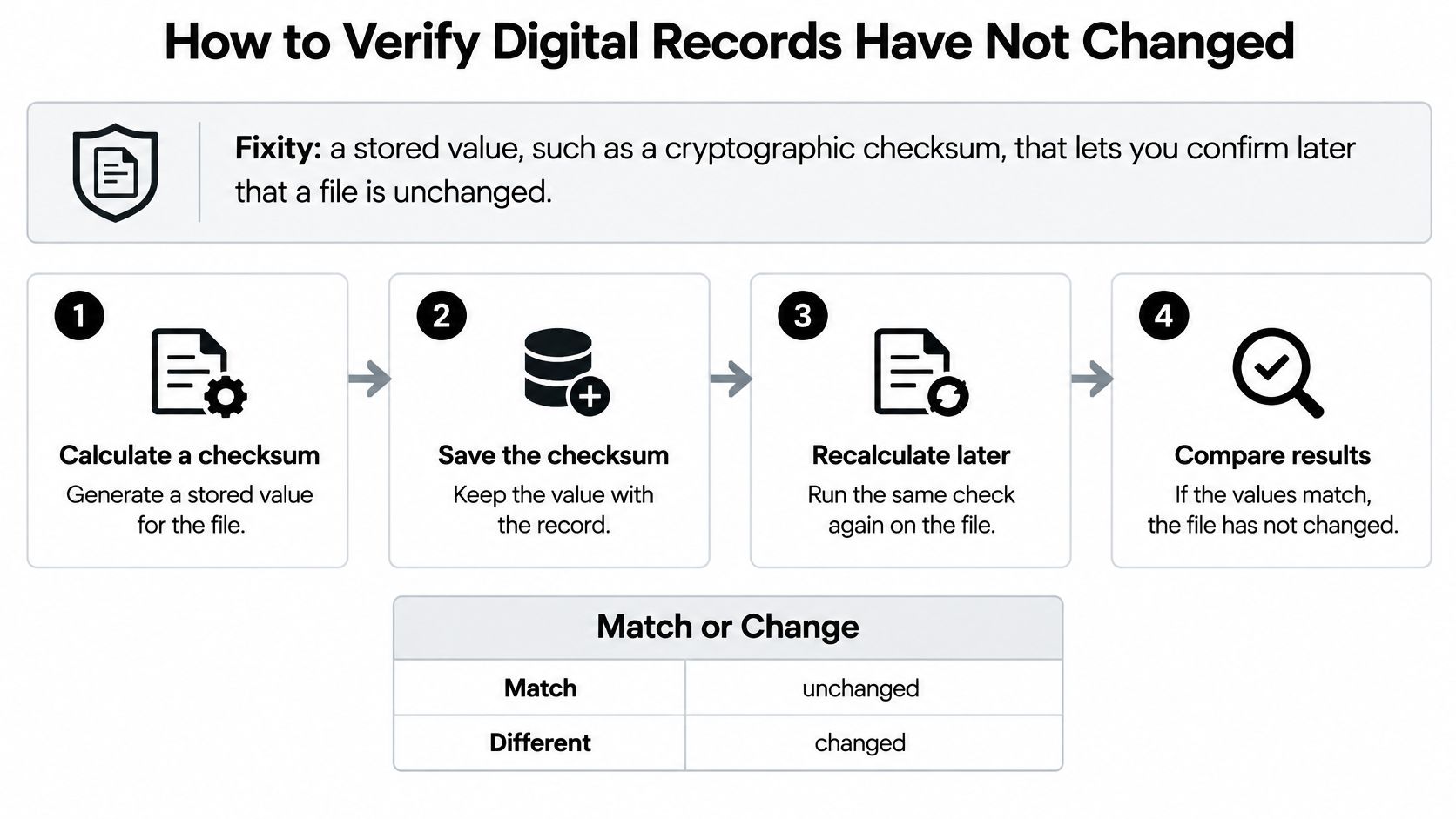
Fixity means a stored value, such as a cryptographic checksum, that lets you check later whether a file has changed. The National Archives and Records Administration's records-management guidance supports recorded fixity information alongside replicated storage, transfer validation, adequate metadata and tracked preservation actions.
This diagram summarizes the basic comparison process.
Put Fixity Into the File Workflow
Calculate a checksum at capture. Use a cryptographic hashing tool when you receive a presentation, handout, evaluation export or certificate file. A baseline created later can't establish the file's earlier state.
Store the checksum in preservation metadata, alongside the file identifier, format and hashing method. Keep that metadata protected so someone can't replace both the file and its baseline without detection.
Maintain replicated copies in separate storage. Replication helps recover from storage loss. Copies alone don't demonstrate that corruption or an unauthorized edit hasn't spread between them.
Validate the checksum during transfers, migrations and downloads. Compare like-for-like files with the same hashing method and retain the verification result.
Log transformations and administrative actions. Record format conversions, renames and other actions with a date and responsible person or service. A rename may leave file content unchanged, but it still affects identification and retrieval.
Test restoration on a documented schedule. Recover the file, its metadata and the links needed to interpret it, rather than checking only whether a backup job completed.
Investigate mismatches before overwriting anything. Preserve the suspect file, compare it with a replicated copy and document the cause. Don't automatically treat the newest copy as authoritative.
Say staff convert a speaker's slide deck into a handout PDF. The output is a different digital object, so it needs its own identifier and checksum, linked to the source presentation and the conversion event.
A matching checksum supports evidence that file content is unchanged. It doesn't establish that the original content was accurate or that its creator was authorized.
That distinction prevents a common mistake: using technical integrity as a substitute for the business controls that establish trustworthy evidence.
Closing the Evidence Gaps Across Systems
The hard question isn't how long you keep records alone. It's whether you can demonstrate that they're complete, findable and appropriately disposed of across disconnected systems.
The illustration below shows the mix of locations a team may need to reconcile.

In PwC's 2025 Global Compliance Survey, 63% of respondents viewed data complexity and disaggregation as a compliance obstacle, rising to 70% in North America, while 56% cited data reliability and quality. These are broad compliance findings, but they frame a concrete problem for event teams: separate applications can preserve conflicting accounts of the same activity.
Establish an Authoritative Source for Each Link
A defensible credit decision may involve a source submission, review action, approval, attendance event, evaluation, credit calculation, certificate and later correction. You don't need every item in the same application, but you do need persistent connections and clear ownership.
Turn the difficult questions into operating decisions:
- When registration and credit records disagree, designate which system controls participant identity and which controls the education decision. Document how staff resolve the conflict.
- When duplicate participant identities appear, use a controlled reconciliation process. Preserve the original identifiers, the merge decision and the person responsible.
- When someone challenges awarded credit, retrieve the attendance evidence, evaluation evidence and rule version used for that decision, not merely the current participant profile.
For disclosure-related links, include the collection and review workflow in your financial disclosure management procedures. A completed disclosure status and a decision about that disclosure are different pieces of evidence.
Use the following video as a discussion prompt while your team examines its own workflow.
Choose a representative activity and draw its evidence chain. Beside each link, name the authoritative source, record owner, identifier and correction procedure; include how scheduled deletion reaches exports and duplicate copies.
The finished map should expose gaps rather than conceal them. Metadata quality, provenance, searchability, reconciliation and documented exception handling matter as much as retention periods.
Deciding Which AI Outputs Become Records
Keeping every AI interaction isn't automatically better recordkeeping. Excessive capture can increase privacy, discovery and security exposure, while insufficient capture can leave a consequential decision unexplained.
NAGARA's AI records-management guidance frames AI governance around retention, privacy, data minimization and human validation. Classify artifacts by use case, assign retention and deletion ownership, and distinguish an exploratory interaction from material used to make an official decision.
Which AI Artifacts to Keep as Records
The following is a proposed responsibility matrix, not a universal legal schedule. Personal-data content must be checked rather than assumed.
| Artifact | Defends a decision? | Holds personal data? | Retention and legal hold owner |
|---|---|---|---|
| Transient prompts | No, unless they explain a kept decision | Often, faculty or participant details | Workflow owner; delete on a defined schedule unless held |
| Final decisions | Yes | Possibly | Record owner, with legal hold rights |
| Reviewer comments | Yes, as rationale | Possibly | Review committee lead |
| Model-assisted recommendations | Yes, with model version | Limited by design; inspect content | Program owner, versioned with the model |
| Human approvals | Yes | Limited by design; inspect content | Approver's office |
| System logs | Yes, as audit trail | Possibly | Records owner, per vendor contract |
Apply the same decision questions to each category:
- Evidence: Does this artifact explain a decision the organization must defend?
- Privacy: Does it contain participant or faculty information that the workflow doesn't need?
- Control: Who can retain, delete, export or place it under legal hold?
Say staff use AI to screen abstracts against submission criteria. Preserve the human approval, reviewer rationale, relevant source references and model version needed to explain the outcome; delete unnecessary faculty details in transient prompts under a defined schedule, subject to holds.
A consistent conference abstract template can help teams distinguish submitted information from generated commentary. Keep testing artifacts when they substantiate the screening method rather than assuming every test belongs in the permanent record.
For organization-wide responsibilities, Freeform Company's governance compliance guidance for enterprise teams offers an additional governance resource. Before adopting third-party AI tools, review contractual rights to access, export, metadata and deletion, including how those rights operate when the relationship ends.
Confirm Your Recordkeeping Plan Before the Next Event
Run a readiness check while staff can still correct gaps before submissions, disclosures and attendee activity accumulate. Assign each action to a named person and keep unresolved questions visible.
Pre-Event Readiness Checklist
Inventory the records. Include abstracts, reviews, disclosures, handouts, evaluations, credits and certificates. Identify working copies and authoritative records separately.
Match each category to its governing rule and clock-start event. Leave an unknown date open for review rather than assigning a convenient default.
Name an owner and authoritative system. Record who resolves conflicts and who authorizes disposition. An application administrator isn't automatically the business record owner.
Check that required metadata survives capture and export. Inspect linked activity, approval state, version information and transaction history in an actual sample.
Start the fixity routine for captured and exported files. Assign responsibility for verification failures and restoration tests.
Trace a submission through to its resulting certificate. Introduce a hypothetical correction and check whether staff can identify the original decision and subsequent action.
Classify AI artifacts and inspect contracts. Confirm that retention, legal hold, export and deletion responsibilities remain workable outside the application interface.
Run a test retrieval, using a target of completion within a day. Start with disclosure and credit records because they connect to several other record types, then produce a sample attendee's complete credit evidence.
Treat the retrieval target as an internal exercise, not a regulatory deadline. Record missing links and assign corrective work before accepting the process as ready.
We support financial relationship disclosure collection, status tracking and reporting, and our credit tracking module collects participant feedback, applies credit rules and makes certificates available to attendees. Planstone is one provider to evaluate, not a default choice.
Before committing to any provider, put these questions into the demonstration: Which metadata is captured? How are credit rules logged? How are corrections recorded? Ask for a sample export and use it to test the answers.
Planstone offers configurable conference and continuing education management software connecting submissions, speaker preparation, disclosures, evaluations and credit administration. Visit Planstone to discuss your workflow, bringing a sample disclosure process and credit evidence chain so you can evaluate how the software fits your recordkeeping responsibilities.