

You're staring at a submission inbox that closed last night with hundreds of records, half the co-author lists incomplete, reviewers asking what they're supposed to score, and a program committee that needs sessions built next week. That mess rarely starts with weak science. It starts when the abstract was treated as a short document to judge once, instead of a structured record that has to survive triage, review, session building, and later publication.
Table of Contents
- Conference Abstract Submission Stages at a Glance
- Preparing Abstracts That Pass Completeness Checks
- Structured Fields and Accessibility Requirements
- Running Peer Review and Scoring Abstracts
- Keeping Reviews Fair, Consistent and Traceable
- How to Build Accepted Abstracts into Sessions
- Choosing How to Run Your Submission Process
- Frequently Asked Questions
Conference Abstract Submission Stages at a Glance
Conference abstract submission is the structured process by which authors propose work, organizers screen and review it, and accepted work becomes sessions in a published program. If you're checking the basic abstract submission format, start with the flow below, because a record changes hands several times before it's scheduled.
| Stage | What happens | Usually owned by | Output |
|---|---|---|---|
| Call for abstracts | Publish scope, categories, deadlines, and length rules | Program committee | Published guidelines |
| Submission | Authors enter metadata, all authors, affiliations, and abstract text | Authors | Submitted record |
| Triage | Eligibility and completeness checks against event rules | Program staff | Eligible or returned records |
| Review | Reviewers score each abstract against defined criteria | Reviewers | Scores and comments |
| Decision | Accept, reject, or reassign presentation format | Program committee | Decision notice |
| Program build | Group accepted abstracts into sessions and schedules | Session organizers | Final program |
Where Filtering Actually Happens
Don't assume most submissions get in. In the large biomedical review of 43 meetings held between 1957 and 1999, 14,945 abstracts were submitted and 46% were accepted, so roughly half of submitted work never entered the program. That review also found about 10% of all submissions were accepted for oral presentation, with the rest generally assigned to posters or rejected.
That second filter catches people out. An author may write for a talk, clear triage, score well enough for acceptance, and still land on a poster because oral slots are scarce. Your workflow has to record that distinction clearly, or authors will prepare the wrong presentation.
Practical rule: Treat acceptance and presentation format as two separate decisions, each with its own owner and notice.
Two stages need the most care. Triage decides whether a record is complete enough to judge at all. Review decides whether it's strong enough for the program. If you blur them, reviewers waste time on ineligible work and staff end up making scientific calls they shouldn't own.
Preparing Abstracts That Pass Completeness Checks
Before a reviewer reads a word of the science, program staff run an eligibility screen on the record itself. They check length against the event's counting method, every author name and affiliation, the oral or poster preference, and language suitable for publication. Fail one item and the submission can be returned without any scientific judgment at all.
That screen matters beyond this stage. The details it verifies, the author list, the length-compliant body, the stated preference, become the record that reviewers score, session builders schedule, and the published program reproduces. A record that enters review clean stays clean all the way to the program guide.
Run Three Checks Before You Submit
- Count using the event's method: A word count and a character count give different results for the same text. Paste into a generic counter and you can pass there while failing the event's own measure.
- Confirm every author: Enter the submitting author, all co-authors, and the principal investigator or laboratory head where the event requires it, with an affiliation attached to each name.
- Match preference to evidence: Choose oral only when the results can carry a talk and the discussion after it. A poster preference commits you to a different format.
Length rules differ between events, so read the current call alongside a conference abstract template instead of copying last year's format.
| Event | Length rule | Excluded from count | Other requirements |
|---|---|---|---|
| American Thoracic Society scientific abstracts | 400 words, abstract body only | Title, authors, institutions, tables, images | Introduction or rationale, methods, results with new data, conclusions |
| CROI | Character-based count with spaces included | Tables and figures | Exact threshold set in the current call |
| University of Wisconsin conference guidelines | No body length stated in the guidelines | No exclusions stated | Every author with affiliations; oral or poster preference; English suitable for publication |
The American Thoracic Society submission criteria require a title, authors and institutions, an introduction or rationale, methods, results with new data, and conclusions, with the body limited to 400 words. CROI's call takes the contrasting approach: a character-based limit where spaces count and tables and figures sit outside the count.
The counting method should change how you edit. Under a word limit, a long technical term costs the same as a short one, so you save space by cutting whole clauses. Under a character limit, every abbreviation and space counts, and dense terminology or long drug and gene names consume the allowance fast. The same paragraph can pass one method and fail the other.
For authorship, the University of Wisconsin conference abstract guidelines instruct submitters to include every author: the submitting author, all co-authors, and the principal investigator or laboratory head, each with an affiliation. The same guidance asks for an oral or poster preference and English suitable for publication.
Missing a senior author at submission is no small typo. Adding one after acceptance changes the authorship record that reviewers, the program, and later publications rely on.
If you run the event, build these checks into the form itself. Configure validation for word counts, character counts, excluded fields, and required sections, and let the form block or flag a body that exceeds the limit. A form that waves a 600-word body through a 400-word rule pushes the rejection to a staff member composing an awkward email, and every late correction rewrites a record the program is already built on.
Structured Fields and Accessibility Requirements
An abstract isn't a shortened manuscript. It's an evidence record that reviewers, session builders, and later readers have to appraise on its own. When that record is only a free-text box, critical details go missing.
In the systematic review of 90 conference abstracts, median adherence to the CONSORT-for-Abstracts reporting standard was only 24% (IQR 18–29%). That review also found 73% of abstracts had missing or insufficient information for at least 15 of 25 data-extraction items, and 62% were judged to have an overall high risk of bias.
Build an Acceptance Gate, Not Just a Word Limit
Use conditional, study-design-specific fields on your abstract submission form for population, intervention or comparator, outcomes, effect estimates, registration identifier, and funding and conflicts. A trial, a cohort study, and a case report shouldn't face identical mandatory fields.
A workable gate has four testable parts:
- Design metadata present: The study type and population are stated in dedicated fields.
- Primary outcome identified: One outcome is named as primary, not buried in prose.
- Numerical results supplied: Effect estimates appear where the design calls for them.
- Identifier validated: A registration or protocol number is entered and checks out.
Automated completeness checks can stop records that reviewers can't reliably appraise. Structured fields also improve search, reviewer assignment, and conversion into sessions, because staff can filter on method or population instead of reading every abstract to group them.
Make Accessibility a Submission Requirement
Accessibility fails when it's treated as final formatting. The CHI 2025 author guidance required accessible submissions and advised authors to contact accessibility chairs early, because assistance requested near the deadline may arrive too late.
Practical elements include real tables instead of images of tables, marked-up equations, semantic headings, accessible metadata, and figures that don't rely on color alone to distinguish groups. A reviewer using a screen reader can't score a results table that's pasted as a picture.
There's a trade-off you have to manage. Technical requirements without templates, testing tools, or an exception pathway can disproportionately burden researchers at under-resourced institutions or authors writing in a second language. Provide an accessible template, a simple pre-submission checker, and a named contact for exceptions, and catch inaccessible files before a reviewer opens them, not after.
Running Peer Review and Scoring Abstracts
A defensible review starts with one rule: every abstract is assessed by at least two reviewers, so no single opinion decides the outcome. The Association for Computing and the Humanities/IAFOR reviewing guidance states that each submitted abstract is assessed by at least two reviewers and acceptance generally requires a combined score of at least 6 out of 10 after two reviews.
| Scenario | Reviewers | Score rule | Next action |
|---|---|---|---|
| Standard abstract | Two reviewers | Combined score of at least 6 out of 10 | Accept if threshold is met |
| Both reviewers rate poor or borderline | Third reviewer added | Threshold rises to at least 7 out of 10 | Decide after third review |
| Author notification | Program staff | Decision already recorded | Inform authors within four weeks of submission |
How Escalation Works in Practice
When both initial reviewers rate an abstract as poor or borderline acceptable, it's sent to a third reviewer, and the threshold rises to at least 7 out of 10. That higher bar is deliberate. A record that needed a tiebreaker shouldn't slip in on the same margin as one that convinced two reviewers outright.
Say an abstract scores in the borderline range twice because one reviewer doubts the methods and another can't find the primary outcome. The third reviewer isn't just another vote. They're resolving whether the weaknesses are fatal or fixable, and the raised threshold reflects that extra scrutiny.
Score Dimensions Separately
Don't collapse review into one overall number. Score these dimensions apart:
- Scientific suitability: Does the question and design fit the program?
- Reporting completeness: Are methods and results described enough to judge?
- Alignment: Do the objectives, methods, results, and conclusions match each other?
Split scoring shows you why an abstract scored low. A strong study reported badly needs a different response than a weak study reported clearly, and a single popularity score hides that difference. It also makes material discrepancies easier to spot before acceptance.
Behind those rules sit operational requirements you can't improvise: reviewer assignment, score capture, conditional escalation, threshold calculation, and notification tracking. Authors are usually informed within four weeks of submission in that published process, so give notification a named owner and a timestamp. When an author disputes a decision months later, you'll need to show who scored what, whether escalation triggered, and when the notice went out.
Keeping Reviews Fair, Consistent and Traceable
Volume changes what fairness requires. The workload picture below is familiar to any committee facing a stack of records and a fixed reviewer pool.

A 2025 analysis of peer review at scale notes that major AI conferences now receive more than 10,000 submissions per venue, creating pressure on reviewer workload and decision quality. Reviewer fatigue and inconsistency aren't personal failures at that scale, they're predictable system outcomes.
Here's the counterintuitive part. Adding more reviewers without calibration, accountability, and quality monitoring can amplify disagreement rather than improve decisions. More uncalibrated opinions give you more variance, not more accuracy.
A Governance Model You Can Measure
- Pre-review eligibility checks: Keep incomplete records out of reviewer queues.
- Calibration: Have reviewers score the same sample abstracts first and discuss gaps.
- Minimum completeness standards: A score with no comment where one is required doesn't count as finished.
- Conflict-of-interest controls: Block assignments where a reviewer has a stake in the outcome.
- Adjudication rules: Define in advance what happens when two scores diverge widely.
- Post-decision audits: Sample accepted and rejected records and check whether rules were followed.
Traceability matters because abstracts change. A scoping review of abstract and full publication consistency found a median inconsistency rate of 39% (IQR 14–54%) between conference abstracts and full publications. Major inconsistencies in study design, sample size, primary outcomes, results, or conclusions ranged from 5% to 45% across studies, and longer delays before publication were associated with higher inconsistency.
Capture immutable study identifiers, such as clinical-trial, protocol, grant, or project numbers, at submission and show them during review. Keep version control and audit trails for changes to title, authorship, abstract text, and presentation type. When you're deciding who can view or edit those records, it's worth reviewing file sharing controls for compliance so access permissions match your audit commitments.
The short video below walks through how review oversight works in practice.
Before acceptance, verify that conclusions are supported by reported results and that disclosures and funding are complete. Automated checks can flag missing checklist items and inconsistencies, but they also produce false positives and false negatives, so final judgment stays with people.
How to Build Accepted Abstracts into Sessions
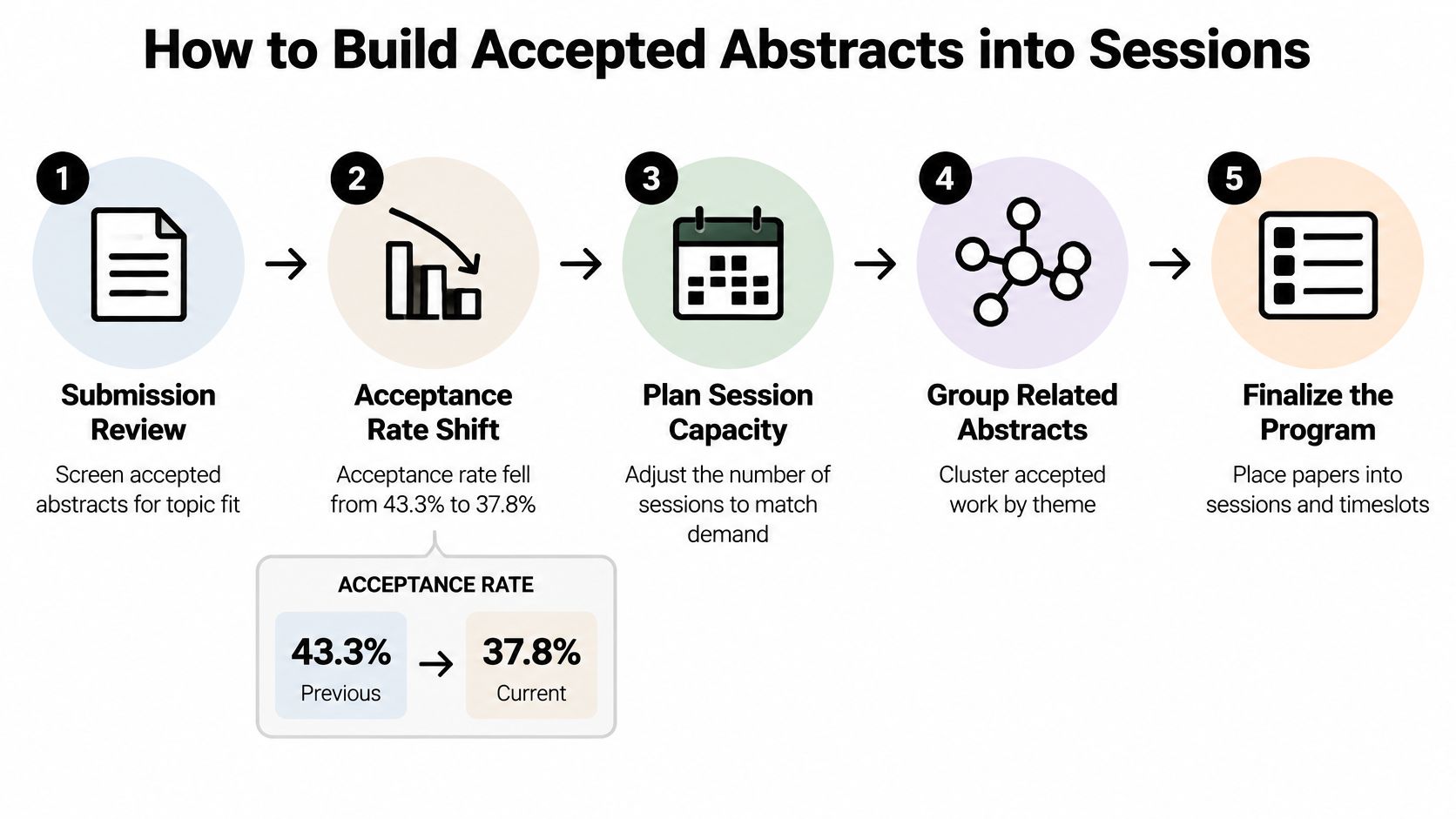
Session building starts from fixed capacity, not from demand. In a peer-reviewed analysis of health policy and systems research symposiums, the overall acceptance rate fell from 43.3% in 2016 to 37.8% in 2018, while the number accepted changed only modestly, from 1,114 to 1,087. Submissions grew, slots didn't, and the acceptance rate absorbed the difference.
Build Sessions in Seven Steps
- Freeze the accepted list: Confirm each record's presentation format before grouping anything. Building sessions from a moving list guarantees rework.
- Group by topic, method, or audience: Cluster abstracts that belong in the same room. Structured fields make this filtering fast.
- Check presenter availability and conflicts: One presenter can't be in two parallel sessions. Catch clashes now, not in the printed program.
- Fit groups into time limits: Count discussion time, not just talk time. A session that fits on paper but leaves no room for questions will overrun.
- Record format changes: Tell the author and update the record in the same action.
- Publish and notify: Release the program and confirm each presenter's placement directly.
- Archive the final version: Lock the record so later changes can be reconciled against it.
Step 5 is where programs break most often. The University of Wisconsin conference guidance says oral submissions not chosen for oral presentation will receive a poster presentation rather than being rejected outright. That's a reasonable policy, but only if the system records the change and communicates it. An unrecorded change leaves a presenter preparing slides for a poster board.
Every session entry should link back to its original abstract, author list, and decision. If you can't trace a scheduled talk to the record reviewers scored, you can't defend the program.
Scheduling across rooms and days gets complicated quickly, and committees juggling parallel tracks may want to find free scheduling software with Gantt charts to visualize overlaps before committing rooms. Whatever tool you use, the abstract record, not a copied spreadsheet row, should remain the source of truth.
One caution on interpreting your own numbers. A falling acceptance rate doesn't automatically mean rising quality. It may only mean submissions grew faster than your session capacity, exactly as in the symposium example above. Report absolute volumes alongside percentages when your committee reviews the year.
Choosing How to Run Your Submission Process
Most programs run submissions one of three ways, and each fits a different volume and rule set. The requirements covered in this guide are your test: length validation, separately scored dimensions, a third-reviewer trigger, and a recorded format change. Ask any option to demonstrate those four things.
| Approach | Strengths | Limitations | Best fit |
|---|---|---|---|
| Spreadsheets and email | Low setup cost and familiar to staff | Manual length checks, weak audit trail, no built-in score thresholds | Small events with few abstracts and one reviewer pool |
| General-purpose form tools | Flexible fields and quick to launch | Word and character validation, escalation, and format-change tracking need custom build | Teams with in-house technical support |
| Dedicated abstract management software, such as Planstone | Built for submission, review, and session building in one record | Requires checks of fit, cost, and features against your own rules | Recurring events with high volume, several reviewers, and session scheduling |
Spreadsheets and email work until the first score disagreement or format change needs an audit trail. At that point you're reconstructing decisions from inboxes, and two staff members may hold different versions of the accepted list.
General-purpose form tools collect fields well. The gap appears in logic: conditional escalation, threshold calculation, and linking an accepted abstract to its session slot usually need custom work that someone has to maintain each year.
Dedicated abstract management software suits recurring events where authors, reviewers, and organizers must work from the same record. Our abstract management module brings submission, review, and session building into one workflow, from a call for abstracts through to the finished program. That's one option in this category, not the only one, and you should test it against your own rules, reviewer model, and budget before committing.
Run a short, fair evaluation. Send each vendor your length rule, scoring model, escalation trigger, and format policy, then ask them to show how each rule is enforced in a live workflow, not in slides. Pricing sits outside this guide, so compare written quotes for the same scope rather than estimates.
Frequently Asked Questions
Does a Rejected Abstract Mean the Work Is Lost
No. A large review of biomedical meetings found that a meaningful share of rejected abstracts still went on to be published, while acceptance alone was no guarantee of later publication. One meeting's decision reflects its capacity and program fit, not a final verdict on the study.
An abstract also outlives any single decision. Because it exists as a structured record, the same work can be revised, submitted to another meeting, or carried into a journal manuscript rather than rebuilt from scratch.
Is a Historical Acceptance Rate a Reliable Forecast
Only loosely. Acceptance varied substantially by meeting and field in the same review, and rates shift within a single event over time. One symposium series saw its acceptance rate fall noticeably within two years even though the number of accepted abstracts barely moved, because submission volume grew faster than the available slots.
Use the rate for your specific event and year, and check current submission volume and session capacity before setting expectations.
Can I Submit a Commercial Proposal
Check the exclusion rules first. Some events prohibit commercial submissions outright, and many reject abstracts that read as sales pitches for products or services.
If your abstract describes a product, tool, or service, frame the record around evidence and outcomes. Methods, data, and limitations belong in the structured fields; product claims invite a completeness-check rejection before review even begins.
If your team is ready to run conference abstract submission as one connected workflow, from the call for abstracts through review and into the finished program, Planstone can help you keep authors, reviewers, and organizers working from the same record. Visit us to see how the platform fits your event's rules and talk through your program, existing systems, and team requirements.