
The program of the conference is the published map of sessions, people, times, places, and the participation rules attached to each session.
You're reviewing the draft before registration opens. The grid looks finished, but a presenter hasn't confirmed availability, a workshop has no credit rule, and attendees can't tell whether the poster hall has seating. Those gaps matter more than the layout. A usable program helps people choose sessions they can attend, participate in, and claim credit for.
Table of Contents
- What the Program of the Conference Contains
- How Sessions Speakers and Rooms Lock Together
- How Committees Turn Abstracts into a Schedule
- Credits Disclosures and Records Behind the Agenda
- Program Patterns from Science Meetings
- Access Details Most Programs Still Omit
- Frequently Asked Questions About Conference Programs
- Check the Program Before You Publish It
What the Program of the Conference Contains
Someone opening a link titled program of the conference expects more than talk titles. They need a public record of what will happen, who will lead it, when and where it takes place, and what participation requires. A compact agenda can provide an overview, but it shouldn't be the only place attendees can find information.
Start by making session types understandable:
- Plenary: A session intended for the whole conference audience to attend together.
- Oral session: A timed set of presented papers.
- Poster session: A shared hall of displayed work with a defined viewing period.
- Workshop: Hands-on practice rather than listening alone.
- Symposium: A themed group of linked talks addressing a shared topic.
These labels help attendees plan their effort as well as their time. A workshop may require preparation or equipment. A poster session may involve moving around a hall, while a symposium asks participants to follow a connected discussion.
Elements of a complete conference program
Use this table as a completeness check, with a named owner for every field.
| Element | What the reader should see | Typical owner |
|---|---|---|
| Session identity | Title, type (plenary, oral, poster, workshop, symposium), and track | Program committee |
| People | Speakers, chairs, moderators, and author order | Speaker coordination |
| Time | Date, start, end, and duration in minutes | Program committee |
| Place | Room, capacity, and parallel-track label | Meeting logistics |
| Learning | Objectives and intended audience | Education staff with faculty |
| Materials | Slides, handouts, or recording, and when access opens | Faculty support |
| Credit | Credit type and value, or an explicit none | Continuing education office |
| Access | Captions, interpretation, seating, step-free route, or remote option | Accessibility and logistics |
Consider a hypothetical scientific meeting with a morning plenary, three afternoon oral tracks, and an evening poster hall. The plenary needs a clear audience and location. The oral tracks need distinct labels so attendees don't confuse concurrent sessions. The poster listing needs a viewing period and an explanation of when authors will be present.
Materials availability deserves its own field. A presentation-file deadline for faculty isn't the same as an attendee release date. State whether handouts will open before the session, whether recordings will follow, and whether access is restricted.
Likewise, don't let a blank credit field imply eligibility. Use none, or an explicit zero where the publishing system requires a numerical value, when a session isn't accredited. An attendee shouldn't have to infer whether a reception, discussion, or demonstration qualifies.
Pre-publication rule: Treat every blank cell as a question someone will ask at the registration desk.
Keep the overview readable, then provide the operational detail on the session page. That preserves a useful grid without turning the entire program into tiny print.
How Sessions Speakers and Rooms Lock Together
A conference grid is a set of connected decisions. Moving a talk changes more than its position on the page: it can affect the presenter's availability, the audience's choices, the room assignment, and the time available for discussion.
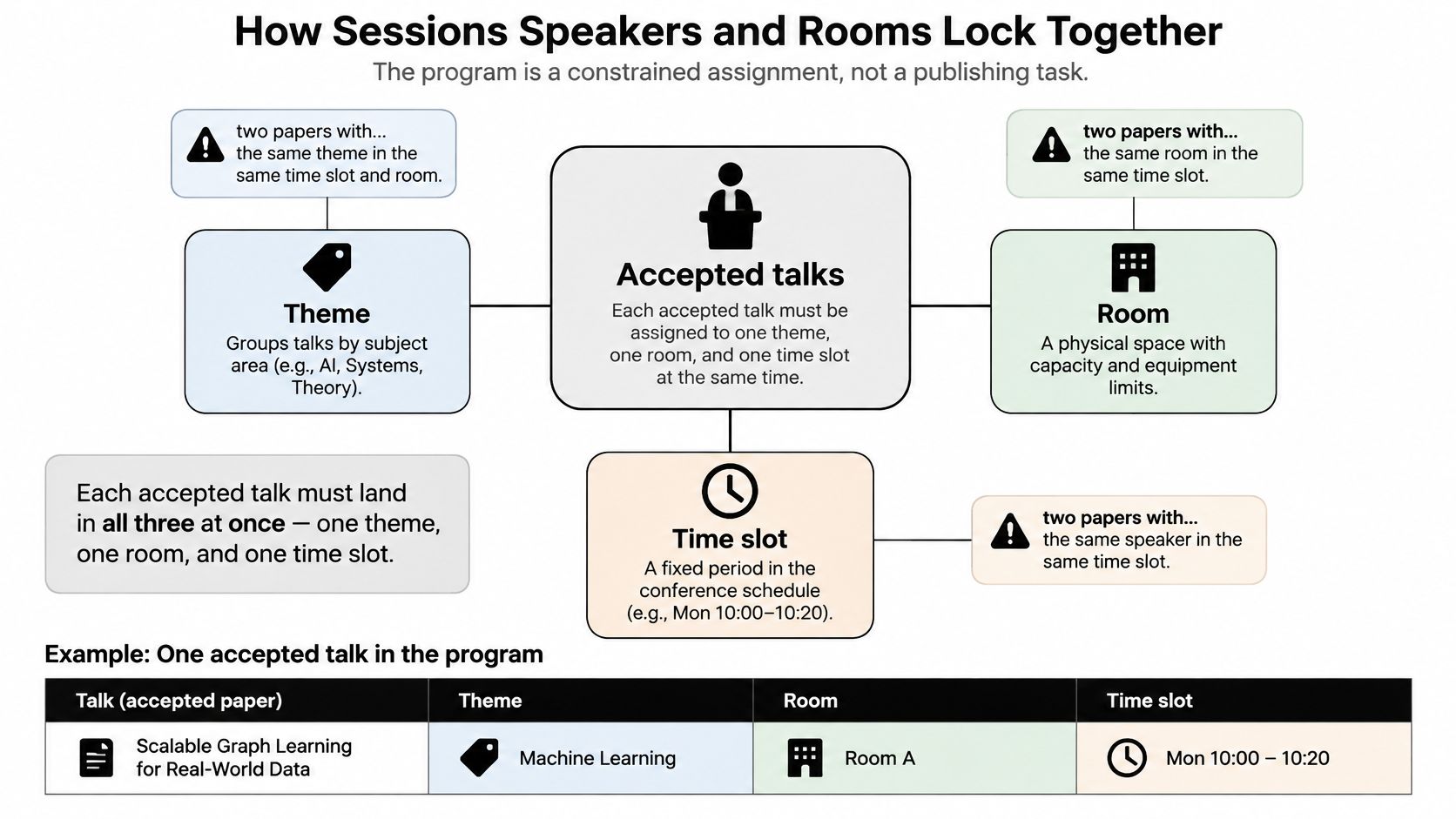
Every accepted talk must fit a theme, room, and time slot simultaneously. A suitable topic match doesn't rescue an impossible room assignment.
Constraints that shape a conference schedule
Separate requirements that make a schedule feasible from preferences that make it useful.
| Constraint | Type | What it prevents or improves |
|---|---|---|
| No shared author in two rooms at once | Hard | A speaker or coauthor missing their own paper |
| Talks fit the session duration | Hard | Overruns and a late start for the next group |
| Presenter availability window | Hard | Assigning someone who is not on site |
| Room capacity | Hard | A full room turning people away |
| Thematic grouping | Soft | Unrelated papers forced into one session |
| Attendee topic preferences | Soft | People missing most of the talks they came for |
| Parallel-track balance | Soft | Two competing sessions in the same specialty |
For a schedule that prohibits author collisions, two papers with a shared author cannot run at the same time. Other firm requirements include keeping presentation time within the session duration, respecting travel availability, and assigning an audience to a room with sufficient capacity.
Soft objectives require judgment. Grouping related work helps listeners follow a topic, but concentrating every popular talk in the same block can make the rest of the program less useful. Avoid placing a star speaker opposite the only other session serving that specialty unless the committee has a clear reason.
A conference-scheduling study in the Journal of the Operational Research Society used a two-stage integer-programming approach, forming thematic sessions before placing individual talks, and produced schedules quickly on real conference instances while allowing attendees to access most of their preferred presentations. The practical lesson isn't that every committee needs to study optimization mathematics. It's that scheduling works better when relationships and priorities are explicit.
Keep relationships rather than pasted text
Maintain linked records for the abstract, authors, topic, presenter, room, duration, and availability. A name pasted into a slide can't reliably support an author-clash check, especially when the same person appears in several submissions.
Connect speaker confirmations to the schedule instead of maintaining a separate email-based version of availability. The responsibilities outlined in speaker management belong alongside session assignments, not outside the program-building process.
A hypothetical failure is easy to recognize: a Friday 8 a.m. methods talk sits opposite the only clinical plenary, and the committee discovers the conflict after the PDF is public.
Replace ad hoc grid editing with a repeatable habit: write the hard limits, rank the soft aims, generate a candidate schedule, and review the exceptions. Record who approved an unavoidable compromise so the next editor doesn't accidentally recreate it.
How Committees Turn Abstracts into a Schedule
Scientific societies have organized invited presentations, timed papers, and sectional meetings for centuries, so program design is a long-standing practice rather than a software feature. What has changed is the cost of revision. A schedule built from connected records absorbs a withdrawal or a room change. A schedule built from pasted text falls apart unnoticed.
A finished program works like a budget more than a poster. Every listed session is the surviving answer to competing demands on time, rooms, and people, and the order in which the committee builds decides whether that answer stays accurate through publication.
A practical build order
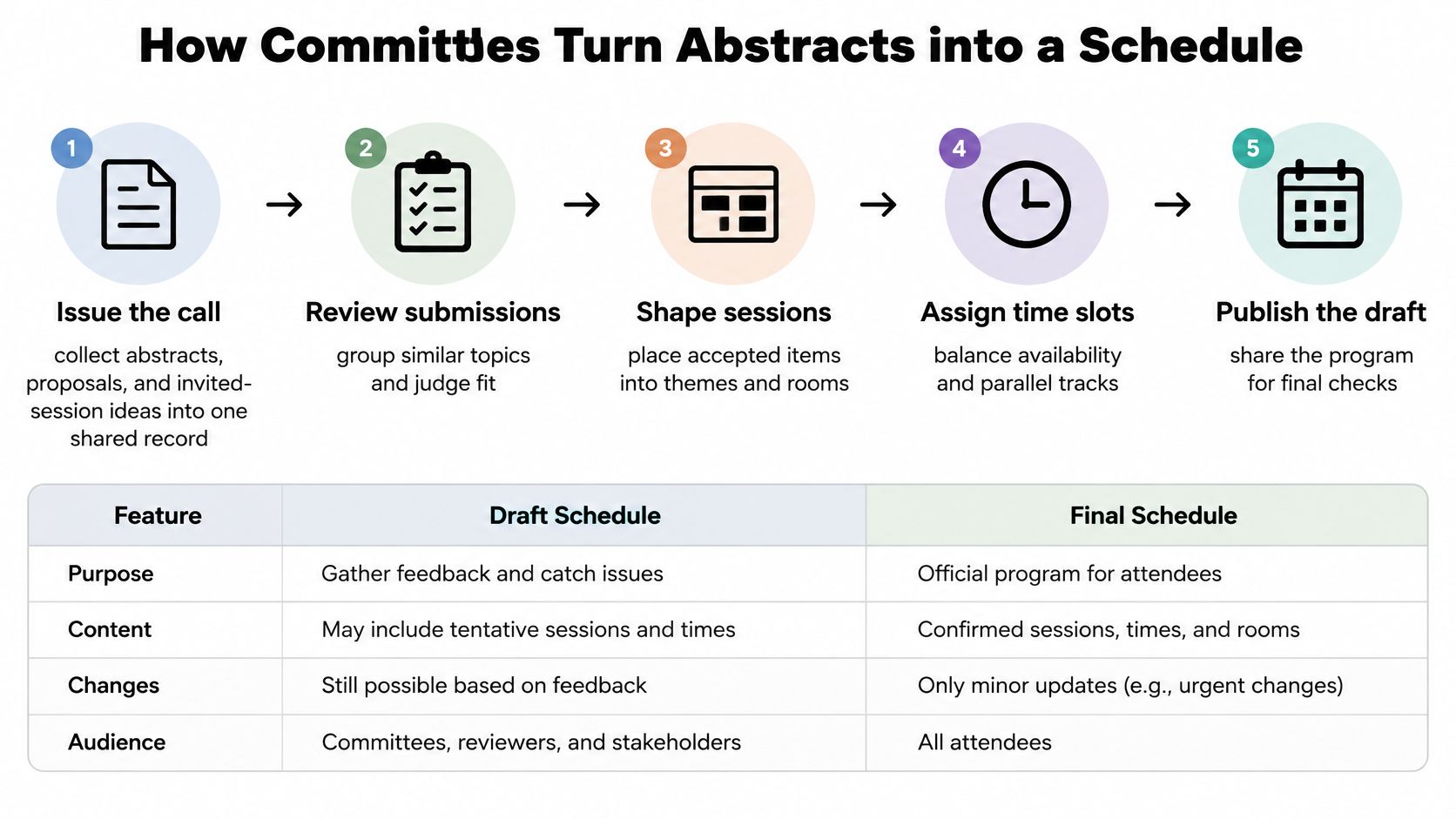
Issue the call. Collect abstracts, proposals, and invited-session ideas into a shared record. Define required fields before opening conference abstract submission, so reviewers receive comparable information rather than separate files with missing details.
Review against written criteria. Tell reviewers what constitutes relevance, quality, and fit. Where a specialty section and central committee both approve submissions, preserve each decision rather than replacing the earlier review.
Accept, reject, or request revision. Resolve outstanding revisions and freeze the accepted set for scheduling. Keep later changes identifiable so an unapproved submission doesn't enter the program.
Group accepted work into session shells. Give each shell a theme and duration limit before adding papers. Leave room for introductions, questions, and transitions instead of filling the entire block with presentation time. A broad topic label isn't enough on its own: the papers inside should form a sequence listeners can follow.
Assign chairs and confirm faculty tasks. Identify who moderates discussion and who handles timekeeping. Confirm the disclosure, presentation-file, and biography requirements with each speaker while the session is still easy to adjust.
Place sessions into days, rooms, and tracks. Test the candidate arrangement against presenter availability and room suitability. Review adjacent sessions as well as simultaneous ones: a presenter may technically finish on time but still be unable to reach the next room. Evaluate attendee choices by specialty rather than looking only for empty grid cells.
Publish a draft, then release the attendee program. Give committee reviewers a defined way to report corrections. After release, maintain a visible update process so the downloadable version and session pages don't tell different stories.
Make sorting decisions visible
A session-building workspace developed with the American Physical Society, refined through a pilot meeting, lets APS sorters filter abstracts, drag submissions into sessions, and work within session-time limits. The principle worth copying is that the limit appears on screen while the sorter works. An overfilled session is visible at the moment it happens, not during final proofreading when moving one talk means re-checking every shell around it.
A late withdrawal is the fragile point. Pulling one talk creates a gap in a timed block, and filling it can shuffle a presenter across days. When the program lives in the same records as the submissions, the committee updates the session once and the change carries through. When the program is a static document, the same withdrawal can leave the grid, the PDF, and the session page disagreeing with each other until someone notices in print.
Credits Disclosures and Records Behind the Agenda
A participant finishes a morning session, walks to the lobby, and asks where the credit certificate comes from. The published grid answered when and where; the credit, disclosure, and attendance records behind the agenda decide whether that attendance counts toward anything.
Credit and record rules attached to sessions
| Rule | What must be true | Figure to plan around |
|---|---|---|
| AMA PRA Category 1 Credit | Activity meets AMA and accreditor standards and is accredited by ACCME or a recognized state medical society | Credit only if that pathway exists, under AMA requirements |
| Session credit value | Participants claim only actual participation and complete the session evaluation | 0.5 to 2.0 credits per session in American College of Surgeons guidance |
| CEU | Organized learning has responsible sponsorship, capable direction, and qualified instruction | 1 CEU = 10 contact hours, according to IACET |
| Contact hour | Interaction with an instructor or prepared materials includes progress monitoring or feedback | A clock hour of qualifying interaction; exclude breaks and unsupervised time |
| Disclosure | Learners receive relevant financial relationships and ineligible-company names before engaging | A format verifiable during accreditation review |
| Participation record | Provider can record and, when authorized, verify physician participation | Six years from the activity date, under ACCME accreditation requirements |
A listing on the grid states intent. The educational record gets built later, from participation evidence. The difference works like a boarding pass versus a flight record: one shows the plan, the other shows what happened. Badge collection and certificate printing establish no accreditation pathway on their own, and a scheduled duration confirms participation only when the record shows the attendee stayed.
Each credit unit measures a different kind of participation. IACET defines the CEU strictly as a measure of structured, noncredit adult learning that confers no credential or professional license, as its CEU issuance guidance explains. Qualifying interaction can be live or asynchronous; leaving materials available creates no monitored learning.
Connect the activity to the certificate
Give every credited session a unique activity identifier. Attach its credit value, eligible audience, attendance rule, evaluation, and any assessment requirement to that identifier.
Many accredited programs require attendance, evaluation, and credit attestation before certificate issuance, and some maintenance-of-certification activities add a post-test. Checking those steps in unrelated spreadsheets invites gaps, so they belong on a single connected record.
Administrators should timestamp evaluation and assessment completion, then calculate the certificate from validated participation. Hold release when records show:
- Attendance without evaluation: The participant hasn't completed a required learning-feedback step.
- Evaluation without eligible attendance: Feedback alone doesn't establish qualifying participation.
- A claim exceeding attended time: The requested amount needs correction before issuance.
A certificate should document a validated learning record.
Disclosure needs equally deliberate handling. Before learners engage, deliver the names of individuals with relevant financial relationships and the ineligible companies involved, in a format the accreditor can verify. A form collected from faculty completes only the staff side of that task; the program still has to deliver the disclosure to learners.
Build that delivery step into your financial disclosure management process, with named responsibility for publication and verification. Retain evidence of what learners could access, because accreditation review examines learner exposure, and collection records cover only the collection step.
Program Patterns from Science Meetings
A useful way to design a program is to choose the audience experience first. A large association congress, a focused discussion meeting, and an abstract-heavy research meeting need different arrangements, even when they use similar session labels.
The sectional association meeting
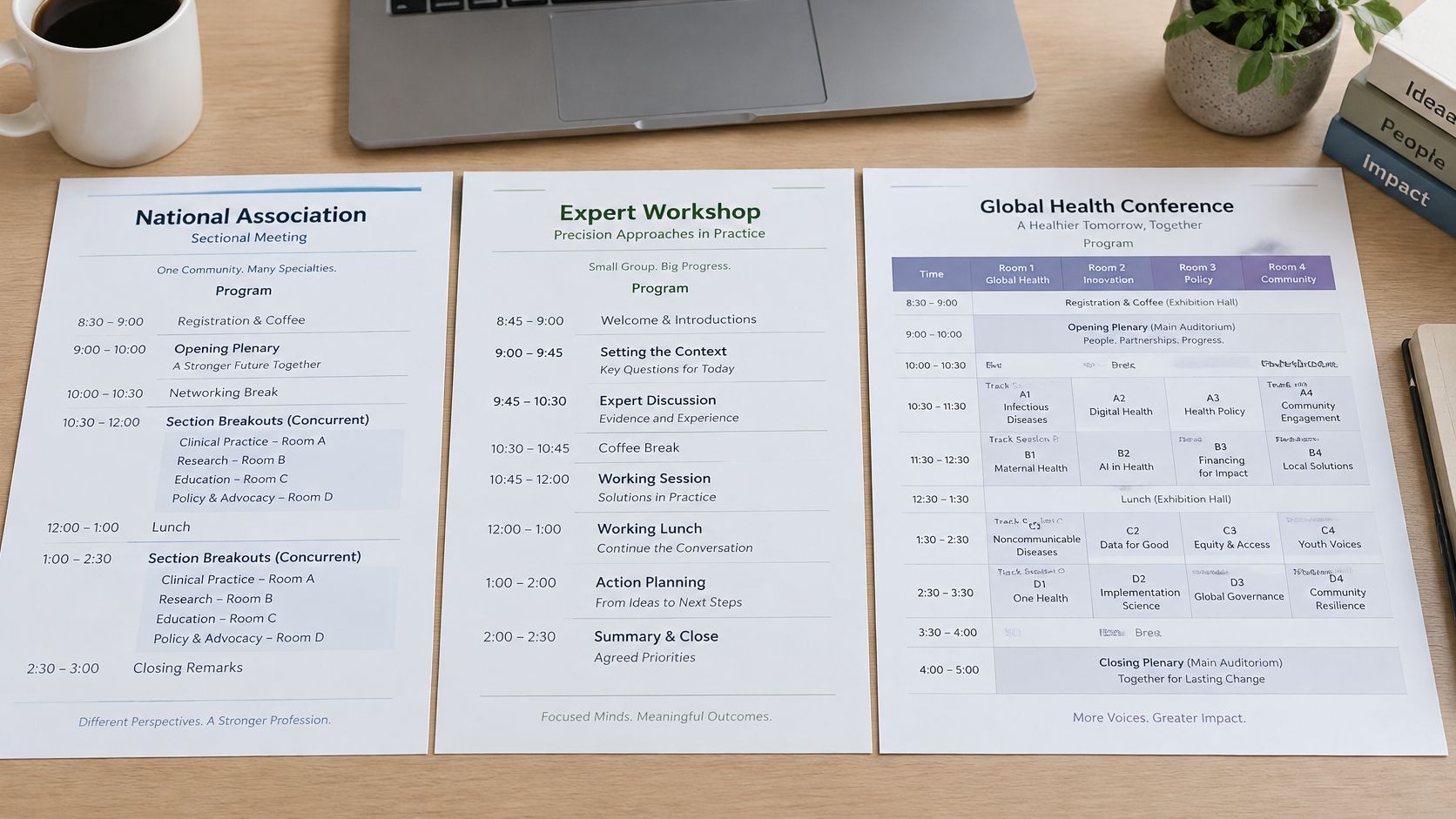
The British Association model combined a shared public experience with specialist sections, accommodating a substantial volume of papers across disciplines and an international audience. Its modern counterpart is recognizable in a medical congress where everyone gathers for an opening plenary before moving into specialty tracks.
Say the plenary introduces a clinical problem that several disciplines approach differently. The afternoon sections can then explore methods, applications, and unresolved questions without forcing every attendee through every paper.
Design choice to copy: Protect a plenary slot that the whole audience can attend. Don't describe it as shared while placing competing scientific sessions against it.
The discussion meeting
Gordon Research Conferences illustrate a different emphasis: narrow scientific topics, varied talk lengths, and deliberate discussion periods. The point isn't to fit more presentations into the day. It's to give participants time to examine the work together.
In a hypothetical methods meeting, a lecture could establish the approach, shorter talks could test its applications, and a moderated discussion could compare limitations. Publish that discussion as an actual program component with a chair and purpose, not as an unexplained gap.
Design choice to copy: Label and protect discussion time. Make clear whether it forms part of the accredited educational activity rather than assuming attendees will know.
The large abstract meeting
For an abstract-heavy meeting, the organizer's main task is turning many individual contributions into coherent sessions. Staff sort accepted submissions into bounded session shells, stop when the time budget is full, and check the resulting assignments before publication.
A collection of technically related papers may still need reordering. Put introductory work before specialized applications where that helps listeners follow the argument, and identify the chair who will keep the sequence moving.
Design choice to copy: Display the duration limit during sorting, while there's still room to change the arrangement.
Each pattern still needs a reader-facing account of session type, people, clock time, room, and the status of discussion time for credit. Another parallel track isn't automatically another educational benefit. If it adds clashes or uncredited filler, revise the format rather than expanding the grid.
Access Details Most Programs Still Omit
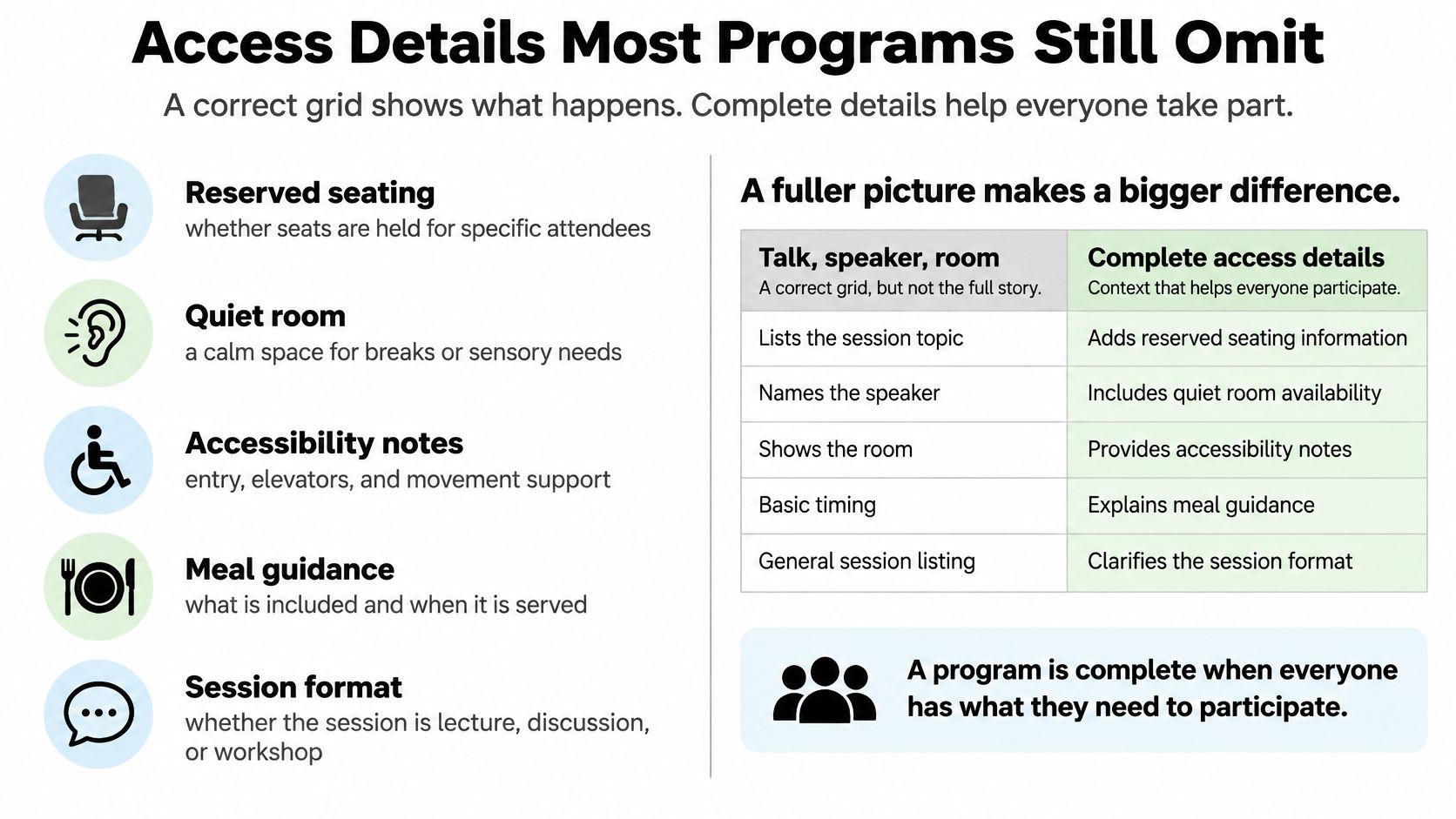
An attendee with a cane reaches the conference center, finds the room number, and then faces a flight of stairs. The grid may be correct. The program is still incomplete. Access details are part of the working document, alongside times and rooms, the way ingredient notes belong on a menu rather than in a separate binder nobody opens.
In the 2025 CHI post-conference survey, about 3% of 908 respondents requested an accessibility-related feature, while reported problems included difficult navigation, overcrowded rooms, and insufficient seating for people unable to stand for long periods. Respondents valued quiet or sensory rooms, interpreters, and reserved seating. A small share can still describe a real barrier for the people affected.
Publish participation conditions
A small disclosed-request rate doesn't prove small need. In a scientific-events inclusion study published in Ecology and Evolution, 11 of 18 respondents who identified a disability hadn't disclosed it before the event. Disclosure is not a reliable signal of demand. Publish conditions so people can plan without explaining themselves first.
Attach practical details to the relevant session or room:
- Navigation: An accessibility legend and step-free route guidance.
- Seating: Capacity, reserved seats, and seating within standing-oriented activities.
- Sensory conditions: Expected intensity and the location of quiet alternatives.
- Communication: Captioning, interpretation, and how to request an accommodation.
- Participation: Remote options and any equipment or preparation required.
If the meeting occupies a shared property, security monitoring may sit with the building budget rather than the conference budget. Teams pricing that item can use this guide to budgeting for strata security monitoring. That budget line is separate from attendee access.
Explain the educational conditions too
State the learning objective, how participation is evaluated, and who is eligible for credit. Explain what happens if someone attends remotely or leaves early, and when slides or notes become available. Those conditions decide whether a listed session is usable.
Publish accommodations proactively so attendees don't have to disclose a personal need merely to learn what participation involves.
These fields are planning checks as well as attendee information. They help the team spot an inaccessible route, an overfilled room, or an activity unsuitable for credit before the program becomes public. A program that answers only “where” and “when” leaves the harder question open: can this person take part and claim the credit?
Frequently Asked Questions About Conference Programs
What is the program of a conference?
It's the public record of sessions, speakers, times, rooms, materials, credit, and access details. Unlike a bare agenda, it explains what participation involves and gives attendees enough information to make realistic choices.
Does listing a session make it eligible for credit?
No. For AMA PRA Category 1 Credit, the activity needs the accepted accreditation pathway and must meet AMA and accreditor requirements. Recording attendance alone doesn't create eligibility, and a certificate isn't proof that the activity was appropriately accredited.
How many credits can a session carry?
Use the value approved for that activity, not a standard amount copied from another conference. American College of Surgeons guidance illustrates session-specific allocation, with participants claiming only the amount corresponding to their actual participation.
How does a CEU differ from a contact hour?
A CEU aggregates qualifying contact hours under the applicable continuing-education standard. A contact hour measures instructional interaction, not elapsed time at the venue. Breaks and unsupported independent activity shouldn't be treated as equivalent to qualifying instruction.
Can a remote attendee earn credit?
Only when the approved activity permits that participation mode and the provider can verify the required attendance, evaluation, and assessment steps. A livestream connection by itself doesn't establish completion. Publish the remote rule before registration.
Must the program show disclosures?
Learners must receive the required disclosure before engaging in accredited education, in a verifiable format. It can be delivered through an appropriate linked disclosure page or another controlled method; collecting faculty forms without learner-facing delivery isn't enough.
Check the Program Before You Publish It
Use a release checklist that tests whether the program works, not just whether it looks finished.
Confirm session completeness. Check type, people, clock time, room, and a duration that accommodates the talks and planned discussion. Resolve placeholders before treating a session as final.
Clear scheduling conflicts. Review author and presenter clashes, then test how the team would handle a withdrawal. A correction should update the shared record and attendee-facing information without requiring everyone to rebuild their own copy.
Validate educational promises. Confirm disclosure delivery before engagement. Check that every stated credit value corresponds to an accredited activity and that attendance, evaluation, and assessment conditions are explicit.
Complete materials and access information. Publish release timing and accommodation details, or explicitly state what isn't offered. Silence shouldn't be used as a substitute for a decision.
Review unresolved fields. Give the release owner a report of blanks and exceptions, with a named person responsible for each remaining issue.
Choose the fix that matches the gap
If abstracts, speaker tasks, and education records sit in separate files, establish a shared record with clear ownership. If the only uncertainty is an interpretation of a credit rule, involve your education office rather than treating it as a software problem.
We've supported conference and education teams since 2003. For a coordination discussion, bring your program structure, existing systems, and team requirements so we can identify where the handoffs need attention.
The final publishing test is straightforward: can an attendee choose a session, prepare for it, reach it, understand its requirements, and complete the necessary follow-up without asking staff to reconstruct the rules?
Planstone connects abstract submissions, speaker preparation, disclosures, evaluations, and credit administration, and offers Planion Events Live for exploring published programs and session guides. Its guides include ObesityWeek® 2026, scheduled for November 14–17, 2026, at the Gaylord National Resort & Convention Center in National Harbor, Maryland. If your gap is coordinating submissions, speakers, and the published program, visit Planstone to discuss your workflow; if it's only a missing credit rule, start with your education office.