
You're three weeks from the abstract deadline. The programme committee wants scores it can defend, and two reviewers have already asked whether their names will be visible to authors. That question decides who accepts the invitation, whose work rises, and whether a sharp disagreement gets averaged into a bland middle.
Peer review processes are design choices, not one fixed quality ritual. Anonymity, signed reports, and an extra round each change a different decision. None of them automatically fixes bias, conflicts, or reviewer fatigue. What follows is the order a programme team has to settle those choices: the model, the roles, the scores, the sequence, the fairness rules, the workload, and the AI policy.
Table of Contents
- Peer Review Models Compared at a Glance
- Who Does What in a Review Cycle
- Scoring Criteria and How to Make Scores Reliable
- How a Peer Review Runs, Step by Step
- Keeping Reviews Fair Through Anonymity and Conflict Rules
- Managing Reviewer Workload and Turnaround Times
- Using AI in Peer Review Without Losing Control
- Confirm Your Review Model Before the Call for Abstracts
Peer Review Models Compared at a Glance
Peer review is the evaluation of a submission by independent experts before acceptance. The models differ mainly in who can see whose identity, and in how many stages the review has.
| Model | Reviewer sees author? | Author sees reviewer? | Typical use | Main trade-off |
|---|---|---|---|---|
| Single-blind | Yes | No | Common default in many journals | Reviewers may be influenced by author names, institutions or seniority |
| Double-blind | No | No | Author identity could bias ratings, such as large abstract pools | Anonymity can fail in small fields where topics reveal authors |
| Open (signed) | Yes | Yes | Programs that need public accountability | Identity disclosure can reduce reviewer acceptance |
| Multi-stage review | Chosen per stage | Chosen per stage | Large pools that need a screening pass before full review | Adds steps, coordination and time |
Nature's peer-review policy shows how a major journal draws those lines in practice. Editors send a manuscript to two or three reviewers after they decide it may interest the readership. They may add reviewers when they need statistical or technical advice. Reviewer identities stay confidential. Authors can choose double-anonymized review, so their identities stay hidden from referees throughout consideration. Author anonymity is a defined submission option, not an automatic feature.
Single-blind review is the common default because it is simple to run and lets a reviewer use prior work as context. Double-blind review fits large abstract pools, where names, institutions, or seniority could tilt ratings before anyone reads the methods. Open review supports public accountability, but some experts decline once they must sign. Multi-stage review puts a screening pass ahead of full critique. That extra pass costs coordination time, and it only pays off when the pool is too large for every item to get a full read.
Practical rule: Choose the model for the decision you care about, fairness, speed, or transparency, then test whether the topic or a small research community reveals the author anyway.
One level of review cannot carry every one of those choices. Planstone offers multi-level review, while competitors offer one level of review, so a screening pass and a full critique can sit in the same workflow instead of in a second spreadsheet.
Who Does What in a Review Cycle
The person who holds the decision is not the person who writes the critique. Mix those up and scores get treated as verdicts.
| Role | Core responsibility | Decision power | Watch-out |
|---|---|---|---|
| Submitting author | Supplies complete files and responds to revisions | No decision power on acceptance | Missed revision deadlines delay the whole cycle |
| Editor or programme chair | Screens submissions, assigns reviewers and reads all reviews | Makes or recommends the final decision | Averaging scores mechanically hides disagreement |
| Reviewer | Evaluates against criteria and writes a critique | Advisory recommendation | Undeclared conflicts of interest |
| Scientific review officer or secretary | Maintains records, runs discussion and issues the summary | Process integrity, not scientific judgement | Missing reviewer-level scores weakens later audits |
| Programme administrator | Manages deadlines, reminders and communication | Administrative only | Policies announced after invitations go out |
Read the table from the bottom of the authority ladder upward. Authors supply complete files and answer revision requests. They don't accept their own work. Reviewers advise against published criteria. A recommendation is not a decision, even when it is strongly worded.
The ICMJE recommendations put the conflict question at the invitation, not after the comments are in. Reviewers disclose relationships that could bias judgement, recuse themselves when a conflict exists, and must not use unpublished knowledge from the review to advance their own work. They also owe a prompt reply and a report inside the agreed window.
Where the handoff breaks
Editors and programme chairs screen, assign, and read every review before they recommend or decide. Averaging two scores hides the disagreement you most need to see. The scientific review officer, or a committee secretary, keeps the record, runs the discussion, and issues the summary. That role protects process integrity. It does not substitute for scientific judgement. Administrators own deadlines, reminders, and communication, and they fail the cycle if the policy lands after invitations have already gone out.
Separate files and email threads lose comments and let versions drift. Planstone's submission management module keeps authors, reviewers, and program organizers working from the same submission records, allowing collection of abstracts, management of reviews, and building of accepted work into sessions.
Scoring Criteria and How to Make Scores Reliable
A single overall mark hides which part of the submission failed. Split the judgement first, then worry about whether two reviewers land in the same place.
| Criterion | Question reviewers answer | Typical evidence | Scoring note |
|---|---|---|---|
| Scientific validity | Are the conclusions supported by the data? | Data, results and analysis | Score separately from significance |
| Methodological rigour | Is the design appropriate and fully reported? | Sample, controls and statistics | Checkable items usually show higher agreement |
| Significance or novelty | Does the work advance the field? | Literature context and stated contribution | Most interpretive; expect more disagreement |
| Programme fit | Does it suit the audience, format and session? | Topic, learning objectives and format | Committee judgement rather than pure science |
| Presentation clarity | Can a non-specialist follow the abstract? | Structure, language and figures | Often scored as a minor criterion |
Keep those five apart, because each one feeds a different decision. A clever idea with a broken analysis should not receive the same mark as a solid method that barely moves the field. Programme fit is a committee judgement about audience and format, which is why a conference abstract form has to collect learning objectives and format details, not only a scientific claim. A worked abstract submission for conference example shows the kind of fields reviewers later score against.
Why two reviewers rarely match
Agreement is weaker than most committees assume. A meta-analysis in PNAS covering 45 studies found that the average correlation between two reviewers' ratings of the same manuscript was only 0.34: independent readers often reach materially different judgements on identical evidence.
That gap has structure, and treating it as random noise wastes effort on extra reviews. Where the disagreement sits tells you what to fix. Missing data and statistical errors are checkable, so rigour scores tend to converge. Novelty and importance are interpretive, so they diverge even among experts. If rigour scores scatter, the form is probably not collecting enough detail. If novelty scores scatter, the answer is better expertise matching rather than a fourth reviewer. Adding reviews is a design choice with a cost, and it pays off only when the disagreement is interpretive rather than a symptom of an ambiguous criterion.
The NIH scoring guidance is one anchored model: a whole-number scale where 1 means exceptional and 9 means poor, with separate scores for individual criteria before any meeting. Anchors like these give "good" and "excellent" a shared meaning, which is where reliability comes from. Store every reviewer-level score as well. Disagreement patterns across a cycle expose ambiguous criteria and calibration gaps that a single committee number erases.
Planstone configures its platform to each program's review criteria, faculty requirements, and credit rules, from the forms contributors complete to the reports staff rely on. The same choice between a structured scorecard and a general impression shows up in hiring, where teams weighing AI interview tool alternatives face an analogous trade-off.
How a Peer Review Runs, Step by Step
A clean cycle is eight moves. Skip one and the later moves inherit the mess.
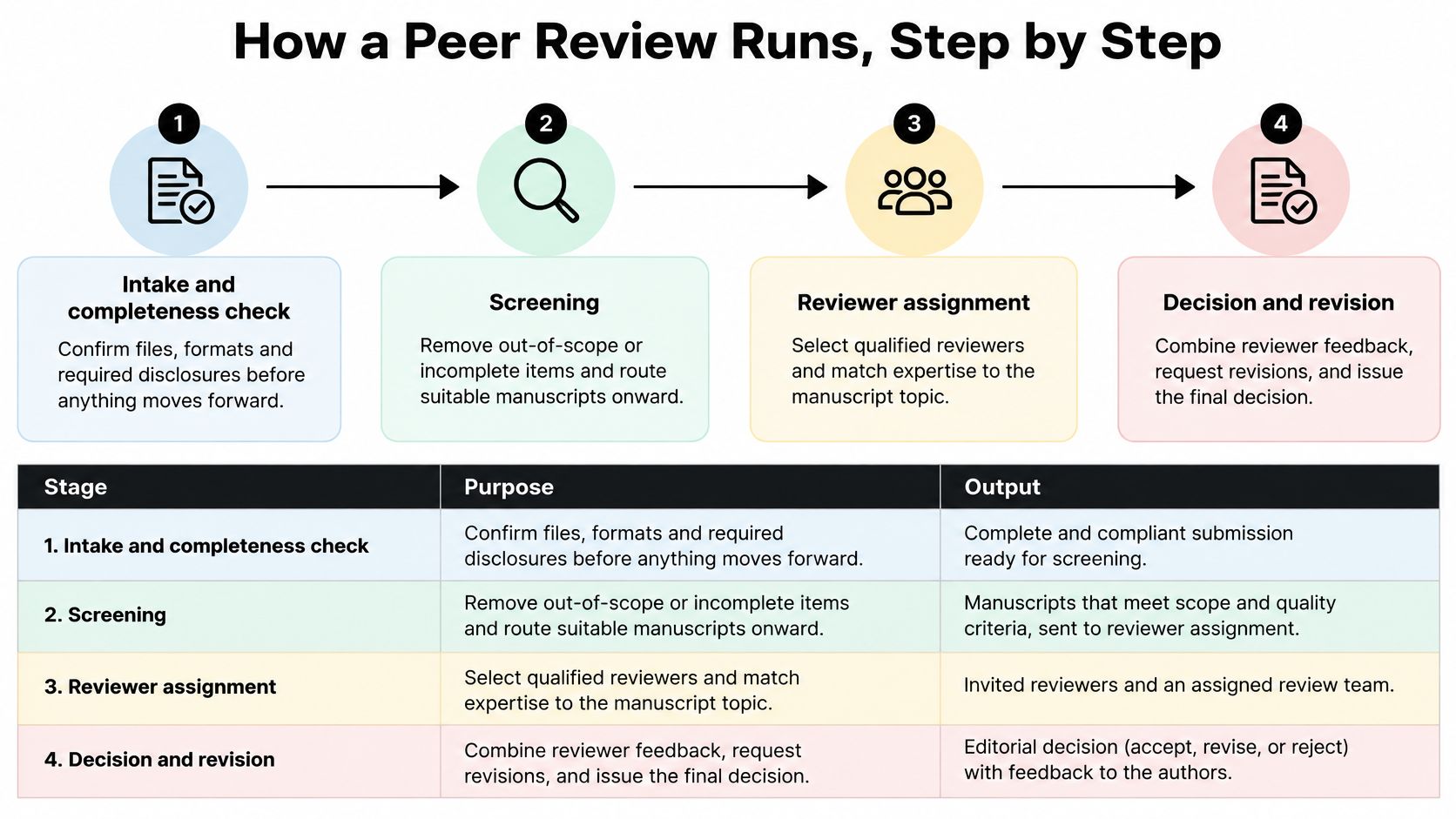
- Intake and completeness check: Confirm files, formats, and required disclosures before anything moves.
- Screening: Remove out-of-scope or incomplete items, and in multi-stage programs run a triage pass that decides what earns a full review.
- Reviewer assignment with a conflict check: Invite reviewers, ask about conflicts at invitation, and record every recusal.
- Independent review: Each reviewer scores the criteria and writes comments without seeing the other scores.
- Preliminary scoring and triage: Flag items that need discussion, and identify items that will not be discussed.
- Discrepancy resolution: Trigger a third review or a discussion when scores pass a set threshold.
- Decision and record: Issue the decision with reasons, and keep reviewer-level scores and comments.
- Feedback to authors: Send the reviews, the decision, and any revision deadlines.
Why preliminary scores exist
Step 5 is where many conference teams blur the record. The NIH first-level review process separates preliminary scoring from the panel's final call. Before the meeting, each assigned reviewer gives a preliminary Overall Impact score and individual criterion scores. Those scores help the committee see which applications most merit discussion. Some applications are not discussed and therefore receive no final Overall Impact score. For applications that are discussed, the scientific review officer's summary statement includes the critiques, a record or summary of the discussion, the priority score, and budget or administrative notes.
Conferences usually compress steps 5 to 7 into one programme committee meeting. Journals run screening and assignment at the editor's desk and leave the final decision with the editor. Either way, preliminary scores are a sorting tool, not the verdict. If you only store the final call, you cannot later see which items were never discussed, or why two reviewers were far apart. A conference abstract submission workflow should capture that trail from the first file upload, so screening, assignment, and the decision sit on one record.
Keeping Reviews Fair Through Anonymity and Conflict Rules
Anonymity is not a fairness guarantee. Treat it as one lever, and measure what it changes.
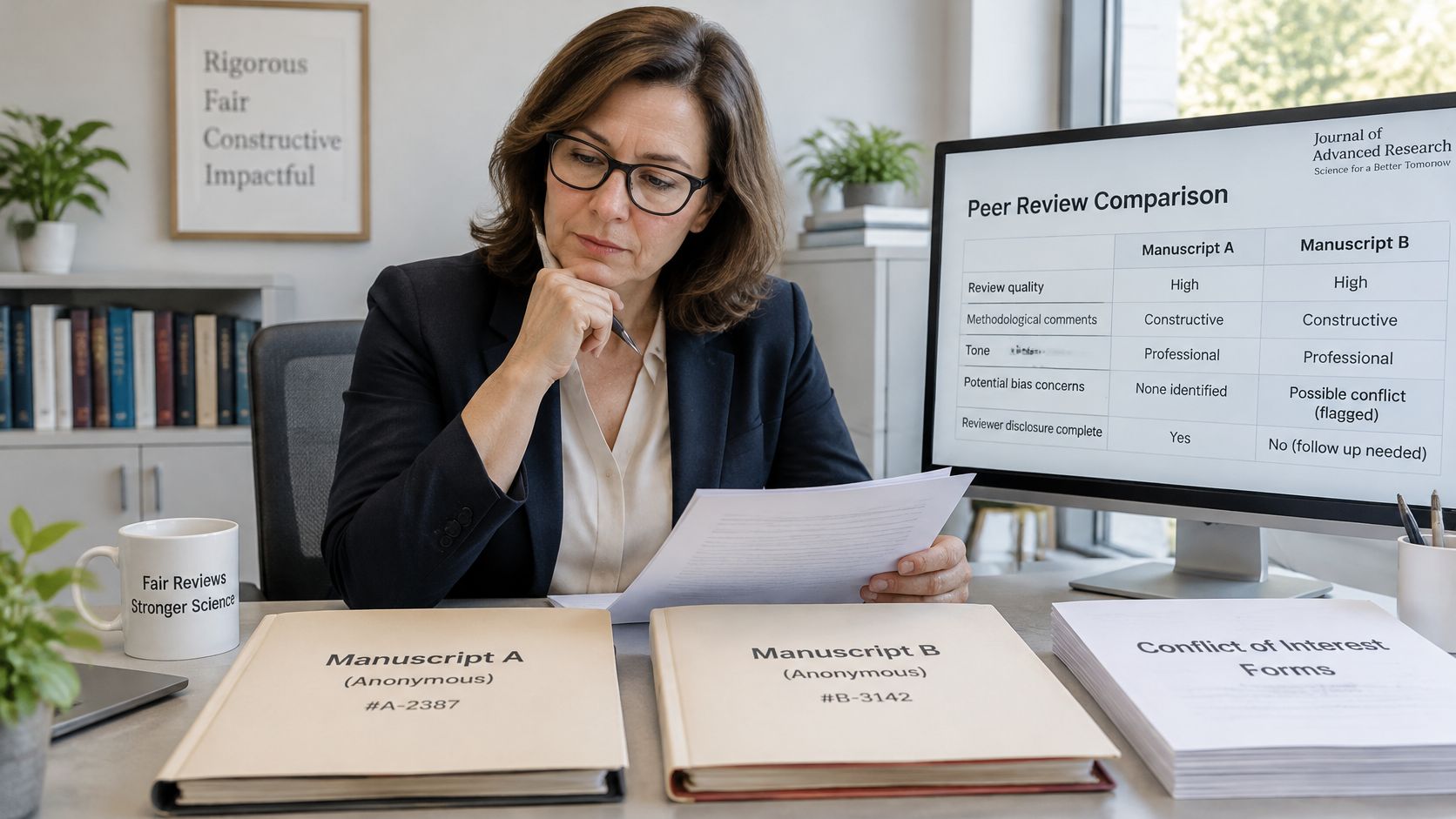
In a randomized trial published in JAMA, masking author identities made little or no difference to review quality. Blinding and unblinding also had no editorially significant effect on recommendations or review time. Reviewers were significantly more likely to decline when asked to consent to identification.
That last point is the one committees feel first. Open review can support accountability. Mandatory disclosure can shrink the pool. That is the trade-off, and it shows up as empty invitations, not as a cleaner score.
Conflicts, leaks, and what to audit
Ask about conflicts when you invite, and record the recusal before any comments exist. A conflict logged after a review is written cannot undo the review. Reviewers must not use unpublished material from the review for their own work, so state that rule in the invitation, not in a policy page nobody opens.
Blinding still fails when the topic, the institution, or the citations give the author away. In a small specialty, a methods paragraph can be a signature. Plan for that leak instead of assuming the mask holds, and decide in advance whether a guessed identity counts as a conflict.
Make identity visibility configurable by stage. Get explicit consent before any disclosure. Keep conflict declarations and an audit trail. After decisions, compare score patterns across reviewer and author groups instead of assuming the mask worked. Calibration meetings and structured rubrics do more for consistency than a blanket anonymity rule.
Fairness is conditional. Test each model against the bias you actually have, such as prestige, seniority, or geography, and report how the accepted set changes.
A 2025 field study summarized by AACSB makes that concrete. Reviewers agreed on only about 40% of which submissions deserved the highest ratings when single-blind and double-blind conditions were compared. The accepted lineup would have differed substantially by model. Single-blind review favored work with senior coauthors and submissions led by PhD students or research scientists, while comparable work from Asian first authors received lower ratings than work from White peers. Anonymity changed rankings. It did not erase disagreement.
Managing Reviewer Workload and Turnaround Times
Deadlines that ignore the hours of a review produce late reports and declined invitations.
SciPoll's 2025 survey found that 41% of surveyed scientists typically spent 2–4 hours on each peer review, while 31% spent 4–8 hours per manuscript. A three-day turnaround on a methods-heavy abstract is a request to skim. Set the clock to the work.
- Match the deadline to length and complexity: A short abstract and a full manuscript are not the same assignment.
- Cap concurrent reviews: A reviewer with six open files will finish the easiest one and stall on the rest.
- Track invitation acceptance: A falling accept rate tells you the pool is tired before the due date slips.
- Remind on a fixed schedule: One note before the due date and one after, not a daily chase.
- Name backups before you need them: Waiting until a deadline is missed adds a full invitation cycle.
The pool is already being asked for more. In IOP Publishing's 2024 State of Peer Review survey, 50% of respondents said the number of peer-review requests they received had increased during the previous three years. Adding reviewers cuts each person's load and raises the chance of uneven standards, so a short calibration exercise belongs in the same plan as the extra names.
What keeps people saying yes
Springer Nature's reviewer reporting found that 85%–86% of reviewers were satisfied with their review experience each year from 2020 through 2024, and communication with editorial offices received a 92% rating in 2024. Reviewers who know when a decision will be made, and what happens to their comments, are more willing to take the next invitation. Track turnaround separately from review quality. A faster cycle that you only measure by speed will reward thin reports.
Using AI in Peer Review Without Losing Control
Split AI use into two buckets before you write a policy. Administrative uses cover language editing, summarising a long file, and matching reviewers to a subject area. Substantive uses cover drafting the critique, generating scores, and making the recommendation. The second bucket shapes the decision, so it carries most of the risk.
Confidential manuscripts pasted into a commercial tool may be retained or reused. Generated text can include hallucinated or biased claims. Accountability for a flawed recommendation stays with the human reviewer, not the tool. Detection will not save you.
IOP Publishing's survey, as reported by Times Higher Education, found that 32% of researchers had already used AI tools to support peer review. Opinions split: 41% expected a positive impact and 37% a negative one. 57% would be unhappy if AI wrote a review report for a manuscript they had co-authored, and 42% would be unhappy if AI merely augmented the report. Only 42% believed they could accurately detect an AI-written review.
Rules you publish before the invitation
- State allowed, restricted, and prohibited uses: Grammar help is not the same act as a generated critique.
- Require disclosure of tool use: Reviewers name the tool and the task.
- Require human verification of every claim: A reviewer signs only what they have checked against the submission.
- Set data-retention rules: Confidential files do not go into systems that keep or train on uploads.
- Apply one rule to the whole committee: Hundreds of reviews cannot run on private interpretations.
The same clarity helps the staff who run the cycle. Teams that improve team alignment through project collaboration already know that a shared rule, written before the work starts, beats a cleanup after scores are in.
Confirm Your Review Model Before the Call for Abstracts
Settle the design before the first invitation, not during the argument over a borderline abstract.
- Write the objective the review must serve, such as fairness, speed, or public accountability.
- Choose identity rules stage by stage, using the model comparison above.
- Define the criteria and the scale, and keep the criteria separate.
- Set the reviewer count, the discrepancy threshold that triggers a third review, and the conflict question at invitation.
- Set the timeline, the reminder schedule, and the backup reviewer plan.
- Publish the policy, including any AI-use rules, before invitations go out.
Note which of these six your team has already made. A call for abstracts that still treats anonymity as a default, or that has no threshold for a third read, will spend the review window renegotiating the rules. The abstract submission form should match those decisions, so authors see the same criteria reviewers will score.
For a conference consultation, clients provide information about their program, existing systems, and team requirements, then discuss where Planstone can help. Bring this list and a one-page brief covering your objective, your current systems, and what the team needs. The right model is the one matched to that objective, not the one that looks most rigorous on paper.
Planstone connects abstract collection, multi-level review, and session building for medical and scientific associations that need a review record they can audit. If your committee is choosing a review model, scoring rules, or an AI policy before the next call for abstracts, bring your current workflow to a working conversation. Visit Planstone to see how submissions, reviews, and accepted sessions can run from one configured record.