
The portal is open, the deadline is closer than it looks, and the text box is still empty. A reviewer will score what you paste, not the paper sitting on your drive. A usable conference abstract template is the difference between a submission a committee can compare and a narrative that never answers the three questions every reviewer asks: what you did, what you found, and what it means.
Table of Contents
- Copy-Ready Template and Metadata Fields
- Writing Each Section So Reviewers Can Score It
- Illustrative Completed Abstract
- Word Limits and What Counts Toward Them
- Handling AI Use Disclosure in the Template
- Reporting Studies Without Final Results
- Common Mistakes and the Final Pre-Submission Check
- Frequently Asked Questions About Abstract Templates
Copy-Ready Template and Metadata Fields
Paste this field list into a working document and write the word limit at the top before you draft a sentence. For a 250-word limit, hold back about 10 percent (roughly 25 words) for line breaks, punctuation, and counter differences between portals. The call's headings override any label shown here.
| Field | What to enter | Suggested words |
|---|---|---|
| Title | Specific title naming the question or study design | 10-15 |
| Authors and affiliations | Names and institutions, presenting author marked | Usually outside the count; check the call |
| Background | Context and the gap the study addresses | 35-45 |
| Objective | One clear aim or research question | 20-25 |
| Methods | Design, population, data sources and analysis | 55-65 |
| Results or study status | Measured findings with numbers, or status of ongoing work | 70-80 |
| Conclusions | Answer to the objective, implication and limitation | 30-35 |
| Keywords | Terms used for indexing and search | 3-5 terms |
| Topic area | Category selected from the call | Single choice |
| AI use statement | Tool, version, task and human verification | Per call rules |
| Registration identifiers | Trial or study registration number where requested | Per call rules |
That order follows the Introduction, Methods, Results and Discussion pattern. A historical analysis of IMRAD documents that the structure began gaining adoption in scientific journals during the 1940s, became predominant in leading medical journals during the 1960s, and was broadly established as the standard by the 1980s. In JAMA, partial use of IMRAD headings appeared between 1950 and 1960, with the complete structure dominant by the 1980s.
The payoff is practical. Reviewers find the question, the evidence, and the significance in the same place on every submission. Structured labels such as Background, Objectives, Methods, Results, and Conclusions tightened that comparison further. A blank text box forces them to hunt.
Metadata before the prose
- Gather author records. Collect presenting author and co-author names, institutional emails, and affiliations in one document, in program order.
- Confirm the topic list. The topic area routes the submission to a committee, so pick it before you draft.
- Mark mandatory fields. Note which boxes the portal requires and which are optional.
- Enter metadata first. Set author, keyword, and topic data before you paste the final text, so any character limit is visible early.
Portals differ, and the call remains the reference. If you are mapping those boxes onto a live form, the same sequence is what an abstract submission form has to capture before review starts.
Writing Each Section So Reviewers Can Score It
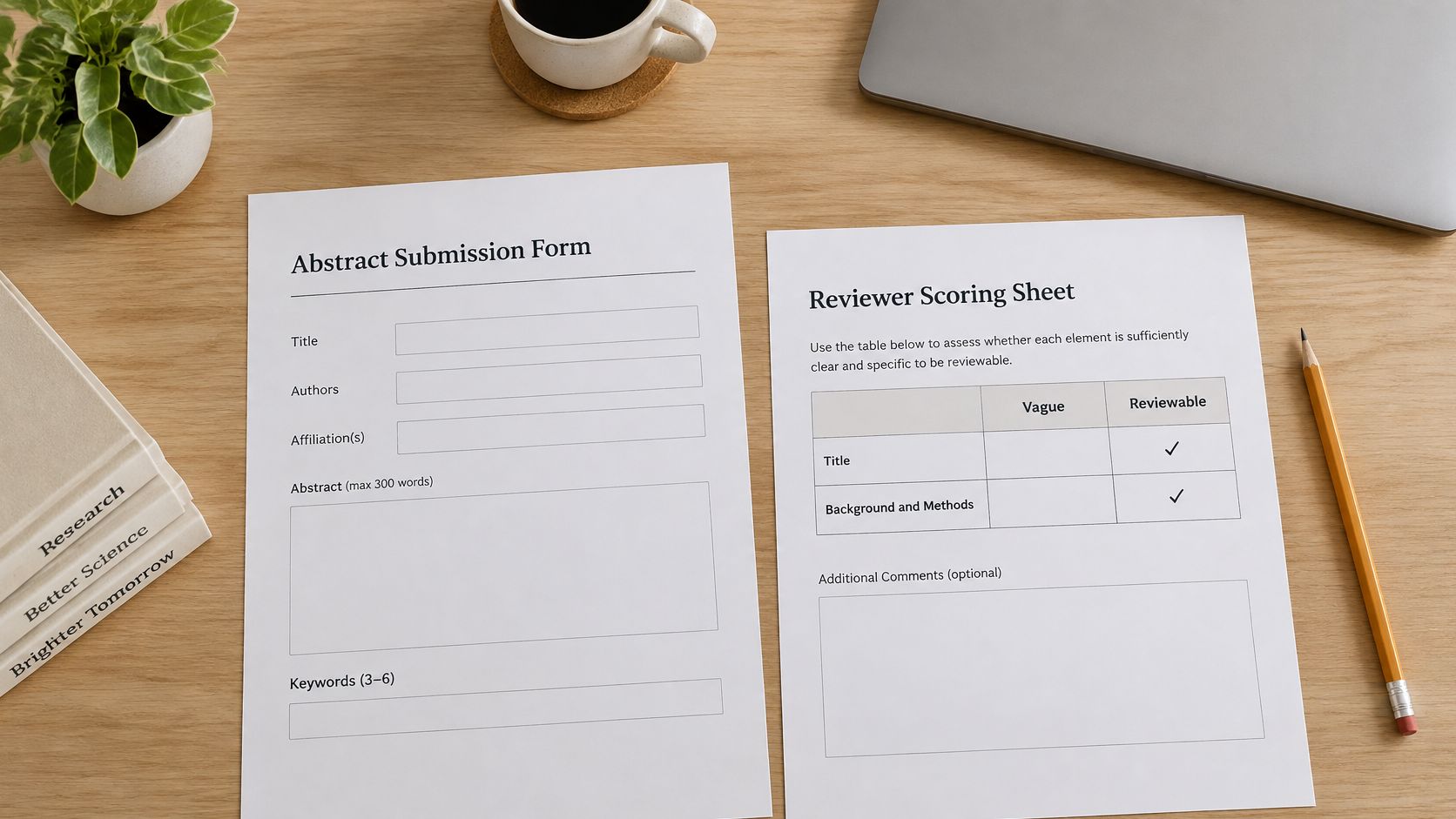
North Carolina Wesleyan University lists the usual components as title, authors and institutional affiliations, background or rationale, methods, results, and conclusions or discussion. Results reports findings, including statistical results when appropriate, without interpreting them. Interpretation belongs in Conclusions.
Title, background, and objective
Title. Name the question or the design in specific terms. "A study of waiting times" hides the work. "Shorter emergency waits after a triage redesign" tells a reviewer what to look for. The common slip is a topic label with no design and no population.
Background. Use two or three sentences of context and end on the gap. Weak: "Wait times are a known problem in healthcare." Strong: "Emergency waits remain long after standard triage, and few sites have tested a same-day redesign." Stop once the gap is named. A literature tour spends the budget you need later.
Objective. One sentence, starting with "To determine" or "To compare," and name the population or the variable. "To compare mean wait time before and after a triage redesign in one emergency department" is scorable. Three aims in one sentence read as an unfocused project.
Methods, results, and conclusions
Methods. State design, setting, sample size, data sources, instruments, and analysis, with numbers where they exist. Leave out ethics numbers and funder names unless the call asks. Thin methods are a frequent reason a sound study still loses points.
Results. Lead with the primary outcome. Give the effect size with its confidence interval or statistical significance, and add a secondary finding only if space remains.
Weak versus strong: "Results were encouraging" tells a reviewer nothing. "Mean wait time fell from 42 to 27 minutes" is an illustrative pair, not a real study, and it shows the difference: a measured change instead of a mood.
Conclusions. Answer the stated objective, then one practical implication and one limitation. Do not introduce a new outcome here.
A short walk-through of how reviewers read a structured abstract is worth ten minutes before you polish sentences.
Before you leave the draft, check each field against one reviewer question. What did you do, what did you find, and what does it mean? If a field answers a different question than its heading, move the sentence.
Illustrative Completed Abstract
The following abstract is illustrative. Every number is invented so you can see the budget applied to real sentences. Replace each placeholder with your own data and recount.
Title (11 words). Reading gains after a 12-week intervention in three primary schools.
Background (39 words). Primary pupils who fall behind in reading often stay behind without a structured classroom program. Evidence on short, school-based interventions remains uneven across ordinary primary settings. This study addressed that gap among pupils in three schools during one term.
Objective (22 words). To determine whether a 12-week reading intervention raises mean reading scores among primary pupils in three schools compared with usual classroom teaching.
Methods (64 words). We used a controlled comparison in three primary schools. One hundred eighty pupils took part over 12 weeks. Reading was measured with the school's standard score at baseline and follow-up. Scores were collected by school staff. We compared mean change between the intervention group and a comparison group using a linear model adjusted for baseline score.
Results (77 words). Mean reading scores in the intervention group rose from 54 to 61 points over 12 weeks. The adjusted mean difference versus the comparison group was 6.2 points, with a 95 percent confidence interval of 3.1 to 9.3. One hundred seventy-one of 180 pupils completed both assessments. The comparison group mean moved from 53 to 54 points. Baseline means were 54 and 53 points in the two groups. No serious implementation failures were recorded in the three schools.
Conclusions (35 words). A 12-week reading intervention was associated with higher mean scores than usual teaching in these schools. The finding may interest literacy leads planning a short program. Follow-up stopped at 12 weeks, so durability is unknown.
Keywords. Reading intervention, primary school, literacy.
Why each field is written this way
- The title names the question and the design. It does not open with "A study of."
- Methods uses one job per sentence. Design, setting and sample, measure, then analysis.
- Results contain only measured values. There is no claim about importance.
- Conclusions answer the objective in the first sentence, then one implication and one limitation, the short follow-up.
Title, keywords, and author lines were left out of the body count above. Whether your portal does the same is the call's decision, not this example's.
Word Limits and What Counts Toward Them
Limits are not a shared standard. Guidance across conferences runs from roughly 100 to 500 words, so a template has to state the count for each submission type. Assuming "about 250" is how authors get truncated or rejected for a rule they never read. The International Committee of Medical Journal Editors recommends a separate abstract word count so editors can judge whether a submission fits length rules. Program committees use the same check on a much larger pile.
| Event | Word limit | What is excluded or included |
|---|---|---|
| Canadian Association of Occupational Therapists, paper and poster | 250 words | Required headings excluded; extended discussion up to 350 words |
| Saudi Ministry of Health conference | 250 words | Title, authors and designations excluded; three to five Vancouver-style references included |
| International Conference on Chemical and Functional Food Science | 350 words | Counting rules not stated in the source |
| General range across conferences | About 100 to 500 words | Varies; confirm in each call |
The Canadian Association of Occupational Therapists caps papers and posters at 250 words and extended discussions at 350, and the required headings do not count. Saudi Ministry of Health guidance also caps abstracts at 250 words, drops title, authors, and designations from the count, and still includes up to three to five Vancouver-style references. It wants Introduction and Aims, Methods, Results, and Discussion and Conclusion, plus a separate case-report format. The International Conference on Chemical and Functional Food Science sets a 350-word limit and also requires title, presenting author contact and affiliation, co-authors, keywords, and a topic area. That source doesn't state what the counter includes.
A three-step count
- Identify the limit and the submission type. A poster and an extended discussion are often different caps.
- List exclusions. Headings, title, author details, references, and case-report sections may follow different rules.
- Count the body in a word processor, then leave a buffer of about 10 percent. Portal counters and desktop counters disagree on symbols.
Write the limit, and the exclusion list, at the top of the template before the first sentence. How those rules show up in a portal is covered in this abstract submission format guide.
Handling AI Use Disclosure in the Template
An abstract can read cleanly and still fail review on a rule the science never touched. Omitting AI provenance is one of those failures.
Most generic templates stop at title, background, objective, methods, results, conclusions, and keywords. Newer calls ask for more. The American Academy of Neurology's 2025 guidance requires authors to disclose how AI was used and which tool was used. Policies are still diverging, so one fixed disclosure either over-reports or under-reports.
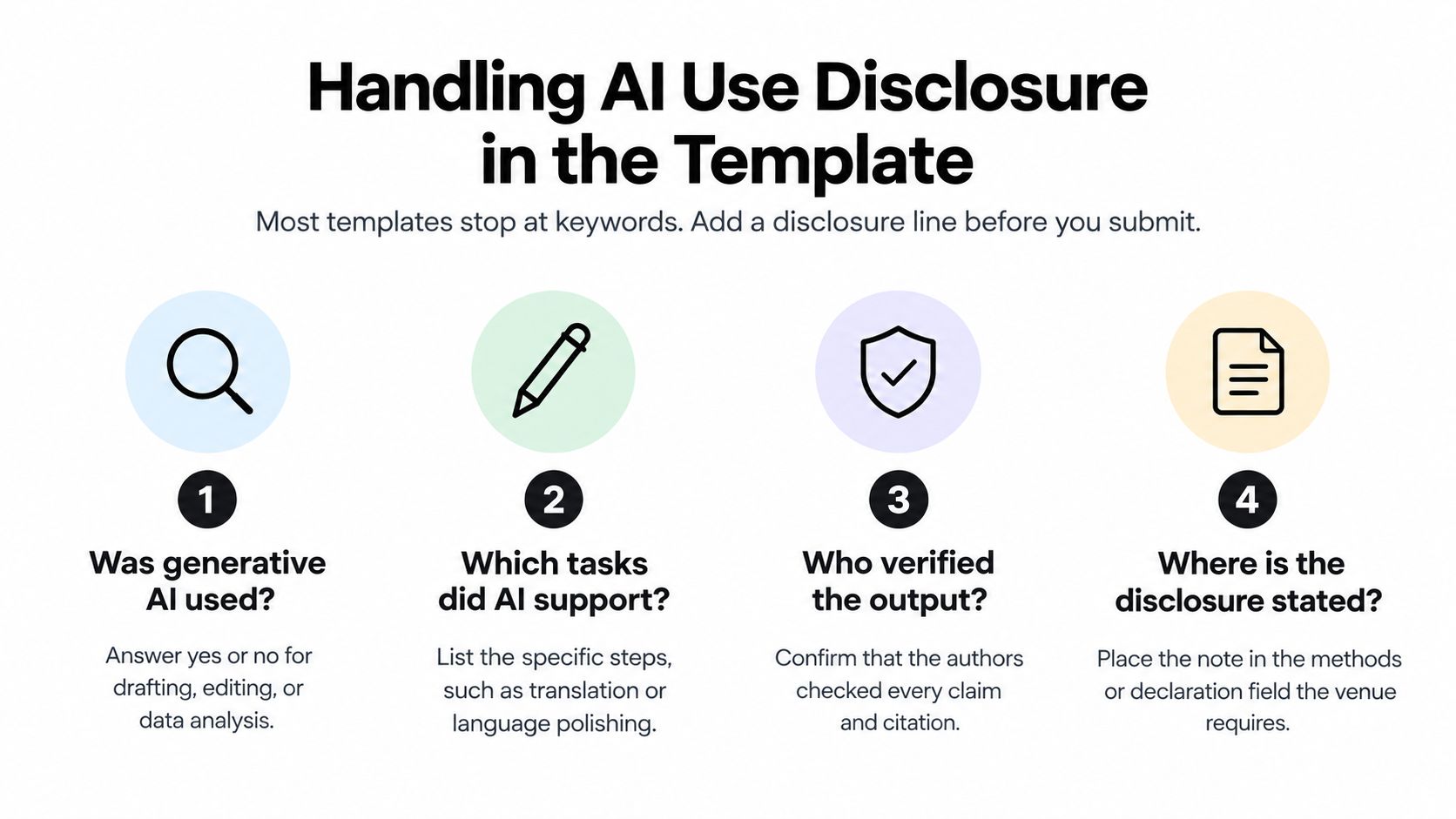
Build four prompts into the template.
- Was generative AI used? Yes or no. Count drafting and analysis, not only the final paste.
- Which tool and version? Name both. "An AI tool" is not a disclosure.
- For what task? Say whether it handled grammar, drafting, images, data collection, or analysis.
- Did humans verify the output and the underlying data? Name the person who checked both.
Where the statement goes
Grammar and spelling help is a different act from drafting text, creating images, collecting data, or analyzing results. Calls often treat these differently, so don't collapse them into "light editing."
If the portal has a dedicated field, use it. If it doesn't, place the statement in Methods, a supplementary document, or an upload attachment, exactly as the call directs. A one-size template produces either needless disclosure or a missing one.
A shorter abstract is not always a better abstract. Cutting the provenance line to save words can be the sentence that makes the file non-compliant.
Check the call first. Keep a running log of tool, version, and prompts while you draft, not the night before submission. Have a human confirm the underlying data before anyone treats AI output as a result.
Reporting Studies Without Final Results
The risky sentence is the one that writes an expected outcome as if it had already happened. Reviewers score that as evidence. If the data aren't in, you've overstated the study, and a later slide can't walk it back. Standard templates still expect methods and numerical results. Some meetings separately allow promissory abstracts for work in progress, and the discussion of promissory abstracts leaves the Results wording unsettled. "Include results" doesn't solve that.
| Study status | Results field holds | Wording to use |
|---|---|---|
| Completed study | Final findings with numbers and effect sizes | Report what was observed |
| Ongoing study | Status line plus interim findings labeled as interim | Preliminary analysis suggests |
| Protocol or planned evaluation | Planned outcomes labeled as anticipated | Will assess, not will demonstrate |
| Quality-improvement project | Baseline measure, intervention and monitoring plan | Baseline data show |
| Qualitative work | Sample size, analytic approach and emergent themes | Themes identified were |
Put the status in the first sentence
Add a data-status label: final, interim, or projected. Put it in the first sentence of Results so a reviewer doesn't have to guess.
"Preliminary analysis suggests" stays inside the evidence you have. "Will demonstrate" promises a result the design hasn't produced. For a protocol or planned evaluation, label outcomes as anticipated and put the analysis plan in Methods, not in Results. A quality-improvement abstract can stand on a baseline, the intervention, and the monitoring plan. Qualitative work can stand on the sample, the analytic approach, and themes already identified. It should not invent a prevalence.
Word limits differ widely, so an ongoing study may have room for a single status line and nothing else. That line still has to be accurate on submission day.
Choose the status that matches the study on the day you submit, not the status you expect by the meeting date. If analysis finishes later, that is a revision, not a reason to write the ending early.
Common Mistakes and the Final Pre-Submission Check
The costliest error is a Results field that states a conclusion and never a measured outcome. Reviewers then have nothing to judge. Everything else on this list is fixable in the same pass.
| Mistake | Why it hurts | Fix |
|---|---|---|
| Results field holds a conclusion only | Reviewers cannot judge the evidence | Add the primary measured outcome with its number |
| Interpretation placed in Results | Mixes fact with opinion | Move the interpretation to Conclusions |
| Headings counted against the limit | Risk of trimming or rejection | Check the call and count only what it includes |
| No AI statement where the call asks for one | Non-compliance with submission rules | Complete the statement or place it where the call directs |
| Expected findings written as results | Overstates the evidence | Use a status label and hedged verbs |
| Title opens with "A study of" | Question hidden from reviewers | Name the question or design in the title |
| Abbreviations not spelled out | Confuses reviewers outside the field | Expand each abbreviation at first use |
| Numbers differ between Methods and Results | Reviewers cannot verify the design | Match each sample size and outcome value across both sections |
Six checks, then submit
- Match heading names and order to the call. Your preferred labels don't outrank the portal.
- Recount in a word processor using the call's exclusions, and keep a buffer of about 10 percent.
- Place sample sizes and outcomes side by side from Methods and Results and confirm they match.
- Confirm the data-status label matches the study as it stands today.
- Ask someone outside the team to state the question and the main finding after one reading. If they can't, revise the title and Results.
- Submit when those checks pass, or ask the program committee to clarify an unclear field. Don't guess a required box.
Organizers building a call can see how required fields sit in a submission workflow. Our abstract management module keeps authors, reviewers, and program organizers on the same records, from the call through review and into sessions.
Frequently Asked Questions About Abstract Templates
Can an abstract already submitted to a journal be reused?
It depends. Read the call's rules on prior publication and the journal's permission before you resubmit, and state any overlap if the portal asks. Overlap you don't declare is a compliance problem, not a formatting one. The word-limit section is where you recheck length if the journal version is longer than the meeting allows.
Can an abstract be edited after submission?
Many portals allow edits until the deadline and lock the record afterward. Confirm that window in the call, and keep the final version in your working document in case the portal times out. If a locked file is missing an AI statement, the disclosure section above is the checklist you'll wish you had finished earlier.
What if the call gives no template or no word limit?
Map the call's stated headings onto the field table in this guide, in the call's order. Email the program committee for the word limit and the required fields before you draft. Guessing a cap, or inventing headings the committee doesn't score, wastes the only read most reviewers give you.
Planstone's abstract management brings submission, review, and session building into one workflow, so the fields in this template can become the records a program committee scores. If you're setting up a call, or you're an author trying to match one, start with the headings, the word count, and the disclosure rules before you polish a sentence. Visit Planstone to see how associations run that workflow from the call through to the program.