

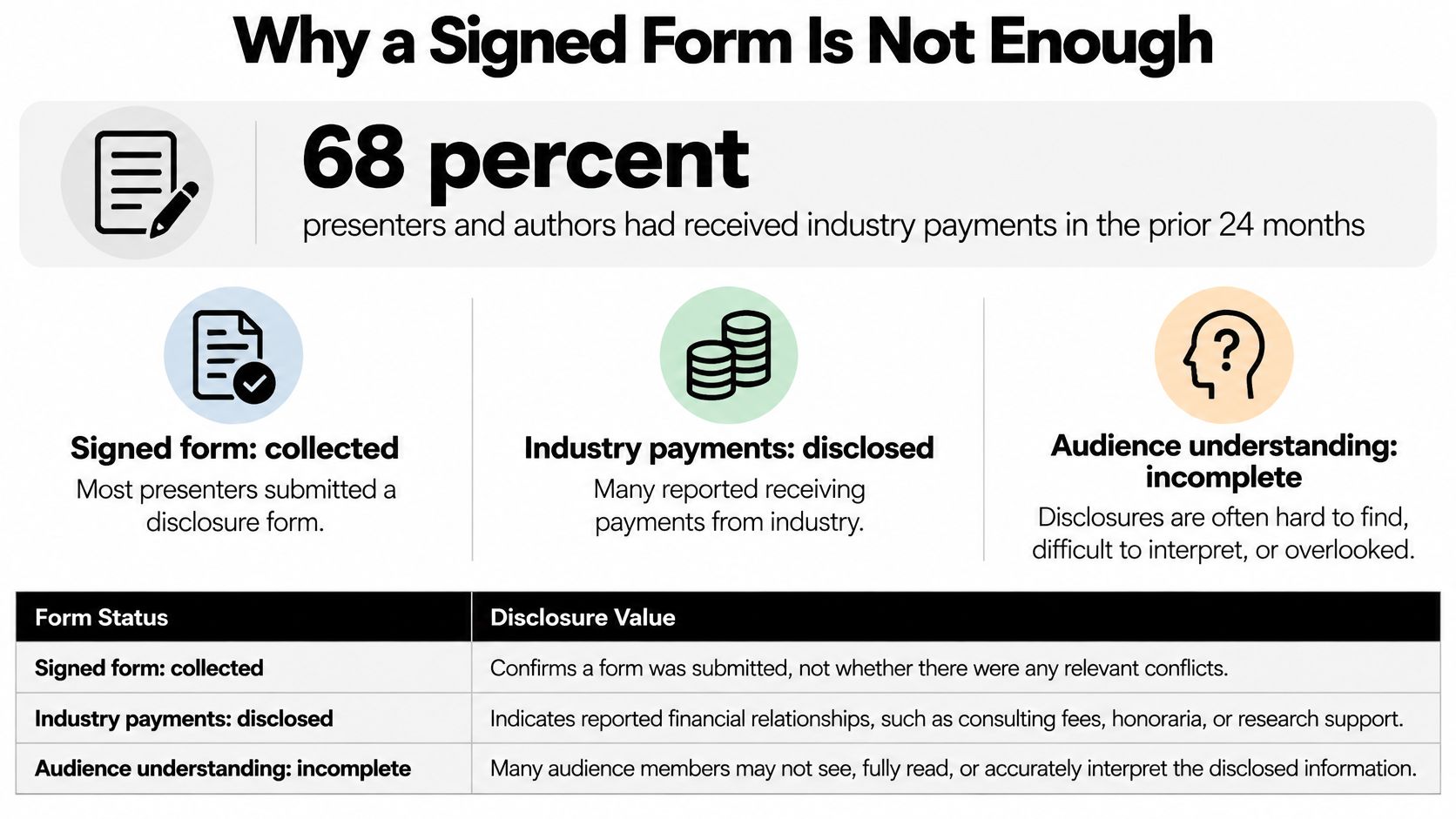
68% of presenters and authors at the 2024 American Society of Neuroradiology annual meeting had received industry payments within the preceding 24 months, according to an original study available through PubMed Central. Receiving a payment doesn't itself establish bias. It does show why an education team needs more than a folder of signed declarations to manage independence.
Table of Contents
- Why a Signed Form Is Not Enough
- The Lifecycle From Request to Retained Record
- Who Reports and What the Record Holds
- When Dollar Thresholds Change the Record
- When Completion Still Leaves the Audience in the Dark
- Mitigation Learner Notice and the Audit File
- Match the Workflow to Your Accreditation Rules
Why a Signed Form Is Not Enough
Financial disclosure management is the controlled lifecycle of collecting reportable financial relationships, reviewing them under the activity's rules, mitigating relationships that could bias content, informing learners, and retaining an auditable record. A signature starts that work. It doesn't finish it.
Say a physician helps plan a course, teaches a session, and supplies a handout. Staff receive a signed PDF and mark the physician complete. But nobody records whether the relationships were reviewed against the planning role, the presentation, or the handout's recommendations.
The document exists. The decisions that make it useful don't.
A person's status isn't an activity decision
A person-level record can support several assignments, but each assignment needs a defensible review outcome. Someone cleared for one topic shouldn't automatically be treated as cleared for every topic they teach.
Spreadsheets become fragile when staff must manage these distinctions manually:
- Relationships stack up. Speaking, consulting, advisory work, equity, and royalties need separate entries, not a single cell labeled industry relationship.
- Historical obligations continue. Ending payments doesn't necessarily remove a relationship from the applicable look-back window.
- Self-reports need follow-up. An incomplete submission may require clarification or comparison with public payment information, rather than an automatic approval.
A spreadsheet can serve as a small team's register. The weakness appears when staff use the same completed checkbox to mean submitted, reviewed, resolved, and ready for learners.
Borrow the control discipline, not another industry's rules
For a broader perspective on assigning responsibility and documenting controls, Matil's guide to managing compliance in financial services offers useful context. Its subject is different, so education teams shouldn't import financial-services requirements into accredited education.
The transferable principle is straightforward: give each decision an owner and preserve its evidence. For accredited continuing education, that means connecting the reporting population, relationship records, relevance decisions, mitigation, learner notice, and retained history. The practical question isn't whether a PDF arrived. It's whether staff can explain why this person may control this content and what learners were told.
The Lifecycle From Request to Retained Record
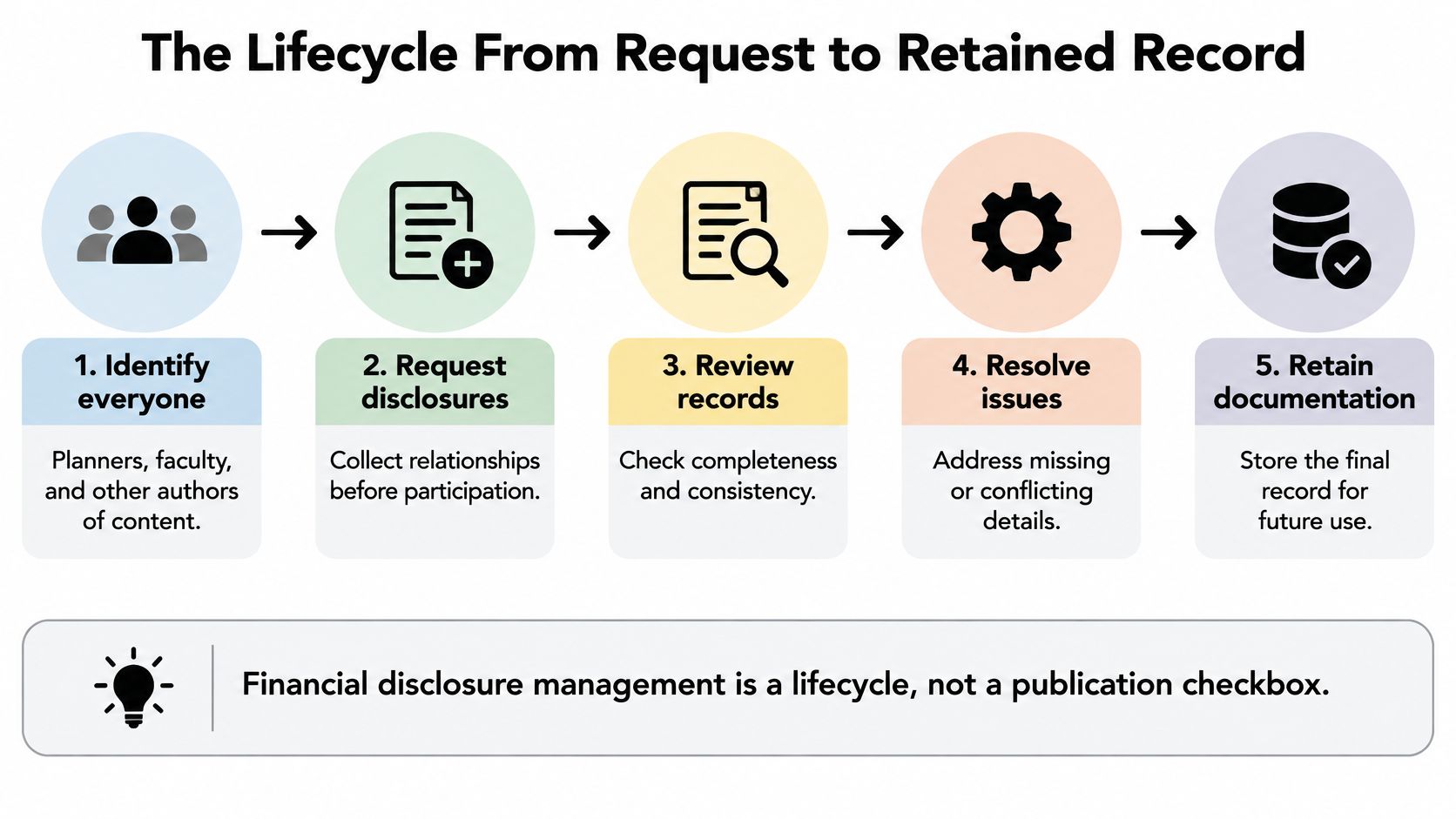
Treat disclosure management as connected controls with explicit exit conditions. Staff should know what evidence permits an item to move forward and who can authorize that move.
The ACCME Standards for Integrity and Independence in Accredited Continuing Education require collecting all financial relationships with ineligible companies during the prior 24 months, without filtering by amount or the individual's opinion of relevance. Operationally, collection must precede the provider's relevance decision.
The controls and their exit tests
Identify everyone who controls content. Build the roster before invitations close. Include planners, faculty, and other people who shape educational materials, not just the names printed in the program. Exit when each person has a named role attached to the activity.
Collect the complete relationship record. Request company names and relationship categories before asking reviewers to judge relevance. Someone without reportable relationships still needs to submit an explicit none statement. Silence means outstanding, not clear.
Review completeness before relevance. Return records with missing companies, unclear categories, or unanswered questions. Only then should the reviewer compare relationships with the person's content-control responsibilities. Record the reviewer, decision, and time of review.
Assign and complete mitigation. Specify the action, responsible person, affected content, and completion evidence. For example, a reviewer might assess a presentation for balanced treatment of therapeutic options and document necessary changes. Build a release hold into the preparation process so unresolved requirements can't disappear behind a finished slide deck.
Publish the learner statement and retain the history. Confirm that the learner-facing version reflects the final review outcome. Save the published statement alongside the underlying submission and decisions, rather than overwriting the original record.
A useful operational state path is:
Submitted → reviewed → mitigation assigned → mitigation completed → learner disclosure published.
Not every submission needs mitigation. Record that determination explicitly instead of creating a fictional mitigation task or leaving an unexplained blank.
Financial disclosure management stages and exit evidence
| Stage | What staff do | Exit evidence |
|---|---|---|
| Identify | List planners, faculty, and other content controllers | Named role tied to the activity |
| Collect | Gather all ineligible-company relationships for the applicable look-back period | Submitted record or a none statement |
| Review | Check completeness, then relevance to the content | Reviewer name, decision, and timestamp |
| Mitigate | Apply a control before content is released | Mitigation assigned and marked complete |
| Disclose and retain | Tell learners and keep the history | Published statement plus retained record |
Use the table as a handoff specification. A coordinator can confirm receipt, but that shouldn't grant the coordinator authority to make the relevance decision unless the organization has assigned that responsibility.
Late additions need the same path. If a substitute speaker joins after materials are approved, reopen the affected assignment rather than borrowing the original speaker's clearance. The collection stage becomes checkable only when the underlying form stores relationships as identifiable records.
Who Reports and What the Record Holds
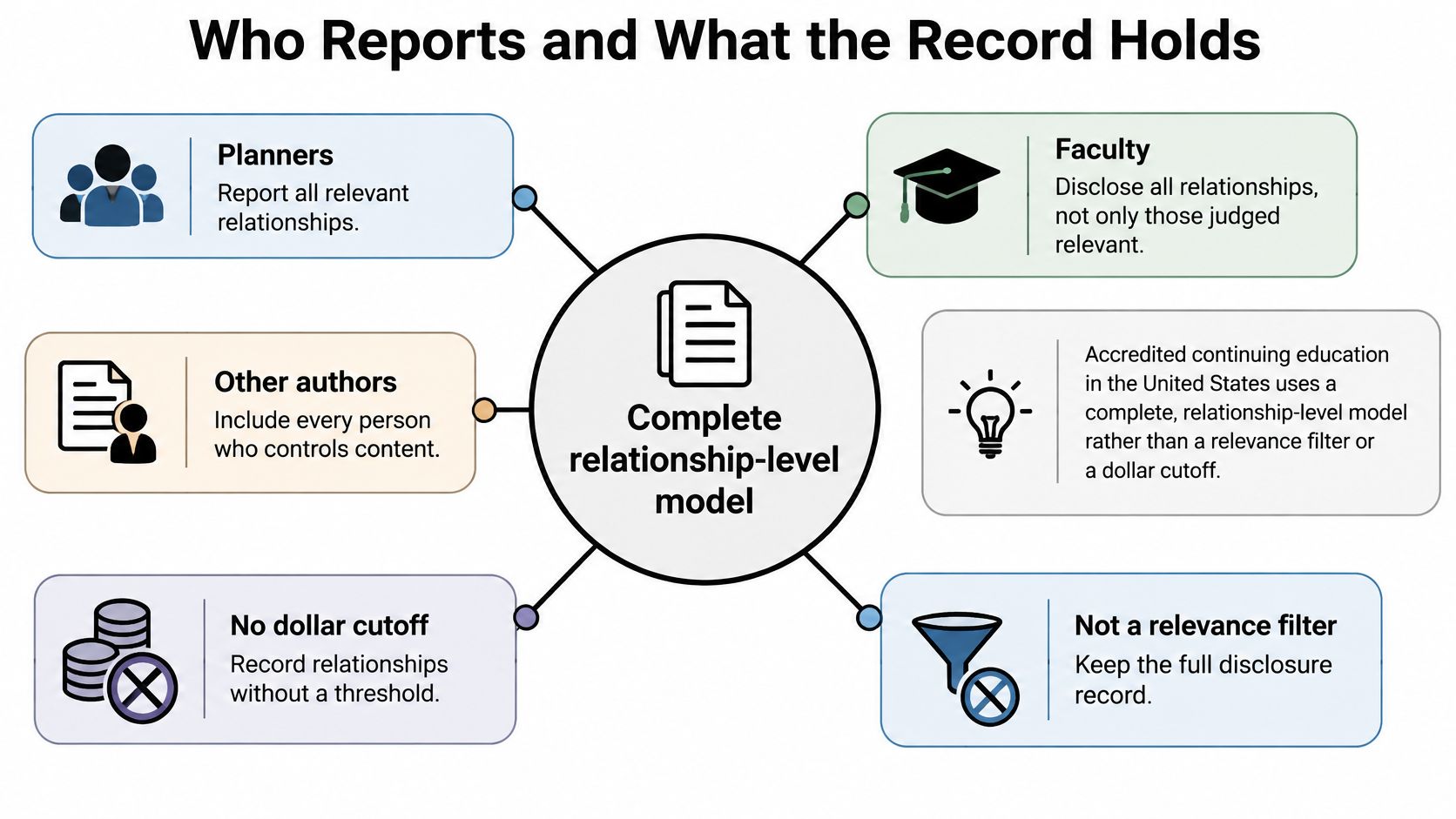
Accredited continuing education in the United States uses a complete, relationship-level model, not a relevance filter or a dollar cutoff. Under ACCME's accreditation requirements, planners, faculty, and anyone else controlling educational content must report all financial relationships with ineligible companies during the previous 24 months, regardless of amount or their own assessment of relevance.
The provider makes the relevance decision after collection. Asking faculty to report only relationships they consider conflicts transfers that decision to the wrong stage.
Store relationships as individual entries
At minimum, each relationship entry should hold:
- Individual. A stable person identifier connected to the person's activity assignments.
- Company. The named ineligible company, rather than a broad description such as pharmaceutical industry.
- Nature of the relationship. A consistent category, with explanatory detail when needed.
- Look-back period. The reporting period covered by the submission, supported by relationship dates where useful.
Offer recognizable categories on the form: employment, research, consulting, advisory roles, speaking, independent contracting, royalties or patent benefits, executive roles, and ownership interests. Allow multiple entries for the same company when the person has different relationship types.
For example, a faculty member might consult for a company and receive patent-related benefits from it. Combining those into other industry work prevents the reviewer from seeing what needs evaluation.
A form that records only relationships the faculty member calls relevant can drop reportable information before mitigation even starts.
Make missing information detectable
A yes-or-no conflict box can't tell staff which company is involved or what the person does for it. It also can't distinguish a genuine none submission from an unfinished form.
Structured fields support concrete checks: identify a required respondent with no submission, flag a relationship without a company, and return an entry without a category. These checks establish completeness, not relevance. A filled field still needs a reviewer's judgment.
Keep role eligibility separate from ordinary relationship review. Owners and employees of ineligible companies are generally excluded from controlling accredited CE content, subject to ACCME's specified exceptions. Don't treat employment or ownership as another consulting relationship that can always be cleared through routine mitigation.
When mapping a speaker-preparation workflow, distinguish the person's disclosure submission from the status of each teaching or planning assignment. That distinction lets staff reuse accurate background information without assuming that a previous activity's review resolves a new one.
When Dollar Thresholds Change the Record
ACCME education rules versus FDA investigator thresholds
| Rule set | Who reports | Window | Monetary filter | Detail the record needs |
|---|---|---|---|---|
| ACCME Standard 3 | Planners, faculty, and other content controllers | Prior education look-back period | None; all amounts | Person, ineligible company, relationship nature |
| FDA public equity | Clinical investigators | Study plus one year after | Above $50,000 | Equity interest, sponsor, period |
| FDA nonpublic equity | Clinical investigators | Study plus one year after | Any ownership not readily priced | Ownership interest and company |
| FDA other payments | Investigator or institution, including spouse and dependent children | Study plus one year after | Cumulative above $25,000, excluding study-conduct costs | Payment type, recipient, amount |
The FDA thresholds and time windows in this comparison come from its financial disclosure guidance for clinical investigators under 21 CFR Part 54: public-sponsor equity exceeding $50,000 and significant payments of other sorts exceeding $25,000 cumulatively are assessed during the study and for one year after completion. The guidance includes payments to an investigator's spouse and dependent children in the cumulative other-payments test.
These aren't alternative settings for the same education form. They address a different regulatory purpose and require different supporting information.
Read each test separately
Start with who is in scope. Education teams identify people who control educational content. Research teams identify covered clinical investigators and collect the financial information relevant to the FDA framework; family recipients belong within that assessment, not in a separate faculty roster.
Next, anchor the time window correctly. An education disclosure uses a retrospective reporting period tied to the educational activity. A research record needs study dates and a post-study monitoring endpoint.
Then apply the appropriate financial test. Publicly traded equity requires valuation information. Nonpublic ownership can't be dismissed because staff can't find a public share price. Other payments require cumulative tracking and a distinction between study-conduct costs and payments covered by that category.
A payment can belong in education even when a research test isn't met
Say an investigator receives an honorarium below the FDA other-payments threshold and has no additional payments that bring the cumulative total above it. That payment may fall outside that particular significant-payment test. It can still belong in the person's accredited CE disclosure when it is a financial relationship with an ineligible company within the applicable education window.
That example doesn't establish that the investigator has no other FDA-reportable interests. Equity, outcome-linked compensation, and other applicable tests require their own assessment.
Store relationship type, amount, recipient, study period, and education look-back separately. A universal minimum-payment setting can improperly suppress education disclosures, while an education-only form may omit details the research team needs. Shared person records are useful; collapsed rule sets aren't.
When Completion Still Leaves the Audience in the Dark
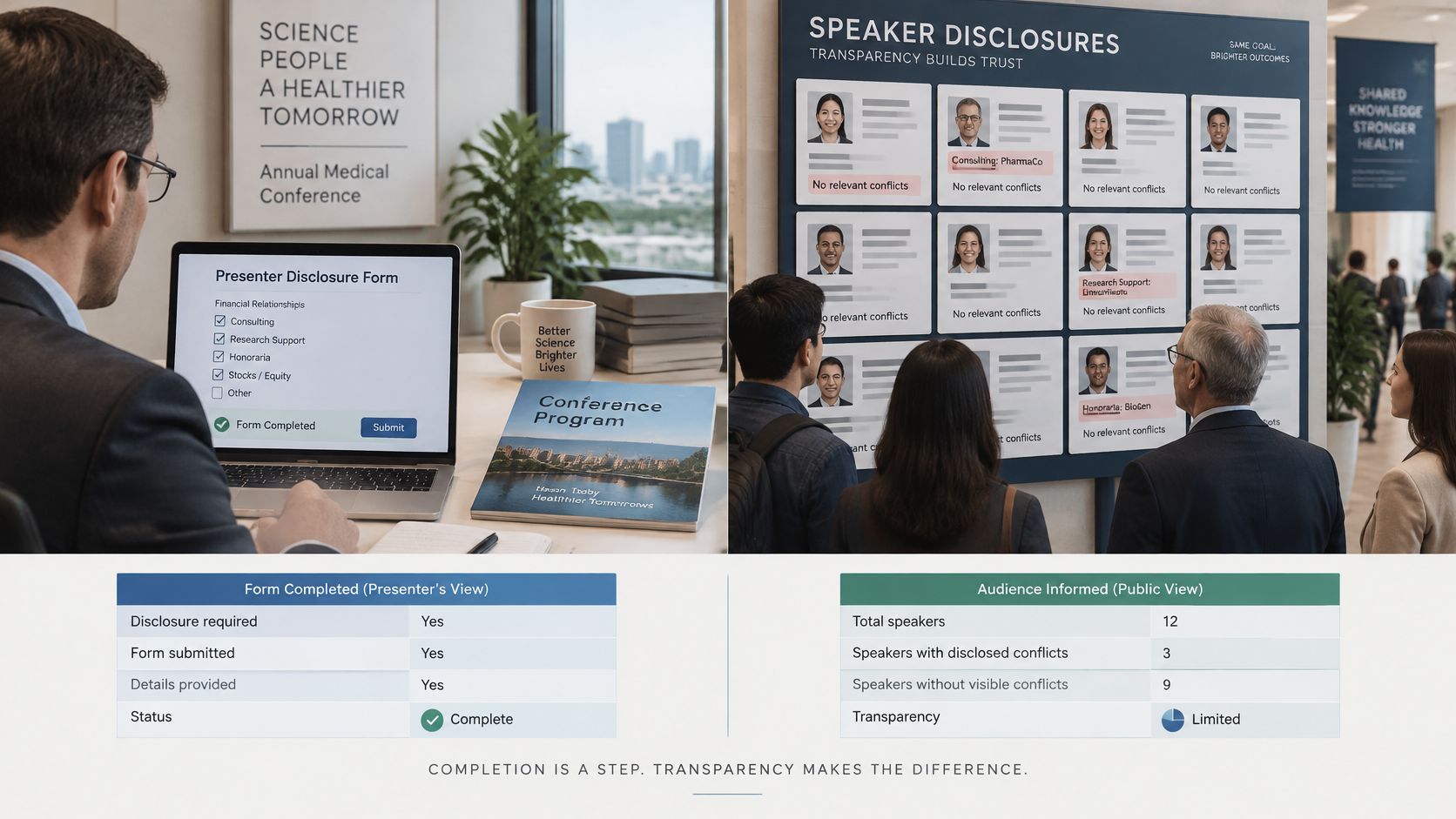
An analysis of the 2025 EuroPerio 11 conference found potential conflicts listed on the conference website for only 6 of 163 invited presenters, or 4%; among 160 presentations, 48.5% contained no disclosure, and the median disclosure lasted seven seconds. Those findings describe that conference, not a universal rate, but they challenge the assumption that a completed administrative process guarantees useful audience information.
Separately, reporting on research comparing radiology guideline authors' journal statements with U.S. Open Payments found that undisclosed payments represented 56.7% of total payment value in 2023. The measure concerns payment value, not the percentage of authors who failed to disclose.
Separate quality problems before resolving them
A disclosure dashboard should distinguish problems that demand different responses:
- Missing disclosure. No submission exists. Request it and keep the assignment outstanding.
- Vague none statement. The response doesn't establish which relationships or period the person considered. Clarify the question and obtain a usable answer.
- Incomplete company or category. An entry exists but can't support review. Return the specific field for correction.
- Outdated look-back. The submission covers an earlier reporting period. Request confirmation or updated information.
- Relevant relationship awaiting mitigation. Collection is complete, but the independence control remains open. Route it to the responsible reviewer.
These aren't interchangeable forms of incomplete. Sending another generic reminder won't resolve a relevance decision that already sits with a reviewer.
Validate usefulness, not just presence
A light quality check should confirm the company and relationship type, the applicable reporting window, a named reviewer and decision, and whether review changed the speaker's role or content. Staff should also inspect the learner-facing output. Can an attendee read it, understand it, and connect it to the person presenting?
Audience test: A disclosure isn't useful merely because staff can prove it appeared somewhere.
A slide stating no conflict can be ambiguous if nobody knows whether the speaker reported all relationships or only self-selected ones. A statement displayed too briefly may be technically present but practically unreadable. Neither problem is solved by counting published slides.
Maintain a centralized, verifiable presenter record in the spirit of Open Payments rather than retyping disconnected forms for every session. Public payment information can prompt clarification, but it shouldn't substitute automatically for the individual's complete report. Resolve discrepancies, preserve the explanation, and carry the result into mitigation and learner communication.
Mitigation Learner Notice and the Audit File
Learner notice should communicate the result of review, not dump the entire intake form into the program. The ACCME information package on integrity and independence specifies disclosure of each individual with a relevant financial relationship, the associated ineligible company, the nature of the relationship, and a statement that the relationship has been mitigated.
For people without relevant relationships, provide a clear no-relevant-relationships statement rather than an unnecessary list of unrelated companies. Keep the internal evidence that supports that conclusion. A general assertion that staff completed the process isn't a substitute for the learner information that applies to the activity.
Preserve the decision sequence
Use timestamps and responsible reviewers to distinguish submitted, reviewed, mitigation assigned, mitigation completed, and learner disclosure published. These states should identify the affected activity or session, not sit only on a person's profile.
Link the decision to the actual faculty assignment or other content-control role. If a planner's mitigation remains open, staff need to find the planning decisions or materials affected, rather than merely seeing a red indicator beside a name.
A release check should compare assignments against unresolved requirements. It should also preserve the version of the learner statement that was published, not just whichever version staff edited most recently.
Keep ended relationships in their historical context
Ending a consulting agreement today doesn't erase its relevance to the retrospective reporting window. Retain its dates and status so the review reflects the period the individual was asked to report.
Don't confuse that reporting window with the organization's document-retention period. Follow the applicable retention policy and accreditation obligations; a current-status field alone won't preserve the history needed to explain an earlier activity.
For a selected session, an auditor should be able to reconstruct:
- Scope. Who was asked to disclose and which roles they held.
- Submission. What each person reported, including corrections.
- Judgment. Who determined relevance and the recorded outcome.
- Action. What mitigation was assigned and how completion was established.
- Communication. What learners received and which version was published.
- History. How the underlying records and changes were retained.
The disclosure file is a chain of custody for independence, not a stack of forms in a speaker folder. Choose a workflow that preserves the handoffs without requiring staff to rebuild them from email after every meeting.
Match the Workflow to Your Accreditation Rules
Test your current process with direct yes-or-no questions:
- Assignment visibility. Can every planner and faculty member be tied to an activity or session before content is released?
- Collection completeness. Can the form store company and relationship type for every reportable tie, plus an explicit none submission?
- Reviewer control. Can a reviewer document mitigation and keep unresolved materials from release?
- Audit reproduction. Can staff reproduce the learner notice and historical decision record after the meeting?
If an answer is no, check where the records separate. Disclosures may live in email while abstracts, slides, and credit requirements sit in different systems.
Configure around the activity
List content controllers and confirm whether the work involves accredited CE, FDA-regulated research, or both. Accreditation descriptions, such as CE accreditations at Premiere Education, can help teams recognize the importance of identifying the relevant accrediting framework. Use your applicable standards to set collection and review rules, not a generic dollar threshold.
Bring disclosure responsibilities into program development early. A call-for-abstracts process is a useful planning point for deciding when accepted contributors enter faculty preparation.
At Planstone, we support financial relationship disclosure collection, status tracking, and reporting. Our speaker portal centralizes assigned tasks, disclosures, presentation files, and correspondence, and we configure the platform to each program's review criteria, faculty requirements, and credit rules, from contributor forms to staff reports.
For a consultation, bring your current forms, reviewer steps, and the systems holding registration and credit data. The decision isn't to buy a form. It's to keep collection, mitigation, learner notice, and retention on an auditable path.
Planstone offers configurable conference and continuing education workflows that connect disclosure administration with speaker preparation. Visit Planstone to discuss your current forms, review handoffs, and reporting needs, and identify how to keep financial disclosure management connected to your program's requirements.