

The most common advice about post-conference reporting is to summarize what happened, add attendee feedback, and finish with recommendations. That produces a recap, not a record a committee can use to approve spending, a sponsor can use to assess delivery, or an education team can use to verify credit.
A useful post conference report template records results against objectives, identifies the evidence behind each conclusion, and turns problems into assigned decisions. Its most important output isn't a polished PDF. It's a documented commitment to what will change, who will make that change, and how the next event will test whether it worked.
Table of Contents
- Core Sections Every Post-Conference Report Needs
- How to Build the Report in Five Steps
- Objectives Versus Outcomes Template
- Attendance Counts That Hold Up Under Review
- Feedback Metrics and Response Rate Benchmarks
- Credit and Certificate Fields to Record
- Turn Findings Into an Owned Action Log
Core Sections Every Post-Conference Report Needs
Use this order for the master report. Write the executive summary last, once the responsible staff have confirmed their results.
| Section | Question it answers | Source data |
|---|---|---|
| Executive summary | Did the event meet its goals, and what changes next? | Decisions from the planning team |
| Objectives versus outcomes | Which targets were hit or missed? | Objective list and final results |
| Attendance and engagement | Who attended and how did they participate? | Registration and check-in records |
| Financial performance | Did spending match the budget? | Final budget and invoices |
| Marketing reach | Who saw the event promotion? | Campaign and channel reports |
| Program evaluation | How did attendees rate sessions and speakers? | Post-event survey results |
| Credit and certificate status | Which learners earned credit and when? | Credit and certificate records |
| Lessons learned and recommendations | What should the next event repeat or fix? | Debrief notes and owner list |
Keep the executive summary to three to five sentences: overall performance, the material exceptions, and the decisions required. The operations lead should own that synthesis, while finance confirms revenue, expenditure, and unresolved invoices. Marketing supplies channel results; the education lead interprets session, speaker, and learning findings.
Report outcomes, not just activity. The Tourism Institute's post-convention guidance describes an outcome-focused sequence, recommends comparison with objectives, earlier conferences, or industry standards, and identifies approximately 8–12 strategically selected indicators as a practical reporting scope.
Use those comparisons carefully. A changed attendance definition or evaluation question can make an apparently favorable year-over-year result misleading. Label differences rather than forcing unlike measures into the same chart.
For a complementary narrative layout, use Planstone's event evaluation report example to organize methodology, findings, recommendations, and supporting appendices.
Working rule: Give every report section a named owner, source system, and due date. Someone who wasn't on the planning team should be able to reconstruct the report next year.
How to Build the Report in Five Steps
The reporting workflow starts before registration opens. If the team hasn't defined what it needs to measure, no amount of post-event formatting will recover missing baseline information.
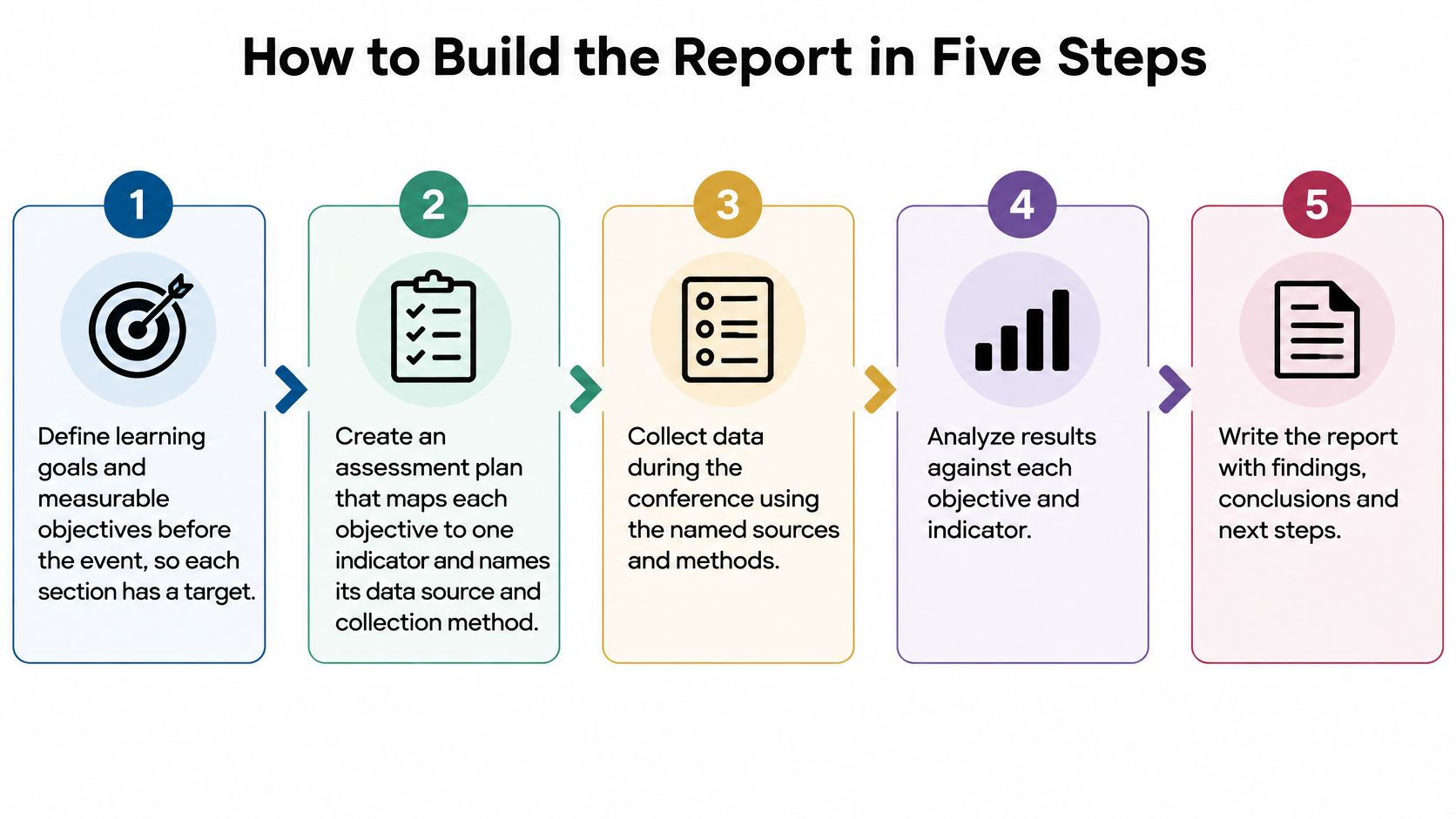
Define learning goals and measurable objectives. Separate participation, satisfaction, learning, and professional application. A session can attract an audience without producing the intended educational result, so don't use popularity as a substitute for learning evidence.
Create an assessment plan. Map each objective to a primary indicator, collection method, data source, and responsible person. For example, an objective about interpreting clinical evidence needs an assessment tied to that skill, not merely a question about whether the speaker was engaging.
Collect the planned evidence. Preserve attendance records, structured evaluations, and assessment responses in exportable form. Use a stable participant identifier where appropriate, control access to identifiable records, and document how duplicate or incomplete submissions will be handled.
Analyze and communicate findings. Compare results with the planned objective, show the base for each measure, and describe limitations. Return an educational summary to the course director rather than leaving interpretation solely with operations staff.
Review the evaluation process itself. Record questions participants misunderstood, unavailable exports, and fields staff had to reconstruct manually. Those are changes to the next reporting process, not just observations about the finished event.
Set separate clocks for reaction and application
I recommend scheduling the immediate survey within 24–48 hours, then reserving a delayed survey or interview at 30–90 days for implementation and practice-change questions. The UAB CME assessment framework supports returning summarized findings to the course director and, where practical, assessing later whether participation changed professional practice; the proposed delayed window gives that follow-up an operational deadline.
Don't label confidence as verified competence. Ask what participants can demonstrate immediately, what they intend to change, and what they subsequently implemented.
At Planstone, our platform connects abstracts, speakers, and disclosures into a coordinated workflow, with handouts flowing to participants and evaluations and credits completing the event. We also provide dedicated conference and account management support. During a consultation, clients describe their program, existing systems, and team requirements so we can discuss where we can help.
Before the next conference, put the template in a shared document, assign its sections, and schedule follow-up now. Confirm that check-in and evaluation forms collect the fields those owners will need.
Objectives Versus Outcomes Template
Start with a row for each planning objective, not each session. This layout identifies the indicator and evidence source before anyone enters results.
| Objective | Indicator | Source |
|---|---|---|
| Registration reach | Registrations against plan | Registration system |
| Learning gain | Pre and post knowledge score change | Pre and post event questions |
| Practice change | Behavior reported during the scheduled delayed follow-up | Delayed survey or interview |
| Budget control | Spend against budget | Final budget and invoices |
| Survey completion | Completed surveys divided by eligible respondents | Survey platform export |
In the working spreadsheet, add columns for target, actual result, variance, status, explanation, and action reference. Preserve the target approved before the event. Changing it after results arrive turns evaluation into justification.
Make variance reproducible
Choose a calculation and label it. Absolute variance is actual minus target; relative variance is actual minus target, divided by target, expressed as a percentage. For rates, distinguish percentage-point movement from relative percentage change.
The sign alone doesn't tell the committee whether performance was favorable. Higher registration can be positive, while higher expenditure may require explanation. Add an interpretation column rather than relying on red and green cell formatting.
A missed target without a cause is an incomplete finding. A missed target without an assigned response is an unfinished decision.
Use met, partly met, or missed only against agreed criteria. Where the source hasn't confirmed a result, leave the numerical cell blank and add a separate status such as awaiting finance reconciliation or awaiting follow-up responses.
A learning-gain row needs comparable assessment evidence. If participants answered different questions before and after the event, explain how the scores can reasonably be compared. A practice-change row remains provisional until the delayed assessment closes.
When no target existed, use a clearly labeled historical comparison or external benchmark. Don't retroactively present that comparison as an approved goal.
Every missed objective should receive an action reference. For budget overruns, distinguish an approved scope change from an avoidable purchasing problem: the first may require a better planning assumption, while the second needs a control change.
Attendance Counts That Hold Up Under Review
| Stage | What it counts | How to report it |
|---|---|---|
| Total registrants | People who signed up | Base for registration conversion |
| Attendees | People who checked in or joined a session | Base for attendance rate |
| Evaluation respondents | People who completed the post-event survey | Base for every satisfaction percentage |
| Credit-eligible learners | People who completed the required evaluation and met criteria | Base for certificates and credit submission |
| Withheld learners | Records held for missing consent or requirements | Follow-up list with named owners |
These groups aren't interchangeable. State whether registration totals include cancellations, staff, speakers, and complimentary places, then keep that definition consistent across exports. Registration conversion also needs its upstream base, such as eligible invitees or tracked registration-page visitors.
Define attendance from evidence the event collected. A check-in scan establishes arrival, not full-session participation; a virtual login doesn't establish completion of an educational activity. Show the attendance rate as attendees divided by eligible registrants, while reporting educational completion separately.
The ACCME CME for MOC beginner guide distinguishes participation from successful evaluation completion and requires learner information and consent before individual reporting. Keep records awaiting consent separate from learners who haven't yet satisfied educational requirements.
Reconcile records without erasing experience problems
Check-in is also an experience measure: 71% of attendee-side respondents in Event Marketer's 2025 B2B events research summary said ease of conference check-in could make or break their event experience. Preserve queue complaints and scan failures alongside the reconciled counts rather than treating them as unrelated anecdotes.
The resulting funnel should produce specific follow-up queues:
- Registered but not checked in: Check cancellations, missing scans, and genuine nonattendance before assigning a no-show status.
- Attended but not evaluated: Send the appropriate evaluation reminder without implying credit was earned.
- Requirements met but records held: Resolve consent, identity, or administrative exceptions with an assigned staff member.
- Certificate unavailable: Confirm eligibility and issuance status before sending a replacement.
Keep identifiable exception lists access-controlled. Committees and sponsors generally need aggregate results, not a roster of individual learner problems.
Feedback Metrics and Response Rate Benchmarks
| Evaluation context | Reported response-rate benchmark |
|---|---|
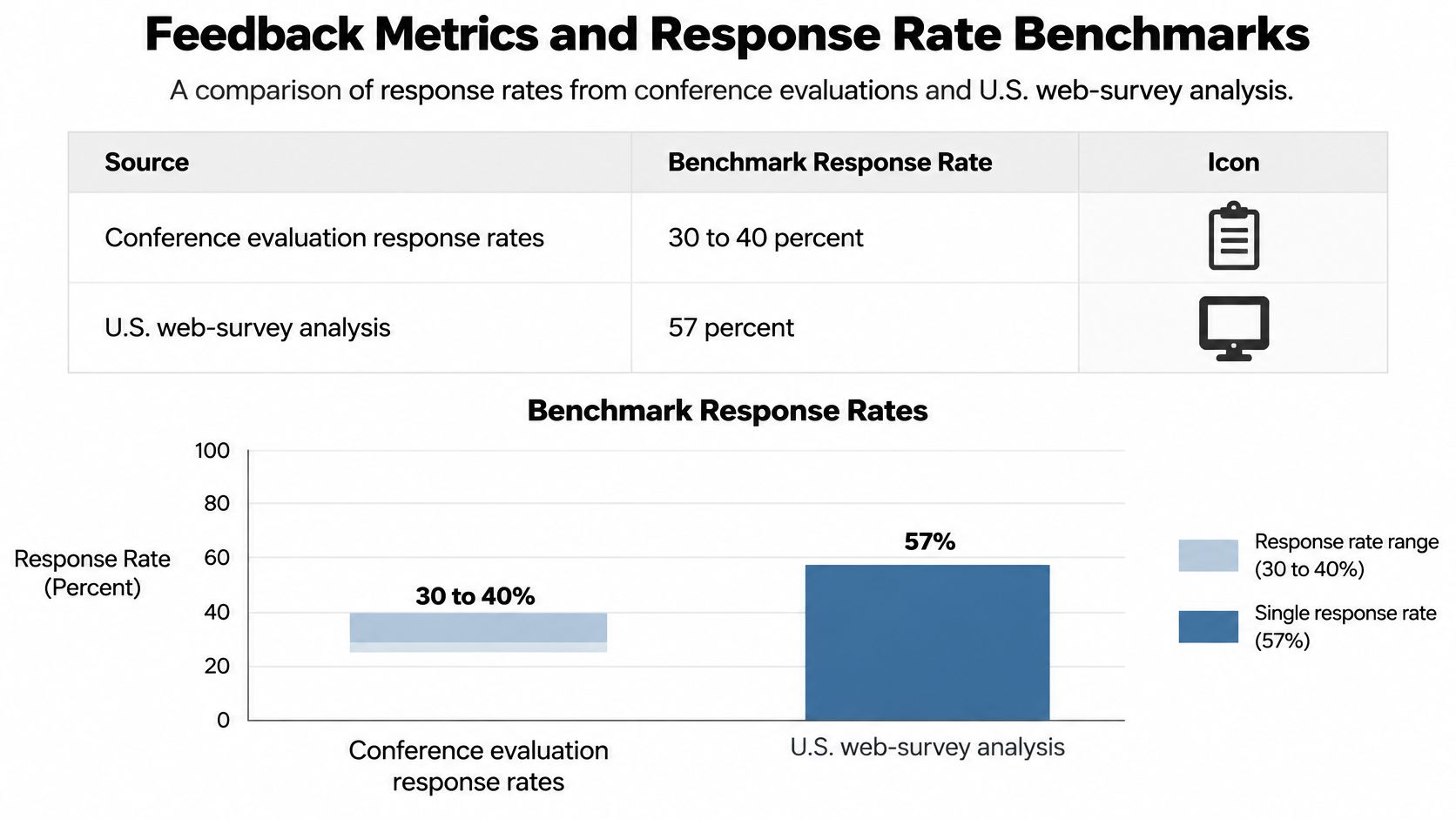
| Published conference-evaluation studies | Commonly average 30–40% |
| U.S. web-survey analysis, meeting or conference evaluations | 57% average |
| U.S. web-survey analysis, output or impact evaluations | 52% average |
These benchmarks, documented in the Health Research Policy and Systems survey-methodology discussion, describe different evaluation contexts rather than a universal pass mark. The same discussion describes a large health survey in which cumulative response increased from 19.1% after the first inquiry to 42.0% after five inquiries, while later reminders produced only small reductions in nonresponse bias.
Response volume and representativeness are separate questions. A larger response pool can still underrepresent a specialty, attendance format, or geographic group. Compare respondent composition with the attendee population before generalizing.
Show the survey's reporting base
Display invitations sent, eligible respondents, completed surveys, completion rate, and item-level missingness. Define whether a completed survey requires every question or only the mandatory items, and document duplicate-removal rules.
A retrospective CME study reported 98.9% satisfaction with speaker and content diversity across responses, using 5,284 post-activity evaluations. That's a specific measure among evaluation responses, not a satisfaction finding for every attendee or proof of educational impact.
- Run reminders deliberately: Send a pre-deadline reminder and a follow-up to nonrespondents, excluding completed records.
- Inspect question wording: Separate speaker delivery, content relevance, perceived learning, and practical application. Planstone's post-event survey questions guide can help organize the questionnaire.
- Label limitations: Flag small subgroups, self-selected comments, missing answers, and post-event recall effects.
For consequential decisions, compare early and late respondents or conduct a short nonrespondent check. Call findings descriptive when representativeness can't be established, and don't present an isolated comment as a population-level conclusion.
Credit and Certificate Fields to Record
| Field | Why it matters | Source requirement |
|---|---|---|
| Participant name | Identifies the learner on the certificate | Course documentation must include the physician's name |
| Activity title and attendance dates | Ties credit to a specific program and time | Course title and attendance dates required |
| Credit hours and accrediting organization | States the credit amount and who granted it | Number of hours and sponsoring agency required |
| Evaluation completion status | Credit depends on completing the evaluation first | Evaluation completed before completion credit is awarded for applicable MOC activities |
| Submission date and method | Shows records reached the reporting system promptly | ACCME encourages submission within 30 days after credit is earned |
| Retention location and period | Keeps records available for later confirmation | California physicians must retain documentation for at least four years |
Apply the credit-administration fields to accredited continuing education and maintenance-of-certification programs. For unaccredited conferences, retain identity, attendance, certificate status, and storage fields; remove credit-hour and credit-reporting fields.
The Medical Board of California CME guidance requires documentation containing the physician's name, course title, attendance dates, credit hours, and sponsoring or accrediting agency, and requires physicians to retain it for at least four years. That physician obligation shouldn't be presented as a universal provider-retention policy.
Separate eligibility, issuance, and submission
Record evaluation completion, the applicable passing result, the date credit became eligible, certificate issuance status, and reporting acceptance. These are separate milestones; an issued certificate doesn't establish that an external reporting system accepted the learner record.
ACCME's credit-reporting guidance encourages providers to submit individual completion data within 30 days after the learner earns credit, using manual entry, batch uploads, or web-service submission. Treat that as an encouraged reporting timeline, not an interchangeable deadline for every accreditor.
For document design, the 24hourEDU course completion certificate guide offers a useful companion resource. Planstone's participation certificate format guide addresses participation documentation; don't use participation wording to imply accredited completion.
Audit check: A learner record is ready only when staff can trace the certificate back to the activity, attendance evidence, applicable completion criteria, and reporting status.
Put every missing required field or rejected submission on an assigned follow-up list. Store the detailed learner ledger securely and summarize unresolved exceptions in the committee report.
Turn Findings Into an Owned Action Log
A polished retrospective is weaker than an action log if nobody is accountable for implementing its recommendations. What went well and what should improve are useful debrief prompts, but they produce observations. Governance requires a decision, an owner, and verification.
Build a friction log covering registration, navigation, technology, accessibility, disclosure completion, session access, and certificate or credit problems. Don't collapse all of those experiences into an overall satisfaction score.
| Log field | What to record |
|---|---|
| Issue and evidence | Specific failure, supporting record, and frequency |
| Affected group | Role, attendance format, geography, or participation history |
| Severity | Effect on access, education, compliance, or staff workload |
| Root cause | Confirmed cause, or an explicit investigation status |
| Decision and owner | Approved corrective action and accountable person |
| Due date and status | Delivery deadline and current progress |
| Verification metric | Evidence that will establish whether the fix worked |
Say participants couldn't access a session because the published access instructions differed from the room's configuration. Record affected access attempts against total attempts, identify the impacted group, and assign the technical lead by name in the live log. Require an end-to-end access test before program publication and review access failures at the next event before closing the issue.
Prioritize the experience that needs repair
Separate networking from keynote and session ratings. A 2025 Associations Now report describing a survey of 69 event professionals found attendees increasingly seek connection rather than high-profile keynote content. That's a reason to examine opportunities for connection directly, not assume a strong speaker rating answers the question.
Break results down by role, format, geography, and first-time versus returning participation where privacy and sample size permit. Identify whether a finding comes from structured responses, operational records, or self-selected comments, and disclose missing evidence.
Prioritize access, credit integrity, and educational delivery before cosmetic improvements. Close an action only when its verification evidence exists, not when someone reports that the task is finished.
Planstone offers configurable conference and continuing education management software, with dedicated support for the workflows that produce evaluation findings, credit records, and participant certificates. Visit Planstone to discuss your program, existing systems, and reporting requirements, including which records your team needs to support committee review and accountable follow-up.