
A finished event report lands in your inbox. The satisfaction score looks strong, the comments are mostly positive, and someone asks whether the event met its educational goals. You scan the pages and realize the report doesn't say how many people responded, when they completed the survey, or whether anyone learned something they can apply.
A useful event evaluation report example does more than summarize reactions. It connects the event's objectives to participant experience, learning evidence, response quality, credit decisions, and specific changes for future programs. Here's how to read that report, identify weak spots, and make its findings useful to planners, faculty, and education teams.
Table of Contents
- What an Event Evaluation Report Actually Shows You
- Defining the Event Evaluation Report and Its Core Purpose
- The Standard Sections of an Event Evaluation Report Example
- How to Read Response Rate, Timing, and Representativeness
- Educational Outcomes and Credit Compliance Metrics
- Satisfaction Scores Versus Learning Evidence in the Report
- Turning Findings Into an Action Plan for the Next Event
- Common Questions About Event Evaluation Report Examples
What an Event Evaluation Report Actually Shows You
The coordinator holding that PDF has a familiar problem: several numbers look plausible, but it's not clear which one answers the question leadership is asking. A satisfaction percentage may describe how respondents felt, but it can't establish by itself whether the program met its objectives or whether the findings represent the people who attended.
A true evaluation report helps readers judge what happened, how well the evidence supports the conclusions, and what should change. It brings participant feedback together with learning measures and operational information, then explains how those findings relate to the event's stated goals. That's different from a marketing recap, which highlights attendance and memorable moments, or a logistical debrief, which records what went smoothly and what caused trouble on site.
Different readers need different answers from the same report:
- Leadership wants to know whether the program served its purpose and where resources should go next.
- Faculty need feedback tied to learning objectives and session delivery.
- Accreditors may need documentation of evaluation methods and educational outcomes.
- Future planners need practical information about access, scheduling, communication, and delivery.
These audiences shouldn't have to guess what a score means. The report should show how the team collected the evidence, who responded, and how the findings connect to decisions.
For a webinar, the same principle applies: evaluate whether participants reached the intended learning or engagement outcomes, not just whether the session ran smoothly. A practical guide to measuring webinar outcomes for trainers can help coordinators think through what to measure beyond immediate reaction.
The useful question isn't, “Did attendees like it?” It's, “What can we reasonably conclude, and what should we do next?” The rest of the report should make those answers easier to find.
Defining the Event Evaluation Report and Its Core Purpose
An event evaluation report is a structured record of participant input, learning evidence, and operational findings from a particular event. It organizes that evidence so a team can judge performance against its goals and make informed choices about future programs.
Think of a flight crew's debrief after landing. The crew doesn't just trade compliments or list complaints. They review the plan, compare it with what happened, identify deviations, and decide what needs attention before the next flight. An event report serves a similar purpose: it should preserve evidence and explain what the team can learn from it.
For continuing-education programs, the report also supports three practical uses identified in the U.S. Air Force's CME Guidebook:
- Give faculty useful feedback. Show how participants assessed instruction and whether the course objectives were addressed.
- Give sponsors and planners operational feedback. Record what worked for participants and what needs revision.
- Inform future needs analysis. Carry learner input forward so a later committee can decide what the next program should address.
A report serves these purposes only when it ties evidence to the original plan. If the program set a learning objective, the report should show how the team assessed it. If participants struggled with an access or scheduling issue, the report should explain how that finding might affect future delivery.
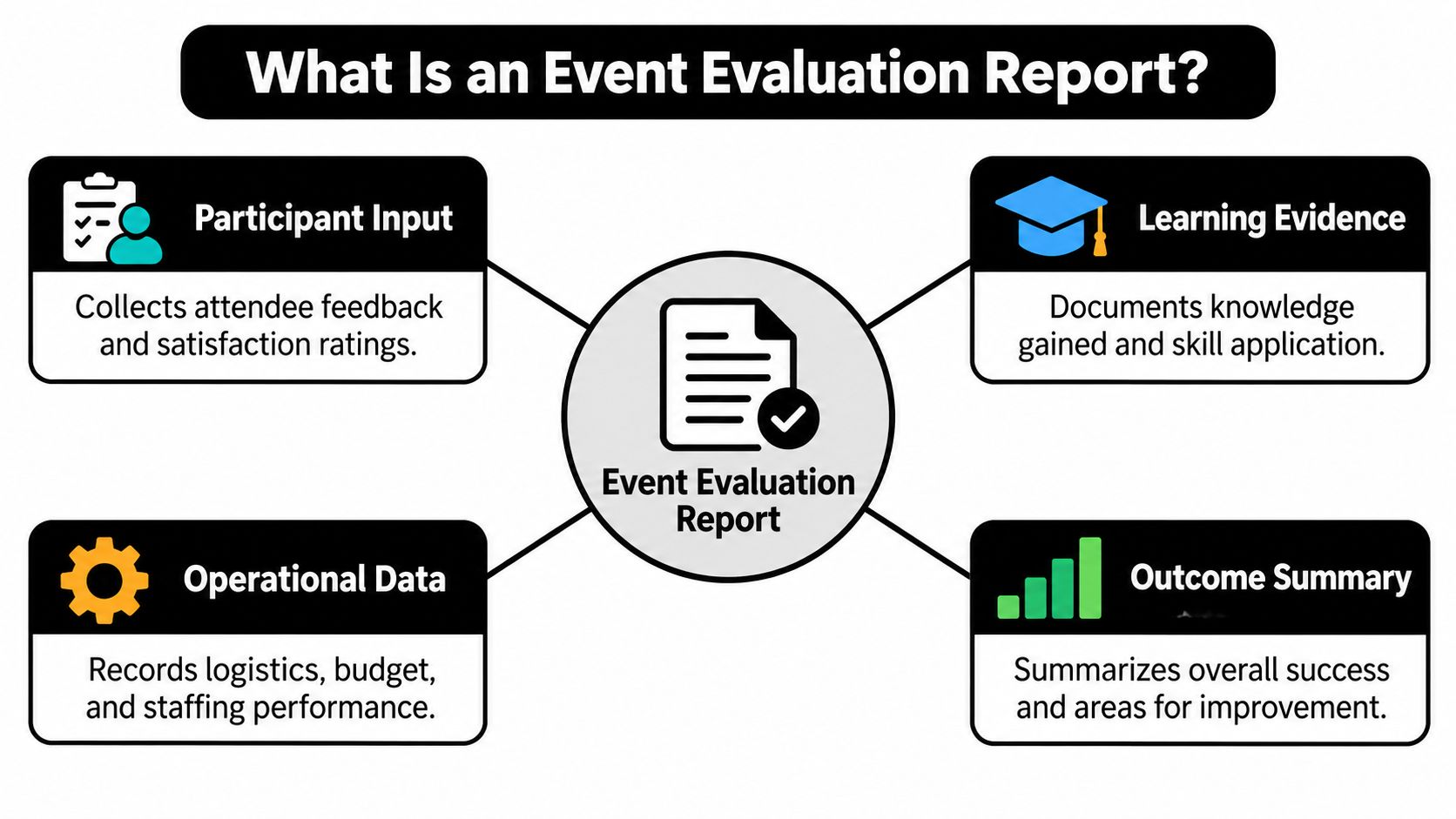
That's why an event evaluation report isn't a transcript of every comment or a page of disconnected metrics. It's a defensible account of how the event performed, what the evidence does and doesn't show, and what the team intends to do with the findings.
The Standard Sections of an Event Evaluation Report Example
A report is easier to assess when its sections follow a clear sequence. Each part answers a different question, and the reader should be able to trace a conclusion back to the evidence behind it.
Begin with the event and its objectives
The executive summary gives a concise account of the main findings and the report's overall conclusions. It should not make claims that the detailed results can't support. The event and objectives overview then identifies the program, its intended audience, and the goals against which the team evaluated it. Without that context, a reader can't tell whether a result is meaningful.
Make the methodology visible
The methodology explains how the team collected and reviewed the evidence. It should identify the eligible participant group, collection methods, survey timing, and any other relevant conditions. A weak report may show polished charts without explaining who could respond or how the team interpreted incomplete data. That makes the numbers difficult to judge.
The scoping review of continuing medical education conference evaluations highlights why these details matter. Among the 83 studies it reviewed, 74, or 89%, collected direct attendee input through surveys or interviews, but only 57% adequately reported participant response rates. A report that omits its response information leaves readers with less basis for judging how representative the findings are.
Present findings in context
The findings should be organized around the event's objectives or major program areas, rather than presented as an undifferentiated list of scores. An outcomes section can then distinguish learning evidence from reactions and logistical feedback.
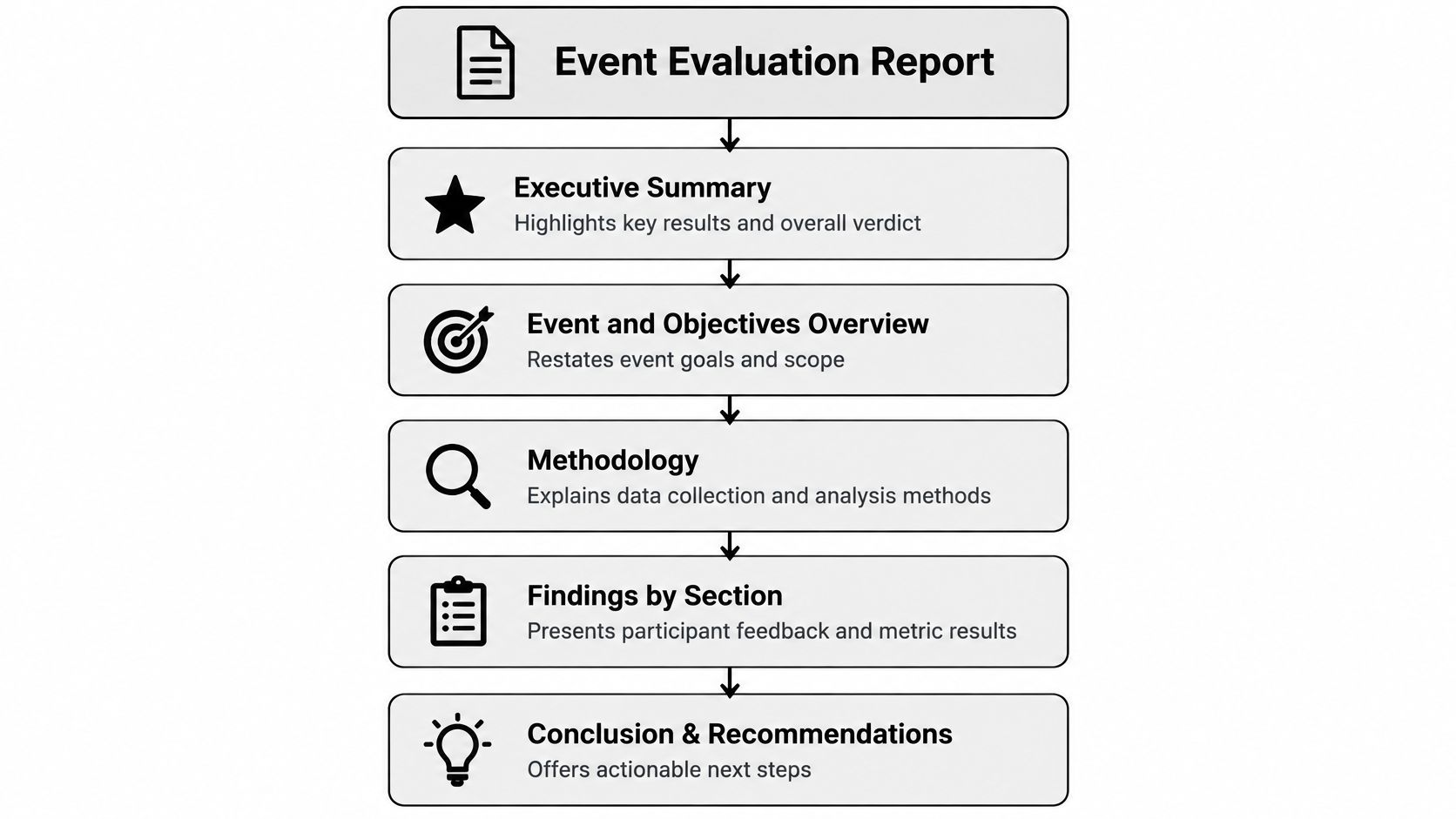
Finish with response and representation notes, recommendations, and supporting appendices. The recommendations should follow from the findings, while appendices can preserve survey instruments, detailed results, and evaluation materials. If the conclusion says “improve the speaker experience,” the report should identify which evidence led to that recommendation. That traceability helps readers separate a considered improvement from a general impression.
How to Read Response Rate, Timing, and Representativeness
Read the methodology before the satisfaction chart. A response rate is the proportion of the eligible or invited group that completed the evaluation, and its meaning depends on how the report defines that group. To interpret the result, look for the number invited, number responding, response rate, survey timing, and collection method.
A response rate doesn't prove that respondents represent everyone who attended. People who complete a survey may have different experiences from those who don't. That's nonresponse bias: the possibility that the missing answers would have changed how the results look. A report can't eliminate that possibility by presenting a percentage, but it can help readers judge it by explaining who was invited and who responded.
Collection mode matters too. In research on 84 web-based surveys conducted over 33 months, meeting and conference evaluations averaged a 57% response rate, compared with 40% for needs assessments, 52% for output or impact evaluations, and 62% for ballots. A separate review of event-management survey methods reported an average of 56% face-to-face versus 33% online across eight surveys. These figures come from the report on survey response patterns, and they're reference points, not guaranteed targets for an individual event.
A real conference example in that report shows why the denominator should be explicit. An international conference sent 4,200 invitations and received 826 completed surveys, a 20% response rate after one reminder. The reported rate alone doesn't explain the results, but the invitation count, completions, and reminder information let readers understand how it was calculated.
Timing adds another layer. Feedback collected immediately after a session captures a near-term reaction; later follow-up can ask whether participants applied what they learned. If a report gives scores without dates or timing, readers can't tell which kind of response those scores reflect.
Practical rule: If the report hides the invitation count, respondent count, survey timing, or collection mode, treat its satisfaction scores as incomplete evidence.
Educational Outcomes and Credit Compliance Metrics
For continuing education, a high satisfaction score can't answer the central educational question: did participants demonstrate learning or a relevant change in competence, performance, or practice? ACCME requires each activity, including live activities, to include an evaluation component that assesses individual learner competence, performance, and/or impact on patient outcomes. Its CME for MOC Evaluation Guide also makes clear that providers should retain the evaluation mechanism and explain how they used it, since those materials may be requested during review.
A report can connect learning objectives to evidence through knowledge checks, confidence measures, stated intent to apply learning, or follow-up about actual application. These measures answer different questions. A post-session knowledge check can provide evidence about what learners know; a confidence rating describes how prepared they feel; intended practice change records what they say they plan to do. Where feasible, delayed follow-up can ask whether application occurred.
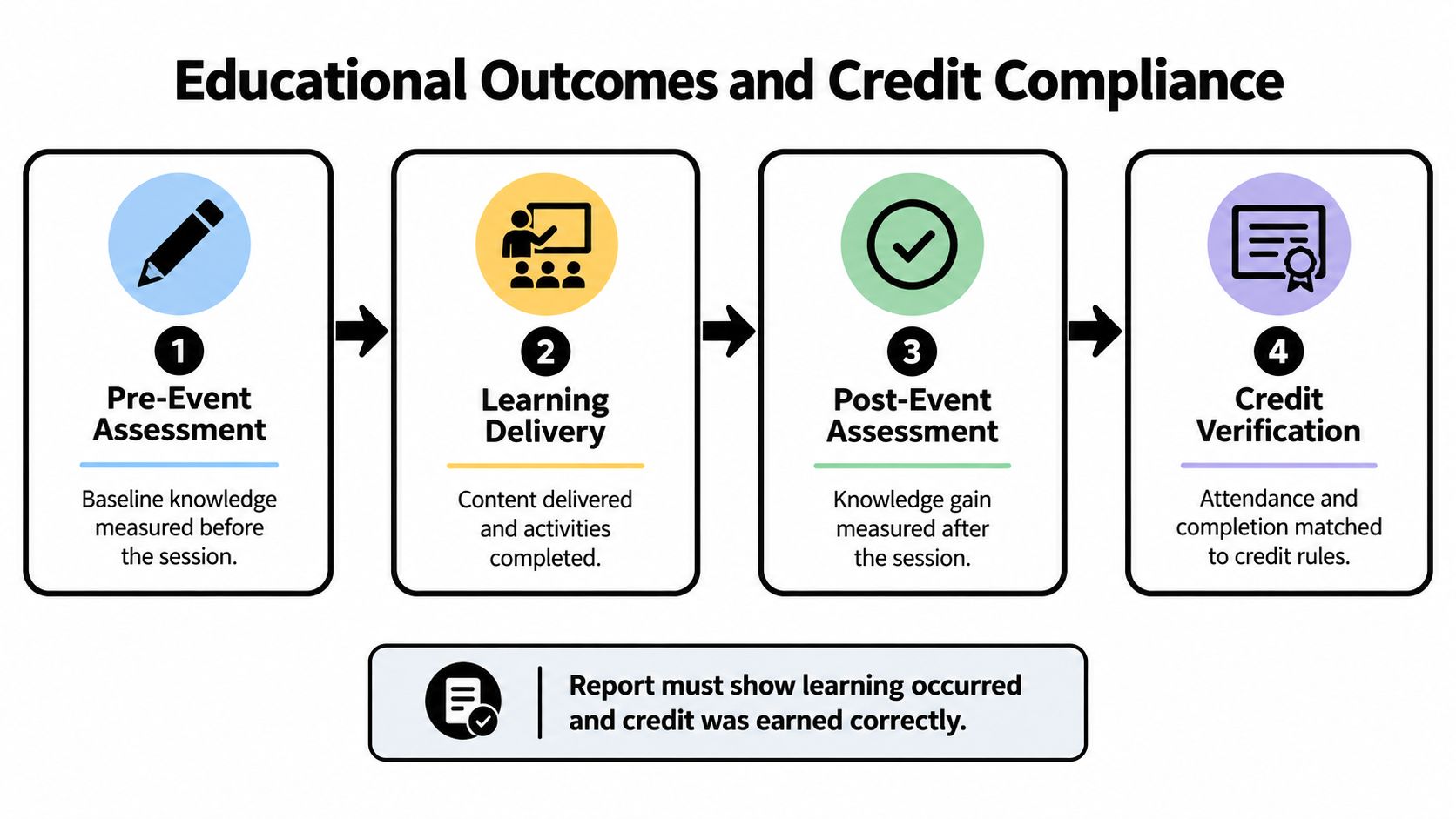
Credit reporting adds a separate requirement when an activity awards Maintenance of Certification credit. ACCME describes a participation threshold as the minimum a learner must meet before credit is reported. The provider must tell learners that threshold in advance and document the evaluation tool, how the evaluation was conducted, and how feedback was provided. The report should state the threshold, identify how many or what proportion of learners met it, and explain how completion data were handled. Evaluation and feedback must be completed before completion credit is awarded, according to the CME for MOC Program Guide.
An average rating and a credit decision are not substitutes for one another. A report should show the line from objectives to assessment evidence to credit handling. For program teams coordinating those records, continuing education credit administration is one component to consider alongside the evaluation method itself.
Satisfaction Scores Versus Learning Evidence in the Report
A satisfaction-only report is easy to scan, but it can leave the most important educational question unanswered. An outcome-linked report still records participants' reactions; it also connects findings to objectives and shows what evidence the team collected about learning.
| Report Element | Satisfaction-Only Report | Outcome-Linked Report |
|---|---|---|
| Overall experience | Summarizes ratings and comments | Reports reactions alongside learning measures |
| Program objectives | May list goals without assessing them | Connects each goal to relevant evidence |
| Learning | Assumes positive feedback signals success | Reports what participants demonstrated or said they learned |
| Follow-up | May rely on intent to return | Can include later checks on application where feasible |
| Interpretation | Offers a broad verdict | Explains what findings support and what remains uncertain |
The distinction matters in practice. In a 2025 University of Birmingham festival evaluation, 96% of respondents felt more connected or somewhat more connected, yet 67% reported learning something new and 33% reported no new learning. The report presents measures of connection and learning that don't tell the same story. Positive experience and learning are related questions, but one isn't proof of the other.
That's especially important for scientific and medical events, where education is often part of the program's purpose. If a report shows high satisfaction but weaker evidence of learning, a reader should ask whether the objectives were assessed with an appropriate method and whether the results justify the report's conclusion. Don't discard the positive reaction data; interpret it alongside the outcomes it can't measure.
Teams reviewing how their feedback processes and findings are organized can explore event evaluation workflows. The essential test is whether the report makes it clear what participants thought, what they learned, and what evidence supports each conclusion.
Turning Findings Into an Action Plan for the Next Event
Recommendations without owners are wishes, not an action plan. A useful report assigns responsibility for each change, gives the team a deadline, and identifies how the next evaluation will show whether the change helped.
Start by translating findings into decisions. If participants rate a session poorly, the education lead might follow up with the faculty member and review the session against its objectives. If a group responds less often than others, the coordinator can review survey access, timing, language, and outreach. If learners miss a credit threshold, the team should examine whether the threshold was communicated clearly and whether the evaluation process captured completion accurately.
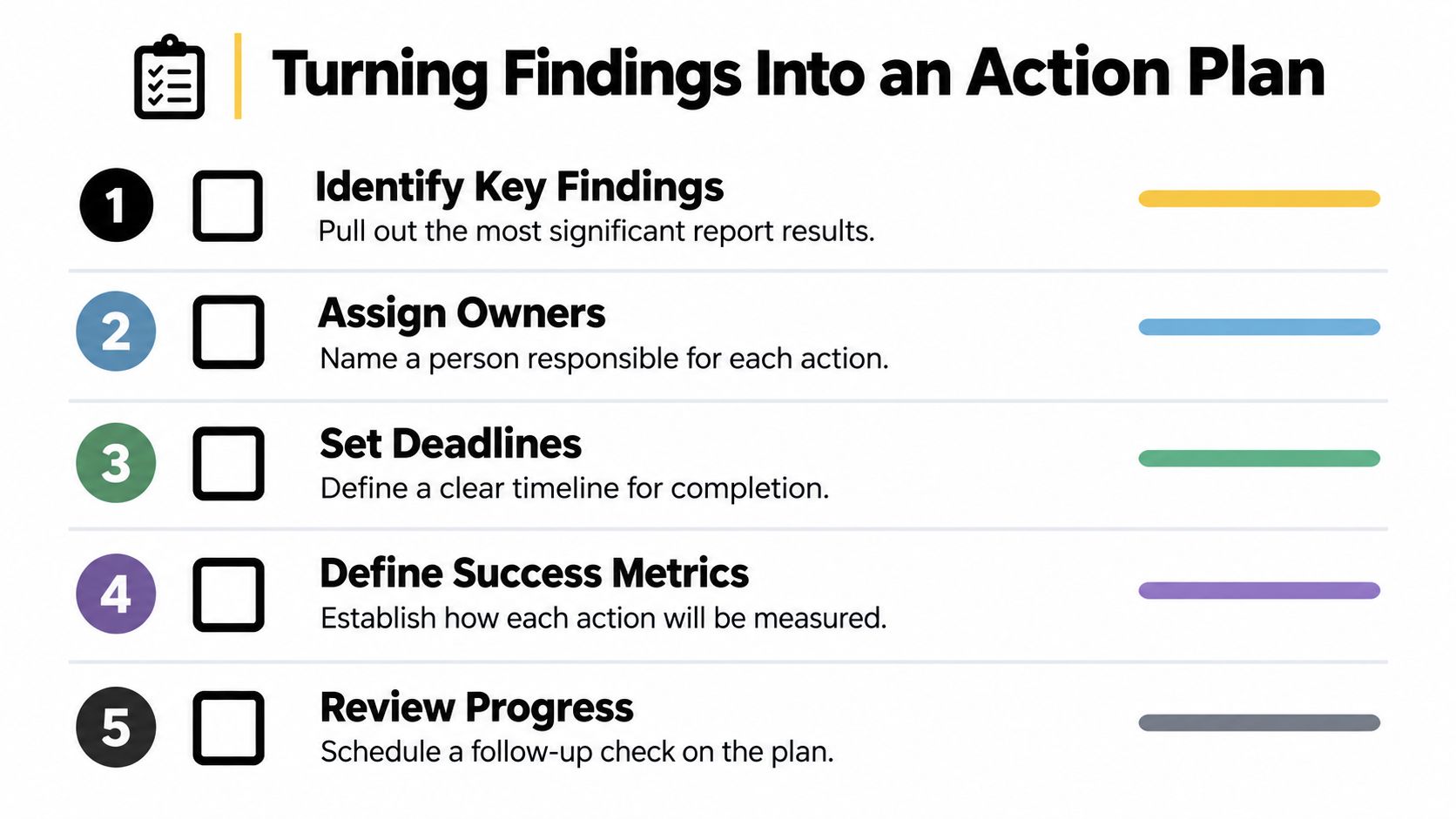
A practical action-plan entry should answer four questions:
- What did the report find? State the result precisely and connect it to the relevant objective or process.
- Who owns the response? Name the staff member, faculty lead, or committee responsible.
- When will the team act? Record a deadline that fits the program's planning cycle.
- How will the team check progress? Specify what the next event's evaluation or operational review will measure.
Keep the evaluation tools and methods with the report. ACCME may request those materials during review, so the final document should make it possible to find the instruments and understand how the team administered them. An audit-ready conclusion records the finding, response, owner, deadline, and follow-up measure in one place.
The point isn't to promise that every recommendation will produce a particular result. It's to make the next decision traceable. When planners revisit the change and its measure, they can decide whether to keep, revise, or drop it based on new evidence.
Common Questions About Event Evaluation Report Examples
Where can I find a useful example to model? Choose a report that shows its objectives, methodology, learning evidence, and recommendations, not only satisfaction charts. Use its structure as a starting point, then adapt it to your event's learning and credit requirements.
What's the difference between formative and summative evaluation? A formative report captures feedback while the event is underway, so staff can respond during delivery. A summative report reviews the event after it ends and informs future planning.
What should software support? Look for evaluation collection, configurable questions, outcome assessment, reporting, and any credit records or certificates your program needs. Confirm that the workflow fits how your team delivers education.
How should hybrid or multi-track reports handle different audiences? Report participation and responses separately where the groups experience different formats or sessions. Explain the comparison clearly, and avoid treating one group's results as representative of everyone.
Planstone provides configurable conference and continuing-education management software that connects evaluations with credit administration and other education workflows. If you're reviewing how your team collects feedback and documents outcomes, visit Planstone to explore whether its configurable tools fit your program.