

Does a formal border, a seal, and a signature turn attendance into continuing-education credit? It doesn't. A participation certificate format is a record that a named person took part in a named activity on stated dates. It claims nothing more unless you add a credit rule that an accreditor has formally authorized.
Staff get into trouble when the file looks finished and the fields are thin. A handsome PDF can still fail a review if the unit is missing, the date was written by hand, or the status line implies CME that was never awarded. The practical fix is a field list you can check, wording that states the limit, and a page a reviewer can read in one pass.
Use the standard below when you brief education staff. It covers required lines, the choice among three certificate types, unit wording, page placement, and the check you run before a batch goes out.
Table of Contents
- Standard Fields Every Participation Certificate Needs
- Choosing Between Participation, Attendance and Credit Certificates
- Accreditor Requirements That Change the Format
- Credit Units and Wording That Stays Unambiguous
- Attendee, Event and Session Details in Practice
- Certificate Layout and Where Each Element Sits
- Verification, Retention and Accessible Digital Delivery
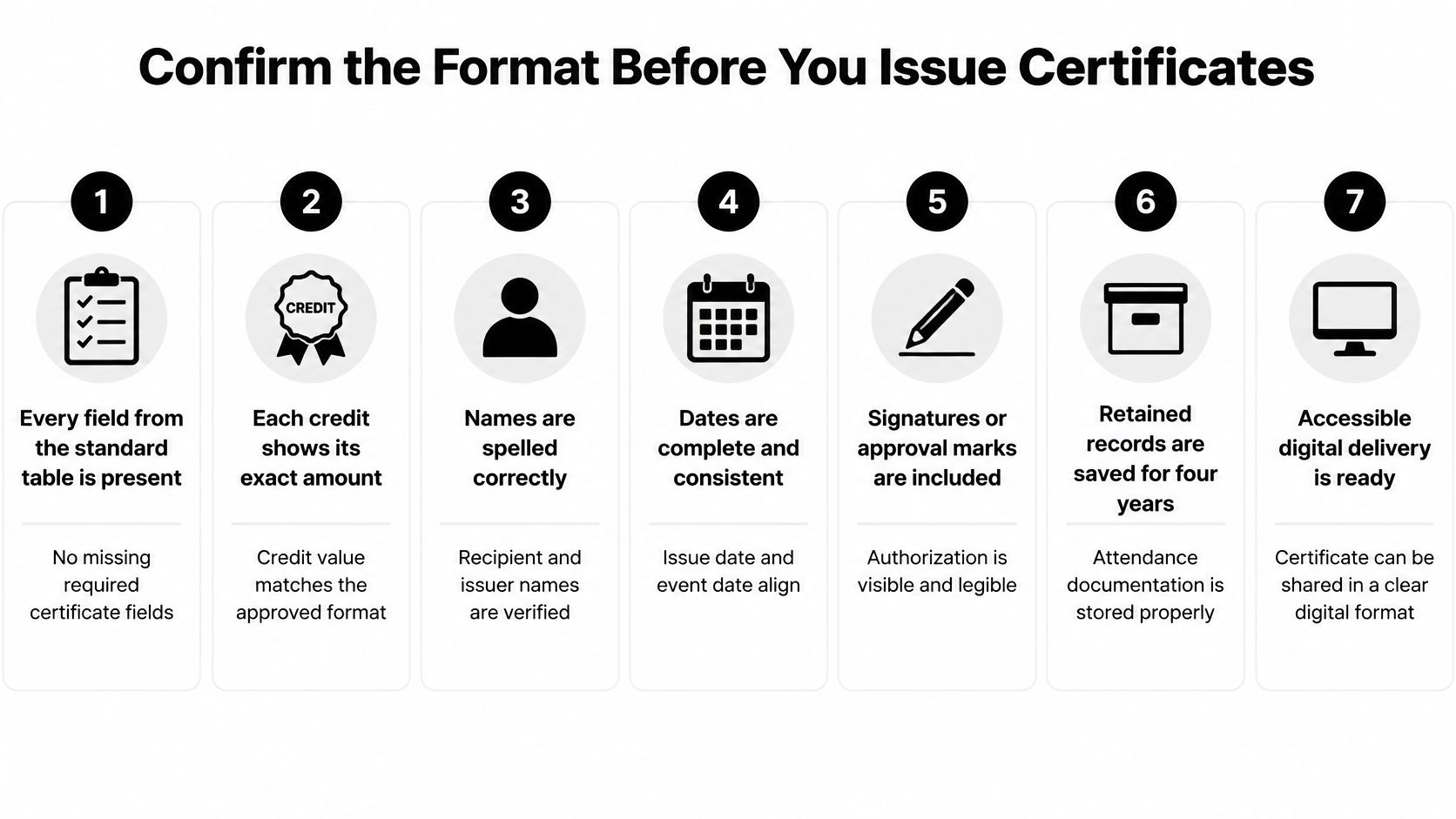
- Confirm the Format Before You Issue Certificates
- Frequently Asked Questions About Participation Certificate Format
Standard Fields Every Participation Certificate Needs
A participation certificate confirms that a named person took part in a named activity on stated dates. It claims nothing further unless you attach a credit rule. Treat the page as a learner record, not as a poster.
The Association of Certified Fraud Examiners requires a certificate of completion to include the attendee's name, the course description, the sponsoring organization, the number of CPE credits, and the course date. That set is the floor for professional-credit documentation. A generic line such as "participated in training" is too vague, because a reviewer cannot match the person, the sponsor, the credit, or the date.
Show each value exactly, or mark the cell Pending when you do not know it yet. Never invent an approval code to fill white space.
Field list you can check before printing
| Field | What to Show | Example |
|---|---|---|
| Recipient name | Name as registered, without nicknames | Maria L. Chen |
| Activity title | Official title from the program guide | Annual Scientific Session on Respiratory Care |
| Session ID | Identifier that matches the program record | SES-RC-14 |
| Activity dates | Full month name and year | 14-15 March 2026 |
| Provider | Legal organization name and city | Example Medical Association, Boston |
| Certificate ID | Unique identifier that is never reused | CERT-2026-10482 |
| Credit amount | Number with its unit | 2.0 contact hours |
| Approval code | Code issued by the accreditor, if one applies | CE-44821, or Pending |
| Signatory | Printed name, title and signature | Dr. J. Patel, Program Chair |
| Verification | Readable URL printed beside the QR code | Typed address, not QR code alone |
The same discipline shows up outside conferences. A certification for language teacher trainees holds up only when it names the person, the course, and the outcome a later employer can check.
Compare the draft with the table and mark every missing field before you print. Later rules cover each line. Leave an accreditor-only field off the page until that body requires it.
Choosing Between Participation, Attendance and Credit Certificates
A participation certificate confirms involvement only. It does not prove learning, a finished assessment, or eligibility for professional credit. A formal look must not imply CME or CEU status.
The continuing-education attendance guidance from Accessibility Online draws that limit. Some policies require verifiable attendance for a defined minimum, for example 75 minutes, and they name the identity or attendance method you may use. Extra claims can reduce trust. Do not print CME or CEU eligibility because the document looks official.
Decision rules from least to most demanding
| Certificate Type | Issue When | Status Statement | Credit Shown |
|---|---|---|---|
| Participation certificate | Attendance recorded and no duration or credit rule applies | This certificate confirms participation only | No |
| Attendance certificate | Minimum duration or delivery mode must be verified | Attendance verified for the stated duration | Duration only |
| Credit certificate | Accreditor conditions are met and a unit is awarded | Credit awarded under the named accreditor approval | Yes, with unit and amount |
Participation certificate: Issue this when attendance is on the record and no duration rule or credit rule applies. The status line should read "This certificate confirms participation only."
Attendance certificate: Issue this when you must verify a minimum duration. Name the method, such as a badge scan or a signed roster, and show the duration you verified. Do not convert that duration into a credit name.
Credit certificate: Issue this only after the accreditor's conditions are met, such as an attendance threshold, a completed assessment, or a submitted evaluation. Then show credit type, amount, accrediting body, and certificate ID as separate fields.
If attendance data changes, issue a new certificate ID and mark the earlier certificate superseded. Do not overwrite the original. For how education teams structure these records, see continuing education certificate programs. Name which of the three types this activity qualifies for, then apply that type's rules.
Accreditor Requirements That Change the Format
One master template with conditional fields beats a new design for every regulator. Show a sponsor reference number only when that sponsor issues one. Show an expiration date only when the accreditor sets one. Show delivery mode whenever a delivery-mode rule covers the activity. If an approval code is not granted yet, print Pending.
The Association of Biomedical Investigators and Inspectors requires the participant's name, pre-printed attendance dates, activity title, number of contact hours, CE sponsor, sponsor-issued CE reference number, and the activity expiration date. Handwritten dates are not accepted. Pull dates from the event record.
What each source adds
| Source | Required Fields or Conditions | Format or Retention Rule |
|---|---|---|
| Washington State training template | Participant name, training title, training hours, approval code, instructor printed name and signature, training entity, program code, training dates | Used as a practical minimum for audits and renewal |
| Association of Certified Fraud Examiners CPE | Attendee name, course description, sponsoring organization, CPE credits, course date | Generic participated statements are not sufficient |
| Association of Biomedical Investigators and Inspectors | Participant name, pre-printed attendance dates, activity title, contact hours, sponsor, sponsor reference number, expiration date | Handwritten dates are not accepted |
| Georgia continuing education rules | Certificate of attendance stating synchronous or asynchronous, provider-signed statement, or official transcript | Delivery mode must be stated, except for independent study |
Georgia's continuing education rules say that, except for independent study, acceptable documentation is a certificate of attendance verifying whether the activity was synchronous or asynchronous, a provider-signed statement, or an official transcript. Those programs need a delivery-mode field on the certificate.
Ask before you lock the design: Request the accreditor's current template. Rules change, and the source's own wording outranks any summary on this page.
Tick every mandatory field against the draft. Remove a field the source does not require. How long you keep the file is separate from what the certificate says.
Credit Units and Wording That Stays Unambiguous
A number on a certificate means little until its unit is printed beside it. A bare 2.0 could be hours, credits, or a typo, and a reviewer at a licensing board will not guess in your favor. The number and its unit always travel together.
Units staff actually print
| Unit | Set By | Conversion | Display Example |
|---|---|---|---|
| Contact hour | Program sponsor and schedule | Basis for CEU conversion | 2.0 contact hours |
| IACET CEU | International Association for Continuing Education and Training | 1 CEU = 10 contact hours; 0.1 CEU minimum per segment | 0.20 IACET CEU |
| CPE credit | Professional certifying body | Set by the sponsor and the profession | 2.0 CPE credits |
| AMA PRA Category 1 Credit | Accredited CME provider | Set by the accreditor | 1.00 AMA PRA Category 1 Credit |
| Board-approved hour | Licensing board | Set by the board | 3.0 hours approved by the board |
The International Association for Continuing Education and Training defines the CEU conversion: 10 contact hours equal 1 CEU, and 0.1 CEU is the minimum issuable per segment. When that unit is authorized, 2.0 contact hours prints as 0.20 IACET CEU. Show contact hours to one decimal place and CEUs to two, so the decimal format itself signals which unit you used.
Print the unit in the same phrase as the number, every time.
Remember what a participation certificate can prove: attendance only. If no accreditor has approved the activity, print contact hours or instructional time and stop there. Do not borrow a credit name the activity has not earned. Contact hours are easy to check against the schedule, while CEUs need an accredited provider and written completion criteria. That is the trade-off.
Place the credit line directly under the activity title so the unit is the next thing a reviewer sees after the session name. Answer one question first: which accreditor's rules apply to this activity? The notes on how to offer continuing education credits walk through that choice before any wording is locked.
Attendee, Event and Session Details in Practice
Fill the identifying lines in the order they appear, and take each value from the registration or program file.
- Recipient name: Use the name exactly as registered. Skip nicknames. Add credentials only when the program requires them. If registration says Maria L. Chen, do not print MARIA CHEN or Maria Chen, RN.
- Event title and session: Copy the official title from the program guide. On a multi-session meeting, put the session title and the session ID on separate lines. "Airway Update" is not a stand-in for "Airway Management Update."
- Dates: Spell the month in full, as in 14-15 March 2026, and print the dates from the event record. For asynchronous or multi-day access, show the first date and the last date the learner could enter the activity.
- Delivery mode: State synchronous or asynchronous, and in person or virtual, with the same wording on every certificate in the batch.
- Provider: Use the legal organization name and the city.
A virtual session filled in
Say Example Medical Association, Boston, runs a live online session inside its annual meeting.
- Recipient: Maria L. Chen
- Activity: Annual Scientific Session on Respiratory Care
- Session: Airway Management Update, SES-RC-14
- Dates: 14-15 March 2026
- Mode: Synchronous, virtual
- Provider: Example Medical Association, Boston
Mistakes that make the record disagree
Abbreviated titles, mixed date styles such as 3/14/26 beside 14 March 2026, names forced into capitals, and a blank delivery mode all make the certificate argue with the registration file.
Compare every field with the registration record and the program record before you issue the certificate. If they disagree, fix the source data first, then the certificate.
Certificate Layout and Where Each Element Sits
Read the page from top to bottom and give each band one job.
The header band holds the issuer logo and the organization name. Under it, the certificate title is the largest type on the page. One status line states what the certificate confirms, and it stops there.
The recipient name is the dominant element. The activity title and a short description sit in a centered block beneath the name. The credit line goes directly under that title, and the date line follows it.

Two signature blocks sit side by side near the bottom. Each has a signature line, then the signatory's printed name and role. The footer carries the certificate ID, a readable verification URL, a QR code at least 2 cm square, and the provider's contact details. Keep any policy note to one line so the ID stays readable on a phone.
Spacing and type
- Margins: At least 15 mm on every edge so nothing clips when the PDF is printed.
- Type: One typeface family and no more than three sizes.
- Contrast: Body text at least 4.5:1 against the background.
- Live text: Store words as selectable text, not as a flattened picture of the certificate.
For a 2026 association conference, the order is header, title, status line, Maria L. Chen, session title, 2.0 contact hours, 14-15 March 2026, two signatures, then the footer. A reader should find the name first, then the activity, then the credit, without reading the footer.
Verification, Retention and Accessible Digital Delivery
A certificate is also audit evidence. Maryland's regulations require license or certificate holders to retain continuing-education attendance documentation for the succeeding four years for possible inspection, and certificates of participation are among those records.
Match a later review to the event with durable identifiers: provider name, activity title, date, hours or credits, participant name, and a unique certificate ID. Store those facts apart from the branded layout, so a logo change does not rewrite history.

How someone checks the document
Print a unique ID and a readable verification URL beside the QR code. The verification page should show whether that ID is valid or revoked. A QR code alone fails when the recipient has no phone or the camera will not scan. The typed address is the backup.
W3C Verifiable Credentials 2.0, published in 2025, supports cryptographically secure, privacy-respecting, machine-verifiable credentials, so a verifier can check that claims came from the issuer and were not altered. Limit personal data to what that check needs.
A file people can actually open
Produce a tagged PDF with selectable text, a document title, language metadata, and a logical reading order. Do not signal status by color alone. Test the file with a screen reader before release, and offer a machine-readable export beside the PDF. A filing habit for these files is covered in recordkeeping for education programs.
Every reissue creates a logged event. The original record is never replaced without notice.
Confirm the Format Before You Issue Certificates
Release the first batch only after a go or no-go pass.
- Every standard field is present. Nothing the field list requires is blank.
- Each credit shows its number with its unit. There is no bare figure.
- The status statement matches the certificate type. Participation, attendance, or credit, and not a mix.
- The delivery mode is stated. Synchronous or asynchronous, and in person or virtual.
- The certificate ID, verification URL, and QR code all appear.
- The PDF is tagged and has passed a screen-reader test.
- The record is stored for the retention period the accreditor requires.
Issue one test certificate to a test registrant. Compare every field with the registration record and the program record. If any field differs, fix the template before the batch goes out.
If an event platform produces the files, confirm before launch that its templates can hold every required field, display the status statement, and keep a log of reissues.
A template that cannot store a required field will not become compliant after the event.
Our credit tracking module collects participant feedback, applies credit rules, and makes certificates available to attendees. We configure the platform to each program's review criteria, faculty requirements, and credit rules. Attendees get a responsive web experience to look up sessions, open presentation materials, complete evaluations, and access their credits.
Send the finished template to the accreditor or sponsor and ask them to confirm it against current requirements before the event date.
Frequently Asked Questions About Participation Certificate Format
Is a participation certificate the same as a certificate of completion?
No. A participation certificate confirms involvement only. A completion certificate usually depends on a finishing criterion. The status statement must say which one you issued.
Can a participation certificate show CE credit?
Only when the accreditor's conditions are met and the credit is awarded. Otherwise print contact hours or instructional time.
Is a QR code enough for verification?
No. Recipients without a working scanner still need the typed verification address printed beside it.
Does every certificate need a signature?
Not by default. The Association of Certified Fraud Examiners minimum does not list a signature. Washington State's training template does require a printed name and signature. Check the list that governs your activity.
Can I correct a certificate after it is issued?
Yes. Reissue it with a new certificate ID, mark the earlier certificate superseded, and never overwrite the original record.
How long must the records be kept?
Keep them for the retention period that governs your activity. Maryland requires license or certificate holders to retain continuing-education attendance documentation, including certificates of participation, for the succeeding four years.
Planstone connects participant evaluations, program-specific credit rules, and the certificates attendees receive after a conference or course. If your staff need a participation certificate format that states its limits and prints credit only when an accreditor's rule applies, we can configure that workflow around your review criteria and credit rules. Visit Planstone to see how certificate issuance fits the rest of your education administration.