
Picture the Monday morning after your annual meeting. Registration closed with a record crowd, the program committee is still debating whether the two-track Thursday format worked, and the evaluation results land as a single row: 4.2 out of 5, 187 responses. Someone asks whether the new venue helped. Nobody can answer, because 4.2 is a headline, not a diagnosis.
That gap is usually a question-design problem rather than a data problem. Surveys that produce it ask attendees to rate a feeling and never ask what created the feeling. The fix is to choose questions by the decision each one informs. Program design, accreditation, vendor contracts, and speaker development each need different evidence, and the strongest post event survey questions arrive in pairs: a rating that compares year over year, plus an open response or a credit record that explains the rating.
The ten below are the ones I would defend in front of an accreditation reviewer or a board finance committee. Each entry names what the question reveals, where it misleads, and how to act on the answer. If participation is your real bottleneck, raising event survey response rates is worth solving first, because a brilliant question nobody answers is decoration.
Table of Contents
- 1. Overall Event Satisfaction Rating
- 2. Likelihood to Recommend the Event (Net Promoter Score)
- 3. Achievement of Stated Learning Objectives
- 4. Relevance to Professional Practice
- 5. Speaker and Presenter Effectiveness
- 6. Intent to Apply Learning or Change Practice
- 7. Logistics and Venue Experience
- 8. Open-Ended Question on Most Valuable Element
- 9. Session-Level Evaluation for Credit Eligibility
- 10. Likelihood to Attend Future Events and Topics Interest
- How the ten post-event survey questions compare by format, purpose, and limitation
- Turning Survey Answers Into Decisions for Your Next Event
1. Overall Event Satisfaction Rating
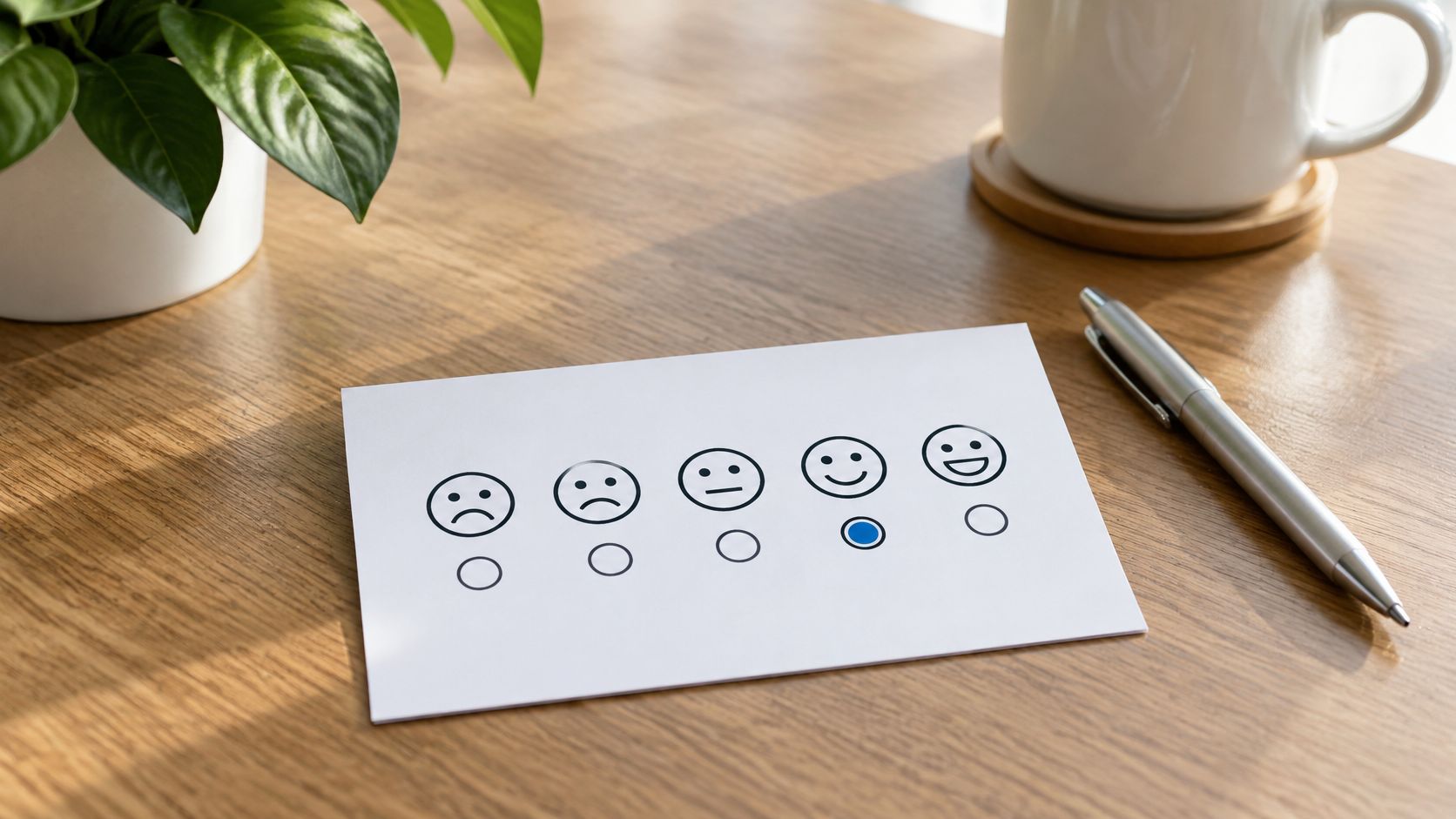
The question is plain: "How satisfied were you with the conference overall?", answered on a five or seven point scale from Very dissatisfied to Very satisfied. It anchors the entire set. Keep the wording identical across years and it becomes the one number your board, your sponsors, and your accreditation file all read the same way.
Treat it as a comparison, not a verdict. The survey methods guidance from the University of Oklahoma identifies 15–20% as a typical response rate for a mail survey even after two or three reminders, which means a survey sent to 10,000 participants might produce only about 1,500–2,000 responses. Attendees with an unusually good or bad experience are more motivated to reply than the indifferent middle, so your average is skewed toward the most opinionated people in the room.
What the score can and cannot tell you
A medical association that asks this item at the end of its annual meeting learns something useful only when it compares the mean against the prior three years. The direction of travel tells it whether shorter sessions, a new venue, or a shifted keynote slot held up. The score never tells it which change did the work.
- Freeze the wording. Any edit to the scale or the prompt breaks the year-over-year comparison.
- Follow with one open question. "What most influenced your rating?" turns a number into a cause.
- Put it first on the form. Respondents who abandon halfway still answer the item you care about most.
- Reuse the same core item across programs and pull the comparison into an event evaluation report instead of rebuilding the chart every cycle.
2. Likelihood to Recommend the Event (Net Promoter Score)
"How likely are you to recommend this event to a colleague?" on a 0 to 10 scale. Scores of 9 or 10 are promoters, 7 or 8 are passives, and 0 to 6 are detractors. Net Promoter Score is the percentage of promoters minus the percentage of detractors, which gives you an advocacy number built to separate enthusiasm from tolerance.
The format matters as much as the metric. Survey item guidance compiled for Western Washington University's assessment program warns that agreement scales invite acquiescence, meaning respondents drift toward agreeing with a statement regardless of their actual view, and that the risk is strongest with agree/disagree, true/false, and yes/no formats. So skip "Do you agree this event was worth attending?" and ask for a number instead.
The same guidance flags double-barreled items. "How satisfied were you with the conference content and networking?" measures two experiences at once and explains neither.
Use case: a scientific society running three annual conferences tracks NPS by meeting, then crosses it with registration data to see which attendee segments arrive in groups and which come alone. That comparison is what tells the marketing team where advocacy is strongest.
- Ask why. One follow-up, "What drove your score?", is what makes detractors fixable.
- Compare like with like. Members and nonmembers, first-timers and regulars, in-person and virtual attendees each carry their own baseline.
- Publish the count. A score from 40 respondents isn't the same claim as one from 400.
- Route detractors. Set survey routing so anyone scoring 0 to 6 gets a specific question about what went wrong.
3. Achievement of Stated Learning Objectives
Accreditation reviewers don't read satisfaction averages. They read this: "To what extent did this activity meet the stated learning objectives?" The item connects a conference to the educational purpose it was approved for, because accreditors assess whether an activity was designed to change competence, performance, or patient outcomes.
Make the objectives do the work
Write objectives in measurable language before the program is locked, then build the question from them. A session with three published objectives should carry three ratings, not one general "was this educational?" item that tells you nothing you can act on.
Example: a continuing medical education provider lists three objectives per session. When one objective scores low across a hundred respondents, the finding isn't "the speaker was weak". It's "the anticoagulant dosing objective didn't land", and the fix is content, not charisma.
Length discipline comes from completion data. In a survey completion-time analysis covering approximately 100,000 surveys, respondents spent about 75 seconds on the first question and roughly five minutes completing a 10-question survey, with abandonment increasing once a survey ran past seven to eight minutes (Great Event's post-event survey guidance). Three to five objective ratings fit inside that budget. Ten don't.
A low objective score is a content finding. A low satisfaction score is a mood. Only one of them tells a course director what to rewrite.
- Cap objectives at three to five so the form stays finishable.
- Store ratings beside credit records so you can prove every objective was assessed, not just delivered.
- Trigger review on a single objective, not only on the session mean.
- Apply program-specific evaluation rules so objective items appear only on activities that carry credit.
4. Relevance to Professional Practice
A session can be excellent and useless to half the room. "How relevant was this session to your current practice or role?" catches that mismatch faster than any satisfaction item, because relevance predicts whether anyone acts on the content afterward.
The trap is reading the aggregate. Response composition shifts by delivery mode. In a longitudinal study of five international Agriculture, Nutrition and Health Academy Week conferences, email feedback surveys drew 30–45% response for in-person events but only 20% for the virtual event, and the researchers cautioned that nonresponse bias remained possible because respondent demographics weren't captured (published in PMC). Report respondent composition beside every relevance figure: role, country, attendance mode, credit-eligible status. A healthy completion percentage can still misrepresent the room.
Use case: a scientific association finds a basic science session scores high on relevance among researchers and low among clinicians. That's not a content failure. It's a signal to split the session into two tracks next year and label each one clearly in the program.
- Ask about role early, so segmentation doesn't depend on guesswork later.
- Cross relevance with reason for attending. People who came for networking judge relevance differently from people who came for a protocol update.
- Filter by respondent profile to surface the gaps an average hides.
- Feed relevance data into the next call for abstracts so submitted work matches documented need.
5. Speaker and Presenter Effectiveness
Rate each presenter on clarity, organization, engagement, and use of time, per session. The value is separation. A weak speaker on a strong topic and a strong speaker on a stale topic require different responses, and a single "session quality" item can't tell them apart.
Example: a medical association sends every presenter an anonymized summary of ratings and comments within two weeks of the meeting. Turnaround beats polish here. A speaker who gets feedback before the next abstract cycle can change the delivery; one who gets it in April for a September program cannot.
Handle the free text carefully
Comments about one speaker in a small specialty can identify the commenter even with no name attached. Guidance on event planning surveys from SurveyMonkey notes that people are more candid when they believe responses are anonymous, which creates a conflict most programs never resolve: anonymity for candor versus confidential, linkable records for credit administration and accessibility follow-up.
Resolve it in writing. State what is collected, who reads comments, how long records are kept, and whether feedback affects certificates or future invitations. Then add a permission-based follow-up item, separate from the evaluation, so a presenter can request a conversation without exposing the respondent.
- Keep presenter items to four or five. Beyond that, ratings flatten and stop discriminating.
- Share feedback the same way every time so faculty trust the process.
- Track scores across several events before making an invitation decision.
- Link session evaluations to speaker records in Planstone's speaker management so feedback follows the presenter across programs.
6. Intent to Apply Learning or Change Practice
What will you do differently on Monday? Ask it directly: "What, if anything, will you change in your practice based on this activity?" This is a forward-looking measure that maps to the behavior level of the Kirkpatrick Model, where evaluation stops asking whether people liked the session and starts asking whether anything moves afterward.
Ask it as a structured choice plus an open field. Give respondents a checklist of plausible changes drawn from the session content, with an "other" box for anything you didn't anticipate. The checklist produces countable categories for outcome reporting; the open field catches the change you never designed for.
Example: a pharmacy education provider asks every participant to name one intended change, then reports the three most common themes to its accreditor as evidence of expected impact.
Follow the claim, don't trust it
Intent is not behavior. A three-month follow-up, three questions long, asking whether the change was implemented, what got in the way, and what support would have helped, converts a promise into evidence. Send it to the same list and match responses by participant record so you can compare intent against follow-through for each person.
- Build the change list from the objectives so intent lines up with what the session claimed to teach.
- Keep the follow-up short. It's a diagnostic, not a second evaluation.
- Report structured counts to accreditors and hold the open text for your own program review.
- Store intent responses with the credit record so outcome reporting doesn't require a second data pull.
7. Logistics and Venue Experience
Registration, check-in, room comfort, audiovisual quality, food service, signage, wayfinding. Rate them as a block and keep the block away from content items, so a great session doesn't soften a projector complaint and a bad lunch doesn't drag down a speaker's score.
This is the section that earns its keep in vendor conversations. "Attendees were unhappy" is unarguable. "Audiovisual scored lowest of all logistics items in the two rooms using portable projectors, across 63 respondents" is a conversation with a supplier who can fix something before renewal.
Example: a meeting planner sees consistently low audiovisual ratings concentrated in one breakout room and requests an equipment upgrade from the venue before the next meeting rather than reopening the whole contract.
Ask fewer, sharper items
Include a "not applicable" option for services some attendees never used: boxed lunch, shuttle, child care, the mobile app. Without it, people who skipped a service either skip the question, which shrinks your denominator unpredictably, or rate it neutral, which pulls the average toward the middle and hides the problem.
Contract rule: share the logistics summary with the venue and the AV provider before the renewal meeting, not after. Feedback that arrives with a signed contract is a complaint. Feedback that arrives three weeks earlier is a negotiating position.
- Separate logistics from learning. One section for the room, one for the program.
- Capture the room or service in the item, not just a score, so problems trace to a provider.
- Watch for one bad room skewing a venue's overall result.
- Coordinate with registration and AV partners so a fix can be scheduled, not just discussed.
8. Open-Ended Question on Most Valuable Element
One open question, optional, and the "why" is not negotiable: "What was the most valuable part of this event for you, and why?" Drop the why and you get a list of session titles you already have in the program.
Independent event-survey guidance recommends pairing rating scales, which compare cleanly across events, with open-ended prompts that surface specific improvement opportunities, and keeping the instrument to roughly 8 to 12 questions with an estimated two-minute completion time, a format associated with stronger participation; the same source reports a 10–20% conference response rate as common (Attendir's event survey guidance).
Example: a scientific society codes 400 open responses into themes and finds that case discussions and cross-track networking outperformed every named session. That finding goes into the sponsor report and the next call for proposals, and no rating item would have produced it.
Code the text, don't just read it
Review 30 responses, write down the themes you see, then apply those codes to the full set. You'll land on a handful of categories: content relevance, pacing, audiovisual quality, credit process friction. Report the counts next to the quotes.
- Ask one value question and one improvement question. Two opens, not six.
- Add a constrained prompt such as "What single change would most improve this session?" Generic comment boxes collect complaints; constraints collect fixes.
- Keep opens optional so respondents with nothing to add still finish the ratings.
- Report top-two-box percentages, medians, response counts, and completion rates per session and per audience segment rather than one event-wide average.
9. Session-Level Evaluation for Credit Eligibility
Attendance confirmation plus a rating per session, so credit is awarded accurately. Many accredited programs require a session-level evaluation before a certificate can be issued, which makes this item administrative rather than optional. It's also the item that lets you test sentiment against operational reality.
Methodological work on event surveys identifies four threats in pre/post comparisons: demographic differences between respondent waves, timing effects, anticipation effects, and differential misreporting or dropout. Current survey-industry benchmarking cited in that analysis puts post-event response at approximately 39%, which leaves most invitees silent (Cambridge University Press).
Compare sentiment with operational evidence
For a credit-bearing program you hold better evidence than a survey: session attendance scans, credit completion, certificate requests, help-desk contacts, disclosure completion. When satisfaction dips in a session that also shows low credit completion, you're looking at a real problem. When satisfaction dips and credits were completed at the usual rate, you're usually looking at a communication problem.
Example: a continuing education provider requires session evaluations before a participant can download a certificate for a multi-day course, which turns a partial survey response into near-full coverage for the sessions that carry credit.
- Set credit rules per session before the event, so the evaluation logic matches the accreditation approval.
- Keep confirmation to a checkbox and one rating.
- Build the credit workflow from rules, not templates, using Planstone's guide to offering continuing education credits as a checklist for what must exist before the form does.
- Report credit records beside survey results, never as a substitute for them.
10. Likelihood to Attend Future Events and Topics Interest
Two questions, both forward-looking: will you attend the next one, and which topics should we cover? The second does more work than most program committees expect, because it tests demand before you commit a room, a speaker fee, and an entire abstract cycle to a theme.
Ask it as a checkbox list of candidate topics plus an open field. A pure open field gives you elegant answers from twelve people. A pure checkbox gives you a ranked list of only the options you already thought of.
Then check the ranking against reality. Stated interest and next year's registrations are different measurements, and the gap between them is where planning errors live. A topic that ranks third in the survey but draws a half-empty room didn't have demand. It had curiosity.
Wait for the second wave
The first responses come from your most engaged attendees, and their preferences aren't the room's preferences. In a survey experiment with 11,177 invited participants, the initial invitation produced a 21.0% response rate and a reminder added 9.0% of responses, bringing the complete rate to 30.1% with 3,361 completed responses, which the authors describe as a rule of thumb that a reminder may add roughly half as many responses as the original invitation (published in PMC).
- Send one reminder before you read the topic rankings, not after you've acted on them.
- Compare stated interest with actual registrations the following year and keep that gap in the planning file.
- Ask about format, not just topic. An in-person workshop and a virtual series are different products with different costs.
- Hand the ranked list to the scientific program committee before the call for abstracts opens, and connect it to your abstract workflow so submissions align with demonstrated interest.
How the ten post-event survey questions compare by format, purpose, and limitation
| Item | Response Format | Main Use | Key Limitation |
|---|---|---|---|
| Overall Event Satisfaction Rating | 5- or 7-point Likert scale | Track overall satisfaction and compare events | Does not explain reasons for ratings |
| Likelihood to Recommend the Event (Net Promoter Score) | 0–10 rating scale | Measure attendee advocacy and loyalty | Score does not identify what drives advocacy |
| Achievement of Stated Learning Objectives | Rating for each learning objective | Assess whether educational objectives were met | Participants may not accurately judge achievement |
| Relevance to Professional Practice | Relevance rating | Assess fit with attendees' roles and needs | Does not measure delivery quality |
| Speaker and Presenter Effectiveness | Ratings by speaker or session | Evaluate presentation skills and identify coaching needs | Ratings may reflect personal preferences |
| Intent to Apply Learning or Change Practice | Open response or checklist | Capture intended behavior or practice changes | Stated intent does not guarantee actual change |
| Logistics and Venue Experience | Ratings across operational areas | Identify and improve event logistics | Attendees may not know who is responsible for problems |
| Open-Ended Question on Most Valuable Element | Free-text response | Discover valued event elements and unexpected strengths | Responses take time to analyze |
| Session-Level Evaluation for Credit Eligibility | Attendance confirmation and session ratings | Support credit eligibility and session-level feedback | Requires careful setup for each session |
| Likelihood to Attend Future Events and Topics Interest | Attendance-intent question and topic checklist or open response | Guide future event and program planning | Stated intent may not predict actual attendance |
Turning Survey Answers Into Decisions for Your Next Event
Ten questions aren't ten projects. Treated as a set, they form a chain: the overall rating sets the headline, the speaker and logistics items explain where the headline came from, the open-response item supplies the language for the board deck, and the learning-objective and credit items produce the evidence your accreditor expects. Break the chain and you're back to arguing about a number with no cause attached.
Read the results in the first two weeks
The event fades faster than most committees expect. Session details blur within days, and the anecdote that would explain a low presenter score disappears once the room has moved on. Block two hours in the calendar for the week after the event closes, before the next program deadline takes over.
Then assign one owner per finding with a date. Someone owns the audiovisual issue in that room. Someone owns the objective that scored low. Someone owns the topic list going into the call for abstracts. A findings document with no names on it is a diary entry.
Close the loop publicly. A short "you said, we changed" message to attendees does more for next year's response rate than any incentive, because it tells people the form isn't a one-way extraction exercise.
Keep the accreditation thread intact
For credit-bearing programs, the survey is only half the record. The other half is which participant attended which session and met which requirement. When those two records sit in separate systems, someone reconciles them by hand at the worst possible moment, usually the week certificates are due. If your evaluations, speaker records, disclosures, and credits live in different tools, Planstone's platform keeps those records in one configured system, with evaluation reports you can edit, share, and compare across events.
The logistics block does double duty as well. The same evidence that tells you a breakout room failed is the evidence you carry into the next site decision, so when you compare venues for fundraisers or annual meetings, you're choosing against measured problems rather than impressions.
If your team is running evaluations across a dozen sessions and reconciling them against speaker records and continuing education rules by hand, Planstone connects those workflows in one configured platform, with evaluation forms you design, credit rules you define, and reports you can pull by session or by program. Bring the questions you're asking now and the credit rules you administer, and we'll walk through how the platform would handle both.