
The most common advice about conference abstracts is to polish the prose until it sounds persuasive. That's the wrong first move. Reviewers need a compliant, traceable summary that shows what you studied, how you studied it, and what you found. A polished abstract that misses the required format or promises results it doesn't report can still fail.
A useful abstract submission for a conference example should therefore do more than provide a template. It should show what each part tells a reviewer, where the evidence belongs, and what information needs to travel with the abstract after acceptance.
Table of Contents
- Example Abstract With Annotations
- Annotated Sections of a Conference Abstract
- How Reviewers Score Each Submission
- Structured Fields Reviewers Expect in Methods and Results
- Disclosures, Identifiers and AI-Use Statements
- Writing Clearly Without Language Bias
- Check the Call Before You Submit
- Frequently Asked Questions About Abstract Submission
Example Abstract With Annotations
The example below uses a fictional pilot cohort. Every number is illustrative, not real study data. Keep the venue's own headings and word limit even if they differ from this format.
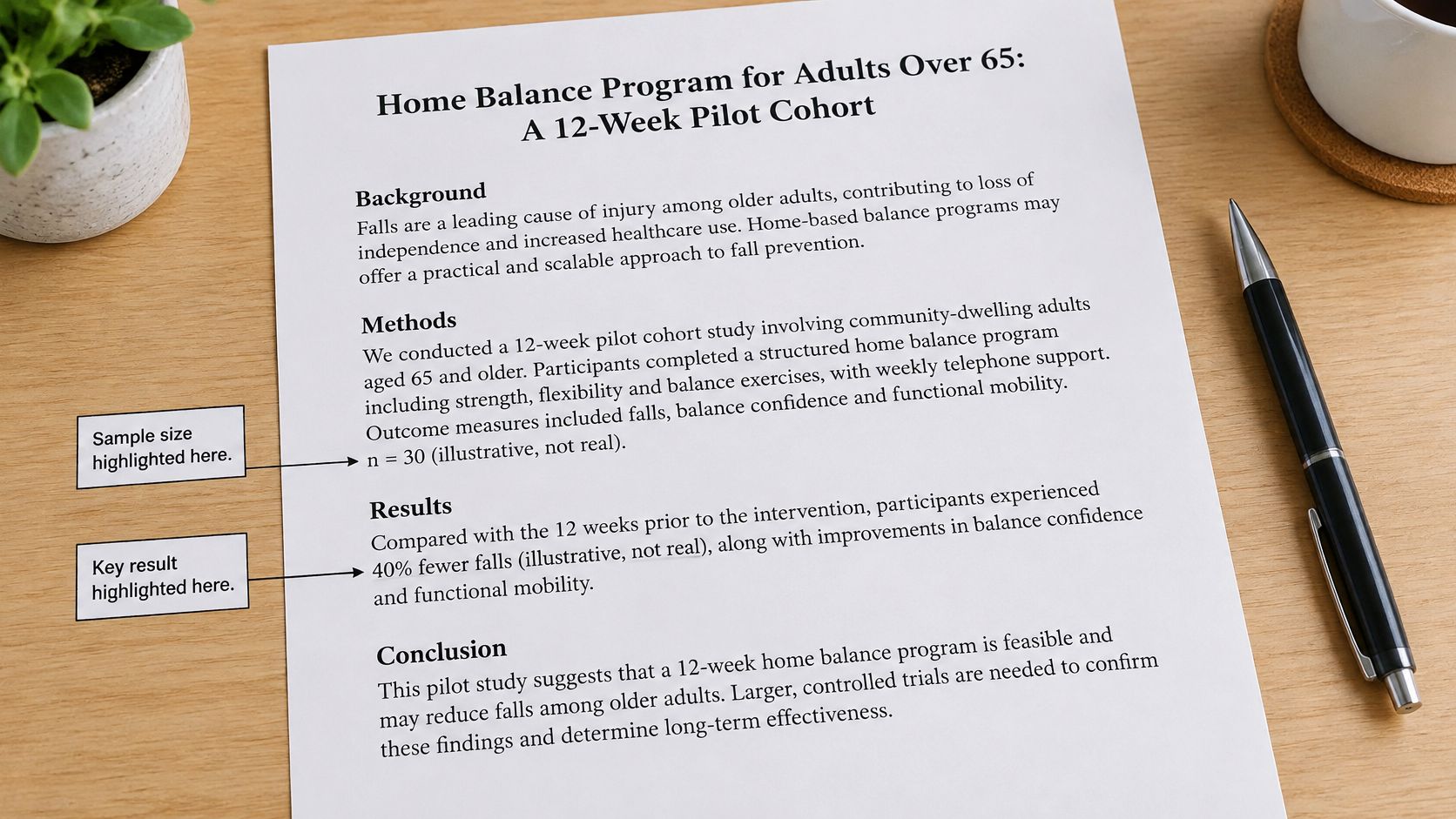
Home Balance Training at Home for Adults Over 65: A Pilot Cohort Study
Background. Falls can cause serious injury and reduce independence among adults over 65. Yet many balance programs require travel to a clinic, leaving fewer convenient options for people who prefer to exercise at home.
Objective. Does a 12-week home balance program improve measured balance in adults over 65?
Methods. In this illustrative prospective pilot cohort, 32 adults aged 65 and older enrolled through a community health center. Participants completed a home balance program with weekly remote check-ins. The primary measure was change in the Timed Up and Go test from baseline to week 12. We estimated the mean within-participant change and its 95% confidence interval, and summarized program completion.
Results. In this illustrative dataset, mean Timed Up and Go time decreased from 14.2 seconds at baseline to 12.8 seconds at week 12, a mean change of −1.4 seconds (95% CI, −2.1 to −0.7). Twenty-six of 32 participants completed the program. No serious adverse events were recorded during the pilot.
Conclusion. These illustrative findings suggest that a home balance program can be delivered with remote check-ins and may improve measured mobility among participants who complete it. A larger controlled study is needed to test whether the change is attributable to the program and applies to a wider population.
Keywords: balance training; falls; home exercise; older adults
Title. The title identifies the population, intervention, and study type. A reviewer can quickly see whether the topic fits the conference and whether the title matches the actual question.
Background. The two sentences establish a need and a gap: falls matter, and travel can limit access to clinic-based options. Avoid turning this section into a history of the field. The reviewer wants to know why this study was worth doing.
Objective. One testable question keeps the abstract focused. If the objective asks whether the program improves a specified measure, the methods and results should answer that same question.
Methods. The design, participants, setting, intervention, outcome measure, and analysis tell reviewers what was done. For the example, they can judge whether the cohort and measure fit the question, rather than having to infer the study design from a vague description.
Results. This section reports a finding, its size, its precision, and a secondary observation. The American Thoracic Society's abstract criteria require results to contain new data and reject wording such as “The results will be discussed.” The society also specifies a descriptive title, authors and institutions, rationale, methods, results, and conclusions, with a body limit of 400 words excluding the title, author information, institutions, tables, and images.
Conclusion. The claim stays within the evidence: an uncontrolled pilot can suggest feasibility and a possible change, but it can't establish that the program caused the change or that it will work for everyone. The strongest abstract states its numbers plainly instead of trying to persuade with adjectives such as “remarkable.”
Annotated Sections of a Conference Abstract
A conference abstract is a short, structured summary that a program committee reads to decide whether work should be accepted for a talk or poster. Its headings and limits come from the specific event, not a universal template.
| Element | Typical rule | What reviewers check |
|---|---|---|
| Title | Descriptive, with no unexplained acronyms | Does it match the study question? |
| Authors and affiliations | Follow the venue's format; often excluded from the word count | Is the presenter identified, and do affiliations match the record? |
| Body sections | Airlangga: 250 words, with Background, Objective(s), Methods, Results, Conclusion. ATS: 400 words, with RATIONALE, METHODS, RESULTS, CONCLUSIONS. | Are all required headings present, in order, with relevant content? |
| Keywords | Airlangga: 3–5 keywords, alphabetically listed | Would a searcher or indexer use these terms? |
| Format and language | Airlangga: Times New Roman, 12-point, single-spaced. ICCFSS: English with publication-quality spelling and grammar. | Does the submission meet the rules, or risk rejection before review? |
The University of Airlangga's 2026 occupational-health conference rules require the listed headings in sequence and set the word limit excluding the title, authors, and affiliations. The American Thoracic Society uses different headings and counting exclusions. The International Conference on Climate, Fisheries, and Food Security sets a 350-word limit and requires English suitable for publication.
Compliance is the first filter. An abstract outside the required format may be rejected before the science is read. Start with the call, then draft to its exact headings, count, language, and formatting rules. For a closer look at how fields and headings work together, see this guide to abstract submission format.
How Reviewers Score Each Submission
Reviewers don't all read or score an abstract in exactly the same way. Abstract peer review can be inconsistent, so a shared rubric and multiple independent assessments make the decision process more defensible.
A practical committee workflow assigns at least three reviewers to each submission. Each reviewer scores independently before seeing other reviewers' comments or scores. A criterion-level rubric helps keep the assessment focused on the same evidence across submissions.
| Criterion | Strong abstract shows | Weak abstract shows | Score anchor |
|---|---|---|---|
| Scientific importance | A clear gap and why the answer matters to the audience | A topic named without a gap or stakes | 5 = clear and significant contribution |
| Methodological appropriateness | Design, sample, and analysis match the question | Vague methods or a mismatched design | 1 = serious defect; 3 = acceptable but incomplete; 5 = strong and publication-ready |
| Validity of conclusions | Claims stay within what the results show | Claims go beyond the data | 5 = fully supported by results |
| Originality | New data or a new angle stated plainly | A known finding repeated without a new frame | 5 = clearly new contribution |
| Writing clarity | Parts connect logically, and plain terms are used | Jargon, missing sections, or unclear links | 5 = followable in one reading |
Read the pattern, not just the mean
The committee can calculate both the mean score and the spread. For example, two abstracts could each have an illustrative mean of 4.2, yet one might have tightly clustered reviewer scores while another ranges from 2 to 5. That disagreement matters. The committee can send high-variance submissions for adjudication instead of ranking them by their mean alone.
Other programs make their priorities explicit. The FECCA 2026 conference criteria include relevance to multicultural communities, originality, clarity and guideline compliance, and contribution to understanding multiculturalism in Australia. A separate International Student Research Conference guideline emphasizes the rigor, appropriateness, and transparency of methods, along with overall clarity and logical connection between abstract parts.
The practical lesson is simple: put evidence for each criterion in the abstract. Name the gap, explain why the design fits, state what is new, and connect the conclusion to the results. Don't expect a reviewer to fill in missing logic.
Structured Fields Reviewers Expect in Methods and Results
A single free-text box can hide missing information. Structured fields give every reviewer the same minimum evidence to assess, and they help authors notice gaps before submitting.
A review of five reporting guidelines found a median of 12 checklist items per abstract and six recurring core elements: study design, objectives, eligibility criteria, participant or study counts, primary-outcome results with precision, and interpretation, as described in this review of structured abstract reporting guidance.
| Study type | Required items | Common omission |
|---|---|---|
| Randomized trial | Randomization method, blinding, sample size, primary outcome with effect estimate and confidence interval | Randomization and blinding not described |
| Systematic review | Databases searched, search dates, eligibility criteria, risk-of-bias method | Search dates missing |
| Evidence synthesis | Risk-of-bias method, number of included studies, pooled effect with precision | Pooled estimate given without precision |
| Observational or cohort study | Setting, participant counts, exposure definition, adjusted estimate with confidence interval | Counts reported without denominators |
| Qualitative or pilot study | Setting, participant count, data collection method, stated limitations | Sampling method not stated |
For a medical research abstract, build the submission form around these fields:
- Structured title
- Objective
- Design
- Setting
- Eligibility criteria
- Sample size
- Intervention or exposure
- Primary endpoint
- Effect estimate with confidence interval
- Limitations
- Funding
- Disclosure status
Make “not applicable” a distinct response from a blank field. A blank may mean the author forgot to provide essential information; “not applicable” says the author considered the question and it doesn't fit the study. If a primary outcome is essential to review, the form should prevent submission until that field is complete.
Structured entries also make it easier to reuse accepted content in session descriptions, accreditation materials, and searchable proceedings without rebuilding methods or results by hand. Authors writing methods may also find this guide to CONSORT and STROBE methods reporting useful when deciding which study details to make explicit. A well-designed abstract submission form can make those required fields visible before the final submit step.
Disclosures, Identifiers and AI-Use Statements
A polished abstract can still be untraceable. If its study identifier, funding, conflicts, or AI-use information lives only in an email or an author's notes, organizers and readers may not be able to connect the submission to the right study or assess its disclosures.
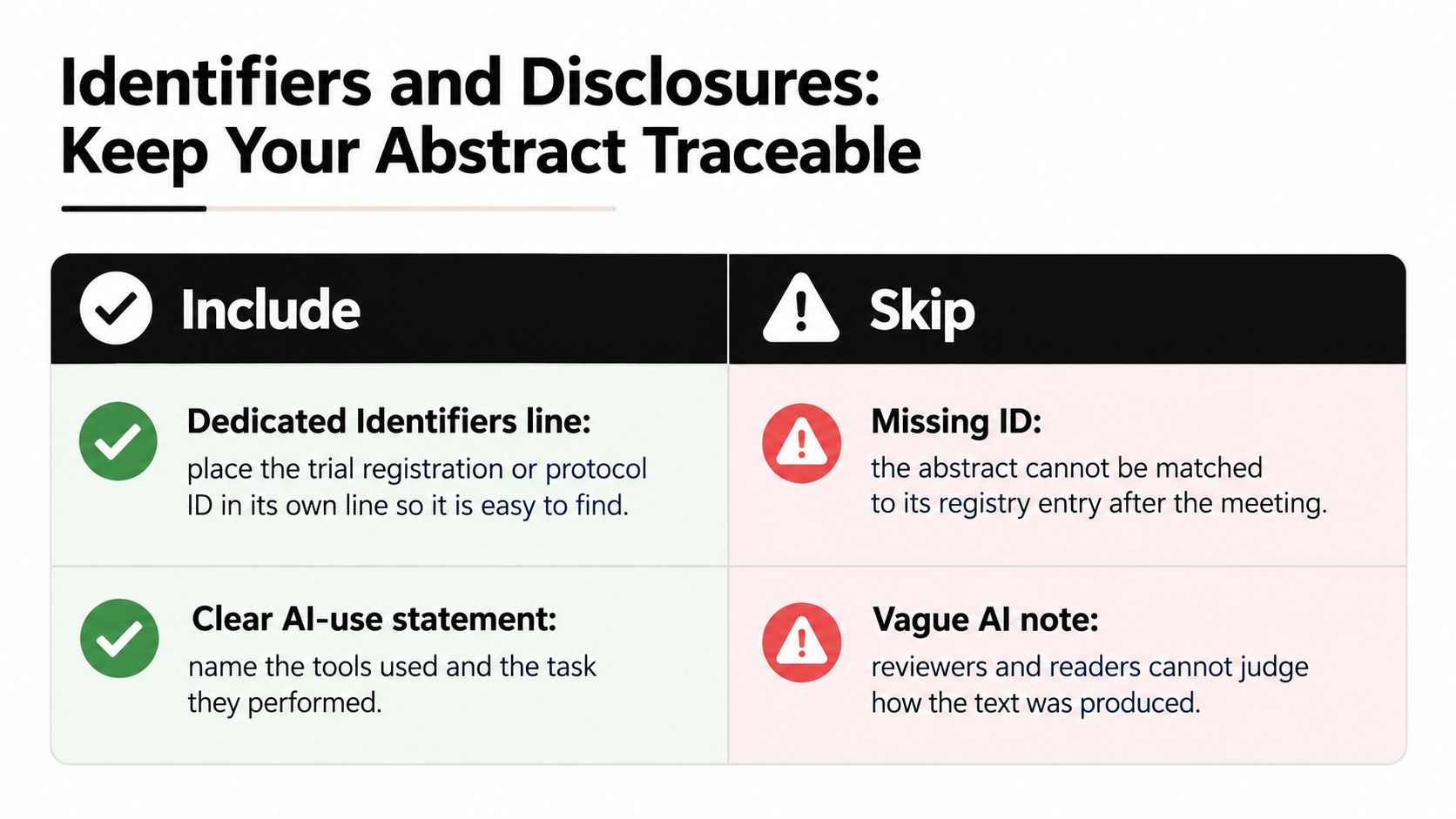
Put a trial registration number or protocol identifier in a dedicated submission field so the abstract can be linked to a later publication. Declare funding and author conflicts on the submission site, and repeat those disclosures on presentation materials when the venue requires it. These practices follow recommendations discussed in this article on abstract identifiers and disclosure practices.
For interim findings, name the study stage, give the sample analyzed so far, and say directly that results may change. Don't phrase preliminary results as final, and don't imply that a tool analyzed data if it only helped polish sentences. Check the venue's AI policy and state what the tool did, whether that was language editing, analysis, or another task.
Submission metadata checklist
- Identifier: Trial registration or protocol ID
- Study status: Final, preliminary, or interim
- Funding: Funding source or required declaration
- Conflicts: Author conflict-of-interest information
- Data limitations: Relevant limits on what the results show
- AI-use statement: Tool and task, if required by the venue
The central point is that traceability and disclosure can matter more than rhetorical polish, particularly in medical and scientific programs. Planstone's financial disclosure report guidance can help teams think through how disclosure information fits into conference administration.
Writing Clearly Without Language Bias
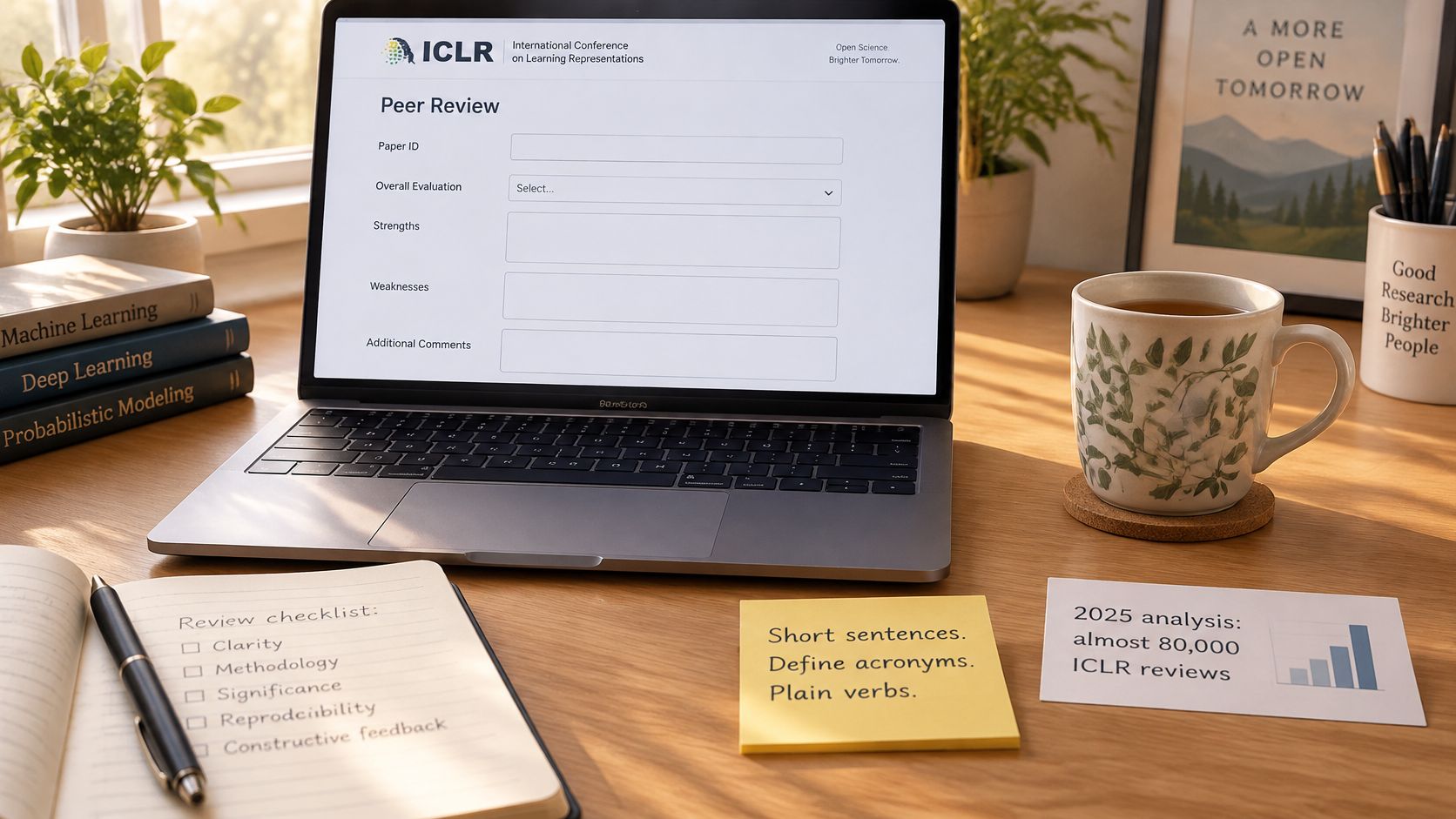
A 2025 analysis of almost 80,000 ICLR peer reviews found significant bias against authors associated with institutions in countries where English is less widely spoken. The analysis also found that reviewers increasingly interpreted AI-like writing and other stylistic signals as indicators of author demographics, according to the ICLR peer-review analysis.
That finding challenges the instinct to make an abstract sound more “native.” Aim for accurate, readable writing, not a different authorial voice.
Consider this vague sentence:
Our program produced remarkable improvements.
A clearer revision, with placeholders for the study's actual results, is:
Mean walking speed rose from [baseline] to [follow-up] m/s over 12 weeks (95% CI [range]).
The revised sentence removes hype and gives the reader a way to judge the finding. The bracketed values are placeholders, not study data.
Prioritize precise claims, transparent methods, short sentences with one idea each, and discipline-standard terms. An editor can help when readers may misunderstand a sentence or when grammar obscures the methods. But replacing an accurate technical term with an idiom just to sound more fluent doesn't improve comprehension, and language editing can't guarantee acceptance because reviewers still judge the work.
Reviewers should keep writing quality and research quality as separate judgments. Clear expression helps them understand the evidence; it shouldn't become a proxy for where an author comes from.
Check the Call Before You Submit
Use a go-or-no-go check for the final pass. A deadline change or a missed field can turn an otherwise strong submission into a preventable problem.
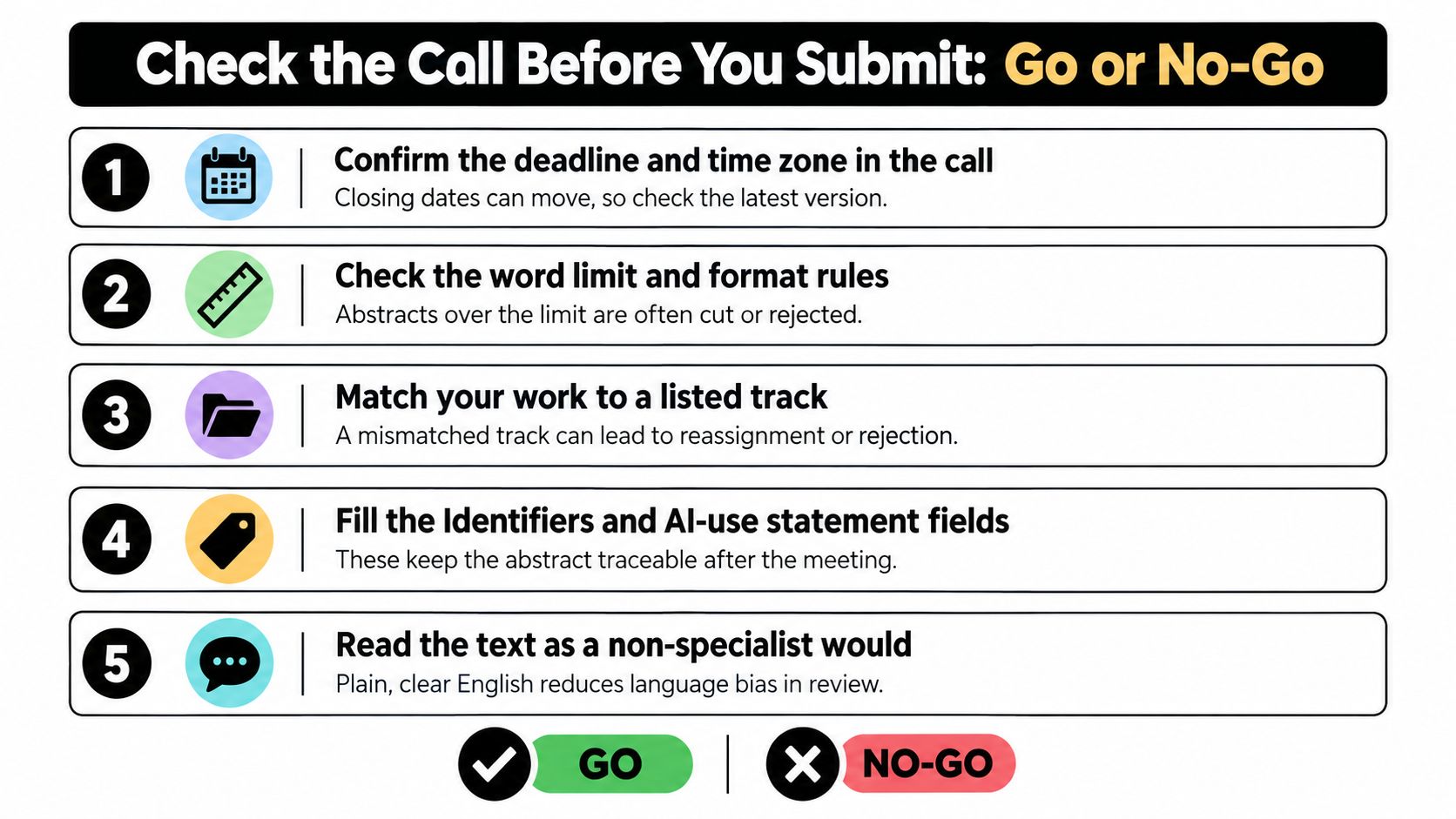
- Confirm the deadline and time zone. The Australian Archaeological Association extended its 2024 abstract deadline from 21 June to 28 June, as noted in its 2024 call for abstracts. Check the latest call rather than relying on an earlier notice.
- Count words against the venue's rule. Exclude only the items the call says to exclude. A title or keyword counted incorrectly can push the abstract over the limit.
- Check headings and order. A missing required section can be treated as noncompliance, even if its information appears somewhere else in the text.
- Verify every Results figure against the analysis file. Check values, units, and intervals before submission so transcription errors don't slip into the review record.
- Match the study identifier, funding, conflicts, and AI-use statement to the portal fields. This keeps the submission record complete and makes it easier to trace later.
- Choose the presentation category that fits the evidence. Oral, poster, workshop, or late-breaking submissions may suit different levels of study maturity.
- Read the abstract aloud once. Listen for sentences where the objective, methods, results, or conclusion don't connect.
Go only when all seven checks pass. If one fails, fix it before submitting rather than assuming you'll be able to change it after the deadline.
For organizers, Planstone's abstract management module brings submission, review, and session building into one workflow, from the call for abstracts through to the finished program. For a conference consultation, clients provide information about their program, existing systems, and team requirements, then discuss where Planstone can help; dedicated conference management and account management support are available.
Frequently Asked Questions About Abstract Submission
Does the word limit include the title and author names? It depends on the venue. Airlangga excludes the title, authors, and affiliations, while ATS also excludes tables and images, so follow the call's counting rule.
Can I submit preliminary results? Often, if the call allows interim findings. Name the study stage, report the sample analyzed so far, state that results may change, and choose a presentation category that fits the evidence.
Do I need to disclose AI tools? Check the venue's policy. If it requires disclosure, say whether the tool polished language, contributed to analysis, or performed another task. If you're trying to understand how to describe a tool's role, you can also browse common AI questions.
Will a non-native English style lower my score? Reviewers should distinguish research quality from writing style. Focus on clear sentences and accurate terminology rather than chasing a “native” sheen.
Are abstracts reviewed blind? Some programs use blind review. Check whether you must remove author names or identifying details from the abstract file before upload.
Can I edit after submitting? Assume you can't unless the portal says otherwise. Verify the editing policy and check every field before the final submission.
Organizers who run a conference call can ask Planstone about abstract management support. A consultation starts with your program details, existing systems, and team requirements.
Planstone connects abstract submission, review, and session building in one workflow, helping conference teams carry work from the call through to the finished program. If your team is reviewing its submission process, visit Planstone to discuss your program, existing systems, and requirements.