

You've got speakers confirmed, a program that looks strong on paper, and registrants already asking how many credits they'll earn. That's usually the moment teams discover they haven't settled the question that controls everything else: which credit their learners can use. If you build sessions, evaluations, and certificates before you confirm that, you can run a polished event and still leave people with credit their licensing board won't accept. Learning how to offer continuing education credits starts in the opposite order. You confirm the profession, jurisdiction, and designating body first, then you calculate minutes, track completion, and release certificates against records that can survive an audit.
Table of Contents
- Credit Systems You Can Offer and What Each Covers
- Confirm Eligibility Before You Plan Any Activity
- Credit Values by Activity Length and Format
- How to Track Learner Completion and Issue Certificates
- Compliance Errors That Cost Learners Credit
- Choose a Tracking Setup Before Your First Activity
Credit Systems You Can Offer and What Each Covers
A continuing education credit is a recognized unit awarded for documented participation in an eligible learning activity, and the unit's name and rules depend on the body that designates it. That definition matters because attendance alone doesn't create credit. The activity has to fit a system someone with authority recognizes, and your records have to show the learner completed what that system requires.
The baseline many planners know is the U.S. Continuing Education Unit, or CEU. According to IACET's history of the CEU, the framework was standardized in 1970, when 1 CEU equaled 10 contact hours of organized learning delivered under responsible sponsorship, capable direction, and qualified instruction. IACET also distinguishes an ordinary CEU from an Accredited CEU, which signals a provider's practices were independently reviewed. Use the CEU as a measurement baseline for multi-profession and noncredit programs, not as a substitute for profession-specific credit.
Credit systems at a glance
| Credit system | Unit name | Who designates or recognizes it | Typical learners |
|---|---|---|---|
| CEU baseline | Continuing Education Unit (CEU) | Standardized U.S. framework; IACET Accredited CEU status marks independently reviewed providers | Multi-profession and noncredit programs |
| AMA PRA Category 1 Credit | Category 1 Credit™ | ACCME-accredited providers; licensing boards decide whether credit meets license requirements | Physicians |
| ADA CERP | CERP credit | ADA Continuing Education Recognition Program recognized providers; state boards vary in acceptance | Dental professionals |
| ANCC NCPD | Contact hour | ANCC-accredited providers; not automatically converted to clock hours or teacher-education credit | Nurses |
Read the third column before the second. The question isn't what you'd like to call the unit, it's who has standing to designate it and who decides whether it counts. Licensing boards and state boards can decide whether a unit satisfies license requirements, so a certificate that looks correct to your team can still fail the learner at renewal time.
A credit unit is not portable across professions or borders by default. The same hour of learning can be valid for one audience and worthless to another sitting in the next chair.
That portability problem shows up in counseling and therapy education too, where requirements differ by license and state. If you're mapping how therapists think about their own obligations, the Be Your Best Self & Thrive resources on therapist continuing education give a useful learner-side view of why generic credit promises create confusion.
Choose the credit unit before you design the program. Every later decision, how you count time, what completion evidence you collect, what the certificate says, and what you report, depends on that choice. Teams that pick the unit last end up rebuilding forms and recalculating totals under deadline pressure.
Confirm Eligibility Before You Plan Any Activity
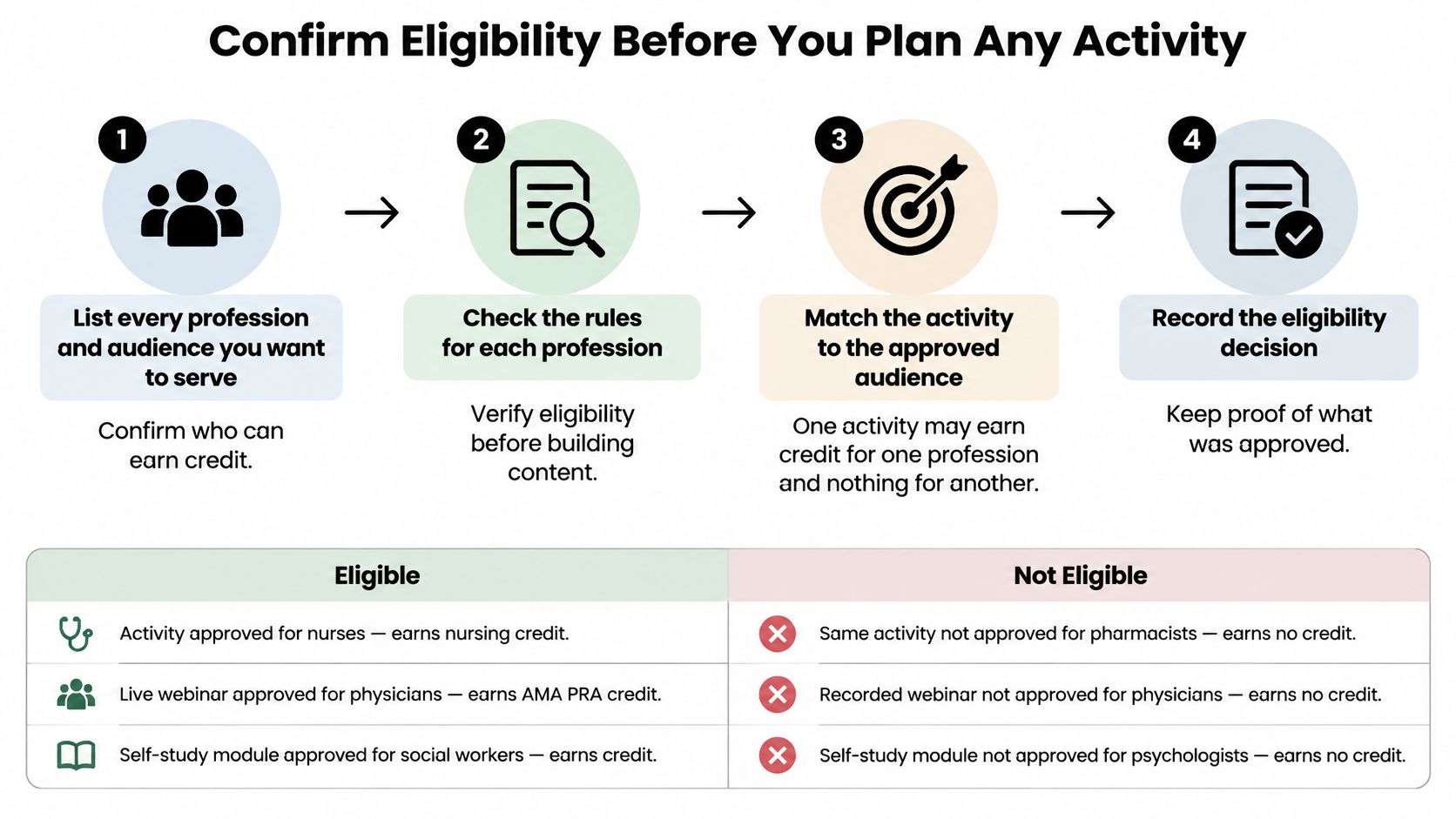
Eligibility comes before content because one activity can earn credit for one profession and nothing for another. A session can be well taught, well attended, and well evaluated, and still produce no usable credit if the wrong body designated it or the learner's board doesn't recognize it. I would not let a planning team lock a program grid until these checks are written down with a named owner.
- List every learner profession and jurisdiction. Write down each profession you expect and where those learners hold licenses, because recognition follows the license, not your registration form.
- Confirm the credit type each profession needs. Match each group to its unit and to the body that designates it, so you're not promising one generic credit to four different audiences.
- Choose direct accreditation or joint providership. If you're not accredited, decide now whether an accredited partner will carry the activity, and get that relationship documented before design starts.
- Classify the format. Label each activity live, enduring, or blended, since format changes how participation is verified and how credit is claimed.
- Get written confirmation. Obtain confirmation from each relevant licensing or accrediting body and name one person who owns the approval record.
- Write the contingency plan. Decide in advance what happens when one audience receives credit and another doesn't, including what your marketing and certificates will say.
Step 3 is where teams most often overstate their position. In the United States, only ACCME-accredited providers or organizations recognized through the relevant accreditation structure may designate AMA PRA Category 1 Credit™, a point set out in the Center for Health Care Strategies health plan CME FAQs. An organization that isn't ACCME-accredited cannot designate that credit on its own. It can take part through joint providership, but the accredited provider stays responsible for compliance, independence, validated clinical content, disclosures, and records. That's not a paperwork detail. It means your partner can, and should, stop an activity that doesn't meet the standard.
The maintenance of certification special case
Maintenance of certification, or MOC, adds conditions on top of ordinary credit. The activity must be directly or jointly provided by an ACCME-accredited organization in good standing and designated for AMA PRA Category 1 Credit. It must be planned around ABMS or ACGME competencies, tied to certified learners' practice gaps, and kept free of commercial bias or control by an ineligible company. If your planning process can't document competencies and practice gaps, you're not ready to offer MOC, however strong the clinical content looks.
Practical rule: If you can't name, for each audience, the credit type, the designating body, and the board that will accept it, you don't have a credit offering yet. You have an intention.
Finish this stage by answering one question in writing. Will this specific audience, in this format, with these objectives, produce usable credit? Advance verification with each relevant body, documented approval ownership, and a contingency plan are how you answer yes with evidence instead of optimism. Skipping the contingency plan is the expensive mistake, because the failure mode isn't that nobody gets credit. It's that physicians do and nurses don't, and you find out from angry learners after certificates go out.
Credit Values by Activity Length and Format
Credit is calculated from eligible time, not from the slot printed in your program. Use this lookup first, then check the rule behind each row before you publish a maximum.
| Activity or format | Eligible time | Credit awarded | Rule that applies |
|---|---|---|---|
| AMA live session, 30 minutes | 30 minutes | 0.50 | 60 minutes per credit, 0.25-credit increments |
| AMA live session, 45 minutes | 45 minutes | 0.75 | 60 minutes per credit, 0.25-credit increments |
| AMA live session, 60 minutes | 60 minutes | 1.00 | 60 minutes per credit |
| ADA CERP session, 14 minutes | 14 minutes | 0 | Under 15 minutes receives no credit |
| ADA CERP session, 15 minutes | 15 minutes | 0.25 | 15-minute increments worth 0.25 each |
| ADA CERP session, 30 minutes | 30 minutes | 0.50 | 15-minute increments worth 0.25 each |
| ANCC NCPD activity, 60 minutes attended in full with post-evaluation | 60 minutes | 1 contact hour | 60 minutes of eligible learning per contact hour |
| Breaks, meals, registration, general business | Excluded | 0 | Excluded under ADA CERP and from AMA calculation |
| Enduring module, completed and assessed | Full module | Credit after completion | Claimed on successful completion, not attendance minutes |
Physician credit
For physicians, University of Chicago CME's credit breakdown guidance calculates credit at 60 minutes per 1 AMA PRA Category 1 Credit™ in 0.25-credit increments, so 45 minutes supports 0.75 credit and 30 minutes supports 0.50 credit. Measure only eligible instructional or formal interaction time and exclude breaks and noneducational segments. The most common mistake is awarding the full activity maximum without verifying each learner's actual participation, particularly in hybrid and livestream programs where joining a stream isn't the same as staying for the session.
Dental and nursing credit
Dental credit follows a different increment. The ADA CERP recognition standards calculate credit from actual eligible instruction, including question-and-answer periods and mandatory self-assessment, while excluding breaks, meals, registration, and general business, and they award credit in 15-minute increments worth 0.25 each, with no credit under 15 minutes. For self-instructional activities, you make a good-faith estimate of the time an average participant needs, and you should keep that estimate on file rather than reconstructing it later.
Nursing credit turns on full participation plus evaluation. Under the NASN instructions for ANCC NCPD contact hours, one contact hour represents 60 minutes of eligible learning, and learners must be present for the full content and complete a post-evaluation for each activity. That rule changes your operations. Partial attendance that might still earn fractional physician credit doesn't produce the same result here, and a missing evaluation isn't a minor data gap, it's missing completion evidence.
Three situations change the values in practice. In hybrid sessions, a learner who joined late has less eligible time than the session maximum. In enduring materials, credit follows successful completion and assessment rather than attendance minutes, so completion records belong in a separate structure from live attendance logs. In mixed programs, the same session can carry different values for different professions, which means your schedule, sign-in method, and certificate logic all need to store credit by profession, not by session alone.
How to Track Learner Completion and Issue Certificates
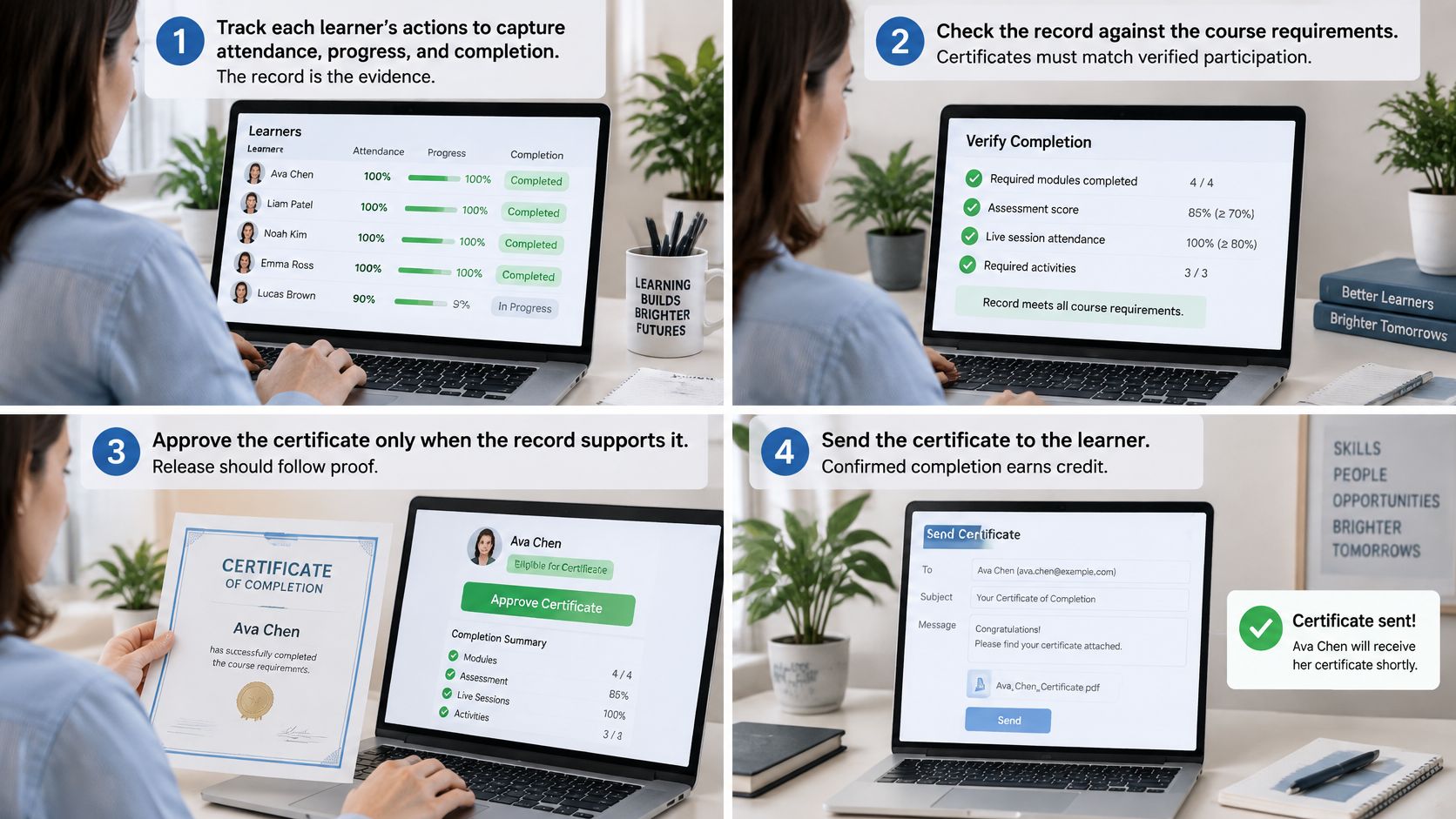
Tracking records what each learner did. Certificates are released only when that record supports them, which is a stricter standard than most event workflows are built for. A registration list proves someone signed up. It doesn't prove they attended a specific session, stayed for eligible time, or completed an assessment. Build the record at learner level from the start, because rebuilding it afterward from room counts and email threads is where credit totals go wrong.
- Register each activity with its approved values. Store the credit type, activity ID, and approved credit value for every session or enduring module, so every later calculation uses the approved figure instead of a planner's memory.
- Log participation per learner, per session. Capture entry and exit events for live sessions and completion events for enduring modules, because a total event attendance figure can't prove individual participation.
- Record excluded intervals separately. Keep breaks, registration, and business meetings as their own intervals, so they stay out of each learner's eligible time instead of inflating it by default.
- Gate completion on evaluation or assessment. Don't change a learner's status to complete until the required post-evaluation or learning assessment is submitted, since nursing and enduring credit depend on that evidence.
- Store the full documentation set. Keep the learner, provider, activity title, format, date, and credit awarded on each record, because that's the documentation an auditor or licensing board will ask you to produce.
- Release and timestamp the certificate. Issue it only when the required assessment and disclosure records are complete, and record the issuance timestamp so you can prove when credit was granted.
- Post it to the learner's transcript. Add the certificate to a cumulative transcript, so learners and staff work from one record instead of hunting through email attachments.
Why learner-level records pay off later
Programs offering CME for MOC show where this leads. According to the ACCME guide to CME for MOC, providers must collect individual learner completion data and submit it through the ACCME Program and Activity Reporting System, called PARS. Aggregate headcounts can't be converted into that submission. If your data model starts with one row per learner per activity, reporting becomes an export. If it starts with session totals, reporting becomes a reconstruction project.
That's also the practical argument for a configurable attendance-plus-completion model rather than a single certificate checkbox. Store session duration, excluded intervals, entry and completion events, assessment status, calculated credit, and certificate timestamp as separate fields. When a learner disputes a total, you can show the arithmetic. When a board asks for evidence, you can produce the record without interviewing your own staff. Reviewing how credit tracking and certificate workflows are structured can help you decide which of those fields your current tools already capture and which you're improvising.
For any certificate you issue, you should be able to show the session time, the completion evidence, and the assessment result behind it. If you can't, the certificate is an assertion, not a record.
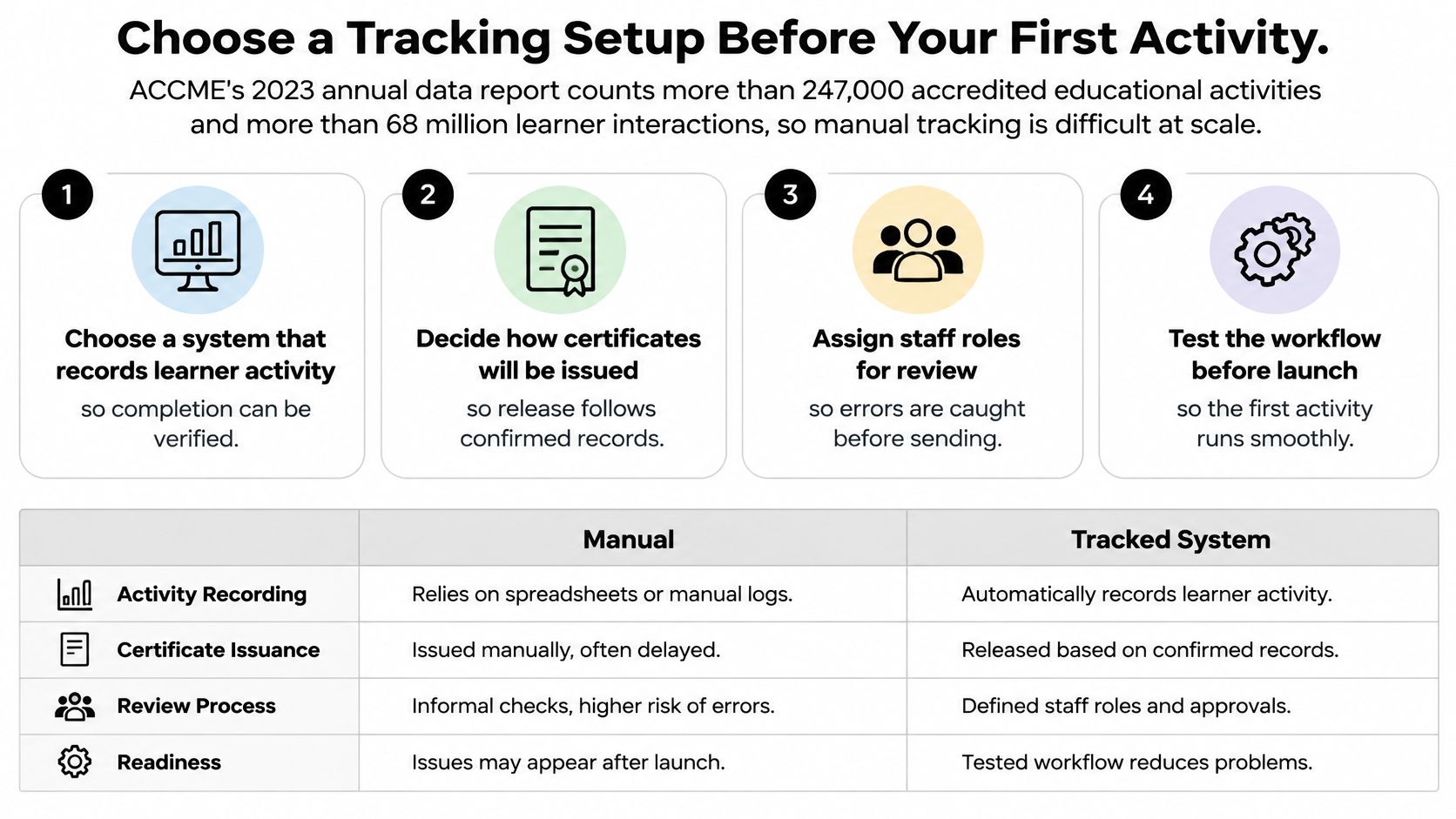
Test the workflow with awkward cases before launch, not with perfect attendees. Run a learner who arrives late, one who skips the evaluation, one who completes an enduring module twice, and one who belongs to two professions. If your process handles those four cleanly, it'll handle the straightforward majority. If it can't, you'll fix it in a test environment instead of in front of registrants waiting on certificates for license renewal.
Compliance Errors That Cost Learners Credit
The error that costs learners credit most often is awarding the full activity maximum without verifying each learner's participation. It's tempting because it's fast, and it's especially common in hybrid and livestream programs where a login record gets treated as attendance. When an audit compares credit totals against logged participation, the difference isn't a rounding issue. It's credit you granted without evidence, and the correction means reissuing certificates and telling learners their totals changed.
The second failure is quieter. Teams collect financial disclosures, file them, and assume the job is done. Collection without a documented relevance review and mitigation before delivery doesn't satisfy the standard. The Massachusetts guidelines for requesting board approval of CME and CPD activities describe an auditable sequence that includes collecting disclosures from everyone controlling content for relationships within the prior 24 months, determining whether those relationships are relevant, and mitigating them before the activity runs.
The auditable sequence
Build each activity in this order. Identify the educational need and write measurable objectives. Establish content validity and scientific justification. Collect disclosures, review relevance, and mitigate before delivery. Separate accredited education from marketing and sales. Require learner assessment against the stated objectives. Then retain evaluation, disclosure, mitigation, participation, and credit records for audit.
Two parts of that sequence get skipped most. First, commercial separation. If promotional content sits inside an accredited session, the session's independence is compromised regardless of how good the science is. Second, assessment. Satisfaction surveys don't show objective achievement. Learners can rate a speaker highly and learn nothing measurable, so your evaluation needs questions tied to each stated objective, not only questions about the room, the slides, and the speaker's delivery. Strong financial disclosure management practices make the first half of this sequence routine instead of a scramble in the week before the event.
| Symptom | Likely cause | Fix |
|---|---|---|
| Credit total higher than logged participation | Full activity maximum awarded without individual participation checks | Recalculate from logged entry, exit, and completion events, then reissue corrected certificates |
| Learners credited for breaks or registration time | Excluded intervals not removed from eligible time | Record excluded intervals separately and rerun the credit calculation |
| Enduring credit claimed on attendance alone | Attendance logs used instead of completion and assessment | Release credit only after successful completion and assessment |
| Speaker disclosure gap found after the event | Disclosure not a prerequisite for session approval | Make disclosure completion a condition of final session approval |
| Promotional content inside accredited session | Commercial and educational content not separated | Separate marketing from accredited education and review content before delivery |
| Satisfied learners but no objective gain measured | Evaluation limited to satisfaction questions | Add assessment questions tied to each stated learning objective |
| One profession receives credit, another does not | Audience eligibility not confirmed with each licensing body | Confirm eligibility with every relevant body before launch and keep the written approval on file |
Turn that table into standing controls. Generate exception reports for missing disclosures, unresolved relationships, absent evaluations, and inconsistent credit totals, and review them before certificates release, not after learners complain. A certificate shouldn't go out while any exception affecting that learner or session is still open.
Choose a Tracking Setup Before Your First Activity
Manual tracking doesn't fail at your first small session. It fails when volume, formats, and credit types multiply. The ACCME 2023 annual data report counted more than 247,000 accredited educational activities and more than 68 million learner interactions in one year, which is the scale accredited systems are built to handle. You don't need that volume for spreadsheets to break. You need a few hundred learners, concurrent sessions, and one person out sick during certificate week.
Answer these questions yes or no before you commit to a setup:
- Activity and learner volume: Will you run enough activities and learners each year that manual reconciliation takes days rather than hours?
- Format mix: Will you combine live, enduring, and blended activities that verify completion in different ways?
- Disclosure gating: Must disclosures block final session approval automatically rather than relying on someone checking a folder?
- Individual records: Does each learner need a completion record that links activity, evidence, credit amount, and certificate?
- Automatic release: Should certificates release as soon as requirements are met, without staff assembling them by hand?
- Reporting exports: Must you produce annual or per-activity reporting for an accrediting body?
If several answers are yes, a configured system is the practical choice. A spreadsheet can work for a handful of live sessions with one credit type and one careful owner. It stops working when records need consistent structure, which is the same reason teams in other regulated fields move to software for managing WHS compliance instead of tracking obligations in shared files. The underlying problem is identical. Evidence has to be findable, dated, and tied to a person.
Where a checklist item needs a platform that stores learner-level records, assess Planstone against that item directly. Our platform manages abstract submissions, speaker tasks, disclosures, and continuing education credits in a single configured platform, and our credit tracking module collects participant feedback, applies credit rules, and makes certificates available to attendees. Confirm the current credit, disclosure, and reporting configuration with our team before relying on it for a specific accrediting body's requirements. It also helps to settle your own terminology and retention habits early, since clear recordkeeping practices determine whether records stay usable years later.
Start with an inventory. List your credit types, your formats, and the tools you use now, then mark which checklist items those tools can't store or enforce. That gap list is your first next step, and it's a better purchasing document than any feature comparison because it's written in your program's actual failure points.
If you're working out how to offer continuing education credits without rebuilding your process every year, Planstone gives associations and education teams one configured platform for submissions, speaker tasks, disclosures, evaluations, and credit administration, so learner records and certificates stay connected from program planning through reporting. Visit us to see how the credit tracking module applies your credit rules and makes certificates available to attendees, and talk with our team about configuring it around your professions, formats, and accrediting requirements.