

An average of 62% of non-formal learning activities across participating OECD countries lead to a certificate, according to the OECD's adult-learning report. Certificates aren't a minor administrative extra. They're a common output of structured adult learning, and providers need to be able to explain exactly what each one proves.
Continuing education certificate programs connect learning activities, completion requirements, credit rules, and learner records. The certificate is the visible output. The underlying record should establish who participated, what they completed, how they qualified for credit, and which rules the provider applied. For associations and conference education teams, that distinction determines whether a certificate can withstand a licensing review or merely look convincing.
Table of Contents
- Continuing Education Certificates Compared with Other Credentials
- Participation Requirements by Credential and Case
- How to Assess Learning Before You Award Credit
- Issuing Certificates and Building Audit-Ready Records
- Proving Recognition and Outcomes After Issuance
- Frequently Asked Questions About Continuing Education Certificates
- Confirm Your Certificate Workflow Before You Choose a Provider
Continuing Education Certificates Compared with Other Credentials
A continuing education certificate records that a learner completed a defined learning activity, usually with stated credits or hours, through an association, university, conference organizer, or another education provider.
Continuing education credentials compared
| Credential | Issued by | Basis for issue | Renewal or validity |
|---|---|---|---|
| Continuing education certificate | Education provider, association, or conference organizer | Attendance or completion, often with an assessment | Validity conditions set by the issuer |
| Professional certification | Credentialing body | Examination or documented eligibility | Renewal through continuing education hours under the credentialing body's rules |
| Digital badge | Issuer or badge platform | Evidence of a defined skill or activity | Expiration and continuing-evidence requirements set by the issuer |
| Microcredential | Education provider, often within a national or institutional framework | Assessed learning outcomes for a small volume of learning | Validity and stacking rules set by the issuing framework |
The distinction is what the issuer verified, not whether the learner receives a PDF or an online credential. A badge can represent participation or assessed achievement. A course certificate doesn't automatically confer a professional designation, and a microcredential doesn't automatically transfer into a degree.
Check recognition before enrolling
Who will accept this credential, and for what purpose? That's more useful than asking whether a program is recognized.
UNESCO IESALC's 2025 Latin America study identifies missing shared definitions, quality-assurance frameworks, and regulatory standards as barriers to recognition. Shorter, more flexible learning isn't automatically more portable.
Check the assessed competencies, workload, issuer credibility, professional-body acceptance, and any written credit-transfer arrangement. Employer acceptance for staff development is different from a regulator accepting the same activity toward license renewal.
For a discipline-specific comparison, The Bible Seminary's explanation helps learners compare ministry program lengths and credits. Administrators can also use continuing education credit administration as a starting point for examining the operational requirements behind an award.
Recognition test: A certificate showing only a title, date, and total time should be treated as a participation record until supporting evidence establishes assessed competence.
Ask for the assessment criteria and acceptance terms before paying for a program, not after completing it.
Participation Requirements by Credential and Case
Credit rules and records vary by credential
A certificate is the visible output of a learning record. That record may need to show more than attendance: the credit claimed, how it was approved, or the subject area it covered. Requirements differ by credential, so keep each case distinct.
| Case | Hour or credit rule | Required record fields | Retention period |
|---|---|---|---|
| Physicians claiming AMA PRA Category 1 Credits™ | Claimed credits must accurately reflect participation and the activity's designated credit | Learner, accredited provider, activity title, format, completion date, credit amount | At least 6 years from activity completion for accredited providers |
| Maryland physicians | Designated hours and credit category | Program title, sponsor, participant, dates, location, credit category, hours, official verification of completion | Set by the applicable authority; confirm the required period |
| California physicians | Approved hours for each course | Participant name, course title, dates, sponsor and accrediting-agency information, approved hours | Minimum 4 years for physicians |
| Alabama licensees | Credits earned in the reporting year | Confirm required documentation fields with the licensing board | Set by the applicable licensing board |
| Nurse practitioners and clinical nurse specialists renewing ANCC certification | 75 contact hours; at least 60 formally approved; 25 pharmacology hours | Role and specialty relevance, approval status, pharmacology allocation | Set by the applicable licensing board |
Treat each row as a separate compliance case. A provider's recordkeeping duty and a learner's duty to retain documentation may apply to different parties and use different start dates.
The AMA credit documentation requirements allow an accredited provider to issue a certificate, transcript, or another documentation format, provided it accurately records claimed credit and core activity details. The format can vary; the underlying record still needs to support the credit claimed.
Under the ANCC certification renewal requirements, nurse practitioner and clinical nurse specialist renewals require 75 role- and specialty-related contact hours, including at least 60 formally approved hours and 25 pharmacology hours. Keep these categories separate in the learner's record. A single total does not show whether the approval and subject-area requirements were met.
Retention needs its own policy
The Medical Board of California's CME guidance requires physicians to retain documentation for a minimum of four years and specifies identifying course and sponsorship information. An attendee account that remains active is not a retention schedule.
Maryland's sponsor and location fields show how a certificate template can miss details needed for a particular credential. California permits recognized providers to report credits electronically, but electronic reporting still depends on accurate underlying records.
Before issuing a certificate, complete these checks:
- Identify the governing authority. Confirm the learner's regulator, credentialing body, and applicable credit category.
- Validate the required fields. Compare the certificate and stored record with the relevant documentation requirements.
- Set the retention schedule. Identify the applicable period for each party and learner group, and distinguish provider obligations from learner obligations.
If a requirement is unclear, confirm it with the regulator before issuing credit. Missing fields are easier to catch during review than after an audit begins.
How to Assess Learning Before You Award Credit
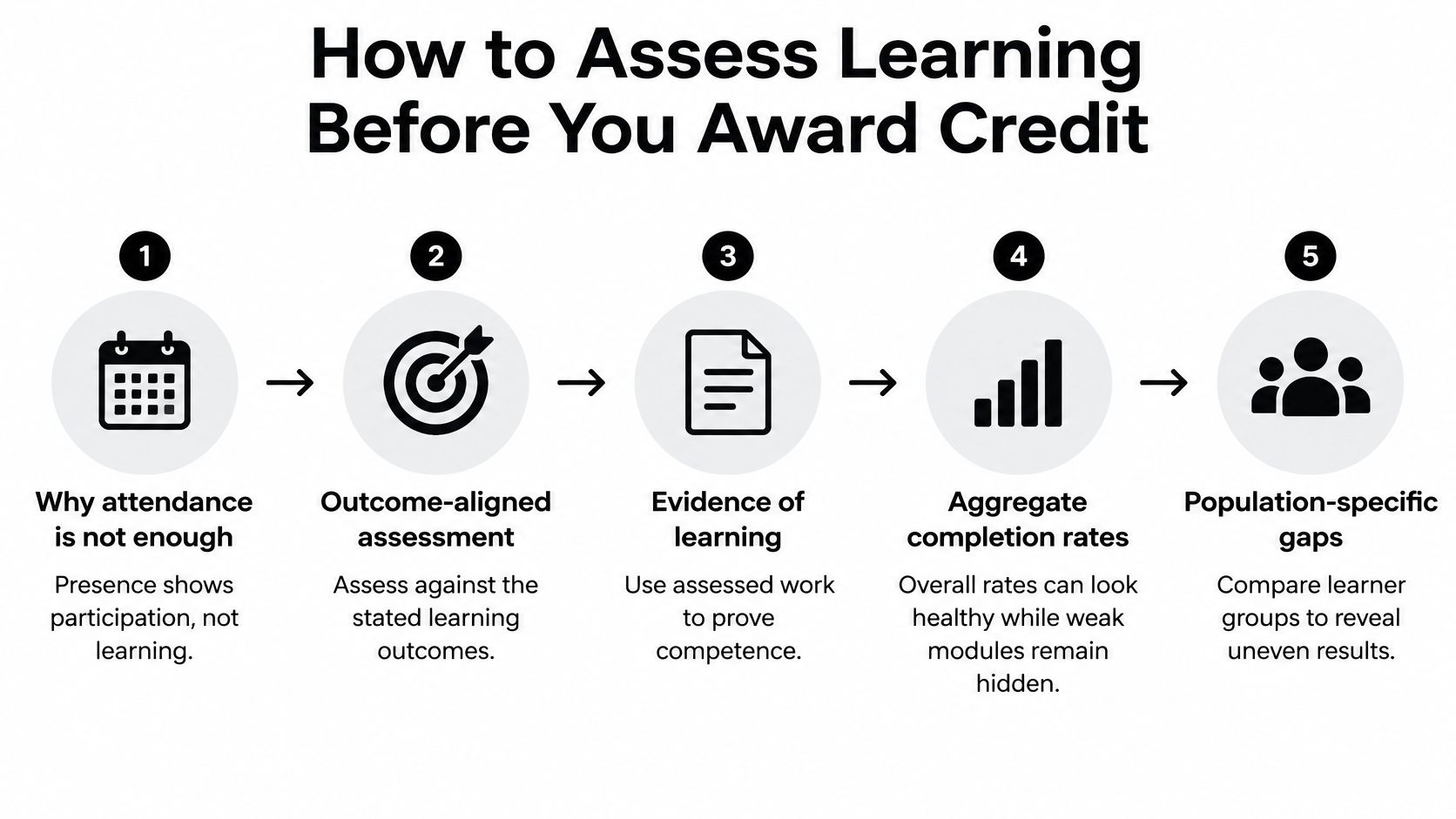
Attendance establishes presence, not learning. An outcome-aligned assessment gives the provider evidence that a learner can perform the task the activity was designed to teach.
The Higher Learning Commission's certificate-program guidance calls for appropriately rigorous learning goals, an established taxonomy or equivalent approach, and separate assessment of certificate-program learning through disaggregated results. Overall completion rates alone can conceal weak modules or gaps between learner groups.
Use the following visual to distinguish participation from evidence of learning.
Build the assessment into the credit rule
- Map sessions to observable competencies. Write what the learner should do, such as apply a dosing rule or interpret a guideline, rather than only understand a topic.
- Choose a suitable assessment. A case question can test judgment; a practical demonstration can test a procedure. Match the method to the competency.
- Set the pass threshold and attempt policy before release. Record both in the completion rule so staff don't make different decisions for equivalent results.
- Pilot the assessment with a small group. Revise items learners answer correctly without instruction when those items don't distinguish the intended learning.
- Add an evaluation beyond satisfaction. Ask about confidence, intended practice change, or performance where applicable, while keeping self-reported confidence separate from demonstrated competence.
- Review results by cohort, delivery format, and learner group each term. Revise underperforming modules instead of relying on an aggregate completion figure.
Keep evaluations and learning assessments distinguishable in the workflow. A learner can enjoy a session without mastering its content, and an assessment can expose a teaching problem that satisfaction ratings miss.
The accompanying video provides another resource for considering the assessment process.
Apply the rule to a clinical session
For a conference activity addressing a clinical practice gap, check content relevance and commercial independence as well as the assessment. Don't let a quiz compensate for unsuitable educational content.
Say a sepsis recognition session uses a case-based quiz. The learner must identify warning signs and select an appropriate escalation action. Under the program's stated rule, the system holds credit until the learner meets the pass threshold and completes the required evaluation; unsuccessful attempts remain recorded rather than being converted into a pass by staff.
Issuing Certificates and Building Audit-Ready Records
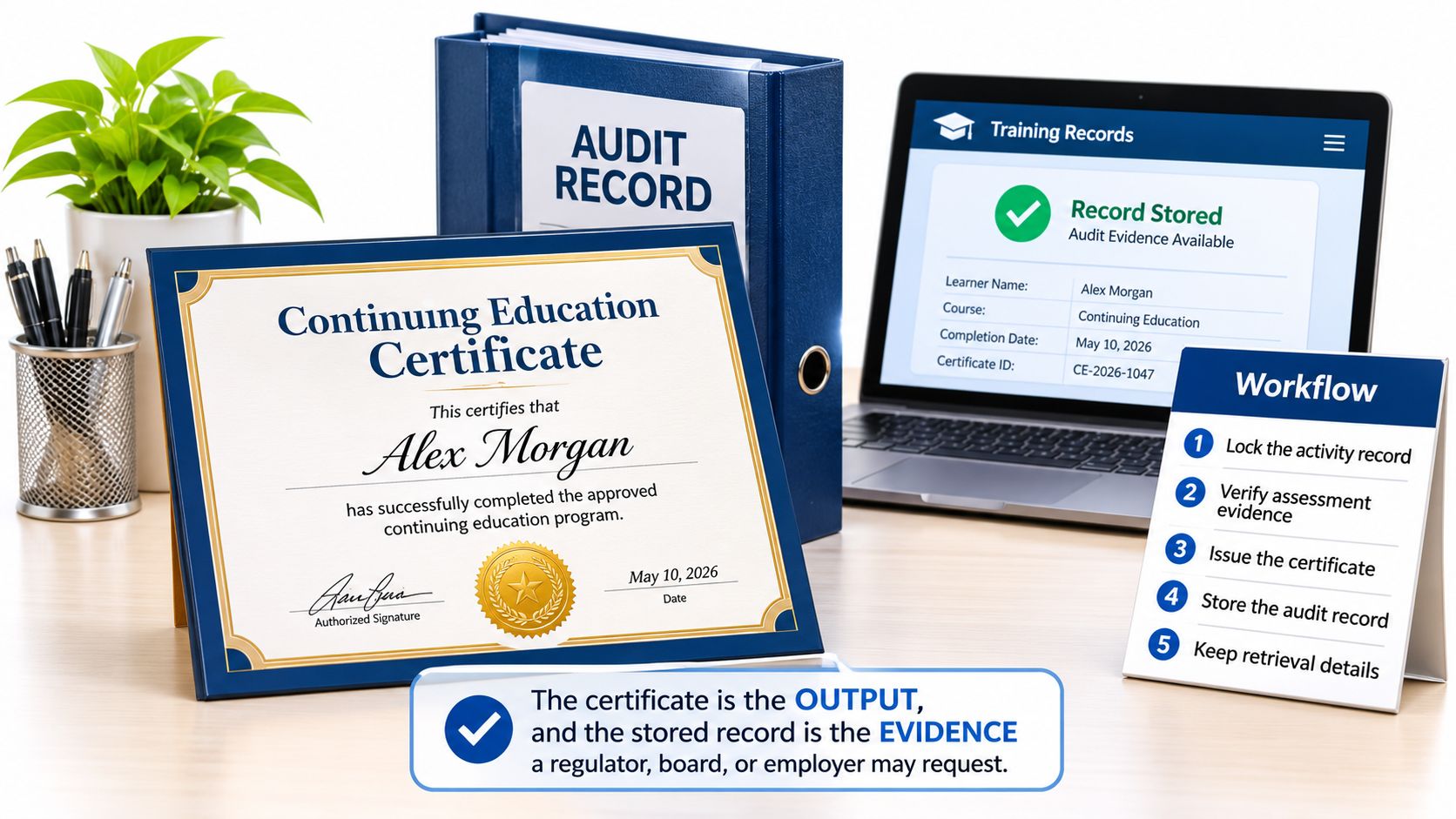
Issue certificates from verified records, not from a separate list of names. Establish the activity and completion rules first, then use those records to generate the participant-facing document.
- Lock the activity definition before registration opens. Record the provider, title, format, dates, and designated credit. Preserve a version history for authorized changes.
- Apply credit rules by learner group. A physician, nurse, and general attendee may have different eligibility within the same session.
- Make required evaluation completion a release condition. Log its completion time, but don't treat it as permission to bypass assessment or attendance checks.
- Confirm the learner passed the assessment or satisfied the applicable attendance rule. Record which condition governed the award.
- Generate the certificate from stored fields. Populate the learner name, accredited provider, activity title, format, completion date, and awarded credit without retyping them.
- Store event and completion records separately from the certificate file. Reissuing a document shouldn't require reconstructing eligibility.
- Log exceptions rather than overwriting history. Record late completion, corrected names, missed sessions, the staff member making the change, and the reason.
The workflow below illustrates the relationship between certificates and supporting audit records.
Preserve evidence behind every award
For medical maintenance-of-certification activities, the ACCME CME for MOC program guide addresses practice-gap relevance, competency alignment, commercial independence, and evaluation of changes in competence, performance, or patient outcomes. Those conditions require evidence beyond a downloadable document.
A certificate issued before required assessment is complete creates an unsupported award, even if staff collect the missing evidence later.
A spreadsheet-generated certificate isn't invalid by itself. The weakness arises when staff can't trace its values back to an approved activity, a learner's completion evidence, and the rule applied.
Your underlying record should hold:
- Preserved source data: Original event details and completion evidence, with controlled amendments.
- Reproducible calculations: Credit rules, eligibility conditions, and the values used.
- Accreditation metadata: Sponsor details, accrediting-agency information, and applicable categories.
- Exception history: Reasons, approvals, timestamps, and account changes.
- Participant continuity: A learner history that survives reissuance and account merges.
Treat continuing education recordkeeping as an operational responsibility with named owners, not a task left until an audit arrives.
Respond to an audit without rebuilding history
Suppose a physician changes state and a board requests a six-year credit history. The provider should be able to produce original completion data, the credit rule applied, and sponsorship fields, rather than only reissued PDFs.
Avoid hand-awarded credits without a log, inconsistent names between registration and certificates, and deleted records during account merges. Each breaks the connection between the person, the educational activity, and the award.
Proving Recognition and Outcomes After Issuance
A certificate documents completion; it does not, by itself, show what changed afterward. Learners may finish every module without applying the content, using the credential, or achieving the goal that prompted enrollment.
Early findings from the 2025 State of Credentialing survey, reported in Accredible's Certified Insights newsletter, indicate that more than half of credential issuers don't track learner outcomes after issuance. Without follow-up, providers cannot distinguish a correctly issued certificate from education that learners later applied.
Follow the learner beyond completion
Build a measurement plan into the program, starting with the learner's intended use:
- Record the starting point. At enrollment, capture the learner's role, intended use of the credential, and confidence in the target task.
- Schedule follow-up six to twelve months after completion. Ask about specific actions, not only whether the program was helpful.
- Measure application and recognition separately. Track workplace use, licensing or credentialing submissions, job changes, promotions, and task confidence.
- Connect responses to the learner ID used for evaluations, credit records, and certificate issuance. Set appropriate access controls and explain why you are collecting follow-up information.
For a specialty example, wound care education for practice growth can help educators frame questions about intended practice application. Ask what learners changed; do not assume that additional education produced growth.
Report what the evidence supports
Administrative workload and limited institutional readiness can make outcome tracking difficult to sustain. Assign someone to own follow-up, maintain contact permissions, and connect outcome collection to the existing learner record rather than relying on a separate spreadsheet.
Reporting rule: Keep attendance, completion, demonstrated learning, and post-program outcomes separate.
A credible outcome report states the sample size, response rate, indicators measured, and time elapsed since completion. Label self-reported results clearly. A promotion that occurs after a certificate is issued does not, by itself, show that the certificate caused it. Nonrespondents may have different experiences, so describe that limitation instead of treating respondents as the entire cohort.
Frequently Asked Questions About Continuing Education Certificates
Is a continuing education certificate the same as professional certification?
No. A certificate documents learning completed through a provider. Professional certification is granted by a credentialing body after its examination or eligibility requirements are met.
Do certificates expire?
The issuer sets any validity conditions. A historical completion record may remain accurate even when a regulator no longer accepts that learning within the current renewal cycle.
How many hours do I need?
Use the rules for your specific credential, role, and renewal cycle. For ANCC renewals, check total contact hours alongside formal approval and pharmacology requirements, rather than relying on a course's advertised duration.
How long must records be kept?
Confirm both the provider's and learner's obligations. AMA, Maryland, California, and Alabama rules use different retention periods or starting points, so a single deletion policy may not suit every participant.
Does attendance prove competence?
No. Competence requires appropriate evidence, such as an outcome-aligned assessment with a stated pass mark. Attendance can still satisfy a participation-based award when that is the governing rule.
Can a lost certificate be reissued?
Yes, when preserved activity and completion records support it. Reproduce the original award accurately and log any authorized correction rather than changing historical information without notice.
Will an employer accept my certificate?
Acceptance is the employer's decision. Provide assessed competencies, workload, issuer information, and relevant accreditation evidence; use the recognition and export questions below to test whether your records support that review.
Confirm Your Certificate Workflow Before You Choose a Provider
Choose a workflow that can issue the required certificate and prove why it was issued. Before comparing software, answer these questions:
- Acceptance: Which regulator, credentialing body, or employer must accept the certificate, and which fields do they require?
- Credit rules: Can different learner groups receive appropriate credit within the same activity?
- Release conditions: Are evaluations and assessments connected to credit release?
- Record continuity: Does evidence survive certificate reissuance and learner-account merges?
- Exports: Can staff produce regulator-ready files by activity and learner?
- Retention and access: How long are records retained, and who controls access?
- Connections: Which registration, membership, or learning systems must exchange information?
For specialty recognition questions, Atlanta Hyperbaric Center's guide can help learners find recognized hyperbaric training programs. Confirm acceptance for the intended professional use before selecting an administrative tool.
At Planstone, our credit tracking module collects participant feedback, applies credit rules, and makes certificates available to attendees. Our platform manages abstract submissions, speaker tasks, disclosures, and continuing education credits in a single configured platform.
Other providers or single-purpose tools may fit better, depending on your answers. For a conference consultation, we start with information about your program, existing systems, and team requirements, then discuss where we can help.
Planstone offers configurable conference and continuing education administration that connects program preparation with evaluations, credit records, and participant certificates. Visit Planstone to discuss your learner groups, credit rules, existing systems, and the evidence your team needs to retain before issuing its next certificate.