
Which number belongs on your certificate: the hours the program advertised, or the hours you sat through? Most claim guides answer a different question. They tell you to attend, complete an evaluation, and download a PDF, as if the document were the finish line rather than the evidence.
Proving participation is the core work. Every credit system has its own accreditation rule, its own time conversion, and its own idea of what a defensible record looks like. Get those three aligned and a claim survives an audit years later. Get them wrong and you'll be reconstructing your attendance from a calendar app while a licensing board waits.
Table of Contents
- Start With the Credit Type You Need
- How to Claim CME Credits Step by Step
- Converting Attendance Time Into Credits
- Handling Partial Attendance and Missed Deadlines
- Match Your Credits to Your License Requirements
- Certificate Fields, Retention and Final Check
Start With the Credit Type You Need
Attending a program and claiming credit for it are two separate events. Credit exists only when an accredited body has designated the activity, and your record has to match the credit type that body issues.
The AMA PRA booklet draws that line clearly. Category 1 credit is designated by an accredited CME provider, while physicians claim and maintain their own records for Category 2. Pennsylvania's medical-board guidance, described in the same booklet, treats Category 2 as self-designated credit for activities that aren't designated Category 1, comply with the AMA definition of CME, and represent a worthwhile learning experience related to your practice. A Category 2 file lives or dies on your own paperwork: activity title, subject or content area, participation dates, and the number of credits claimed.
Sort the systems before you register, because they don't interchange.
| Credit type | Who designates it | What your record must show | How you claim it |
|---|---|---|---|
| AMA PRA Category 1 Credit | Accredited CME provider | Provider name, activity title, date, credits awarded | Complete the provider's process and keep the certificate |
| AMA PRA Category 2 Credit | You (self-designated) | Activity description, subject area, participation dates, credits claimed | Create and retain your own record |
| AMA Direct Credit | AMA, after your application | Activity title, accreditation statement, date, claimed amount, proof of completion | Submit the AMA Direct Credit Application with the processing fee |
| European CME credit (ECMEC) | EACCME-accredited organizer | Accrediting body, total credits, participation time | Claim only the hours actually attended |
| RCPSC MOC accredited activity | Accredited organization | Accreditation status, activity category, dates, credit calculation | Record the activity and upload the certificate |
Time spent teaching or preparing a session doesn't count toward AMA PRA credit on its own. Neither does registration without participation.
Three questions to answer before you register
- Who accredited this activity? Look for a named accrediting body, not just a logo on the brochure.
- Which credit type will I receive? Category 1, Category 2, direct credit, ECMEC, and MOC credit all behave differently.
- What document will prove it? If you can't picture the certificate's fields, you don't yet know what you're claiming.
Nurses, pharmacists, and other nonphysician learners follow separate credit systems that this table doesn't cover. Check with the body that licenses or certifies you, and don't assume an AMA PRA credit automatically counts toward its requirements.
How to Claim CME Credits Step by Step
The sequence below is the one that survives scrutiny. Each step exists because something downstream depends on it: skip one, and the document you end up holding may not prove what an auditor asks it to prove.
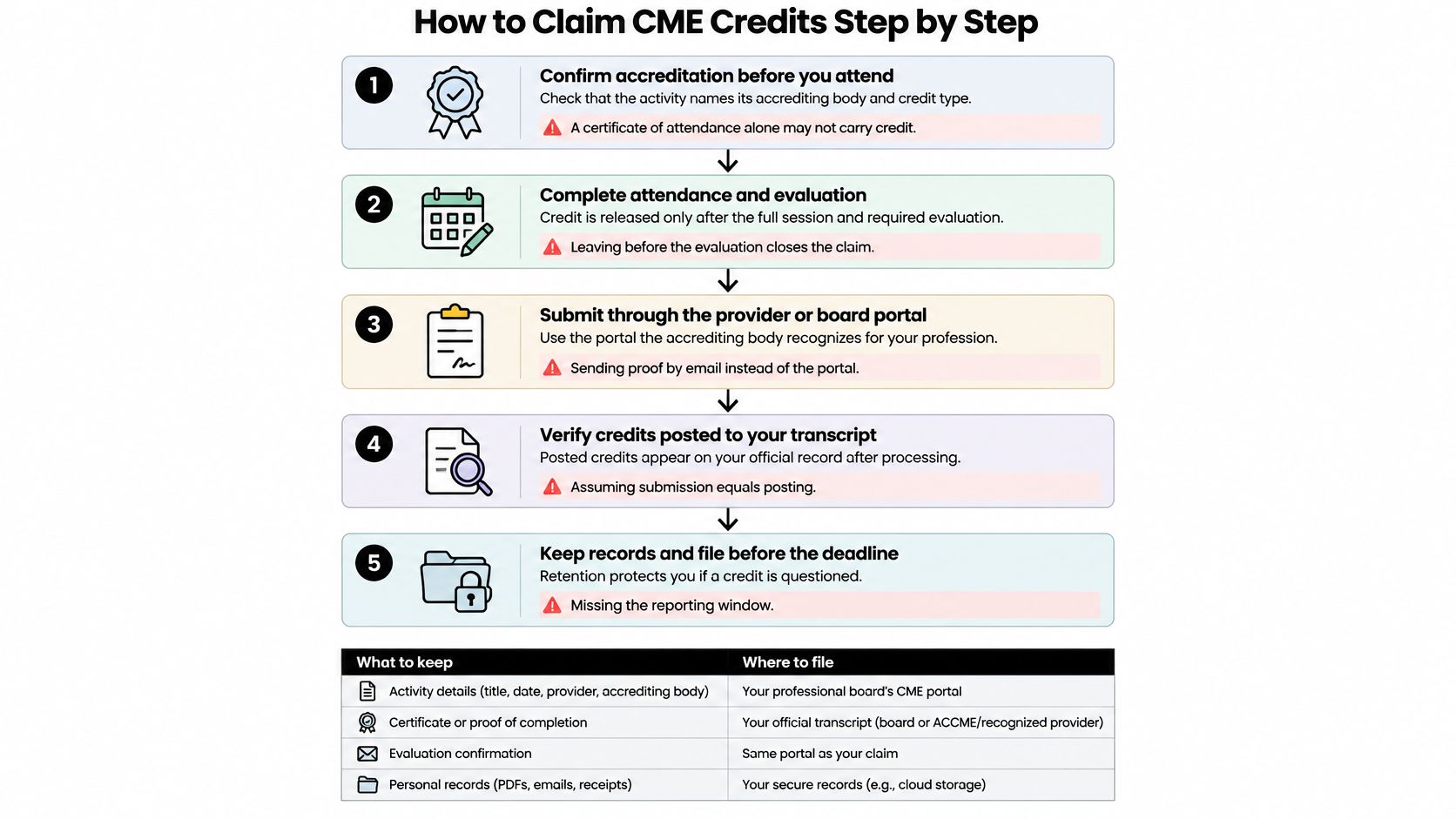
1. Confirm accreditation before you attend. Check that the activity names its accrediting body and its credit type. Common slip: a certificate of attendance is not always accredited CME credit, so ask which document carries the credits.
2. Register under the learner identity you'll claim under. The certificate carries the name on the registration, so a nickname or a shared department login creates a mismatch you'll spend weeks fixing.
3. Record your participation. Note start and end times, or the specific sessions you attended. EU-ACME guidance on collecting CME credits is direct on this point: participants should claim only the hours they spent in the educational activity. For EACCME-accredited live events, the minimum activity duration is 30 minutes, and 30 minutes of education equals 0.5 European CME credits (ECMEC). Your notes are the raw evidence everything else rests on, so write them down the same day, not the same month.
4. Complete attendance checks and any post-test. Some portals won't release credit until these conditions are met. Common slip: leaving the room before the final scan, then discovering the record shows half a day.
5. Submit the evaluation. EACCME procedures commonly require a post-event evaluation, and some programs send the link after the congress closes. Others ask for an evaluation of every session you claim plus an overall one. Treat the evaluation as part of the activity itself: unfinished evaluations are one of the most common reasons a claim stalls.
6. Claim the credit you earned, not the advertised maximum. Select the matching credit type at the same time, because switching it later usually means starting over. This is the step where honesty about your actual participation protects you, since the number on the certificate is the number an audit will test against your attendance record.
7. Download the certificate or transcript and store a copy outside the portal. Portals close, and logins expire. For European activities, send the EACCME certificate to your national accreditation authority where recognition or conversion is needed.
Here's a short walkthrough of the claiming workflow in practice.
Before you close the tab, run a completion check. The certificate should show the accreditation statement, your name, the activity title, the date, and the credits awarded. If any of those is missing, the claim isn't finished. A certificate with a blank field is like a receipt with no total: it looks official, but it proves nothing specific.
When there's no provider designation
Some eligible activities carry no provider designation. The direct-credit route replaces steps two through seven.
- Confirm eligibility and timing. Confirm that the activity qualifies for direct credit under the AMA's current eligibility rules before you apply.
- Assemble the file. Activity title, accreditation statement, date, claimed amount, and proof of completion.
- Submit and archive. Send the application with the applicable processing fee and keep a copy of everything you sent.
Converting Attendance Time Into Credits
Say you attend 75 minutes of a three-hour accredited course before a clinic calls you away. The claim is 1.25 AMA PRA Category 1 Credits, not 3.0, and the certificate should show that figure. The math is straightforward once you know the increment.
U.S. physicians claim according to individual participation time, up to the activity's designated maximum, in 15-minute increments, with each quarter hour worth 0.25 AMA PRA Category 1 Credit, per AMA guidance on claiming credit. That's why 45 minutes becomes 0.75 credit and two hours becomes 2.0 credits, provided the activity permits that amount. The AMA's FAQ for participating physicians adds a detail worth remembering: accredited providers must be able to supply credit documentation for at least six years after an activity ends, which is a floor, not a substitute for your own copy.
Canada works differently. The Royal College MOC framework awards 1 credit per hour for accredited activities and 0.5 credit per hour for unaccredited ones, caps unaccredited Section 1 activity at 50 credits per five-year cycle, and requires 250 credits over five years with at least 25 credits annually.
| Activity type | Conversion rule | Worked example |
|---|---|---|
| AMA PRA Category 1 | 0.25 credit per 15-minute increment, up to the activity maximum | 45 minutes = 0.75 credit; 2 hours = 2.0 credits |
| EACCME live event (ECMEC) | 0.5 ECMEC per 30 minutes; 30-minute minimum | 30 minutes = 0.5 ECMEC |
| RCPSC MOC, accredited activity | 1 credit per hour | 3 hours = 3 credits |
| RCPSC MOC, unaccredited activity | 0.5 credit per hour; Section 1 capped at 50 credits per five-year cycle | 4 hours = 2 credits |
Two mistakes account for most inflated claims. The first is rounding partial quarter hours up, which pushes the total past what you attended. The second is claiming the full program because its sessions appeared on the schedule you registered for. For multi-day or multi-track meetings, total the minutes session by session, then convert the sum once. If you want a deeper reference on how continuing education credit hours are structured across programs, that's the place to start.
Practical rule: convert minutes to credits after the event, from your own notes, not before it from the brochure.
Handling Partial Attendance and Missed Deadlines
Say you attend the morning of a two-day symposium, skip the afternoon workshops, and let the evaluation email sit in your inbox for a month. None of that is unusual, and none of it automatically costs you the morning.
Partial attendance. Claim only the sessions or hours you attended. Where a program allows session-level claims, evaluate each session you attended, then complete the overall evaluation if it's required separately. Claiming less than you earned also happens for practical reasons: a 2025 study of CME-course attendees surveyed from 2022 to 2023 found that 70% reported claiming fewer CME hours because of inadequate lactation accommodations.
Missed evaluations. Some programs treat the post-event evaluation as a condition of credit rather than an optional survey. Check whether the provider accepts late submissions before you write the credit off. A phone call to the CME office is cheaper than repeating the course.
Deadlines. Claiming windows vary widely, and one set of conference claiming instructions enforces a 21-day post-event window. Set a calendar reminder for the day the event ends, not the day you get home.
If the portal has already closed
- Save your attendance evidence. Screenshot or export the confirmation, with its date visible.
- Email the provider's CME office. Include the activity title, the date, and your attendance evidence.
- Keep the reply in your file. A written answer from the provider is documentation too.
Ask which document carries the credits. A certificate of attendance proves you were in the building. It doesn't always prove you earned accredited hours, and the difference matters when a board asks.
Complete the evaluation the same day you finish the activity. The link is easy to find while the content is fresh, and impossible to find three months later.
Match Your Credits to Your License Requirements
A claim can be valid and still fail a renewal check. Think of the certificate as a receipt: it proves what was earned, while your board rule decides whether that purchase fits the budget. The credit type, the cycle dates, and the certificate fields determine whether the hours count where you need them.
| Jurisdiction | Total hours | Cycle | Category rule |
|---|---|---|---|
| Texas | 48 hours | Two years | 24 hours must be AMA PRA Category 1 |
| Kentucky | 60 hours | Three years | 12 hours in Category 1 |
| Maryland | 50 credits | Two years before expiration | At least 25 Category I credits |
| California | 50 hours | Biennial renewal cycle | Approved CME; records retained at least four years |
The Kentucky Board of Medical Licensure schedule sets 60 hours over three years, including 12 hours in Category 1. Texas uses a different shape: the Texas Medical Board's CME guidance sets 48 hours per two-year cycle, with 24 of them in AMA PRA Category 1. Maryland adds a reporting quirk on top of its hour count. The Maryland Board of Physicians renewal guidance asks for at least 50 Category I or Category II credits in the two years before expiration, including at least 25 Category I, and notes that physicians generally shouldn't send CME documents with the renewal unless selected for audit. They must still retain those documents for six years.
That last point causes confusion. Self-attestation means you keep the proof ready, not that the proof stops mattering. A board can ask later, and the answer has to come from documents that show participation, credit type, and dates.
A four-step check before renewal
- Look up your board's current rules. Check the rule for the cycle you are completing, not last cycle's rule or a colleague's summary.
- Put each certificate into the right bucket. Category I, Category 1, and Category II labels matter because one category may not fill another category's slot.
- Confirm the activity falls inside the cycle dates. A conference attended two weeks before the cycle opened belongs to the earlier cycle, even if the certificate arrives later.
- Write down the audit requirement beside each activity. Store the certificate, attendance confirmation, and any evaluation record together so the file answers questions without a scramble.
A useful analogy is a filing cabinet with labeled folders. The label is the board category, the folder is the renewal cycle, and the papers inside are the documents that prove attendance. If a certificate lands in the wrong folder, the hours still exist, but they do not help at renewal time.
International physicians face an extra step. A U.S.-accredited certificate may still need acceptance from a home regulator or employer, and that decision belongs to the licensing authority or employer that sets the requirement. If you are building a documentation set from scratch, this guide to continuing education certificate programs covers what a provider-side record should contain.
Claiming the right hours with defensible documentation beats maximizing total hours with paperwork you can't explain.
Certificate Fields, Retention and Final Check
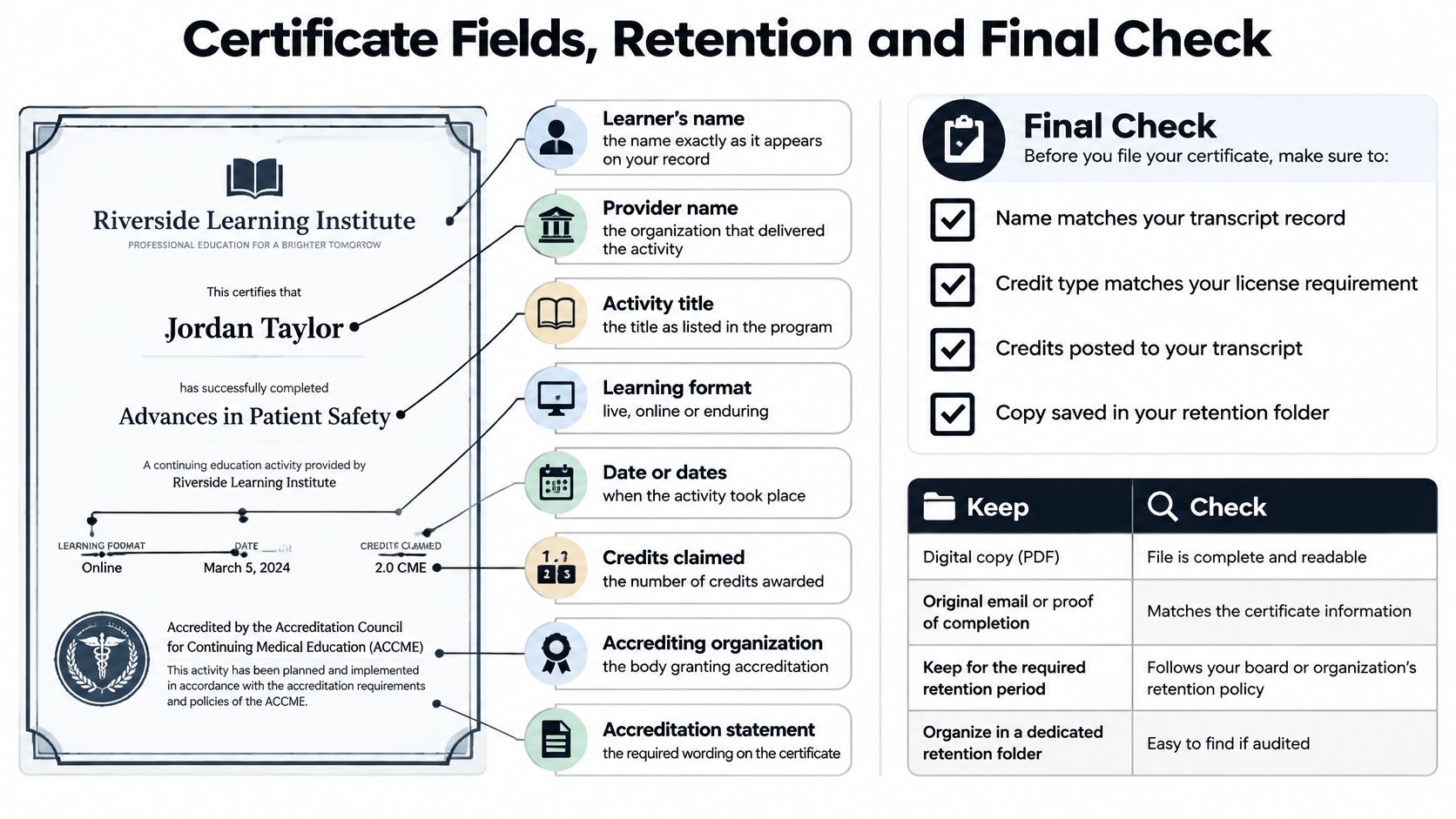
A certificate that can't answer who, what, when, and how much isn't evidence. It's a souvenir. The California Medical Board's audit standard is a useful benchmark because it lists the fields explicitly.
The California board's CME requirements call for at least 50 hours of approved CME per biennial renewal cycle and records retained for a minimum of four years, identifying the physician, course or program title, attendance date, number of credit hours, sponsoring organization, and accrediting organization where applicable.
The field checklist
- Learner name. Exactly as it appears on your licensing record, not a preferred name.
- Provider name. The organization that delivered the activity.
- Activity title. As listed in the program, not a paraphrase.
- Learning format. Live, online, or enduring. Formats carry different rules in some systems.
- Date or dates. The actual attendance date, which may differ from the publication date.
- Credits claimed. The number you earned, not the maximum offered.
- Accrediting organization and accreditation statement. The wording that tells a board which rule set applies.
Category 2 entries work in reverse: you write them yourself, including the activity description, subject area, participation dates, and credits claimed. Our evaluations module collects participant feedback, applies the program's credit rules, and makes certificates available to attendees, which is the provider-side version of the same discipline. If you want a template for what a compliant record looks like, this explanation of participation certificate format walks through the structure.
Build the file once, then maintain it
Use one folder per licensing cycle, one PDF per activity named by date and title, and a spreadsheet with columns for credit type, credits claimed, and where the certificate lives. Keep your own copy even when the provider stores records, because a six-year retention rule at the provider end can expire before your board's obligation does.
Before the claiming window shuts, confirm three things: the credits on each certificate match your time records, the credit type matches your board's rule, and the file exists in two places. If the portal shows no credit, contact the provider with the activity title, date, certificate, and attendance evidence in one message. Vague queries get vague answers.
Planstone connects evaluations, credit rules, and certificate delivery in one configured platform, so attendees claim the hours they earned and administrators can see the record behind every certificate. If your program handles partial attendance, session-level evaluations, or multiple credit types, our team can map those rules into the workflow before your next event. Visit Planstone to talk through how credit tracking would work for your conference.