

A peer-reviewed analysis of state occupational therapy boards found licensed professionals facing required continuing education ranging from 10 to 40 hours per renewal cycle, a fourfold gap, while six states required none at all for renewal (the 2016 study is published in PubMed Central). Same profession, same credential, wildly different obligations.
That gap is why a continuing education credit hour can't be treated as a fixed quantity. It's a recorded entry, and the recording rules decide whether the entry counts.
Table of Contents
- What Continuing Education Credit Hours Measure
- How Credit Hours Are Calculated Under Each Rule
- Requirements Vary by Profession and Jurisdiction
- Faculty Credit Differs From Attendee Credit
- How to Document Credit Hours for Each Participant
- Avoid Credit Mistakes and Check Eligibility Before Enrolling
- Frequently Asked Questions About Credit Hours
What Continuing Education Credit Hours Measure
One hour of attendance can produce different credit totals under different rules. A continuing education credit hour is a recorded unit of eligible learning that a licensing body, accreditor, or employer accepts as evidence of professional development. It is a compliance entry, not an hour spent in a room.
A bank statement offers a useful analogy. Attendance is the transaction: a session took place, and someone participated. The credit record is the posted entry. If it was recorded under the wrong rule, a licensing board may not accept it, even when the learner attended the session.
Three terms that get mixed up
- Hours of time. The clock time scheduled for learning, which may also include breaks, meals, or introductions.
- Credit awarded. The amount calculated from eligible learning time under a particular set of rules. The same hour can produce different credit amounts for different learners.
- Certificate. A document reporting the credit awarded. It records the result, but the number still needs to follow the applicable rules.
These distinctions matter when a certificate shows a credit total that a regulator does not accept. The document may be accurate as a record of what a provider awarded, while the award itself does not meet the regulator's requirements.
A 2024 review of countries worldwide found a formal continuing medical education system in 96% of the countries analyzed, yet only slightly more than half required physicians to participate as a condition of practicing medicine (the review appears in PubMed Central). Having a CME system and requiring participation are separate facts.
Practical rule: Before relying on a credit entry, identify the profession, jurisdiction, renewal period, and rule used to calculate it.
Keep those four details with each credit record. Without them, a number on a certificate may be difficult to verify or apply to a renewal requirement.
How Credit Hours Are Calculated Under Each Rule
Credit is calculated from eligible time, not from the length of the event printed in the program. The frameworks below each publish their own arithmetic: ANCC certification renewal requirements, IRS continuing education provider FAQs, and the AMA PRA Credit System requirements.
| Framework | One Credit Equals | What Counts | Rounding |
|---|---|---|---|
| ANCC nursing contact hour | 60 minutes of eligible learning | Instruction plus evaluations and post-tests; excludes breaks, meals, introductions | Nearest quarter hour |
| IRS approved CE contact hour | 50 minutes of instruction | Instructional time only; breaks and introductions excluded | Whole credits only, no partial credit |
| AMA PRA Category 1 Credit (participant) | 60 minutes of live formal interaction | Faculty and physician interaction time in live activities | 0.25-credit increments, nearest quarter |
| AMA PRA Category 1 Credit (faculty) | 2 credits per presentation hour | Eligible original presentations at live CME activities | Nearest quarter credit |
Three frameworks, three answers
Under ANCC rules, one contact hour represents 60 minutes of eligible learning, and time spent completing evaluations or post-tests can be included while breaks, meals, introductions and administrative activity can't. Rounding to the nearest quarter hour is permitted, but the method has to be logical and defensible, and any activity longer than three hours needs a detailed agenda showing where the time went. A four-hour conference block containing 30 minutes of breaks and a 15-minute administrative opening supports 3.25 contact hours, not four.
The IRS rule reads differently. One credit is awarded per full contact hour, a contact hour is 50 minutes of instruction, and no partial credit exists. A 75-minute educational activity earns one credit rather than 1.5, and a 100-minute activity earns two if all 100 minutes qualify as instruction.
AMA PRA Category 1 Credit for participants runs on 60 minutes of formal interaction between faculty and physicians, awarded in 0.25-credit increments rounded to the nearest quarter hour. Three frameworks, three totals, one clock.
A four-step method
- Identify the governing rule. Which accreditor designates this credit, and which licensing body accepts it? Everything downstream depends on the answer.
- Measure eligible minutes. Session start and end, minus the excluded blocks. Not the scheduled slot, the eligible remainder.
- Apply that rule's rounding. Nearest quarter hour for ANCC and AMA, whole credits only for the IRS. Never blend two methods in one program.
- Record the method used. Store the rule, the excluded intervals and the rounding decision with the entry, so a later audit can redo the arithmetic.
A single universal hours-to-credits conversion breaks the moment a program serves more than one framework. It over-awards against a 50-minute rule and under-awards against faculty ratios, and neither error surfaces until a learner's renewal is rejected.
Units travel badly between fields, too. Water engineers log professional development hours in a different currency from nurses, and this guide to how water engineers report PDH hours shows how PDH records diverge from CEU math even when the underlying training is similar.
Requirements Vary by Profession and Jurisdiction
A credit hour is a recorded compliance entry, not a universal measure of seat time. The entry counts only if it matches the learner's license, renewal cycle, required subject areas, and reporting rules. For example, California behavioral-health licensees need 36 hours every two years, including six hours of law and ethics (California Board of Behavioral Sciences CE brochure).
| Program | Required Amount | Cycle | Notable Rule |
|---|---|---|---|
| California behavioral-health licensees | 36 hours | Every 2 years | Includes 6 hours of law and ethics |
| Massachusetts Licensed Site Professionals | 36 credits | 3 years | Up to 12 lapse credits reusable at next renewal |
| Hawaii insurance licensees | 24 hours | Every 2 years | Complete education and receive provider reporting before paying renewal fees; finish at least 15 days before the deadline |
| US licensed customs brokers | 20 hours (2024 to 2027 period); 36 hours in later periods | Triennial | Reduced requirement for 2024 to 2027 only |
| Royal College of Physicians of Ireland (2025 to 2026) | 50 CPD hours per year | Annual, reviewed over 3 years | Must cover all 8 domains of good professional practice |
| Board of Pharmacy Specialties | 100 recertification units | Set by the specialty board's recertification period | At least 80 approved, assessed education units; up to 20 self-reported |
The same number of hours can represent different compliance outcomes. California's 36-hour total includes six hours of law and ethics, so 36 hours of clinical electives do not meet the full requirement.
Rules also differ on credits earned during a lapse. Massachusetts Licensed Site Professionals may use up to 12 lapse credits at the next renewal. That allowance does not apply automatically to other professions or jurisdictions.
For Hawaii insurance licensees, timing involves both learning and reporting. Education must be completed and provider reporting received before renewal fees are paid. Finishing the coursework is not enough if the report has not arrived.
Requirements can change between cycles. The Federal Register notice on customs broker continuing education sets a 20-hour requirement for the 2024 to 2027 triennial period, with 36 hours in later periods. A credit total from an earlier cycle may no longer apply.
Some frameworks also require specific categories and evidence, not just a total. The Royal College of Physicians of Ireland framework divides annual CPD hours among planning, practice review, work-based learning, and accredited education, with coverage required across all domains of good professional practice over a rolling window.
Before enrolling, check the regulator's rules for your license, renewal cycle, and subject requirements. Confirm that the resulting record includes the fields the regulator requires. Continuing education certificate programs can support documentation, but the applicable rules determine what the certificate must show.
Faculty Credit Differs From Attendee Credit
A physician who attends an hour of a live activity and a physician who presents that same hour don't earn the same credit. Physician faculty may receive credit at a 2-to-1 ratio to presentation time: a one-hour presentation can qualify for two credits, while a 45-minute presentation can qualify for 1.5 credits, rounded to the nearest quarter credit (AMA faculty credit guidance). Attendance earns one credit for each 60 minutes participated, claimed in 15-minute increments.
Put both roles in the same session and the mismatch becomes obvious. One hour of programming produces 1.00 credit for the audience and 2.00 credits for the presenter, from a single session record.
Same room, same hour, double the credit. The difference isn't the learning. It's the role and the ratio the accreditor attaches to it.
What the record has to store
A system applying one universal conversion will misstate at least one of those groups every time. Five items have to live separately on the record:
- Attendance validation. Evidence the person was present, per session, not just registered.
- Session-level eligible minutes. The instructional remainder after exclusions.
- Learner role. Attendee, faculty, moderator, or panelist, because the ratio changes.
- Activity format. Live, enduring, or blended, since each verifies completion differently.
- Credit designation. The accreditor and credit type the activity was approved for.
Keep those on the record and reporting reconciles awarded credit to verified participation. Drop any one and the reconcile becomes a manual investigation.
Build the rules as configurable rule tables keyed to accreditor, activity type, participant role, date and rounding increment. Rules change, including effective dates that split a single program year, and a table you can update beats a formula buried in an export that nobody wants to touch.
How to Document Credit Hours for Each Participant
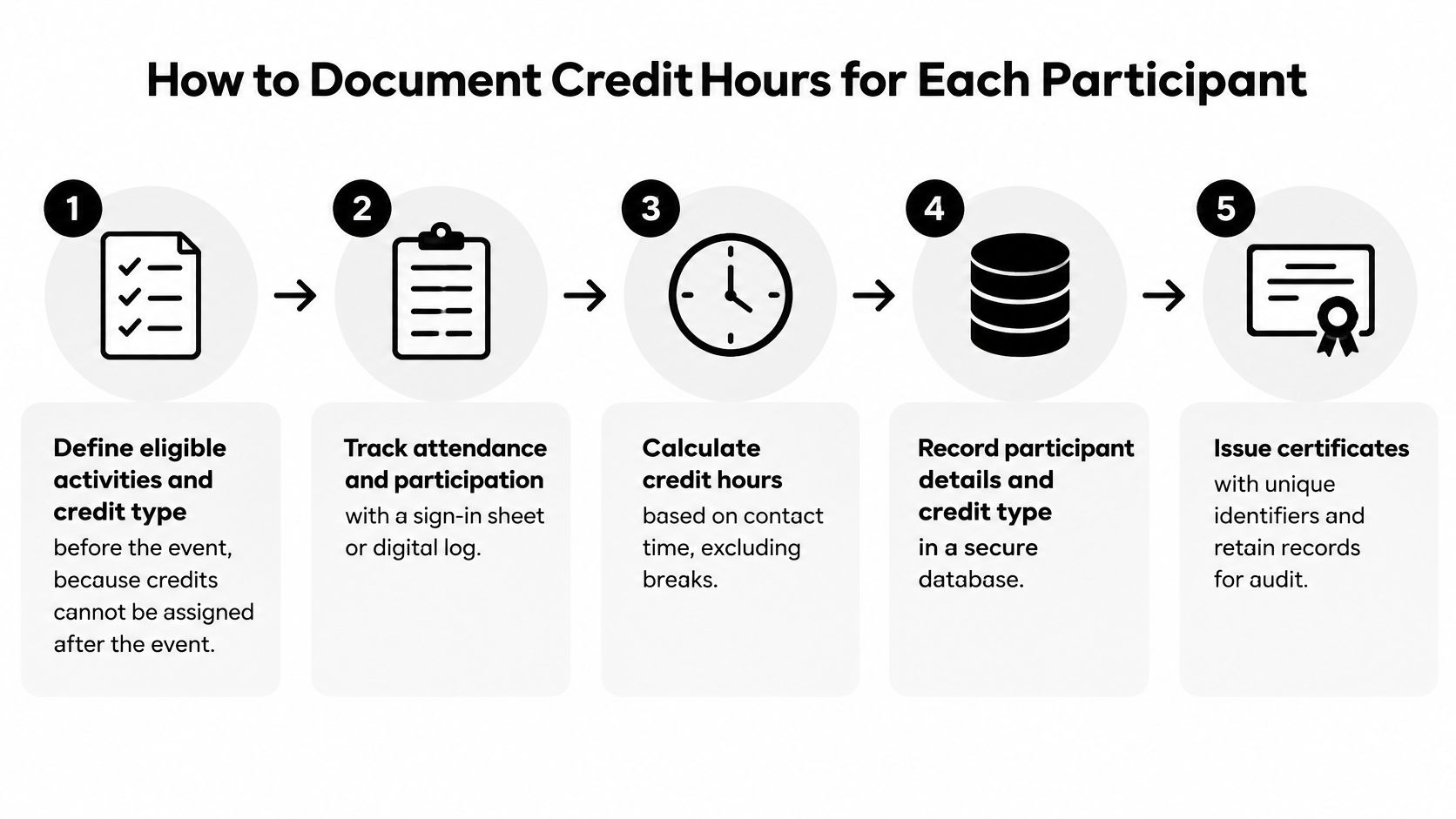
A certificate is the visible result of a longer record. To support an audit, document who completed each eligible activity, how credit was calculated, and what was issued. For programs subject to the IRS provider rules, the record must support participant eligibility, completion, certificates with the current qualified program number, and segment-level attendance (31 CFR 10.9).
Use these seven steps to build the record from planning through retention. The workflow can be managed in a configured system or a carefully maintained spreadsheet.
- Define eligible activities and credit types before the event. Set the credit type, designating body, and approved maximum while the agenda can still be adjusted. This gives staff a rule to apply when they review participation.
- Record session start and end times, listing excluded intervals separately. Give breaks, meals, and introductions their own entries. A total session length alone does not show how many minutes qualify.
- Verify attendance for each segment and participant. For continuous conferences and conventions, records must show completion and attendance at each individual segment, not just registration for the event. A daily sign-in covering several parallel rooms cannot confirm which sessions a person attended.
- Record evaluation and post-test completion. Include these when the applicable rule requires them or counts them toward completion. If a post-test is required, its completion is part of the evidence, not a detail to fill in later.
- Apply the rule for each participant's role and credit type, then use the specified rounding method. Faculty and attendees may receive credit differently. Applying the attendee calculation to faculty, or the reverse, can produce an incorrect total.
- Issue a certificate showing the program number and credit awarded. The certificate should match the participant's recorded credit. Use a participation certificate format that includes the information needed to identify the program and the credit issued.
- Retain attendance and completion records for the required period. The IRS provider rule specifies four years after the program ends. Other regulators may require longer retention, so follow the applicable audit window when it exceeds that period.
Audit file checklist
Keep six items together:
- The agenda with session times.
- A time log that identifies excluded intervals.
- Attendance records by segment and participant.
- Evaluation and post-test completion status.
- The credit rule applied and its rounding method.
- A copy of each certificate as issued, with its issue date.
These records let staff trace each certificate from a participant's attendance through the rule used to calculate the credit.
Avoid Credit Mistakes and Check Eligibility Before Enrolling
Most credit failures aren't dramatic. They're reasonable assumptions, held by intelligent people, that happen to be wrong for their license. Four of them account for a large share of the reissued certificates and rejected renewals that education teams deal with.
One hour is one hour everywhere. It isn't. Units, cycles and eligibility rules differ by regulator, so the record needs profession, jurisdiction, cycle and governing rule attached to every entry. Without those four fields, a total is a number without a provenance.
An attendance certificate proves learning. It proves attendance. The Royal College of Physicians of Ireland framework requires CPD spread across planning, practice review, work-based learning and accredited education, with documented coverage of all domains of good professional practice over a rolling window. That standard can't be met by a certificate alone, so objectives, assessments, reflections and practice-review evidence need to sit alongside the attendance record.
Any hour counts. The Board of Pharmacy Specialties requires that the bulk of recertification units come from approved, assessed education, with only a limited slice from self-reported CPD, plus an annual reflection and plan. A folder of self-reported webinars doesn't clear it.
Late hours are fine. Total hours can be complete and the renewal still fails, if mandatory categories are missing or the provider's report reaches the regulator after the fee is paid. Timing and subject mix are part of the requirement, not paperwork around it.
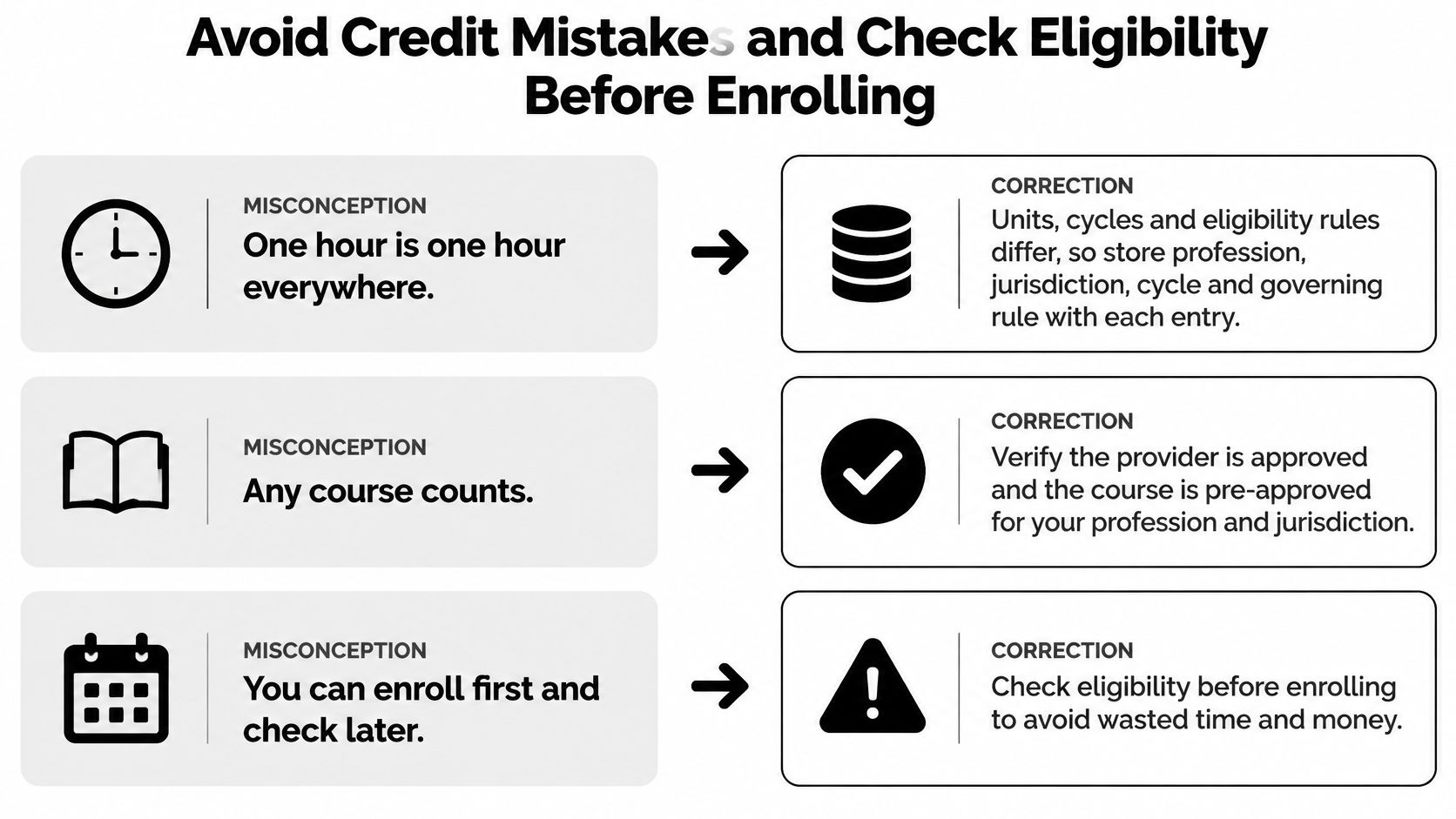
Six checks to run before you enroll
- Confirm your licensing body, renewal cycle and required categories. Write them down with the date you checked, because the rules move.
- Confirm the accreditor and the exact credit type. ANCC contact hours aren't automatically interchangeable with CEUs, clock hours or educator credits; acceptance depends on the receiving state or agency recognizing ANCC-accredited nursing education (NASN guidance on ANCC NCPD contact hours).
- Check the stated eligible minutes and the rounding rule. Ask what the four-hour block contains. The answer is often 3.25.
- Confirm the reporting deadline and whether completion must be reported before a renewal fee. Fifteen days of buffer is a habit worth keeping.
- Request a certificate showing the program number and credits, and keep it for at least four years. Store it where you'll find it during a renewal, not in an inbox, and settle on recordkeeping or record keeping conventions your whole team follows.
- Confirm the credit counts toward a required category, not just the total. This is the check people skip, and it's the one that fails.
Confirm the rules with your own regulator before enrolling, not after. Our platform lets an organization run individual modules alongside systems it already has, or bring submissions, speakers and continuing education administration into one place, with each module configured around its process and branding.
Frequently Asked Questions About Credit Hours
Are continuing education credit hours the same in every state? No. Required amounts, renewal cycles and mandatory subject categories are set by each regulator, so a figure from another profession or state tells you nothing reliable about your own.
Is one ANCC contact hour the same as one CEU? Not automatically. ANCC contact hours convert to another unit only if the receiving licensing body or agency explicitly permits it, so label the credit type accurately and don't convert on your own.
Do breaks, meals or introductions count toward credit? No. Under ANCC, IRS and AMA rules those blocks are excluded from eligible time. A four-hour block with 45 minutes of noninstructional content is a 3.25-hour block, and the arithmetic should be visible on the record.
Do I need proof for each session of a multi-day conference? Yes. Records must verify attendance at each individual segment, not merely registration for the overall event, and that's the difference between a certificate that survives an audit and one that doesn't.
Can credits earned during a lapse be used? Sometimes. Massachusetts Licensed Site Professionals may reuse credits earned during a lapse at the next renewal; many other regulators don't allow it, so check the lapse rule before assuming the hours still count.
How long should I keep certificates? At least four years, matching the IRS provider retention rule, and longer if your own regulator's audit window is longer.
Planstone configures continuing education administration around a program's credit types, attendance rules, eligibility limits and certificate requirements, so learner records, evaluations and certificates stay tied to the rule that produced each number. If your team is still reconciling credit totals in spreadsheets the week before renewal season, our credit tracking module collects participant feedback, applies your credit rules and makes certificates available to attendees. Visit Planstone to see how programs like yours run submissions, speaker tasks, disclosures and credit administration in one configured platform.