

A financial disclosure form is a standardized questionnaire that records an individual's financial relationships with companies, sponsors or other parties so potential conflicts can be reviewed, mitigated and disclosed. In U.S. healthcare alone, the scale of that record keeping is enormous: the CMS Open Payments program has published 84.05 million records totaling $72.80 billion in payments and ownership interests since 2017, involving 2,843 companies, 1.12 million physicians, 414,872 non-physician practitioners and 1,440 teaching hospitals, according to the CMS Open Payments overview. Look-back windows differ by program, from 24 months for accredited continuing education to 36 months for journal disclosures, and clinical research carries an update duty that runs a year past study completion.
The form itself decides whether any of that is reviewable. A field set that captures the wrong counterparty, hides the date, or never records who reviewed the answer produces paperwork that looks complete and answers nothing. The pattern repeats across programs: weeks spent chasing signatures, then the discovery that no one can say which faculty member had a relevant relationship with the company funding the symposium.
Table of Contents
- What a Financial Disclosure Form Is and Why It Matters
- Typical Fields on a Financial Disclosure Form
- How Disclosure Rules Differ Across Programs and Regulators
- Financial Disclosure Rules for Clinical Research
- How to Collect Disclosure Responses Step by Step
- How to Review and Verify Disclosure Responses
- Special Cases and a Cycle Checklist
- Set Up a Disclosure Workflow That Holds Up
What a Financial Disclosure Form Is and Why It Matters
A reviewer who cannot name the company, the type of payment, and the dates covered cannot defend a mitigation decision. The form is the front end of that verification workflow. Field design and one consistent look-back decide whether answers can be reviewed, reconciled, and produced later.
Organizations that publish research, run accredited education, or award contracts share one problem: money can bend judgment, and outsiders cannot see the tie. The form turns that risk into a structured record, one row per person, per relationship, per period. Conference faculty and planners, abstract authors, clinical investigators, journal authors, and public officials complete different versions. Obligations differ by program. Each version still has to ask, record, review, and then disclose or mitigate.
I judge a form by four jobs, not by how clean the PDF looks.
Transparency means the organization can produce the record on request, instead of relying on whoever ran the meeting. Review input means the conflict process gets the facts it uses: counterparty, nature of the relationship, timing, and amount. Compliance evidence means an accreditor or regulator can see that the right people were asked, instructed, and reviewed, not only that a stack of forms exists. Audience trust means attendees and readers can see the financial backdrop behind expert content.
A completed form does not prove a conflict. It supplies structured information a committee evaluates against its own policy. That evaluation is the substantive work.
If the look-back printed on the form does not match the policy, two faculty members describing the same consulting contract will report different years. Reconciliation fails before anyone opens a mitigation discussion. If the form never records who reviewed the answer and what was decided, the file looks complete and still cannot be defended twelve months later.
Open Payments, run by the U.S. Centers for Medicare & Medicaid Services under the Physician Payments Sunshine Act, shows the same discipline at national scale. Manufacturers and group purchasing organizations must report certain payments, transfers of value, and physician ownership interests, and CMS publishes that data annually. Consistent categories, recipient identities, reporting periods, and a correction process keep the data usable. A conference program needs those habits in miniature: one look-back, named counterparties, and an audit trail from answer to decision.
Paper collection breaks at the seam. Forms arrive, someone files the signatures, and nobody writes down the relevance call. The evidence file is the signature plus the review note. Without the note, the program cannot show why a relationship was mitigated, disclosed to the audience, or judged not relevant.
Typical Fields on a Financial Disclosure Form
A usable form separates two families of fields. Identity and role fields anchor the disclosure to a specific person and a specific piece of work, so a reviewer knows whose relationship they're evaluating and what content it touches. Relationship fields describe the counterparty, the nature of the tie, the amount and the timing.
| Field group | What it captures | Examples and notes |
|---|---|---|
| Respondent identity | Name, credentials, institution, email | Links the disclosure to a person and organization |
| Role and activity | Position in the program, session, abstract or study | Faculty, planner, author, investigator, reviewer |
| Counterparty | Company or organization name and type | Ineligible company, commercial interest, study sponsor |
| Relationship type | Nature of the financial relationship | Consulting, speakers bureau, advisory board, equity, royalties, research grant, employment, travel |
| Amount and dates | Payment value or range, transaction or relationship dates | Annual totals, monthly retainers, ownership value |
| Look-back period | Time window the policy requires | 24 months for ACCME, 36 months for ICMJE, study-specific for FDA |
| Relevance | Whether the relationship relates to the content or role | Self-assessed at collection, then confirmed by a reviewer |
| Support for the work | Funding and sponsor role for the project itself | Grant, equipment, sponsor role in design, analysis and writing |
| Attestation | Signature confirming accuracy and completeness | Date, electronic signature, commitment to update |
| Review record | Reviewer decision and mitigation | Relevant or not relevant, mitigation action, learner disclosure date |
Relationship type needs fixed categories
Free text is unmanageable. If the answer to "nature of relationship" is a paragraph, you can't count consulting relationships, can't filter by speakers bureau work, and can't audit last year's decisions against this year's. The ICMJE proposed disclosure form uses structured categories, including grants, personal fees, nonfinancial support, patents, employment, consulting, speakers' bureau participation and travel, alongside free-text context and recipient fields that distinguish the individual from the institution.
Keep both: the structured category for filtering, the free text for the reviewer who needs to understand the arrangement.
Amounts and dates make materiality judgeable
Even where a policy sets no minimum, a payment value or band lets a reviewer separate a one-off honorarium from a standing retainer. Dates matter just as much. A relationship that ended before the look-back window opens should be visible as ended, not omitted or wrongly included.
Print the look-back window on the form
This is the field group that causes the most silent errors. ICMJE's standardized model uses a 36-month reporting window for other relationships, while support for the reported work may be reported without a time limit. ACCME accredited education works to 24 months. A faculty member who disclosed on a journal form in March will carry the wrong mental model into your conference form in June. Put the window and its start date in the instructions, in plain language.
Separate support for the work from personal relationships
ICMJE's model asks authors to report sources of support for the work, the sponsor's role in study design, data collection, analysis, interpretation, writing, submission restrictions, and the author's access to data. That's a different question from what the author personally received. Blend them and you lose the ability to answer either.
Practical rule: print the look-back period, the definition of an ineligible company, and one worked example on page one of the form. Clarification emails drop sharply when the rule is visible at the point of answering.
Close with an attestation that commits to updates
The form ends with a signature, a date, and a statement that the respondent will report changes. Without the update commitment, every downstream re-attestation trigger has no basis to stand on.
Map your current form against the table above and write down the missing fields. That list is your rebuild scope, and it's usually shorter than people fear.
How Disclosure Rules Differ Across Programs and Regulators
The phrase "financial disclosure" carries different duties depending on who is asking. Most readers of this article run education programs, so start there: for accredited continuing education in the United States, a form should collect information from every planner, faculty member and other person who controls educational content about all financial relationships with ineligible companies during the 24 months preceding involvement, per the ACCME Standards for Integrity and Independence.
No minimum dollar threshold applies. ACCME requires disclosure regardless of compensation amount and regardless of whether the individual believes the relationship is relevant. Relevance is decided at review, not at collection. That single design decision prevents respondents from self-screening out the relationship your committee most needs to see.
| Program or regulator | Who must disclose | Look-back or reporting window | Dollar threshold | Where it appears |
|---|---|---|---|---|
| ACCME accredited CE | Planners, faculty, content controllers | 24 months | None | Internal records plus learner-facing disclosure |
| ICMJE journal submissions | Authors and contributors | 36 months for relationships, no limit for work support | None | Published with the article |
| FDA clinical studies (21 CFR Part 54) | Covered clinical investigators | Study period plus one-year update duty | Significant payments as defined by regulation | Submitted to the FDA by the sponsor |
| CMS Open Payments | Manufacturers and group purchasing organizations report | Prior program year | Reporting thresholds apply | Public federal database |
| Government ethics filings | Officials and employees per jurisdiction | Varies by jurisdiction | Varies by jurisdiction | Often public |
Collection is not the same as learner disclosure
ACCME draws a line worth copying into your data model. Collecting a disclosure is internal. Disclosing to learners is a separate output with required content: the affected individual's name, the company name, the nature of the relationship, and a statement that relevant relationships were mitigated.
Two outputs, two formats, one source record. Build the training slide rendering from the reviewed record, never from the raw submission.
One policy, one form version
Organizations running several program types should configure a separate form per policy rather than one generic instrument. Each version prints its own look-back period, its own definitions and its own relevance instructions. The financial disclosure management workflow that supports multiple program types depends on this separation: a single form trying to serve ACCME, ICMJE and a sponsored symposium at once will be wrong for at least two of them.
When a respondent asks why your form differs from the one they completed last month, the answer is the policy behind it, not inconsistency for its own sake. Say that in the instructions.
Financial Disclosure Rules for Clinical Research
Clinical research runs a tighter regime, and it's the clearest argument against treating a disclosure form as a general conflict-of-interest declaration. Under U.S. Food and Drug Administration regulations in 21 CFR Part 54, sponsors must collect financial information for each covered clinical study and then either certify that specified investigator interests are absent or disclose them.
The FDA's guidance on financial disclosures for clinical investigators confirms the practical expectation: investigators provide sufficient and accurate financial information to the sponsor, and promptly update it.
Certification or disclosure, and the record shows which
Say a sponsor is closing out a covered study with four investigators. Two have no reportable interests, so the sponsor certifies that absence using Form FDA 3454. One holds equity in the study sponsor above the significance line, so the sponsor files a disclosure using Form FDA 3455. One cannot be reached for a complete answer, which means the information cannot be obtained, and that also lands in the disclosure process rather than in a certification.
Your form has to record which path each investigator took. A form that just captures "no conflicts" and a signature cannot support the distinction, and the filing becomes a guess made in a regulatory office months later.
The reportable categories are specific
- Outcome-dependent compensation arrangements tied to how the study turns out.
- Significant payments such as research grants, equipment, consulting retainers or honoraria.
- Proprietary interest in the tested product.
- Significant equity interests in the study sponsor.
That's a different field set from a conference form. Compensation structure, ownership stakes and product interests need their own questions with their own definitions, and each answer ties to a specific study rather than to a person's whole portfolio.
Operational lesson: the regulatory filing is assembled from your form. If the form doesn't capture the category with enough detail, the sponsor's submission can't be complete no matter how much diligence the regulatory team applies.
Build a re-attestation trigger, not a one-time questionnaire
Investigators must promptly update their information whenever a relevant change occurs during the investigation, and continue to do so for one year after the study is completed. An investigator who signs a consulting agreement in month seven of enrollment owes an update, and the sponsor's records must show when that update arrived and how it changed the filing.
Treat the initial form as the start of a live record. Tie re-attestation requests to study milestones (first patient in, interim analysis, database lock, study close) and to a fixed calendar through the post-completion year. A static PDF in a shared folder satisfies neither the update duty nor an auditor's question about timing.
How to Collect Disclosure Responses Step by Step
Collection is where most programs lose time, and the losses are predictable: unclear scope, late invitations, no single status view, and approval granted before disclosures land.
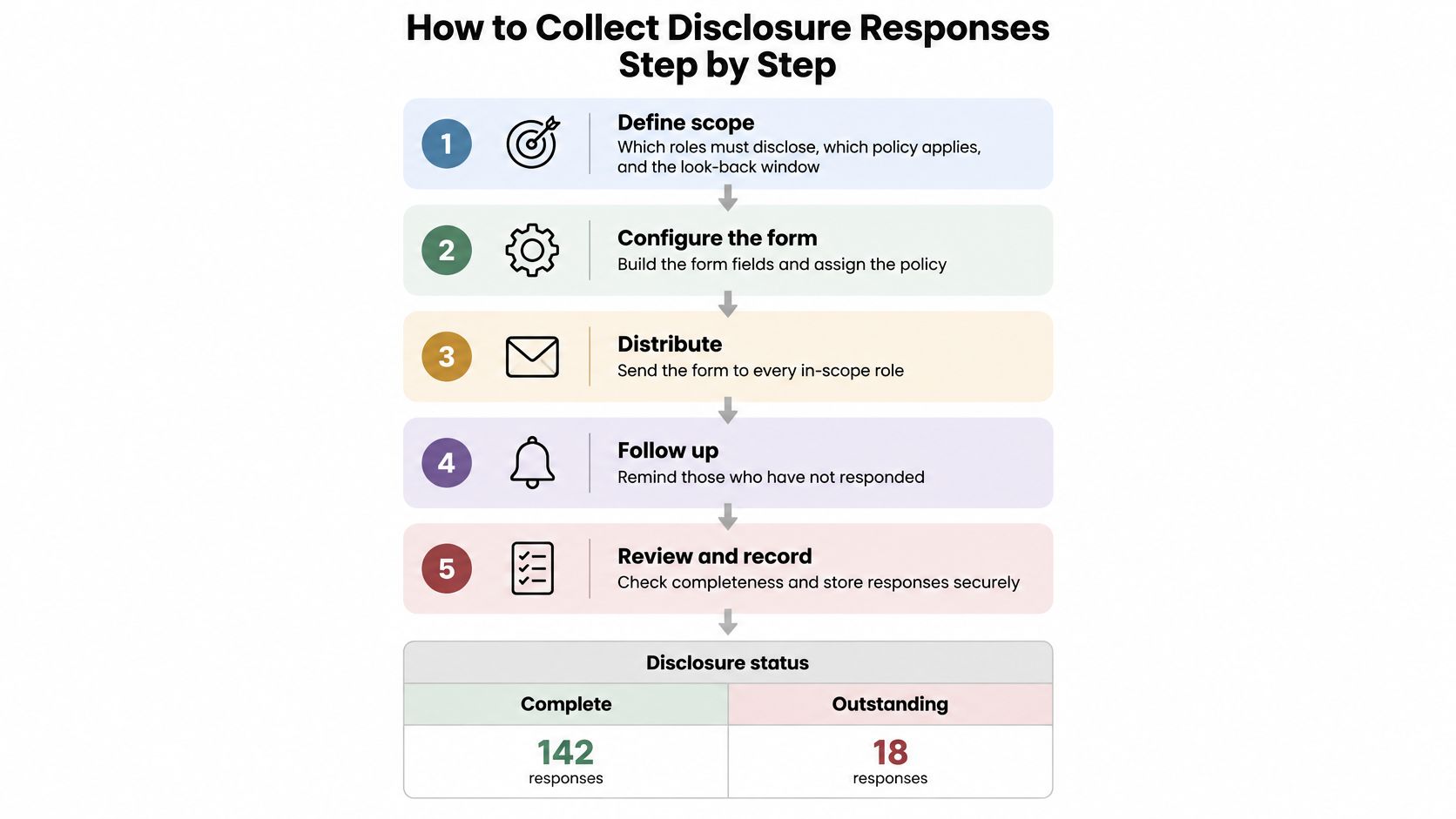
Run it in this order.
- Define scope. Decide which roles must disclose, which policy governs each one, and the look-back window that applies. Write all three down before anyone builds a form. The program chair, the session moderator and the abstract reviewer may fall under different rules.
- Configure the fields. Use the reference table, and attach the definitions respondents need: what counts as an ineligible company, what counts as a covered relationship, whether institutional relationships are in scope.
- Build the respondent list from program data. Pull faculty, planners, abstract authors, reviewers and session chairs from the submission and program systems, not from an email thread. Every name gets a role and an activity attached.
- Send invitations in plain language. State the deadline, the reason the form exists, and what happens if it isn't returned. Respondents comply faster when they understand that session confirmation depends on it.
- Track completion in one place. Status should be visible by person and by activity, with reminder scheduling built in. Two spreadsheets kept by two coordinators is how duplicate and missing records happen.
- Hold approval until disclosures are complete. Session acceptance, speaker confirmation and content sign-off all wait. This is the only step that reliably moves completion rates, because it converts the form from a request into a dependency.
- Keep the form open and require re-attestation each cycle. Copied prior answers perpetuate outdated companies and stale relationship types.
Two design choices that save the most time
One master disclosure, many assignments. A faculty member teaching three sessions and reviewing six abstracts should complete one versioned disclosure linked to each activity, not ten separate forms. The ICMJE model endorses exactly this: each disclosure versioned and linked to the specific abstract, session or activity, with one master record populating multiple assignments.
A clear route for respondents outside database coverage. When no public payment registry exists in a respondent's jurisdiction, give them an attestation path plus institutional records, and tell them explicitly that the absence of a database doesn't reduce what they must report.
Practical rule: make the completion dashboard the meeting agenda. Show outstanding disclosures by session, not by name, so the program committee sees which content is blocked rather than which person is late.
How to Review and Verify Disclosure Responses
Review converts submissions into documented decisions, and it's the stage most programs under-resource. The case for doing it properly is blunt: a 2025 study of 432 surgeons found that 84.2% had discrepancies between conference disclosures and the U.S. Open Payments database, as reported by Clinician.
That number doesn't mean four in five faculty lied. Forms use different look-back periods, definitions, covered relationships and thresholds, so a speaker can complete one form and still omit something another form requires. The discrepancy is a design failure before it's an integrity failure.
The review ladder
- Completeness. Check every required field against a fixed list. Missing counterparty, missing date or an unsigned attestation sends the form back immediately.
- Relevance assessment. Decide whether the relationship touches this session, abstract or study. A consulting relationship with a device maker is relevant to a talk on that device and may be irrelevant to a talk on statistical methods.
- Independent review. Positive disclosures go to someone without the relationship in question. The program chair who co-authored with the speaker shouldn't rule on the speaker.
- Mitigation. Record what changed: the content was revised, the individual's role was adjusted, the relationship was referred for peer review. "Reviewed and cleared" without a described action is not mitigation.
- Verification. Where a public database exists, reconcile. Normalize dates and relationship categories first, compare, then request clarification rather than opening with an accusation.
Data quality gap or concealment
Distinguish the two before you escalate. An honest gap usually shows up as a category mismatch or a look-back difference, and it corrects quickly when you send the specific record and ask the respondent to confirm or explain. Concealment tends to involve a relationship the respondent actively held while answering "none."
Send a clarification request with a deadline and a named reviewer. Document the response, the corrected form and the date. Escalate only when the clarification goes unanswered or the explanation contradicts the record.
| Review finding | Typical action | Documentation to keep |
|---|---|---|
| No financial relationships reported | Accept and proceed | Completed form and attestation |
| Relationship disclosed, not relevant to the content | Accept with a written rationale | Reviewer note explaining the relevance decision |
| Relationship disclosed and relevant to the content | Mitigate before approving the session or study | Mitigation action, reviewer sign-off, learner disclosure text |
| Discrepancy with public payment data | Request clarification from the respondent | Correspondence, corrected form, audit trail entry |
| Incomplete or ambiguous fields | Return the form for completion | Reminder log and resubmission date |
| Refusal to disclose | Escalate per policy | Committee decision and policy reference |
From review decision to learner-facing text
For accredited education, the reviewed record produces a controlled rendering: the individual's name, the company, the nature of the relationship and a statement that relevant relationships were mitigated. That rendering is generated from the reviewer's decision, not from the raw submission, and it carries the date it was produced.
The audit trail closes the loop. Keep the submitted form, reviewer notes, the evidence used, the decision and every date attached to them. An auditor asking in November about a March session should get an answer in minutes, not an afternoon of inbox archaeology.
Special Cases and a Cycle Checklist
Some situations don't fit the standard path, and they're the ones that generate angry emails two weeks before the event.
Multi-event programs. One master disclosure, versioned, linked to each session, abstract or study. Re-collecting the same relationships for each event multiplies work and invites inconsistent answers.
Mid-cycle changes. A new consulting retainer or an equity purchase during the cycle triggers an update. For FDA-covered studies the duty runs during the investigation and for a year after completion, which means the trigger lives in the study calendar, not the conference calendar.
No public database. Rely on attestation plus institutional records, and still ask for clarification when the reported categories look thin relative to the person's role.
Institutional versus personal. A university license or an institutional research grant is a different disclosure from a professor's personal royalties. Capture both, label them separately, and don't let one substitute for the other.
Unpaid volunteers. Someone who controls content discloses whether or not they were paid. Service on an advisory board with no honorarium still counts if the policy says it does.
The cycle checklist
Before launch
- Policy and look-back window written down per program type
- Field groups from the reference table present and tested
- Respondent list built from program roles
- Definitions and one worked example attached
- Deadline set and published
During collection
- Single status view by person and activity
- Reminders scheduled before the deadline, not after
- Approval blocked until required disclosures are complete
- Updates accepted and versioned
During review
- Completeness check on every form
- Relevance decided per activity
- Independent reviewer for positive disclosures
- Reconciliation where a public database exists
- Mitigation recorded with a described action
- Learner text names the person, company, relationship and mitigation
After the event
- Form, notes and dates archived together
- Next cycle refreshed with re-attestation, never copied answers
If a paper affidavit process is still in play for some signatories, the financial disclosure affidavit explains where a sworn statement fits and where it doesn't replace a structured form.
Set Up a Disclosure Workflow That Holds Up
A dozen faculty can still run on the field table, a status spreadsheet sorted by person and activity, and calendar reminders. One named owner blocks session acceptance until every required disclosure is complete, then files the attestation, reviewer note, and mitigation with the program record. That setup holds at small volume. It breaks once several conferences, accredited credit across programs, and staff turnover sit on the same calendar.
The break shows up in the record, not in the policy wording. Each field is the front end of review: if the look-back is not fixed on the form for that program, two events store the same relationship under different windows and a later reviewer cannot tell which rule applied. Reminders and mitigation notes then live in separate inboxes. Six months on, the decision cannot be reconstructed.
I would score any system on a short list before you commit. Can it set a different look-back per policy, track status and reminders, keep the history of one disclosure across events, route a positive answer to an independent reviewer, report exceptions, and connect abstracts, speakers, and credit records? If versioning or routing is missing, staff rebuild both in spreadsheets within a year. Run that list as a disclosure management software comparison. Those gaps show up in tools built to collect answers, not to support review.
Planstone fits that configured path. The platform manages abstract submissions, speaker tasks, disclosures, and continuing education credits in one place, with disclosure status visible across a program so staff can see who still owes a form and what was already reviewed.
A named reviewer still decides relevance and writes the mitigation. The record has to make that decision findable, attributable, and repeatable after the person who made it has left.
Take one upcoming program. Compare its current form against the field table, list the missing fields, and close them before the call for abstracts opens. That pass stops more review failures than another policy rewrite.
Planstone gives associations and education teams a single configured platform for collecting financial relationships, tracking who still owes a disclosure, and reporting on what was reviewed before content goes live. If your next conference is still running on emailed PDFs and a status spreadsheet, Planstone can connect abstracts, speakers, disclosures and credits into one workflow, with a speaker portal that keeps tasks, disclosures and presentation files in one place.