

Can your team show that every disclosure was reviewed and resolved, or only that someone submitted a form? Late responses are frustrating, but the bigger problem is uncertainty: disclosures live in spreadsheets, speaker records don't show what's current, and staff can't distinguish missing information from a relationship awaiting review.
Disclosure management software covers several different jobs. Conference platforms connect disclosures to speakers and abstracts. Continuing education systems connect faculty requirements to accredited activities. Research compliance tools manage investigator interests and institutional review. Enterprise ethics suites handle employee conflicts, gifts, and outside activities.
Choosing the right category matters more than buying the longest feature list. An advanced employee ethics system won't necessarily produce faculty disclosure slides, while a speaker portal may not support institutional conflict-management plans.
The tools below are grouped in that order, from conference faculty workflows through CE administration, research compliance, and employee ethics. Each assessment considers collection routes, status tracking, review and reporting, adjacent workflows, and limitations. Product capabilities aren't a guarantee of accreditation compliance, and early-access functionality deserves a different evaluation from an established module.
Buying principle: Ask vendors to demonstrate the path from invitation to learner-facing disclosure, not just a completed questionnaire.
For associations, the strongest shortlist starts with the work staff must complete before education begins, then tests whether the software preserves evidence of that work.
Table of Contents
- 1. Disclosures
- 2. X-CD
- 3. Sessionboard
- 4. Cadmium Eventscribe
- 5. M Events / The Conference Exchange (Confex)
- 6. CloudCME
- 7. EthosCE
- 8. AAMC Convey
- 9. Cayuse Outside Interests
- 10. NAVEX One Disclosure Management
- Disclosure Management Software Compared
- How to Choose and Put Your Disclosure Process to Work
1. Disclosures
Best fit: conference and continuing-education teams managing disclosures alongside faculty preparation.
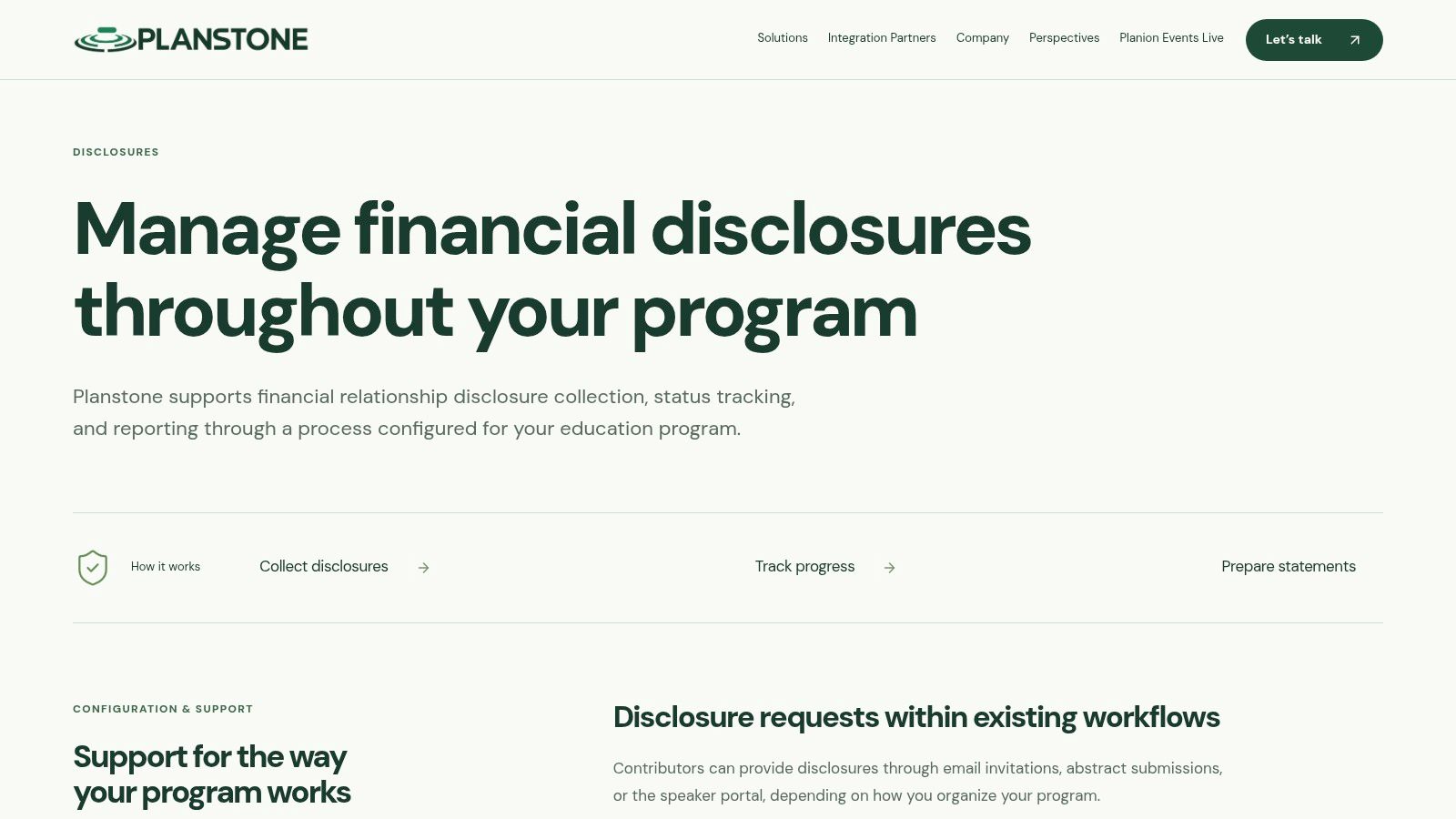
Planstone Disclosures connects financial relationship collection with the work speakers already need to complete. Contributors can respond through email invitations, abstract submissions, or a speaker portal, rather than following a separate process disconnected from their conference responsibilities.
Staff can monitor completion, follow up on outstanding requirements, and prepare relationship statements for presentation slides and handouts. That last step matters operationally: collecting accurate information doesn't help attendees if staff must reconstruct it manually when producing event materials.
Where it fits in the preparation process
We configure forms, faculty requirements, and reports around each program's process. Our speaker portal provides a central place for assigned tasks, disclosures, presentation files, and correspondence, while individual modules can work alongside existing systems or within a combined conference and CE platform.
- Advantages: Multiple collection routes, visible completion status, configurable workflows, and a connection between disclosure records and speaker preparation.
- Trade-offs: Configuration requires clear decisions about roles, requirements, and outputs. Public product information doesn't specify pricing or detailed plan limits.
- Implementation priority: Define who reviews relationships and what staff need to publish before configuring reminders and reports.
Our guide to financial disclosure management explains the process behind the software decision. Use that process map to distinguish submission, review, resolution, and publication responsibilities.
I'd shortlist this option when the immediate problem is coordinating faculty disclosures with the rest of a medical or scientific program. During evaluation, follow a returning speaker's record through an update, staff review, and the final disclosure statement, rather than judging the system solely by its form builder.
2. X-CD
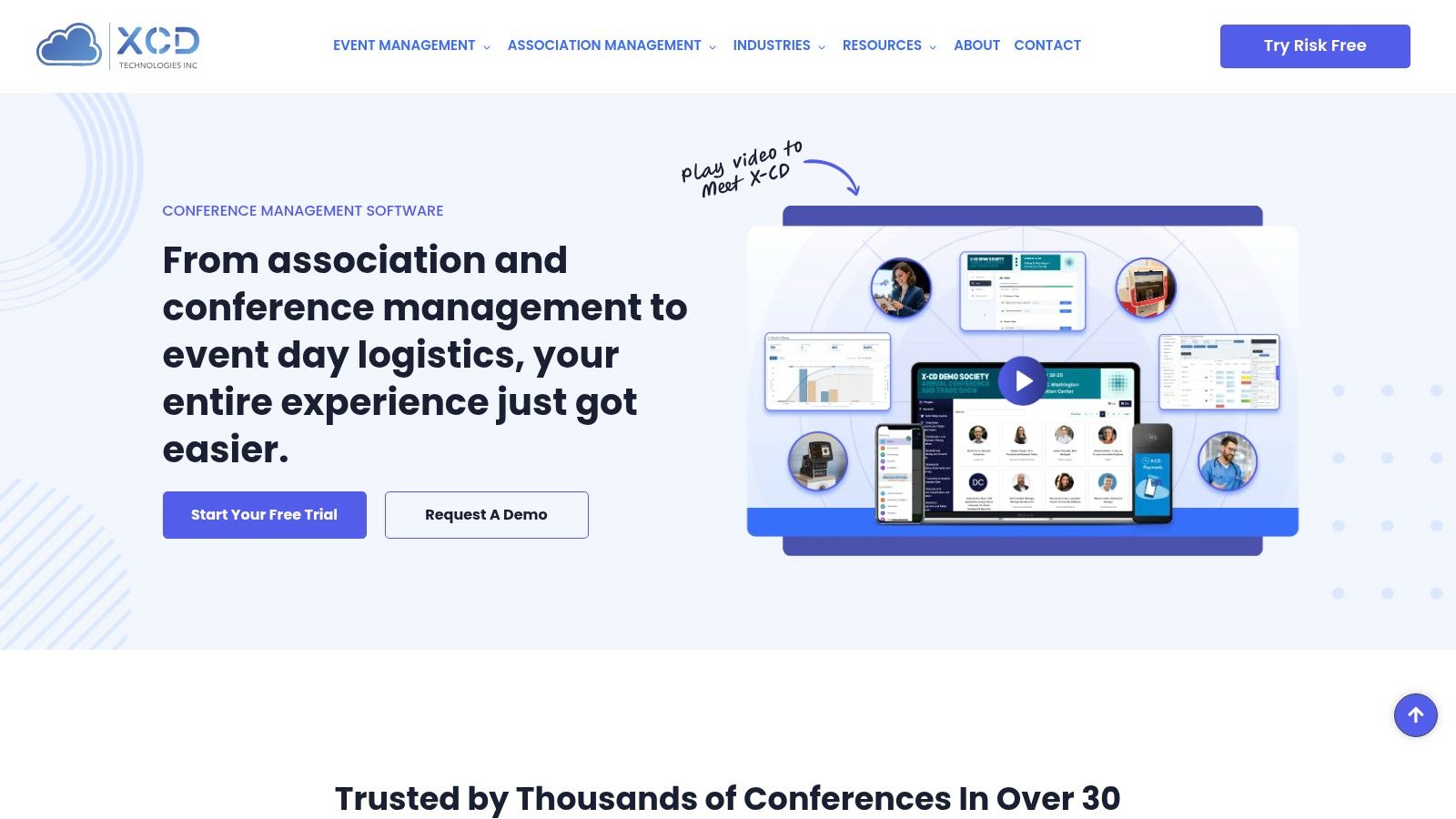
Returning faculty shouldn't have to start from an empty record every time an association runs another meeting. X-CD supports reusable disclosure records across events and years, making it relevant to organizations with recurring contributors and a substantial scientific program.
Its disclosure tools connect with abstract submission, speaker preparation, and conference programming. Custom disclosure and conflict-of-interest forms, review workflows, and reporting sit alongside a speaker portal for biographies, agreements, and presentation files.
Choose the module scope deliberately
X-CD is most compelling when disclosure collection is part of a broader conference-management purchase. Optional abstract review, agenda-building, and CE-credit modules can keep related work together, but they also create purchasing and implementation decisions that a disclosure-only buyer may not need.
- Strength: Reusable records can reduce repetitive entry for returning contributors while connecting disclosures to speaker and abstract records.
- Limitation: The platform's breadth may be unnecessary if your existing conference systems already work well.
- Commercial consideration: Pricing is quote-based and depends on selected modules and event volume.
In a demonstration, distinguish reusing information from confirming that information remains accurate. Have a returning faculty member update a relationship, then inspect what reviewers see and whether event-specific outputs reflect the change.
Also test how staff identify an invited speaker who hasn't submitted an abstract. A conference workflow should account for both invited faculty and contributors entering through the submission process.
3. Sessionboard
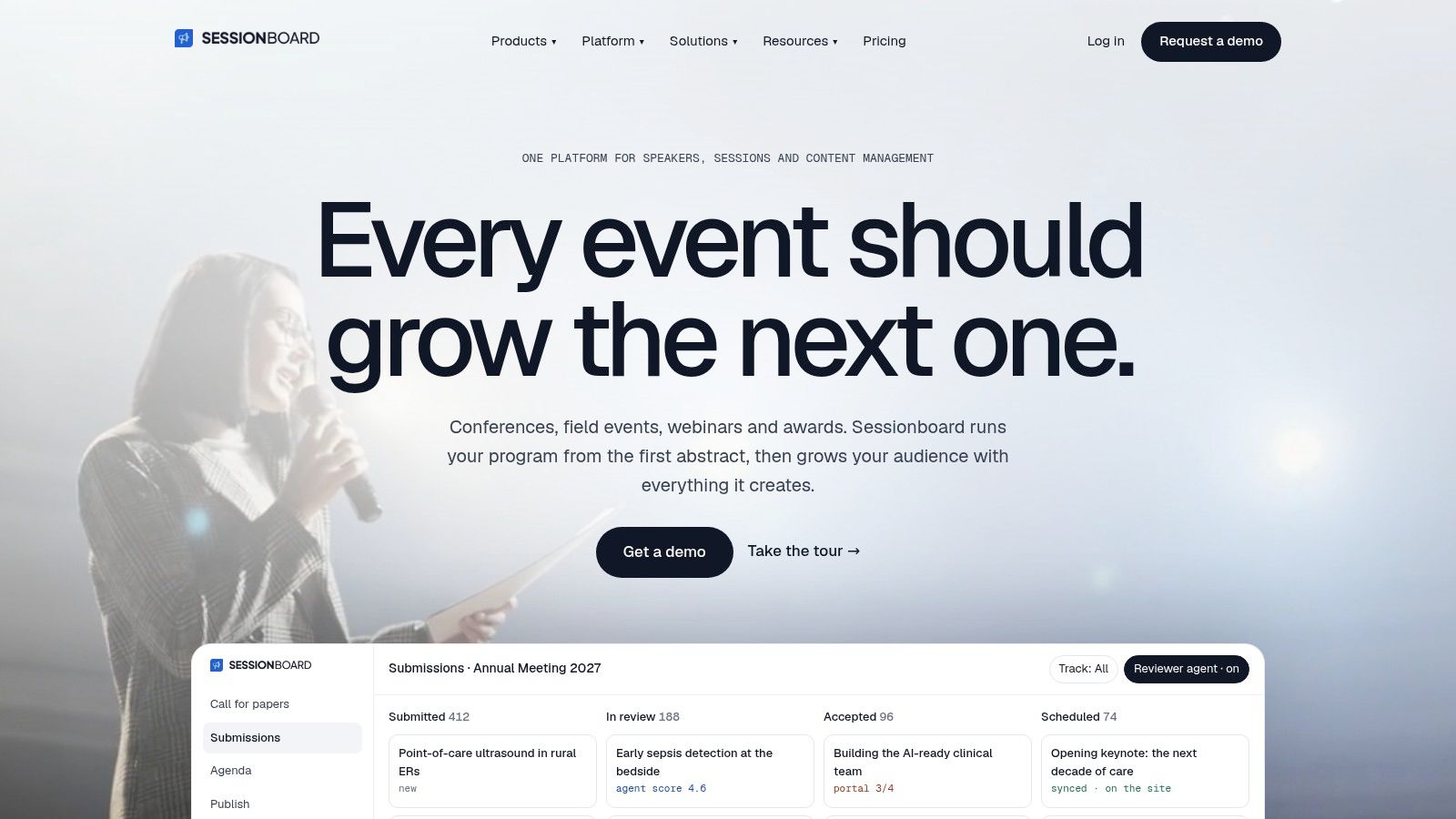
Treat availability and maturity as purchasing criteria, not footnotes. Sessionboard documents disclosure functionality as an Early Access Preview, so buyers should confirm its current release status before relying on it for an accredited program.
The proposed workflow is attractive for speaker-heavy meetings. Organization-wide records, private form links, and contact-level tracking can help staff distinguish missing, current, expiring, and expired disclosures without searching individual event folders.
Private links also let contributors respond without creating a login. That removes an access step, although teams should still examine identity verification and how responses attach to the correct contact.
A convenient collection experience isn't evidence that relevance review, mitigation, and audit exports are ready for your program.
Templates cover financial disclosures, speaker conflicts, and reviewer or committee conflicts. Connections to abstracts, faculty tasks, and review-conflict rules make Sessionboard relevant when program-development staff also own disclosure coordination.
- Advantages: Contact-level oversight, low-friction collection, and connections between disclosure requirements and conference content workflows.
- Caveats: Early-access status requires careful validation. Accreditation-specific review, mitigation, reporting, and retention needs must be demonstrated rather than assumed.
- Access and pricing: Contact Sessionboard to establish availability, package scope, and commercial terms.
I'd consider it when a team values integrated speaker management and can tolerate product-maturity evaluation. For a fixed accreditation deadline, require a demonstration of available functionality, not a roadmap commitment.
4. Cadmium Eventscribe
With Cadmium Eventscribe, the first decision is scope: event-level collection or a disclosure task tied to a submission. That choice controls more than who receives a form.
Administrators can collect disclosures from all authors or only a lead author, set instructions and attestations, and capture relationship details. Tasks connect with abstract and speaker workflows, while disclosures can also appear on event websites and mobile apps, so one record can serve program operations and attendee-facing display.
Configuration changes the compliance fit
Presentation display satisfies audience visibility; the compliance file still needs collection scope, relevance review, mitigation, and an audit trail. A lead-author-only setup can fit a large scientific meeting where co-authors do not control delivered content. Accredited education usually needs everyone with content control identified before promotion or publication.
For accredited education, ACCME's identify, mitigate, and disclose standard requires collecting relevant financial relationships with ineligible companies from everyone controlling content during the previous 24 months, with no minimum dollar threshold.
That makes all-author versus lead-author a policy decision. Confirm who controls content, map each person to collection and review, then test whether the configured task produces evidence your accreditation file can use.
Public product pricing isn't stated. I'd evaluate platform cost only after establishing which configuration supports your actual disclosure obligations.
5. M Events / The Conference Exchange (Confex)
A disclosure can be approved in the office and still fail to reach the audience. M Events and The Conference Exchange, or Confex, deserve consideration when disclosure handling must connect with presentation delivery and congress production.
Confex describes tools for collecting, reviewing, and publishing disclosure statements, including displaying them to attendees at the start of presentations. Presenter portals support file uploads and conflict-of-interest disclosure management, while the wider offering includes conference technology and presentation services.
The practical distinction is the combination of software and delivery support. For a complex medical congress, coordinating the approved statement with the presentation environment may matter as much as collecting the underlying form.
- Best use: Medical and scientific meetings that need disclosure handling alongside presentation management or production services.
- Main advantage: A connection between disclosure information and what attendees see.
- Main trade-off: The service scope may be substantial for an organization seeking only a collection tool.
Clarify which Confex functions are available through M Events, who configures them, and who owns the final publication step. Pricing and the division between software and managed services aren't publicly itemized.
A useful demonstration starts with a faculty member changing a relationship after uploading a presentation. Ask the vendor to show how staff review that change, replace the attendee-facing statement, and confirm which version will appear in the room.
6. CloudCME
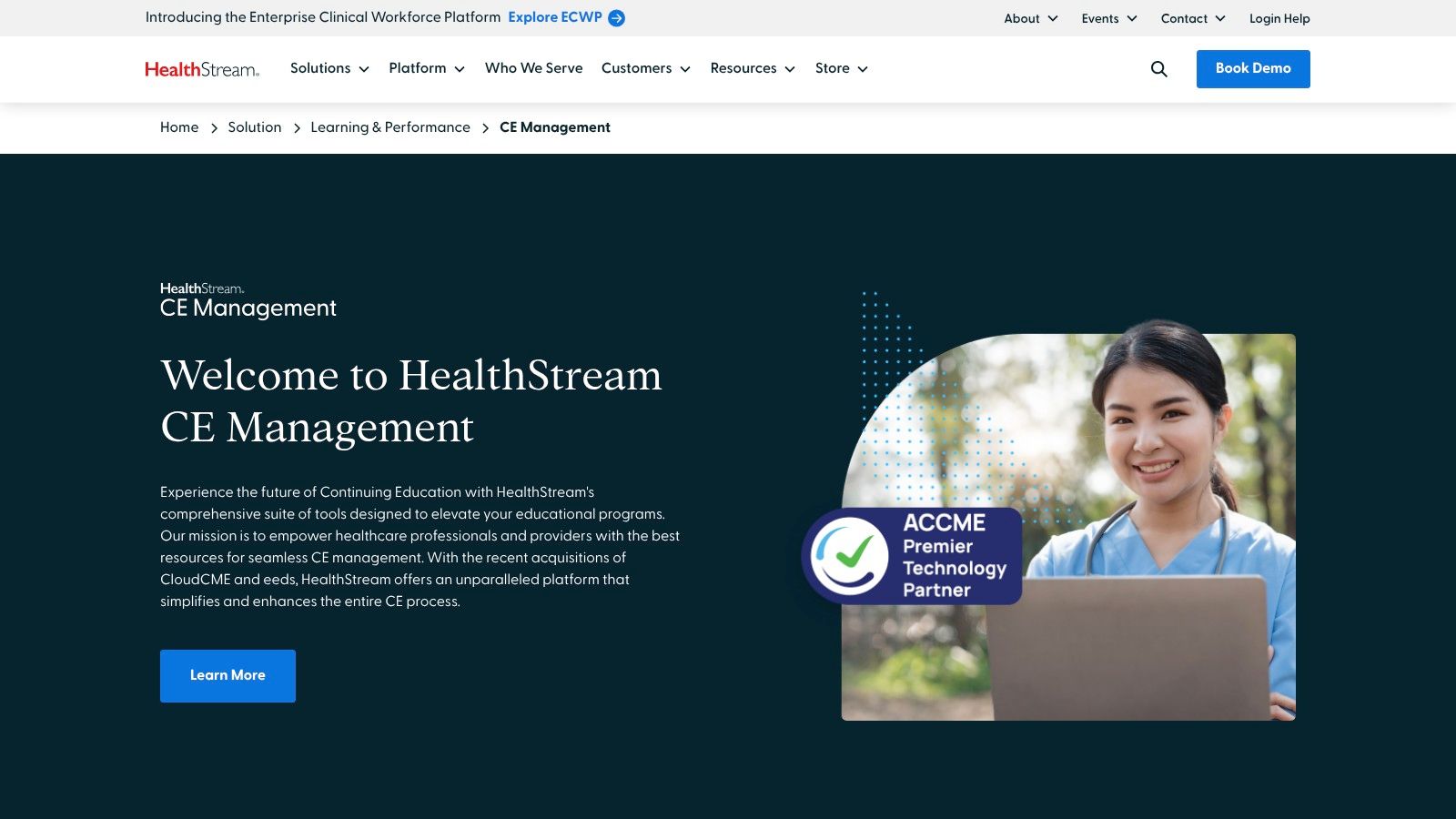
Best fit: a CE department whose primary workload is activity administration and learner records. CloudCME places faculty disclosure tasks within a broader continuing-education environment rather than treating conference programming as the starting point.
Faculty can complete or update disclosure forms through the portal. The surrounding platform supports activity administration, evaluations, attendance, transcripts, and certificates across CME, CNE, CPE, and Joint Accreditation credit types.
Start with the activity lifecycle
CloudCME makes sense when the same department administers recurring education, tracks participant credit, and manages faculty requirements. Client implementations may include disclosure reports and faculty task tracking, so inspect the proposed configuration rather than assuming every customer has an identical setup.
- Advantages: Disclosure collection sits near activity administration, participant records, and certificate processes.
- Trade-offs: Reporting and faculty workflows can depend on implementation. Abstract-heavy congress development may require a different emphasis or complementary tools.
- Pricing: Public pricing isn't provided; establish the proposed scope before comparing quotes.
Keep faculty compliance separate from learner eligibility. A completed disclosure doesn't establish whether a learner has satisfied professional requirements, and navigating state CME mandates is a separate administrative task.
For evaluation, use a recurring educational activity rather than only a large annual conference. Test how staff identify faculty whose disclosure needs attention, review changes, and connect the approved information to that activity without disturbing attendance or credit records.
7. EthosCE
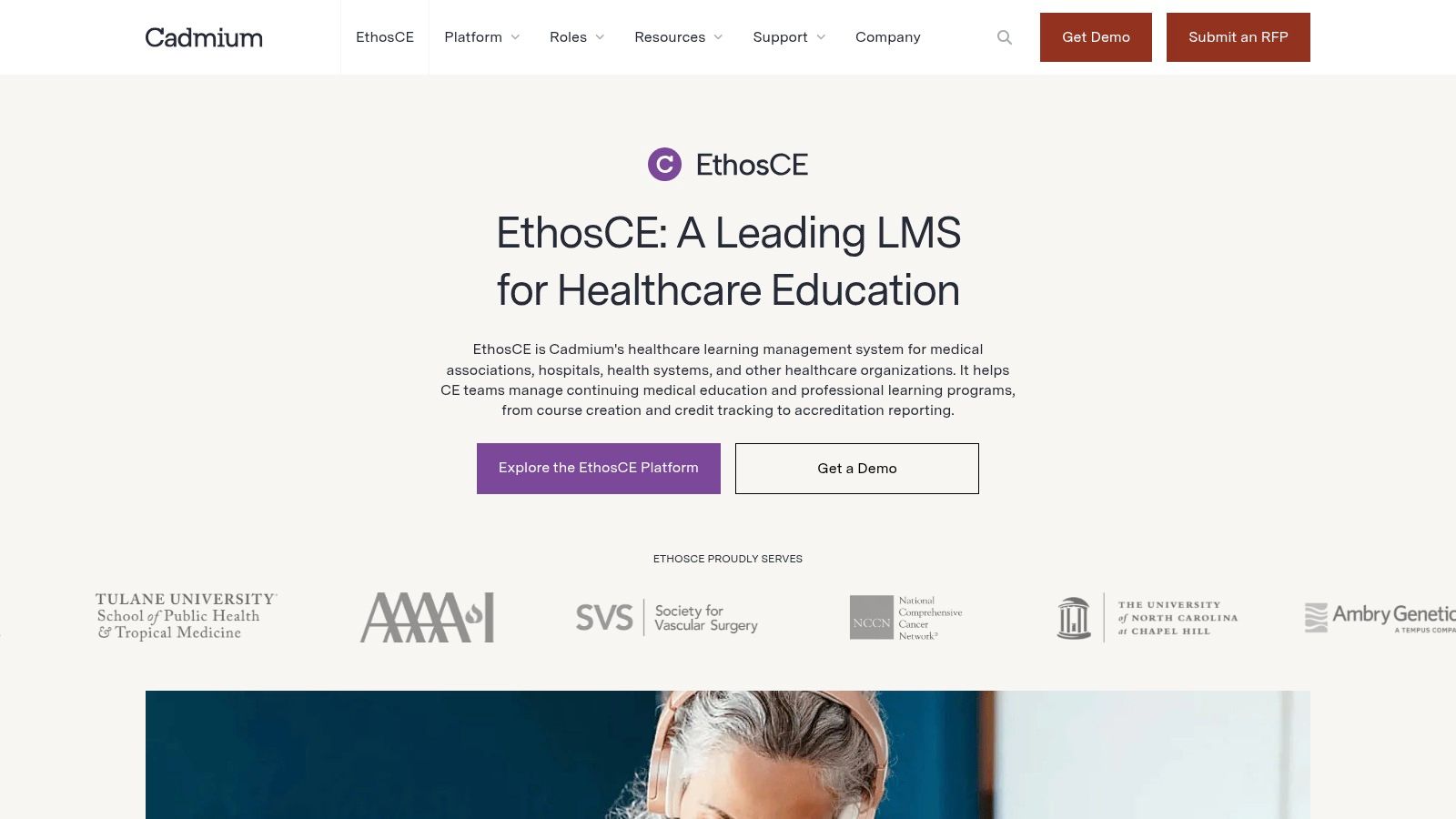
If your team's daily workspace is a healthcare learning management system, EthosCE may fit better than a conference-first platform. Its faculty-management tools combine disclosure collection with profiles containing biographies, credentials, photographs, CVs, and other required materials.
Customizable faculty forms and disclosure-status tracking support preparation, while the broader platform handles learner credit and certificates. That combination suits associations, hospitals, academic health systems, and education providers delivering healthcare learning.
The trade-off is category scope. EthosCE is primarily an LMS and continuing-education platform, not a replacement for a full abstract-review and scientific session-development system.
Confirm the faculty-management package
- Advantages: Centralized faculty records, disclosure collection, status oversight, and connections to healthcare education administration.
- Limitations: Faculty-management capabilities may be an add-on, and public pricing isn't provided.
- Evaluation focus: Confirm the included forms, review permissions, reports, and integration responsibilities in the proposed package.
Map the education process before comparing LMS features. Our explanation of how to offer continuing education credits can help separate faculty preparation from evaluation, credit rules, and certificate administration.
Organizations also trying to find an LMS for employee training should distinguish general workforce learning from accredited healthcare education. Similar course-delivery features don't necessarily imply equivalent faculty disclosure workflows.
Test whether staff can identify a faculty member's outstanding materials and disclosure status together, then inspect what evidence remains after review.
8. AAMC Convey
AAMC Convey approaches disclosure from the individual's financial-interest record, not from the conference schedule. Physicians, researchers, and scientists can maintain information and submit disclosures to participating organizations for CME, committees, publications, and board service.
That makes Convey relevant when professionals repeatedly disclose to different organizations. Subscribing organizations can configure disclosure purposes and requirements, while individuals can access, print, or export submitted disclosures.
Reusing a financial-interest record isn't the same as updating every disclosure already submitted from it.
Previously submitted disclosures don't automatically update when an individual changes financial-interest information. Teams need a clear procedure for changed relationships, renewed submissions, and determining which record applies to an activity.
- Advantages: A focused financial-disclosure service supporting multiple professional purposes and repeat submissions.
- Boundary: It doesn't replace abstract review, scheduling, speaker-file collection, or credit administration.
- Commercial model: Organizations subscribe annually according to disclosure volume; individuals use the service without charge, as described by Convey.
For an association with established conference technology, Convey may complement rather than replace the existing stack. The critical integration question is how staff connect a submitted disclosure to the correct faculty member and activity without maintaining an unreliable parallel spreadsheet.
During evaluation, test a committee member who also serves as faculty. Confirm how organizational purposes differ, how staff retrieve the appropriate submission, and what happens when that person reports a new interest after the original review.
9. Cayuse Outside Interests
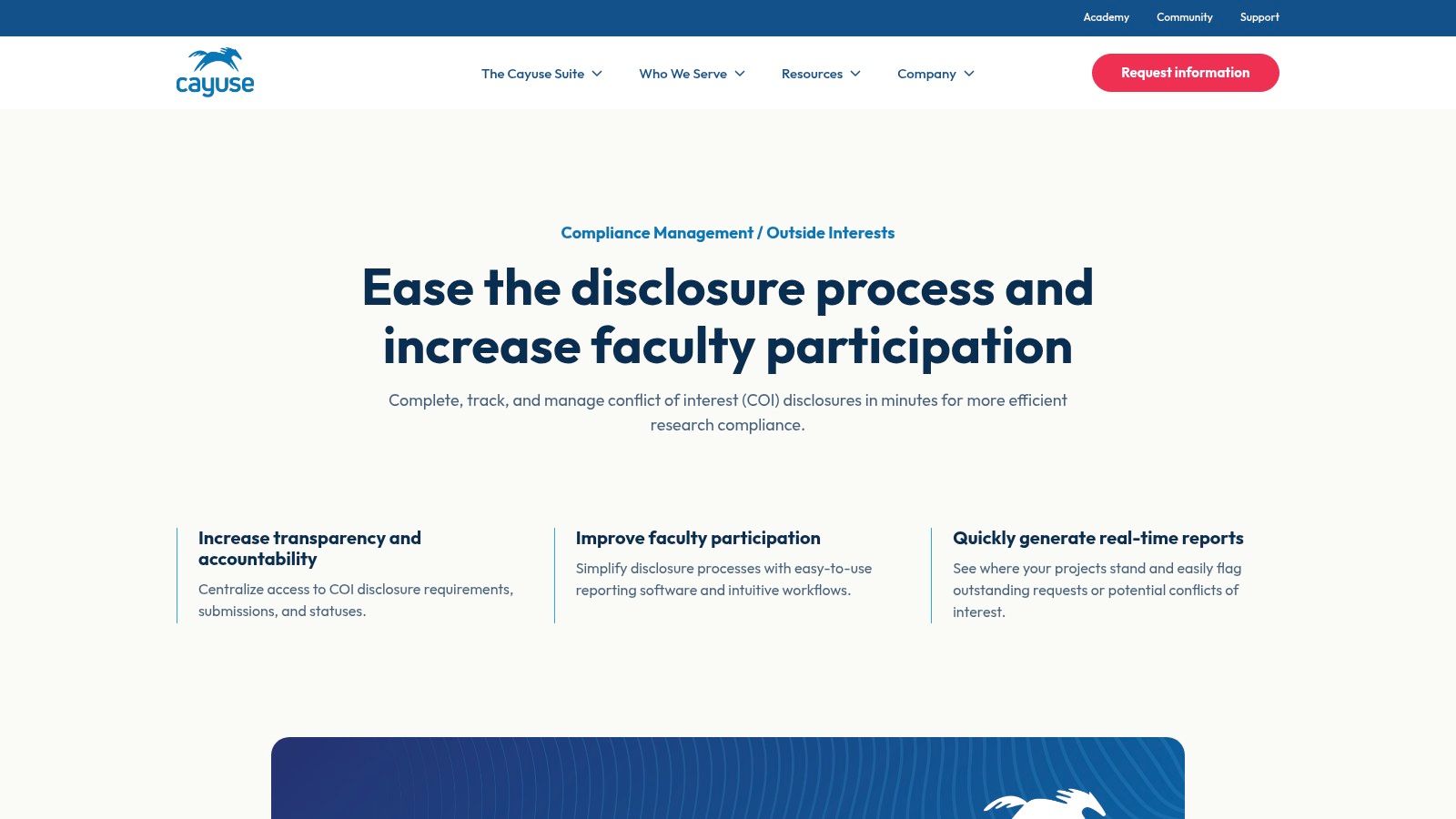
Institutional research compliance requires a different starting point from speaker preparation. Cayuse Outside Interests centralizes disclosure requirements, submissions, and oversight for faculty, investigators, and project-related interests.
Its capabilities include configurable forms, automated reminders, reporting, review workflows, and management plans. Prior interests can carry into new forms for review, which is useful when institutions need continuity without treating an earlier declaration as permanently current.
Follow the interest beyond the event
Research-linked obligations may continue after a conference or study milestone. Under FDA financial-disclosure rules for clinical investigators, investigators must promptly update relevant information during the investigation and for one year after study completion.
That requirement illustrates why a conference deadline alone may be insufficient for a research-compliance process. It doesn't establish that any particular software configuration automatically satisfies the rule.
- Strengths: Institution-wide administration, annual and project-triggered processes, and documented review or management plans.
- Trade-offs: The workflow isn't designed specifically around conference speakers, abstracts, presentation files, or session preparation.
- Buying consideration: Pricing, implementation, and connections to the wider Cayuse suite require a scoped discussion.
I'd shortlist Cayuse when the institutional compliance office owns the requirement. If the meeting team only needs speaker disclosures and presentation statements, an institutional research platform may introduce more process than the task warrants.
Test reviewer reassignment, revised interests, management-plan follow-up, and access restrictions. Those scenarios reveal more about institutional fit than a polished submission form.
10. NAVEX One Disclosure Management
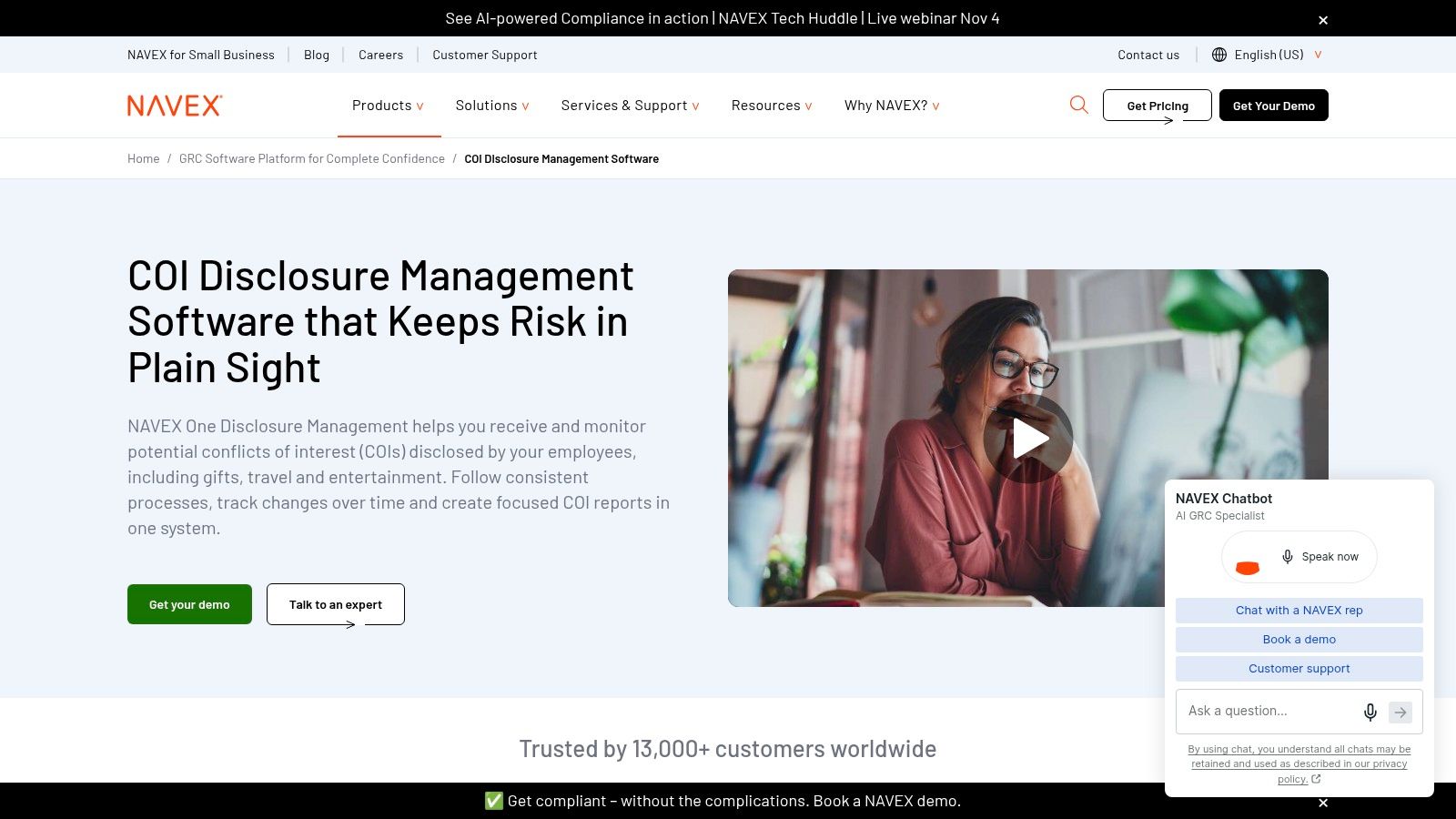
Employee gifts, outside employment, and family connections don't belong in a speaker-preparation workflow. NAVEX One Disclosure Management addresses enterprise ethics and compliance disclosures within a broader governance, risk, and compliance environment.
Configurable questionnaires can target different employee groups and disclosure types. Routing, reminders, escalations, follow-up, and reporting support review by designated staff, while employees can submit updates outside annual campaigns.
The advantage is consistency across an employee disclosure program. An ethics team can define which reviewer receives a particular type of disclosure and retain related records for ongoing review.
- Best fit: Enterprise employee conflicts, gifts, travel, entertainment, outside activities, and family relationships.
- Strength: Structured review and audit trails connected to wider compliance activity.
- Limitation: It doesn't provide abstract-to-session development or conference faculty preparation.
- Pricing: Commercial evaluation is demo- and quote-led.
For a medical association, distinguish disclosures made as an employee from those made as someone controlling educational content. The same person may have obligations in both contexts, but the questions, reviewers, and publication requirements can differ.
Compare an enterprise ethics suite with conference-focused disclosure management only after assigning ownership of each process. Buying an enterprise system won't, by itself, solve missing faculty statements, and buying a conference tool won't replace an employee ethics program.
Disclosure Management Software Compared
Group these tools by disclosure context before comparing anything else. Conference faculty collection, CE administration, research compliance, and enterprise ethics programs each answer to different reviewers and downstream systems.
| Best for | Disclosure collection method | Scope beyond disclosures | Pricing transparency |
|---|---|---|---|
| Planstone Disclosures: conference and continuing-education teams | Speaker portal and abstract submission records | Tracks disclosure status and reporting; connects with abstracts, speaker tasks, and CE credits | Not specified |
| X-CD: medical and scientific associations managing conferences | Custom forms and workflows through a speaker portal; reusable records across events | Abstract review, agenda building, speaker preparation, and CE credits | Quote-based; depends on modules and event volume |
| Sessionboard: medical and scientific meetings needing speaker and reviewer disclosures | Reusable forms and private links; contact-level status tracking | Abstracts, faculty tasks, and review conflict workflows | Contact for pricing and access |
| Cadmium Eventscribe: associations and nonprofits using a broader event platform | Event-level or submission-based forms assigned to authors or speakers | Abstracts, speaker management, event websites, and mobile apps | Public pricing not stated |
| M Events / The Conference Exchange (Confex): medical and scientific events needing presentation support | Online abstract and speaker systems; presenter portal for COI forms | Disclosure review and publication, presentation management, and event services | Not publicly listed |
| CloudCME: CME and continuing-education departments | Faculty complete or update forms through the portal | Activity administration, evaluations, attendance, transcripts, and certificates | Public pricing not found |
| EthosCE: healthcare education providers and CME teams | Customizable faculty forms with status tracking and profiles | LMS, learner credits, certificates, and accreditation workflows | Public pricing not found; faculty management may be an add-on |
| AAMC Convey: organizations collecting medical and research professionals' financial interests | Individuals maintain and submit disclosures to participating organizations | Supports CME, committees, publications, and board service; not conference management | Annual organization subscriptions priced by disclosure volume; individuals use it free |
| Cayuse Outside Interests: universities and academic medical centers managing research compliance | Configurable forms, reminders, and centralized status tracking | Conflict reviews, management plans, and research-administration workflows | Contact Cayuse for pricing and implementation details |
| NAVEX One Disclosure Management: enterprise employee ethics and compliance programs | Configurable questionnaires with review routing, reminders, and updates | Broader GRC, risk management, reporting, and audit trails | Demo- and quote-led |
The first five rows collect disclosures where speakers already work, inside portals and submission systems. CloudCME and EthosCE sit in CE administration, where faculty management may carry an add-on cost. Cayuse Outside Interests and AAMC Convey serve institutional review of financial interests, and NAVEX One handles employee questionnaires. Only Convey publishes a pricing structure, so treat every other demo as the pricing conversation and ask which modules and integrations the quote covers.
How to Choose and Put Your Disclosure Process to Work
Map the disclosure context before comparing vendors. Conference faculty teams need links between people, abstracts, tasks, and presentation materials. CE administrators need activity-level oversight and learner-facing disclosures, while research offices need institutional review and management plans, and ethics teams need employee questionnaires and routing.
A completed form is only the beginning of an accredited education workflow. ACCME's accreditation requirements call for identifying and mitigating relevant financial relationships before education begins, then disclosing the individuals, companies, relationship types, and mitigation statement to learners.
Pilot the complete process
- Define ownership: Assign responsibility for collection, relevance review, mitigation, publication, and record retention.
- Use a representative event: Include invited faculty, abstract presenters, planners, and a contributor whose relationship changes.
- Inspect exceptions: Test missing responses, ambiguous company names, reviewer reassignment, and revised statements.
- Verify outputs: Review disclosure slides, handouts, reports, and exports against your actual accreditation and organizational requirements.
- Confirm the commercial scope: Establish included modules, configuration work, integrations, training, support, and pricing before committing.
Don't automate interpretation without review controls. Standardize company names and relationship categories, but preserve the original response and a reviewer's explanation when a match or relevance decision changes.
Security also belongs in the pilot. Use EventUploader's guide to event data security to frame questions about permissions and information handling, then determine who needs access to financial relationship details.
Choose for the work your team owns
X-CD, Sessionboard, Eventscribe, and M Events/Confex suit different conference-centered scenarios. CloudCME and EthosCE place disclosures within broader education administration, Convey provides a reusable professional disclosure service, and Cayuse and NAVEX address institutional research and enterprise ethics respectively.
Confirm limitations as carefully as features, particularly early-access availability, task-type restrictions, and whether submitted records update automatically. Compare the cost of configuration and ongoing administration alongside the subscription, without assuming a broader platform will be cheaper or simpler.
Planstone has worked with associations and education teams since 2003, specializing in medical and scientific associations. We support financial relationship disclosure collection, status tracking, and reporting within a configurable conference and CE platform, with dedicated account management for implementation and ongoing use.
For a consultation, bring your program structure, existing systems, and team requirements. We can discuss where individual modules fit alongside those systems or where a combined workflow makes sense.
Planstone connects faculty disclosures with speaker preparation, abstract management, and continuing education administration. Visit Planstone to request a consultation and discuss the collection routes, review responsibilities, and reporting your team needs for its next program.