
A financial disclosure affidavit is a sworn statement of a person's income, assets, debts and monthly expenses, filed with a court, government body or program and usually supported by records.
But does every document called a financial disclosure require an oath? That distinction matters, especially for conference and education teams handling faculty disclosures rather than court filings. The document's official name, signature language and governing rules determine what the filer must disclose and what happens after submission.
Table of Contents
- What a Financial Disclosure Affidavit Is and Where It Applies
- What the Affidavit Contains, Item by Item
- How It Differs From a Standard Disclosure Form
- When Courts and Programs Require an Affidavit
- Filing Deadlines and Penalties for Incomplete Affidavits
- Financial Disclosure in Continuing Medical Education
- Common Questions About Financial Disclosure Affidavits
- Run a Pre-Signing Review Before You Submit
What a Financial Disclosure Affidavit Is and Where It Applies
The phrase financial disclosure affidavit describes documents used in different settings, but it doesn't identify a universal form. A family court wants evidence of someone's financial position. An ethics office reviews reportable interests, while a continuing medical education provider collects relationships that could affect educational independence.
The word affidavit specifically signals a sworn statement. Government financial reports and professional attestations aren't automatically affidavits just because they disclose financial information.
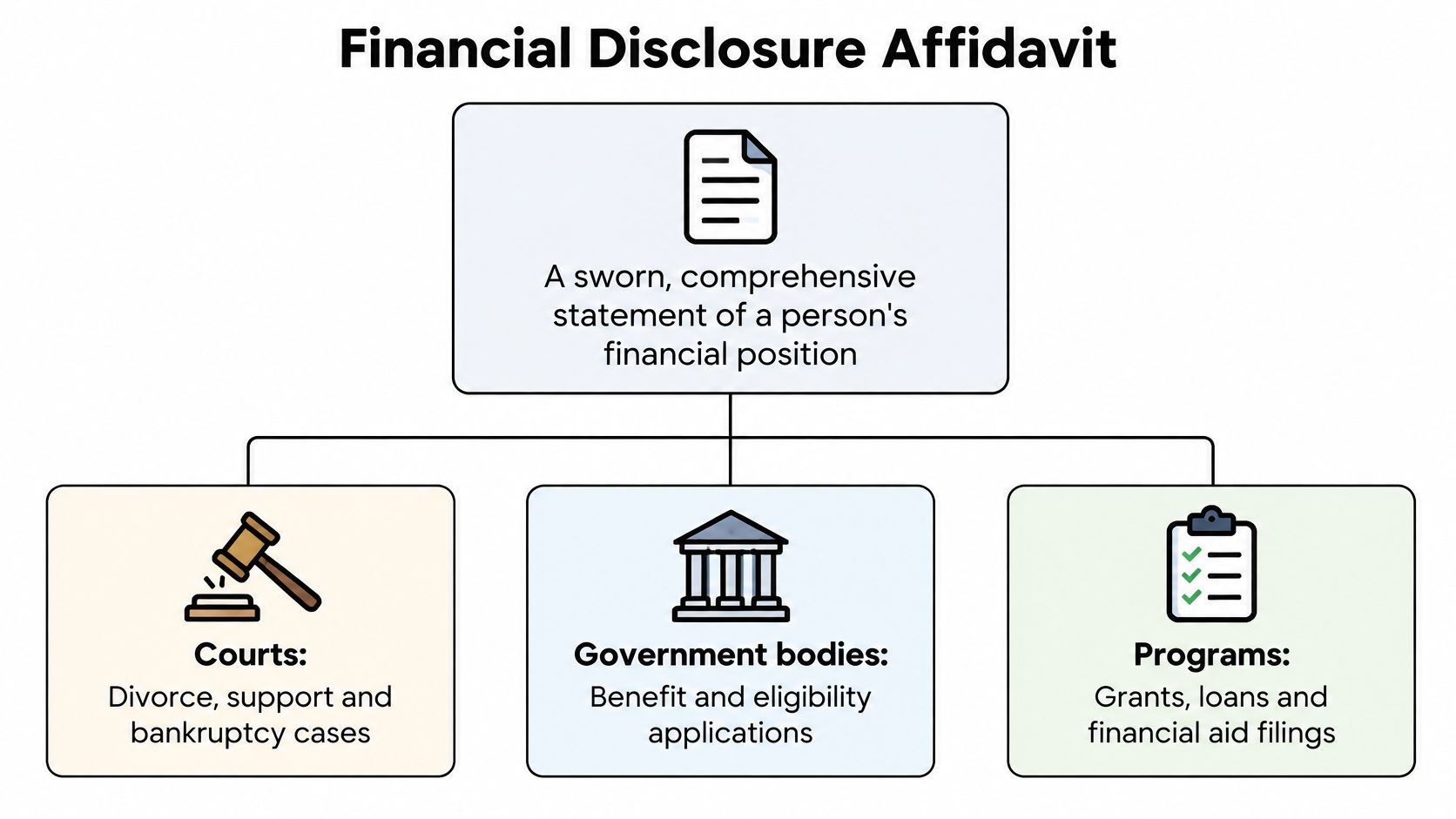
Settings where a financial disclosure affidavit applies
| Setting | Who files | What it supports | Governing source |
|---|---|---|---|
| Family court, divorce or support case | Parties to the case | Child support, alimony, property division, attorney fees and temporary relief | Court-specific form, such as Florida's mandatory disclosure rule |
| U.S. federal executive branch | Senior officials, nominees and certain confidential filers | Public financial disclosure and ethics review | Executive-branch public disclosure form under federal ethics law |
| Continuing medical education | Planners, faculty and others who control educational content | Identifying and managing relevant financial relationships | Accreditor's CME disclosure standard |
In federal ethics practice, the U.S. Office of Government Ethics disclosure FAQ identifies the Ethics in Government Act of 1978 as the foundation of the modern system and OGE Form 278e as the principal executive-branch public disclosure report. In 2023, at least 29,360 public financial disclosure reports were filed by senior agency officials, alongside more than 420,000 confidential reports across the federal government.
Those filings serve an institutional ethics process, not a divorce court's assessment of household finances. Similarly, a faculty disclosure supports an accredited provider's review of financial relationships, not a calculation of personal net worth.
Start with the recipient: Identify who requires the document before deciding what information to collect.
The phrase is used loosely in news coverage and some state forms. The governing body's own form name and instructions are the reliable check. Your first task is to identify the setting, because the reporting categories, applicable thresholds and filing timetable follow from that choice.
What the Affidavit Contains, Item by Item
A court financial affidavit is more than a salary declaration or household budget. It brings together earnings, property, obligations and recurring spending so the reviewer can evaluate the person's overall financial position.
The New York Family Court financial disclosure form requires an affirmation of accuracy and disclosure of income from all sources, assets, liabilities and net worth, regardless of where the property or obligation is located. Its requested items include checking accounts, vehicles, homes or apartments, mortgages, other real estate, boats, stocks, bonds and individual retirement accounts.
Build a complete financial inventory
| Component | What to gather | What the reviewer needs to understand |
|---|---|---|
| Income | Wage records, business records, rental receipts and benefit statements | All reportable income sources, not just take-home pay |
| Assets | Account statements, ownership records and valuation support | What the filer owns and the value reported |
| Liabilities | Mortgage, loan, credit and other debt records | What the filer owes |
| Monthly expenses | Housing, health insurance, utilities and other insurance records | Recurring financial commitments |
| Sworn attestation | Completed signature and oath requirements | What the filer is affirming as accurate |
| Supporting records | Required earnings, tax, account and debt documentation | Whether the entries can be checked |
Income should distinguish wages from self-employment receipts, rental income and benefits. Follow the form's treatment of gross income, deductions and net income rather than putting the same take-home figure into every field.
For assets, use the valuation date and method the form requires. Listing a home without its associated mortgage, or a retirement account without its supporting balance, can leave the reviewer with an incomplete picture.
Net worth means assets minus liabilities. It isn't the same as monthly cash flow: someone can own valuable property while having little readily available cash.
Make the entries traceable
Supporting documents should explain how you reached each figure. The precise attachment requirements come from the governing form, so don't assume that uploading tax returns alone completes the disclosure.
For context on the sworn document's role in divorce proceedings, the Law Office of Bryan Fagan, PLLC explains why divorce affidavits matter. For broader terminology, our guide to a financial disclosure report provides a related reference.
Before drafting, compare your records against every category in the form. Mark records you still need to obtain rather than leaving the corresponding account or obligation out without a note.
How It Differs From a Standard Disclosure Form
An affidavit is a sworn statement; a standard disclosure form is usually an unsworn questionnaire limited to the topics it asks about. The signature instructions, not the document's appearance, establish whether the filer is taking an oath.
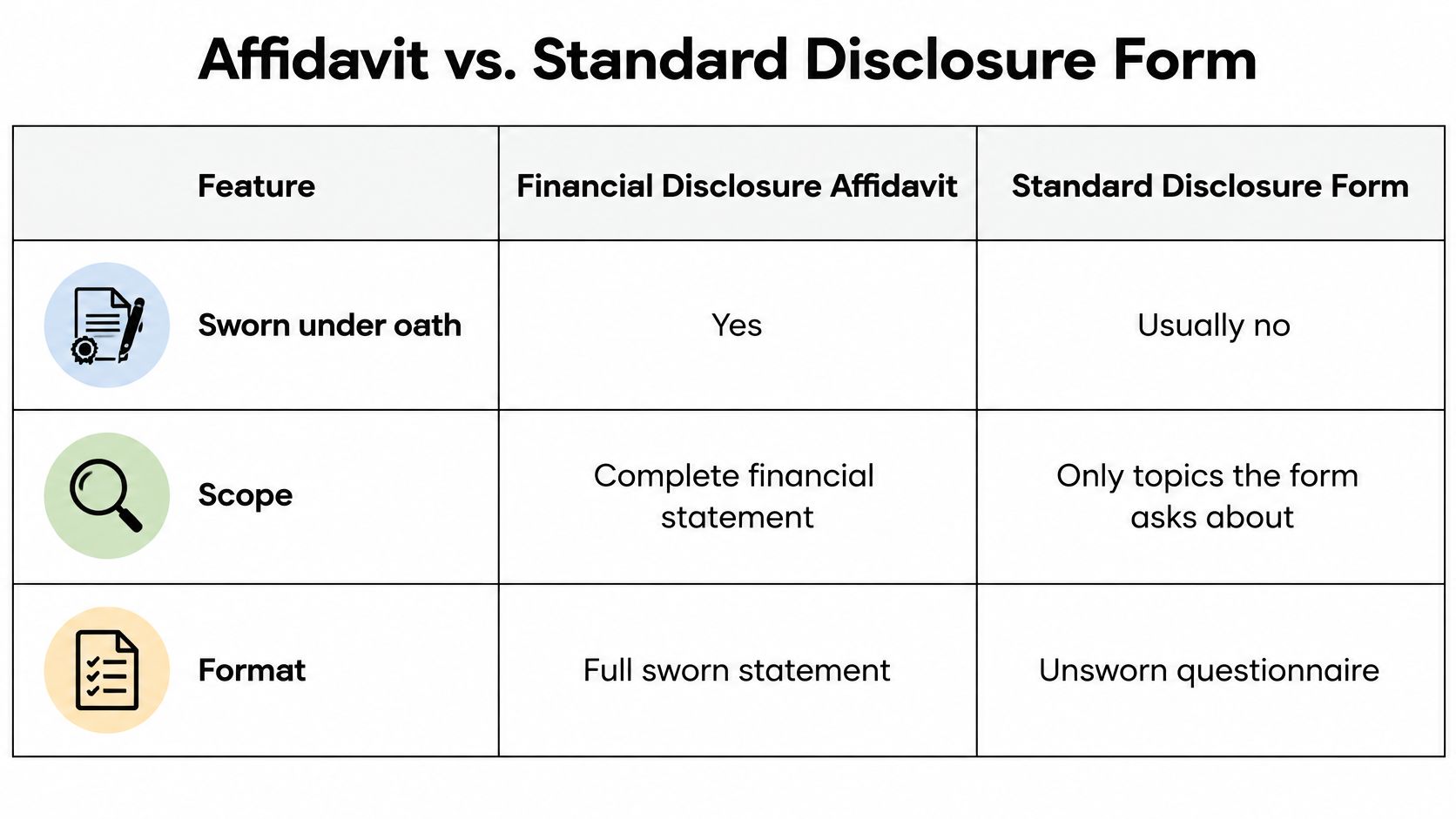
Financial disclosure affidavit versus standard disclosure form
| Feature | Financial disclosure affidavit | Standard disclosure form |
|---|---|---|
| Legal status | Sworn statement, often signed before a notary | Typically unsworn; signature confirms accuracy |
| Scope | Full financial picture, including income, assets, debts and expenses | Limited to the topics the form asks about |
| Supporting evidence | Usually requires earnings, tax or account records | Often self-reported without attached records |
| Rule source | Court rule or statute; regulated programs may instead require an attestation | Organization's policy or questionnaire |
| Consequence of inaccuracy | Court sanctions may include dismissal, costs, fees or contempt under the applicable rules | Policy-based consequences, such as follow-up review or restricted participation |
| Typical use | Litigation; related reporting and attestation processes occur in government ethics and regulated education | Routine screening, membership, employment or event administration |
These categories describe common uses, not permission to assume that every government or educational disclosure is sworn. An accreditor's standard can require a detailed attestation without turning it into a court affidavit.
Conflict disclosure requires a decision after collection
A conflict-of-interest disclosure asks whether a relationship could influence someone's judgment. It may ask about consulting, employment, investments or other interests without asking for a complete personal balance sheet.
Collection is only the beginning. A designated reviewer should classify the relationship, determine relevance or materiality under the applicable standard, record mitigation and decide what others must be told. Depending on the circumstances, that could mean recusal, limited participation or additional content review.
Disclosure tells the organization what relationship exists. It doesn't, by itself, establish that the relationship has been appropriately managed.
Court affidavits also undergo review and may be challenged. The distinction is their primary purpose: establishing financial facts rather than managing influence over a professional decision.
For conference teams, an abstract submission form is another separate record. Collecting an author's proposal doesn't establish that the author has completed financial disclosure.
Use the required form and read its signature block. If it requires an oath, follow the affidavit execution instructions; if it requests internal screening information, confirm who reviews it and what decision follows.
When Courts and Programs Require an Affidavit
Courts require financial disclosure when a requested decision depends on a party's finances. Common triggers include child support, alimony or spousal maintenance, property division, attorney fees and temporary financial relief.
The Florida Bar Journal's discussion of financial affidavits explains that Florida Family Law Rule 12.285 generally makes the affidavit mandatory for initial or supplemental requests for permanent financial relief and also applies to temporary financial relief. Parties generally can't waive the requirement, although simplified and certain uncontested dissolution procedures receive different treatment.
Florida family-law affidavit form by income
Florida's official family-law affidavit instructions generally direct individuals with gross annual income under $50,000 to the short form and those with $50,000 or more to the long form, with income and expenses expressed monthly.
| Gross annual income or case type | Form generally used | Key rule |
|---|---|---|
| Under $50,000 | Short form | Monthly amounts; nonmonthly bills converted to monthly |
| $50,000 or more | Long form | Monthly amounts; expenses labeled as estimates when not currently paid |
| Other states | The governing court's designated financial affidavit | Verify the court's own form and income threshold |
The income test concerns gross income, not the amount left after withholding and household spending. Don't choose a shorter form because it looks easier or because your net pay is lower.
Standardize the reporting period
A biweekly paycheck and a quarterly insurance bill describe different periods. Convert them using the governing form's instructions before combining them with monthly amounts.
Say a filer copies a quarterly premium into the monthly insurance field. The entry would overstate recurring monthly spending even though the underlying bill is genuine. Record the calculation alongside the source document so the reviewer can follow it.
The instructions also distinguish actual spending from estimates. If an expense doesn't represent what you currently pay, identify it accordingly rather than presenting it as an established payment.
For additional practical context, The Law Office of John P. Sherman, PLLC discusses mandatory financial disclosure in divorce. Use that explanation alongside, not instead of, the current court instructions.
New York and other states use their own documents. Before drafting, confirm the applicable procedure, current form and income test, including whether a simplified or uncontested process changes the requirement.
Filing Deadlines and Penalties for Incomplete Affidavits
Florida's official instructions require filing with the court and service on the opposing party or attorney within 45 days after service of the petition when the affidavit wasn't served with the initial papers; Arizona's official financial affidavit instructions separately warn that failure to provide required financial information can result in dismissal of a claim, court costs, attorney fees or contempt.
A deadline isn't an administrative preference. The filer must satisfy the court's requirements for both delivery to the court and service on the other side.
Filing deadlines and stated consequences by jurisdiction
| Jurisdiction | Filing timing | Stated consequences |
|---|---|---|
| Florida | Filed with the court and served within 45 days after service of the petition, when not served with initial papers | Confirm under the governing court rules |
| Arizona | Given to the clerk for filing | Dismissal of a claim, court costs, attorney fees, contempt |
| U.S. federal ethics public reporting | Entry, nomination, annual and departure reporting requirements apply | Confirm under the applicable ethics rules |
| Your jurisdiction | Confirm in the governing rules | Confirm before filing |
Federal executive-branch reporting uses milestone-based deadlines rather than a family-court petition timetable. New entrants and nominees have position-related filing obligations, continuing filers submit annual reports, and departing filers must check the applicable termination-report deadline.
Treat missing information as a case issue
An incomplete affidavit can affect the information available for support, property or fee decisions. A missing debt may distort apparent net worth; an unsupported income entry may require clarification before the court can assess it.
Disclosure duties can arise in child support, spousal maintenance and attorney-fee matters. Don't assume that completing a document for one request necessarily satisfies every pending disclosure obligation.
Calendar both actions: Record the filing deadline and the service requirement, then retain proof that each was completed.
If a record is unavailable, identify the gap and seek direction through the appropriate procedure. Don't invent a balance or assume that an unexplained blank will be accepted.
As soon as the petition is served, confirm the current deadline, permitted service method, required attachments and sanction rules. A generic template can organize information, but it can't establish the procedure for your case.
Financial Disclosure in Continuing Medical Education
Continuing medical education uses a relationship-focused disclosure rather than a complete household financial statement. Its collection standard is broader regarding potentially relevant relationships, but narrower regarding personal financial detail.
Under the Accreditation Council for Continuing Medical Education disclosure standard, planners, faculty and others controlling educational content must disclose financial relationships with ineligible companies during the preceding 24 months, regardless of dollar value or the individual's view of relevance. The same standard includes individual stocks and stock options while excluding diversified mutual funds.

Capture relationships consistently
Ask for the company's legal or commonly used name and the nature of the relationship. Use controlled categories so reviewers don't have to interpret inconsistent descriptions.
- Employment and leadership: Employee or executive role.
- Research: Researcher or contracted researcher.
- Professional services: Consultant, advisor, speaker or independent contractor.
- Intellectual property: Royalty or patent beneficiary.
- Ownership: Reportable ownership interests, including applicable stock holdings.
A faculty member shouldn't omit consulting work because they think the company has nothing to do with the planned presentation. The accredited provider determines relevance, using the disclosed relationship and the person's educational role.
Preserve the review trail without overcollecting
Keep the submission date, attesting person's identity, covered reporting period and responses indicating either relationships or no relationships. Preserve an auditable revision history so a correction doesn't erase what was originally submitted.
Assign distinct responsibilities. Faculty supply complete information; reviewers assess relevance; education staff track outstanding items; authorized decision-makers document mitigation and learner-facing disclosures.
For conference teams, financial relationship disclosure management should be treated as a workflow requirement, not merely a question added to registration. A submitted form needs an identifiable review status and a documented outcome.
Collect the minimum information needed for those decisions. Exact compensation amounts can increase privacy exposure without improving a mitigation decision, so don't request them unless the governing standard or another documented requirement calls for them.
Set access roles and a retention schedule, and separate internal review records from learner-facing disclosures. Check the accreditor's current standard before configuring the form, especially when speakers participate across jurisdictions.
Common Questions About Financial Disclosure Affidavits
Is a standard disclosure form the same as an affidavit?
No. Check whether the signature requires an oath or affirmation rather than assuming that any signed questionnaire is an affidavit. The recipient's instructions control.
Do I need a notary?
Read the signature block before signing. Some sworn forms require execution before a notary or another authorized person, so don't sign in advance if that would defeat the required process.
Can I use a generic template?
Use the governing court's current form instead. A generic worksheet may help you gather records, but it may omit required categories, execution language or filing instructions.
What if I find an error after filing?
Document the error and follow the court's procedure for correcting or amending the filing. Preserve the original version and don't wait for the opposing party to identify the discrepancy.
Does the form cover a spouse's or household's finances?
Read each question and its instructions carefully. Don't assume that a form asking about your finances either includes or excludes information about other household members.
Does a conflict-of-interest disclosure always lead to a decision?
It should receive an appropriate review, but disclosure doesn't automatically mean disqualification. The organization may document that no relevant conflict exists or require a measure such as restricted participation.
Before signing: Resolve uncertainty with the governing court, program instructions or a qualified adviser, not by guessing what a question probably means.
Run a Pre-Signing Review Before You Submit
Review the completed document as a connected record, not a collection of independent boxes. Apply the checks relevant to your setting, since a court affidavit and a faculty attestation won't require identical information.
Match figures to records. Trace each financial entry to its supporting document and check category totals. Investigate discrepancies between earnings records, tax documents and the amount entered rather than forcing them to agree.
Check units and estimates. Confirm that recurring income and expenses use the required reporting period. Keep conversion calculations and identify estimated expenses where the form requires them.
Look for omissions. Check account lists, creditor statements and relationship records. Don't exclude an item merely because its value seems minor or because you believe it won't affect the decision.
Confirm dates and responses. Verify the reporting window and complete both relationship and no-relationship questions. An unanswered field shouldn't stand in for a negative response.
Preserve the signed version. Keep a dated, unaltered copy with its supporting records. Record later corrections through the required amendment or revision process rather than overwriting the original.
Verify execution and submission. Have a qualified adviser review a court filing, especially where ownership or income treatment is unclear. Confirm signature formalities, filing requirements, service instructions and proof of completion.
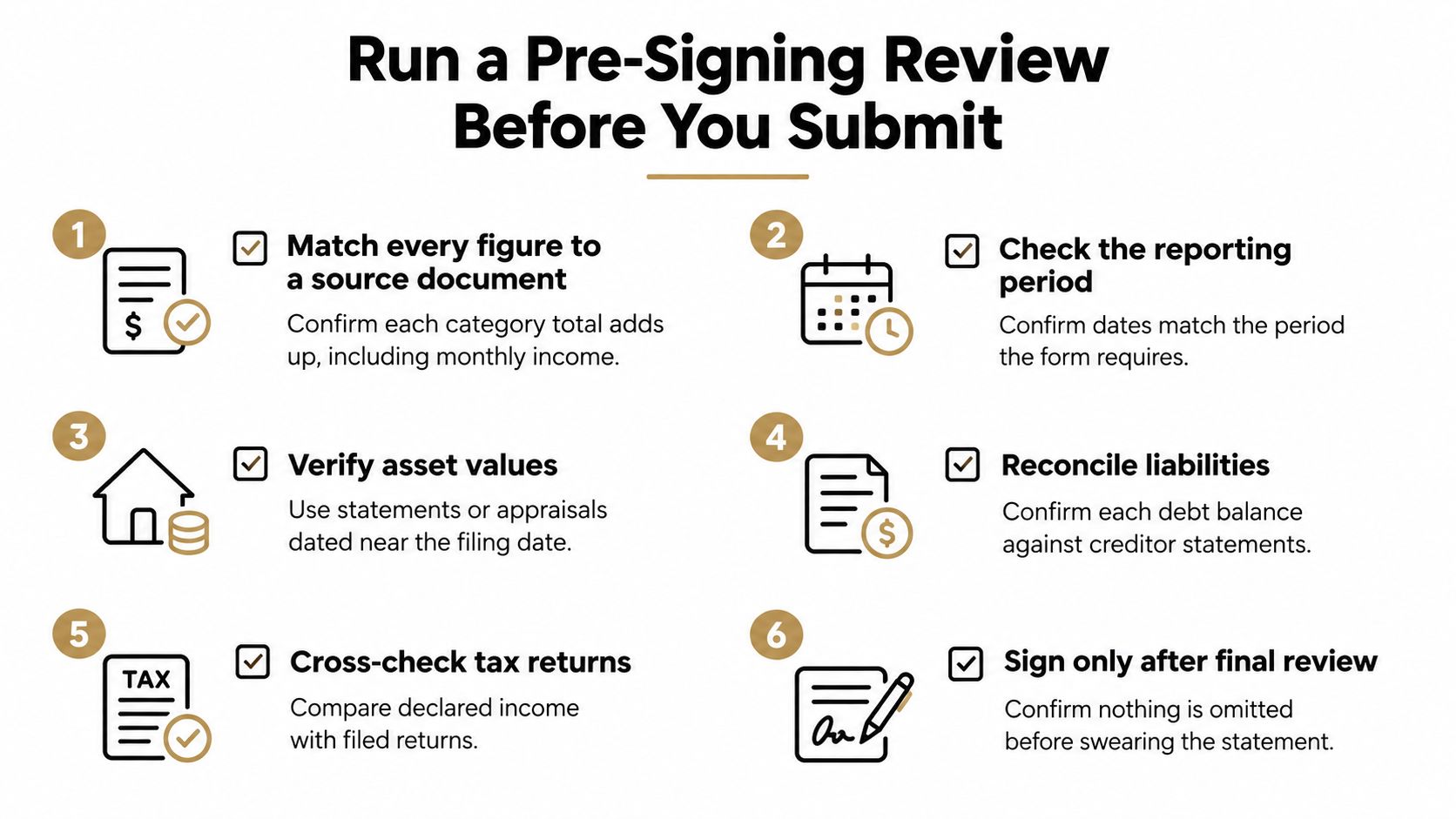
These checks support careful preparation; they don't replace the governing form or legal advice. For organizations managing faculty disclosures, we support financial relationship disclosure collection, status tracking and reporting, with a speaker portal for assigned tasks, disclosures, presentation files and correspondence.
Our conference and continuing education software connects disclosure administration with speaker preparation and education workflows. Visit Planstone to discuss your program's collection, review and reporting requirements and confirm the configuration that fits your process.