
Structured abstracts received 100 more words than unstructured abstracts in the ICMJE's 1991 recommendations, about 67% more space, because authors still needed to report purpose, procedures, findings, and conclusions systematically (ICMJE recommendations and annotations). That difference reframes abstract formatting as a question of evidence capacity, not cosmetic consistency.
An abstract submission format defines the structure, length, metadata, and delivery requirements a submission must satisfy. Authors need to respect those requirements, but program committees have an equally important responsibility: configure submission systems so the published rules and the enforced rules match.
Table of Contents
- What an Abstract Submission Format Actually Defines
- Unstructured Versus Structured Abstract Formats
- Core Structural Components of a Submission Form
- Word Limits, Character Limits, and What Counts Toward Them
- Study-Design-Specific Reporting Controls
- File and Formatting Specifications Beyond the Body Text
- AI and Generative Tool Disclosure Fields
- Supporting Fields, Metadata, and Cross-References
- Quick Reference for Authors and Program Teams
What an Abstract Submission Format Actually Defines
Structured scientific writing predates conference software. IMRAD, Introduction, Methods, Results, and Discussion, spread through scientific journals beginning in the 1940s, reached approximately 80% adoption in the journals examined during the 1970s, and became their sole original-paper format during the 1980s; adoption milestones included the New England Journal of Medicine in 1975, the British Medical Journal in 1980, and JAMA and The Lancet in 1985 (scientific manuscript preparation and structured reporting guidance).
The operational lesson isn't that every conference needs identical headings. It's that reviewers need identifiable places to find the research question, procedures, evidence, and interpretation. A submission form should preserve that information architecture rather than merely collect a document.
The rules behind the template
A useful format specification separates distinct obligations:
- Structural rules identify required headings and the evidence expected under each.
- Length rules define the counting metric, thresholds, and exclusions.
- Field rules determine where authors, affiliations, disclosures, and supporting identifiers belong.
- Delivery rules specify whether authors enter text, upload files, or complete both tasks.
These layers require different validation. A completed Methods box doesn't establish methodological adequacy, just as an accepted file extension doesn't establish compliance with the word limit.
Practical rule: Treat the format as an agreement between authors, administrators, and reviewers. Every mandatory instruction should have an identifiable check or review responsibility.
Authors approaching conference writing from longer academic work may find the Thesis Book Project on dissertation abstracts useful for orientation. However, a dissertation-oriented resource can't replace the conference's own eligibility rules.
For committees, the decisive distinction is between scientific judgment and administrative validation. Software should check mechanically testable requirements. Reviewers should assess whether the submitted evidence supports the conclusions.
Unstructured Versus Structured Abstract Formats
An unstructured abstract presents the summary as continuous prose. A structured abstract organizes that summary under explicit labels, whether authors type those labels into a document or complete separate submission fields.
The historical ICMJE benchmarks cited above allowed 150 words for unstructured abstracts and 250 for structured abstracts. Those limits were historical recommendations, not universal conference rules. Their enduring operational lesson is that explicit reporting obligations require enough space to meet them.
| Decision | Unstructured format | Structured format |
|---|---|---|
| Author interface | Continuous narrative field | Labeled fields or prescribed headings |
| Completeness check | Requires reading the narrative | Can identify missing sections before review |
| Main advantage | Flexible presentation | Clear locations for required evidence |
| Main limitation | Missing elements can be harder to detect | Rigid headings may poorly fit some submission categories |
Modern ICMJE guidance calls for structured abstracts for original research, systematic reviews, and meta-analyses. As established in the manuscript guidance cited earlier, exact headings can vary by publication. For case reports, editorials, and short communications, committees should specify the required format explicitly rather than assume authors will infer it from the category name.
Choose the format before opening submissions
The committee should first identify what reviewers need to evaluate, then choose the input structure. If reviewers must compare methods and findings across research submissions, separate fields provide an administrative advantage: staff can distinguish an empty Results section from a completed narrative awaiting scientific assessment.
An unstructured field may suit a category whose evaluation depends on a coherent proposal rather than completed empirical findings. That remains a program-design decision, not permission to omit required information.
A universal template therefore creates a trade-off. It simplifies administration, but it can force unlike submissions into headings that don't fit their purpose. Standardize the evaluation requirements before standardizing the screen layout.
Core Structural Components of a Submission Form
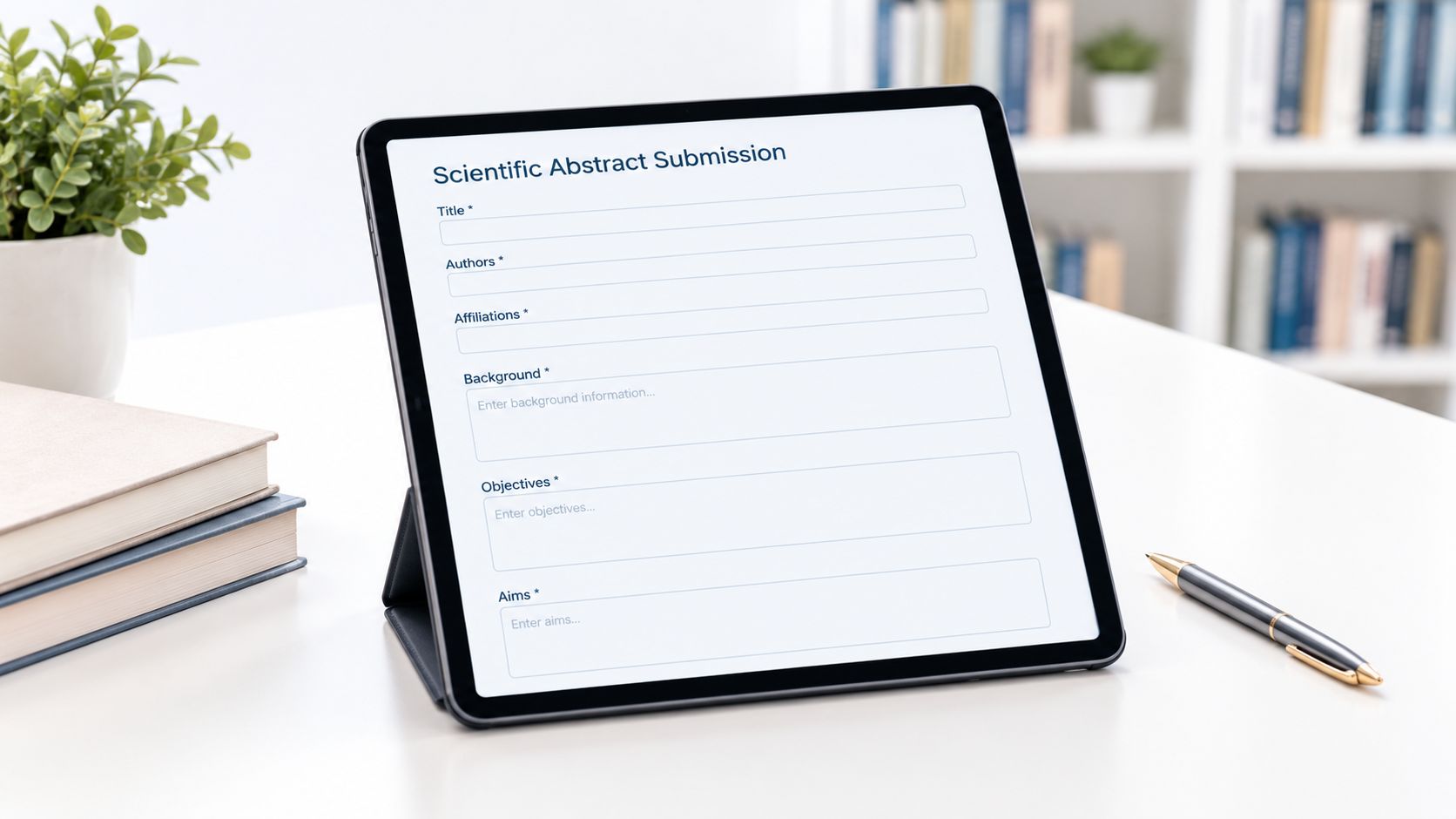
A research submission form should make the relationship between the question, method, findings, and interpretation visible. Separate narrative fields are useful when each has a clear reporting purpose.
A field-based interface makes those responsibilities explicit.
Build the scientific record in sequence
- Title and authorship should identify the work and its contributors, with affiliations stored separately from the scientific narrative.
- Background and objectives should establish the problem and the question being answered. Separate objectives from background when reviewers need to assess alignment explicitly.
- Methods should prompt for relevant design, setting, population, intervention or exposure, comparator, and outcome measures.
- Results should request actual findings, including sample size, effect estimates, and confidence intervals where applicable.
- Conclusions should explain what the findings support without extending beyond the evidence presented.
The University of Hong Kong's Medical Research Conference requires Introduction, Method(s), Results, and Conclusion, with acknowledgments identifying funding when applicable. It also prohibits promises such as “results will be discussed” and “data will be presented,” requiring findings or conclusions instead (HKU abstract submission guidelines).
That distinction matters for validation. A nonempty Results field may contain only a promise, so committees should pair required-field checks with reviewer instructions on substantive completeness.
Keep preparation guidance separate from eligibility rules
For broader checklist habits, contributors may consult ProMed Certifications' tips for submitting nursing applications. That resource concerns application preparation, not scientific abstract standards; the conference's instructions remain controlling.
For teams examining how collection connects with review and program development, the submission-management overview provides relevant workflow context.
A video resource can supplement written preparation instructions.
Word Limits, Character Limits, and What Counts Toward Them
A length limit is incomplete unless it defines both the metric and the counted content. A word counter can't enforce a character limit, and a body-text counter can't determine whether headings or disclosures belong inside its scope.
The following examples show why committees need event-specific configuration. They are representative published rules, not interchangeable standards.
Abstract length rules across representative conferences
| Conference or source | Metric | Cap | What is excluded |
|---|---|---|---|
| Canadian Association of Occupational Therapists | Words | 250 for paper or poster abstracts; 350 for extended discussions | Confirm counting treatment in event instructions; required headings apply |
| University of Massachusetts Chan Medical School | Words for body; characters for minimum and title | 400-word body maximum; 400-character minimum excluding spaces; 200-character title maximum including spaces | Spaces excluded from the stated minimum, but included in the title limit |
| IMU medical-research guidance | Words | 300 | No exclusion established here; Microsoft Word submission required |
| American Association for Thoracic Surgery | Characters including spaces | Fewer than 2,500 | Title, authors, institutions, and one table or image |
The UMass Chan rules demonstrate why a submission may need separate body, title, and minimum-length checks. The AATS rule also illustrates a boundary condition: “fewer than” isn't equivalent to “up to.” Staff should translate that wording accurately into acceptance logic.
Allocate words around reporting obligations
Shortening background is usually a more defensible editorial choice than deleting information needed to interpret the findings. Authors should protect design, outcome definitions, relevant denominators, and uncertainty before preserving contextual prose.
Good Practice for Conference Abstracts and Presentations notes that CONSORT for Abstracts may require around 300 words for randomized trials and recommends excluding authors, affiliations, registration numbers, and sponsor acknowledgments from the substantive limit.
A shorter template isn't necessarily a clearer template. If essential reporting competes with administrative metadata, the counting policy needs reconsideration.
Program teams should publish exclusions explicitly and test the same text in the instructions, author interface, and final validation process.
Study-Design-Specific Reporting Controls
A randomized trial and an educational intervention shouldn't receive identical Methods prompts merely because both enter the same conference. Study design should determine reporting questions, while the program category determines the review pathway.
The EQUATOR Network's conference-paper and abstract reporting resources catalog relevant guidance, including observational-study reporting through STROBE and resources for other designs. The updated CONSORT framework contains 30 minimum reporting items plus a participant-flow diagram for randomized-trial reporting; that broader checklist shouldn't be mistaken for a requirement to reproduce an entire trial report inside an abstract.
Translate guidance into conditional questions
Start with a study-type selector covering randomized trials, observational studies, diagnostic studies, systematic reviews, quality-improvement projects, and educational interventions. Then show prompts relevant to the selected design.
For a trial, ask about allocation and the intervention comparison. For observational research, prioritize the exposure, population, and outcomes. For a review, request the eligibility approach and synthesis method rather than intervention-delivery details.
| Form decision | Recommended behavior |
|---|---|
| Study type changes | Reassess applicable prompts and required fields |
| An item doesn't apply | Permit an explicit explanation where appropriate |
| Required evidence is missing | Flag incompleteness without assigning scientific merit |
| Narrative is exported | Preserve associated structured variables |
Separate completeness from merit
Reviewers should be able to identify missing reporting information independently from weak scientific evidence. An unclear denominator may justify a targeted clarification; it doesn't automatically establish that the underlying study is poor.
Store sample size, intervention or exposure, comparator, outcome definition, effect estimate, confidence interval, and registration number independently where the workflow warrants it. That design allows organizers to filter and export those variables without repeatedly extracting them from prose.
The committee should still avoid collecting fields it won't use. Every required variable needs a defined reporting, review, or publication purpose, otherwise conditional forms can become unnecessarily burdensome.
File and Formatting Specifications Beyond the Body Text
An abstract can satisfy the scientific headings and still fail the submission's delivery requirements. File specifications are eligibility conditions when the published rules make them mandatory, not merely suggestions for visual consistency.
The IMU guidance cited in the length comparison requires Microsoft Word .doc or .docx files, along with a purpose statement, pertinent experimental procedures, a data summary, and conclusions. It also advises avoiding nonstandard abbreviations. These requirements should be checked together rather than distributed across disconnected instructions.
Define the upload contract
Program teams should publish a compact technical specification covering the following:
- Accepted format should identify permitted extensions. If PDF is accepted, say so explicitly; don't assume that a readable document is an eligible document.
- Presentation requirements should state any prescribed font, size, or layout rather than leave staff to apply unwritten preferences.
- Figures and tables should have clear allowance, caption, and resolution rules where applicable.
- Characters and notation should address permitted symbols and provide a way to inspect equations, superscripts, and other scientific text.
- File naming and size should be specified when the workflow depends on them.
These are recommended configuration checks, not universal conference requirements. Committees should reject a file only under a stated rule, and authors should have an opportunity to inspect the uploaded or rendered result.
Configuration test: Upload a scientifically realistic sample, not just a plain-text placeholder. Check the characters and formatting your authors actually need.
Distinguish submission files from presentation materials
An abstract upload and a later presentation handout serve different purposes. Staff should assign separate instructions and completion states rather than assume that accepting the abstract also completes speaker preparation.
For planning that later distribution stage, the handout-publishing overview describes a related workflow. Keeping the stages distinct helps organizers explain which document is required now and which belongs to an accepted speaker's later tasks.
AI and Generative Tool Disclosure Fields
AI disclosure should describe the activity, not merely record a yes-or-no answer. Language polishing, literature mapping, image generation, and data analysis create different questions for reviewers.
ICIS submission frequently asked questions permit generative AI for activities including literature mapping, text mining, and editing, while requiring disclosure and justification. The American Academy of Neurology's guidance requires transparency about use in writing, images, and data collection or analysis; its subsequent instructions specify the tool name, version, exact prompt, and how and where it was used.
AACR's guidance distinguishes placement by activity: AI used in the underlying study belongs in Methods, while AI-generated text or other material is disclosed at the end of the abstract. These policies shouldn't be flattened into a universal permission or prohibition.
A proposed disclosure model
| Reviewer-facing category | Information the form should request |
|---|---|
| Language assistance | Material edited and scope of assistance |
| Research support | Literature mapping, text mining, or related activity |
| Generated material | Text, images, or other generated content |
| Methodological use | Role in data collection, analysis, or interpretation |
A neutral example field is:
AI assistance disclosure: Tool and version; activity performed; affected sections or materials; author verification; justification; prompt details where required by conference policy.
This is a proposed field format, not an attributed policy quotation. The conference should state where the disclosure appears and whether it counts toward the substantive limit.
Keep disclosure types distinguishable
Requiring exact prompts may support auditability, but committees should consider whether that burden is proportionate for routine language editing. They shouldn't create an unstated exemption when an event's policy expressly requires prompts.
Financial disclosure and AI-use disclosure also answer different questions. The disclosure-management overview provides context for managing disclosure workflows, but organizers should retain distinct labels, instructions, and review responsibilities for each disclosure type.
Supporting Fields, Metadata, and Cross-References
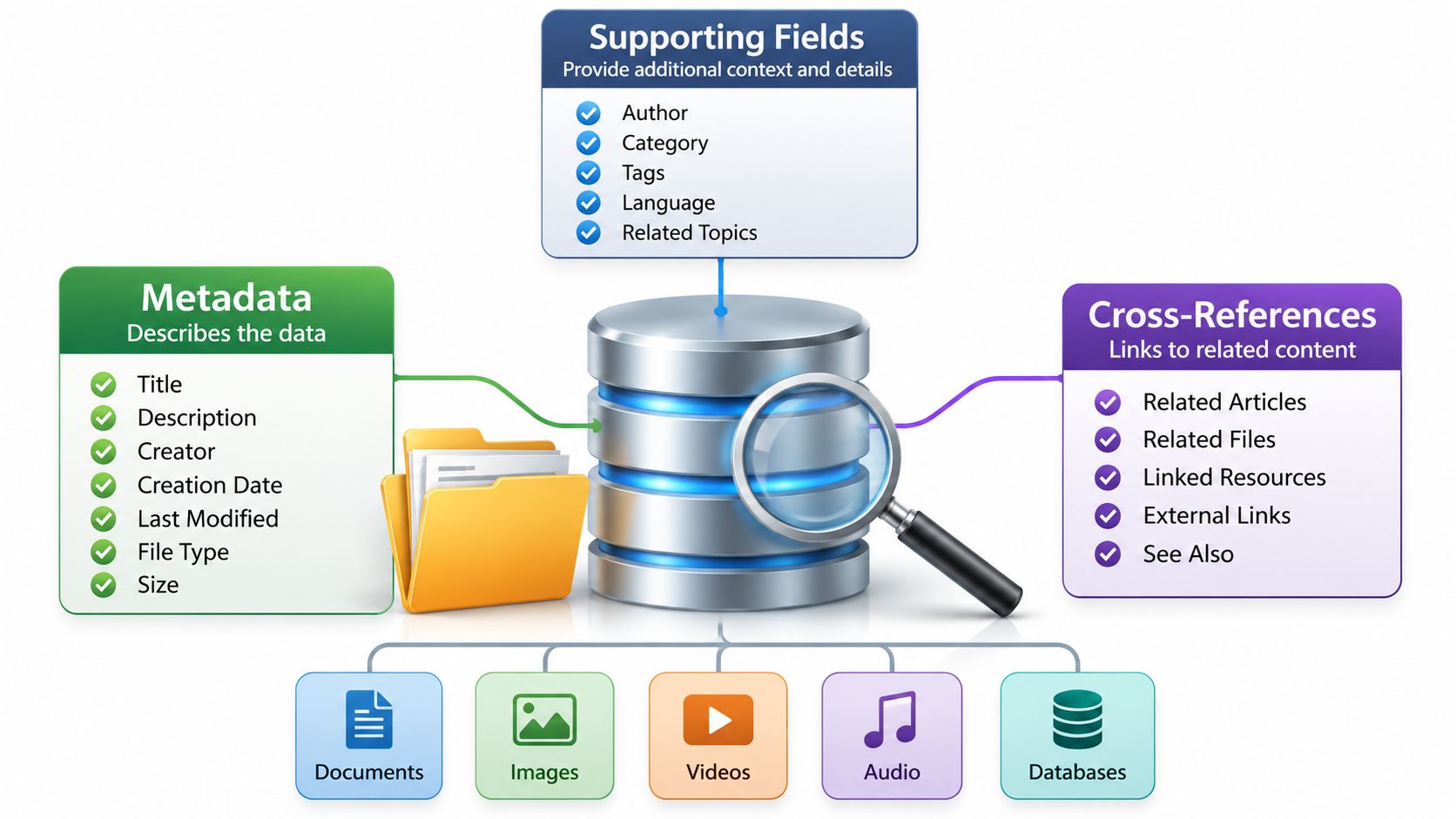
A complete submission record includes more than the abstract body. Committees should decide which supporting information they need, who may see it, and which later workflow will use it.
The distinction between narrative and supporting data is useful when designing that record.
Give supporting fields an operational purpose
- Keywords and categories should support reviewer assignment, session development, and program search where those workflows use them.
- Funding sources and grant numbers should be captured in designated fields, with acknowledgment placement defined separately.
- Trial registration identifiers should remain searchable identifiers rather than appear only inside narrative text.
- Ethics approvals and consent statements should trigger applicable eligibility review, including an explanation when a requirement doesn't apply.
- Conflicts of interest should connect to the appropriate contributor and disclosure process.
- Corresponding-author contact should identify the person responsible for clarification and revision.
- Presentation preference should distinguish an author's requested format from the committee's eventual assignment.
These are recommended record-design choices, not a claim that every conference requires every field. Collecting unnecessary personal or administrative information adds work without establishing scientific completeness.
Preserve relationships rather than duplicate text
A registration identifier can support registry or publication lookup when applicable. A funding record can feed acknowledgments without requiring staff to copy it from the body. Ethics information can support an acceptance gate when the conference's policy requires that review.
The important configuration question is what happens next. If a field has no owner, validation rule, access rule, or downstream use, the committee should reconsider why it is mandatory.
Keep author-level information attached to authors and study-level information attached to the submission. That distinction becomes especially important when contributors participate in multiple proposals or accepted work develops into a session.
Quick Reference for Authors and Program Teams
Authors should verify compliance against the selected submission category, not against a remembered general standard. Program teams should test that same category as an author would, including conditional fields and uploaded files.
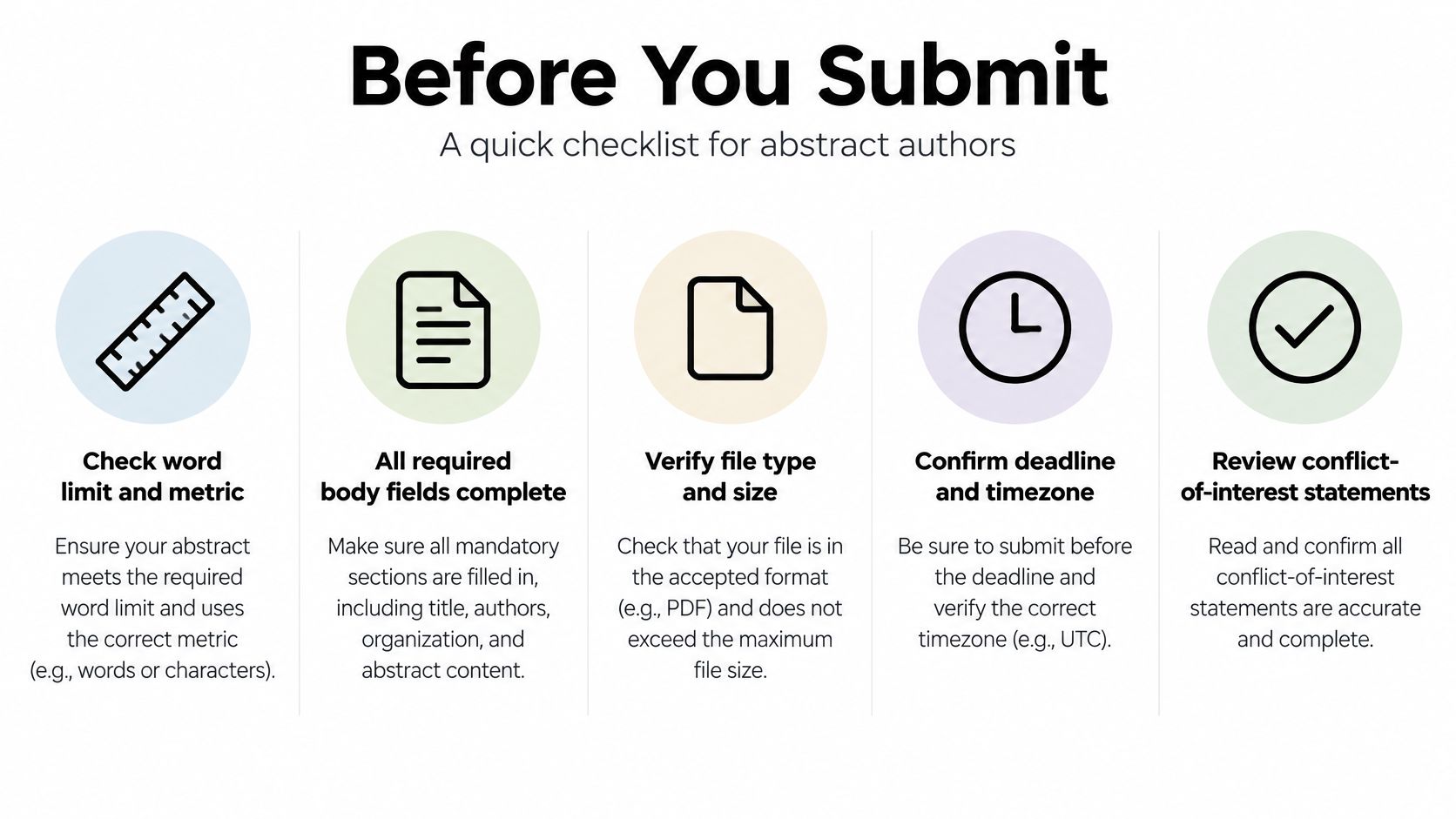
The following visual provides a final preparation reminder.
Author checklist
- Confirm the metric and exclusions against the length rules, including title and minimum-length requirements.
- Complete the scientific fields using the structural components, with findings rather than promises.
- Inspect the file against the technical specifications, including naming rules and rendered scientific notation.
- Declare applicable AI use using the disclosure requirements.
- Check supporting records for funding, registration identifiers, conflicts, and applicable ethics information.
- Verify the deadline and timezone in the event's instructions before final submission.
Program-team checklist
- Test boundary conditions for minimums, maximums, spaces, and excluded fields.
- Exercise conditional pathways using the study-design controls.
- Assign review responsibilities so administrative completeness and scientific merit remain distinguishable.
- Check access and exports for the supporting metadata, including information withheld from particular reviewer groups.
- Reconcile instructions with behavior so authors don't encounter a stricter, looser, or different rule at submission.
The most useful acceptance test is straightforward: can an author comply using only the published instructions, and can staff explain every validation message by pointing to those instructions? If not, revise the configuration or the policy before submissions open.
Planstone offers configurable conference and continuing education management software connecting abstract collection, review workflows, speaker preparation, and disclosures. Visit Planstone to discuss your submission categories, counting rules, and review requirements, and evaluate how its configurable forms and implementation support could fit your program.