

Your medical association's annual meeting is approaching, abstracts are still moving through review, and faculty disclosures are incomplete. After the meeting, your team will need to collect evaluations, apply credit rules, and answer certificate requests. A credit ledger won't manage that entire process, but buying a full learning management system might introduce course-delivery tools you don't need.
The right CME tracking software depends on what your team must manage around the credit record. Separate the options into three categories before comparing features:
- Credit-record systems organize member credits, reporting cycles, certificates, and transcripts.
- Program-administration platforms connect activity planning, contributors, disclosures, evaluations, and credits.
- Learning management systems deliver courses and assessments alongside learner credit administration.
A learner-facing progress view matters, too. A progress tracking dashboard for med students illustrates a related need for clear progress visibility, but accredited education teams must also preserve the evidence behind each award.
The options below serve different buyers, not interchangeable requirements. For an association managing abstracts and speakers, upstream program coordination may determine the shortlist. For an education business selling enduring courses, assessments and commerce may matter more. Public product descriptions establish a starting point, but they don't confirm your implementation scope, contract inclusions, or reporting configuration.
Table of Contents
- 1. Planstone
- 2. Coordinator's Choice CME Tracker
- 3. CME Tracker by cme-tracker.app
- 4. CloudCME
- 5. Rievent
- 6. EthosCE by Cadmium
- 7. CMEGenius
- 8. OasisLMS
- 9. Path LMS by Momentive Software
- 10. MapleLMS
- How the ten options differ by core focus, buyer fit, public pricing, and reporting scope
- Match the Tool to Your Program, Then Verify in a Demo
1. Planstone
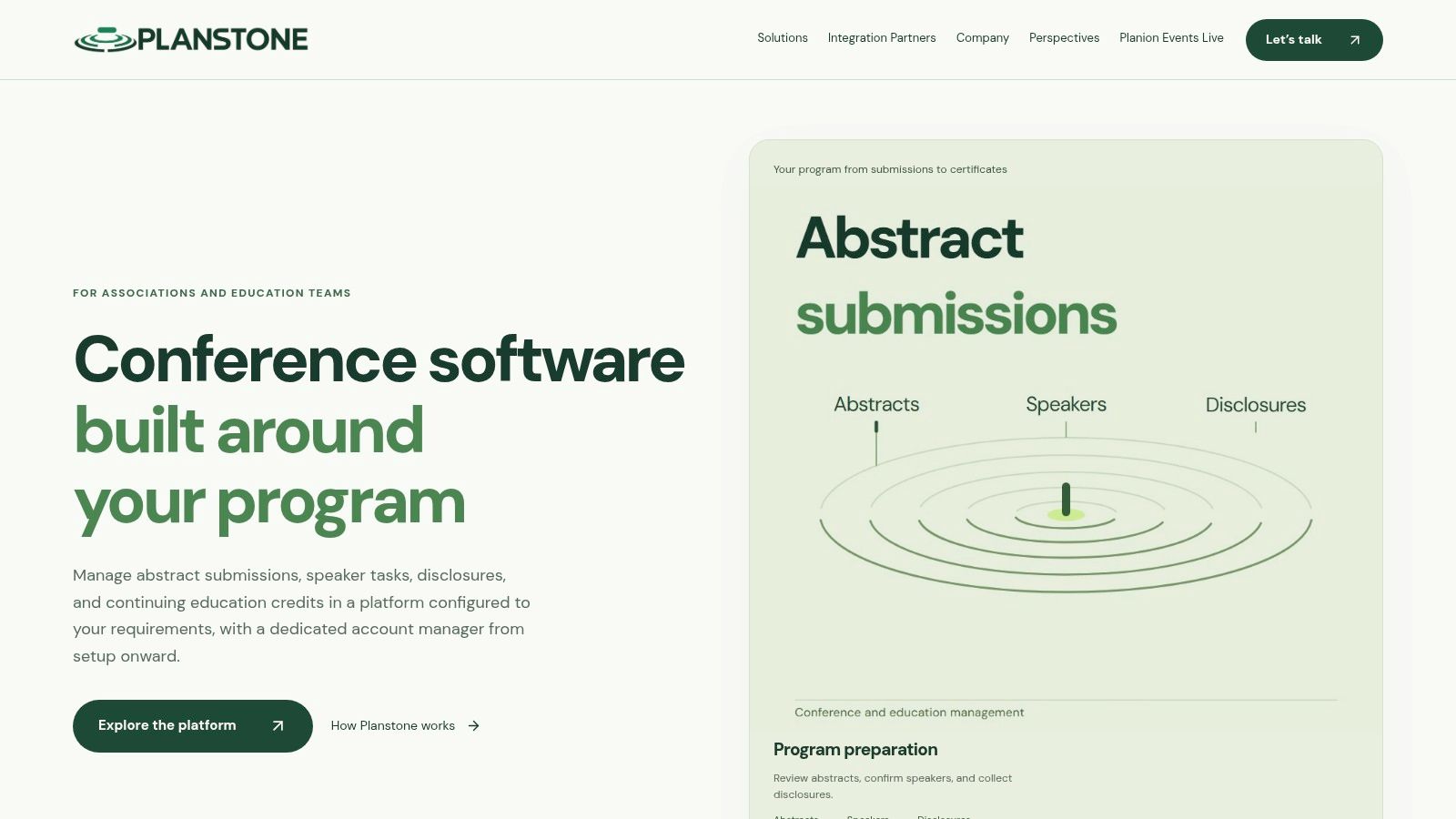
Best fit for medical and scientific associations that need conference administration connected to continuing education. Planstone connects submissions, reviews, session development, speaker preparation, disclosures, handouts, evaluations, and credit administration.
That distinction matters when credits depend on a program your staff must first build and prepare. Our abstract tools support authors, collaborators, and reviewers, while the speaker portal brings assigned tasks, disclosures, presentation files, and correspondence together. Staff can monitor completion and follow up on outstanding requirements.
Where the connected workflow helps
Our evaluation module collects participant feedback, applies program-specific credit rules, and makes certificates available to attendees. The responsive attendee experience also supports session lookup, presentation materials, evaluations, and credit access.
- Configurable scope: Use individual modules alongside existing systems or combine submissions, speakers, and education administration.
- Program-specific setup: Configure forms, workflows, reports, branding, and credit rules around organizational requirements.
- Connected systems: Integration options include AMS and CRM platforms, registration providers, audiovisual providers, and event applications.
- Ongoing support: A dedicated account manager works with configuration and technical specialists through implementation, training, event preparation, and changing requirements.
The session-building workspace developed with the American Physical Society offers a concrete example of configuration around scientific programs. Organizers can filter abstracts, move submissions into sessions, and work within session-time limits.
The trade-off is preparation. Configuring connected workflows requires decisions about ownership, data exchange, and exceptions. Public pricing isn't listed, and the available information doesn't establish specific awards or certifications.
This is a stronger fit when your operational problem begins before attendance tracking. If you only need somewhere to store externally earned credits, a narrower record system may be sufficient.
2. Coordinator's Choice CME Tracker
Coordinator's Choice CME Tracker sits between a transcript database and full program administration. A CME office managing activity applications, faculty requirements, budgets, and learner records gets modular tooling for the administrative work surrounding education, well beyond a place to store earned credits.
The published offering covers activity planning, agendas, review and approval workflows, and contributor administration. Disclosures, biographies, presentation materials, releases, and reminders sit alongside learner-facing registration history, credit claiming, certificates, and transcripts.
The buying decision is the module combination
Optional surveys, event applications, speaker portals, text-in attendance, and external-credit tracking let organizations expand their setup over time. Modularity is the advantage and the purchasing challenge: buyers need to map which modules depend on each other before comparing quotes, since a feature assumed to be standard may carry its own line item.
- Advantages: Administrative and learner workflows share a broader product family, and published module pricing supports preliminary budgeting. The product also identifies ACCME Premier Technology Partner status.
- Disadvantages: Separate modules complicate scope comparison, and setup plus recurring maintenance can materially affect the purchase.
- Verify in a demonstration: Follow an activity from approval through attendance, evaluation, credit claiming, and a corrected transcript.
Record authority deserves the same attention as module scope. Imported attendance, learner-entered external credit, staff-approved awards, and final reporting records carry different weight, and treating them interchangeably produces transcripts nobody trusts. Whether your internal policies say recordkeeping or record keeping, the useful work is defining who can change each record and what evidence must remain attached.
This option suits a structured CME office better than a team seeking only a lightweight member credit log.
3. CME Tracker by cme-tracker.app
An osteopathic association tracking member credits has a different purchasing problem from a course publisher. CME Tracker by cme-tracker.app targets that narrower association workflow, emphasizing member records and configurable state and cycle requirements rather than full LMS delivery.
Members can use guided self-reporting to classify credits. Staff can bulk-upload attendance and credit records, including conference records, while eligible association programs can use custom certificates.
A member's reported credit and an association-issued credit should remain distinguishable, even when both appear on the same transcript.
Focused records without a full course platform
The vendor describes member-management integrations and custom reporting, plus configurable cycle schedules and credit categories. Those functions are relevant when the main job is maintaining an organized member history rather than hosting instructional content.
The practical upside is a narrower operational scope. Associations with an established website, registration system, and education delivery process may not need to replace those systems just to improve credit records.
The limitation is the specificity of its stated audience. Non-osteopathic organizations should establish whether their credit taxonomy and workflows fit, and public information doesn't fully detail integration specifications, security assurances, or implementation requirements.
Use your actual continuing education credit hours rules during evaluation. Demonstrate an imported conference record, a member-submitted activity, an incomplete submission, and a corrected award. Pricing tiers aren't publicly published, so a quote should identify migration, configuration, and ongoing support separately.
4. CloudCME
For organizations running accredited education across departments, CloudCME belongs in the broad program-management category, not the simple credit-ledger category. HealthStream's continuing education management offering covers activity applications, registration, faculty administration, evaluations, certificates, transcripts, and reporting.
HealthStream identifies reporting connections including PARS, JA-PARS, CPE Monitor, NARS, and CE Broker. It also describes mobile-oriented learner access and faculty scheduling and disclosure collection, with organizational examples including Johns Hopkins and Memorial Sloan Kettering.
Put disclosure handling through a real test
Disclosure collection isn't merely a faculty checkbox. ACCME Standard 3 requires collection of financial relationships with ineligible companies during the previous 24 months, alongside the applicable mitigation and learner-facing disclosure requirements.
A useful demonstration should therefore distinguish collecting a response, reviewing relationships, documenting mitigation, and presenting the final disclosure before participation.
- Advantages: Broad activity administration and learner self-service can support an education office seeking a shared system.
- Disadvantages: The breadth may exceed a small provider's needs, and pricing requires a sales conversation.
- Unconfirmed scope: A named integration doesn't establish that every reporting destination or feature is included in your package.
Before implementation, document how you'll offer continuing education credits, including eligibility, completion evidence, and reporting ownership. Then test that process rather than accepting a generic certificate demonstration.
5. Rievent
A publisher combining journal education, webinars, and live meetings needs more than an online-course completion counter. Rievent describes support for those formats alongside enduring materials, regularly scheduled series, and manuscript review.
The platform, within HealthStream, manages activities from creation through reporting. Its learner portal supports activity selection, registration, credit claiming, certificates, and transcripts, while administrative functions cover evaluations, surveys, tests, and activity data.
Stronger fit for mixed-format education
Rievent describes automated reporting for ACCME PARS and JA-PARS, ANCC NARS, and ACPE CPE Monitor. Its customer examples discuss easier attendance and evaluation processing and reduced report-preparation effort, but those examples aren't a guarantee of equivalent results for another organization.
The advantage is format flexibility. An association with journal-based learning and recurring live programs can evaluate their shared administrative requirements without assuming everything must behave like a conventional course.
The trade-off is scope. A team seeking only a credit repository may not need broad activity management, and public pricing isn't listed.
- Test learner self-service: Retrieve an older transcript, correct a learner profile, and regenerate documentation.
- Test administrative exceptions: Process incomplete evaluations, changed attendance, and rejected reporting records.
- Clarify ownership: Confirm the product roadmap, support arrangements, and contracting responsibilities with HealthStream following the ownership transition.
The key question isn't whether Rievent supports your activity labels. It's whether staff can administer the exceptions within each format without maintaining a parallel spreadsheet.
6. EthosCE by Cadmium
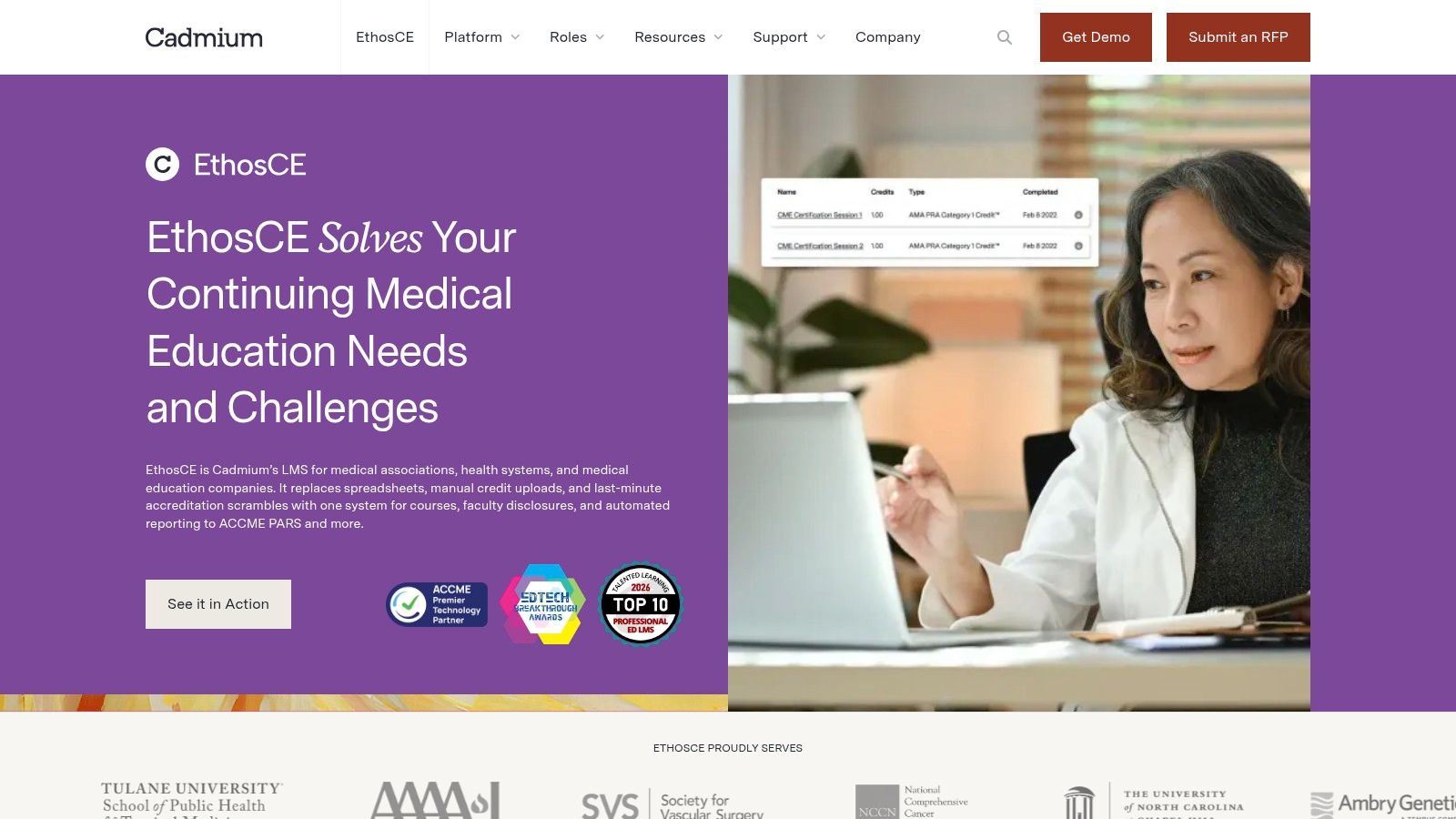
Choose the LMS category when delivering education is part of the requirement. EthosCE by Cadmium combines healthcare-focused course delivery with learner credit administration, faculty management, and commerce.
Its published capabilities include learning paths, faculty profiles, disclosure forms and workflow statuses, registration payments, discounts, and course sales. It also identifies reporting for PARS, JA-PARS, CE Broker, and CPE Monitor and lists ACCME Premier Technology Partner status.
Course completion isn't the same as credit claimed
The AMA PRA provider FAQ requires physician documentation to reflect credits claimed, not the maximum available, and identifies the participant, provider, activity, format, date, and credit information that documentation must contain.
That makes participant-level testing important. A completed course, a passed assessment, and a claimed credit award may represent different workflow states.
- Advantages: Healthcare specialization connects faculty administration, learning delivery, and credit records. Related Cadmium event and content products may support a broader connected environment.
- Disadvantages: Pricing isn't published, and a wider suite introduces more configuration and purchasing decisions.
- Verify the boundary: Establish which reporting connections and event-management functions belong to the quoted implementation rather than adjacent products.
EthosCE is a sensible candidate when education delivery and credit administration should share an environment. If your existing LMS already works, compare the operational cost of replacing it against adding a narrower administration tool.
7. CMEGenius
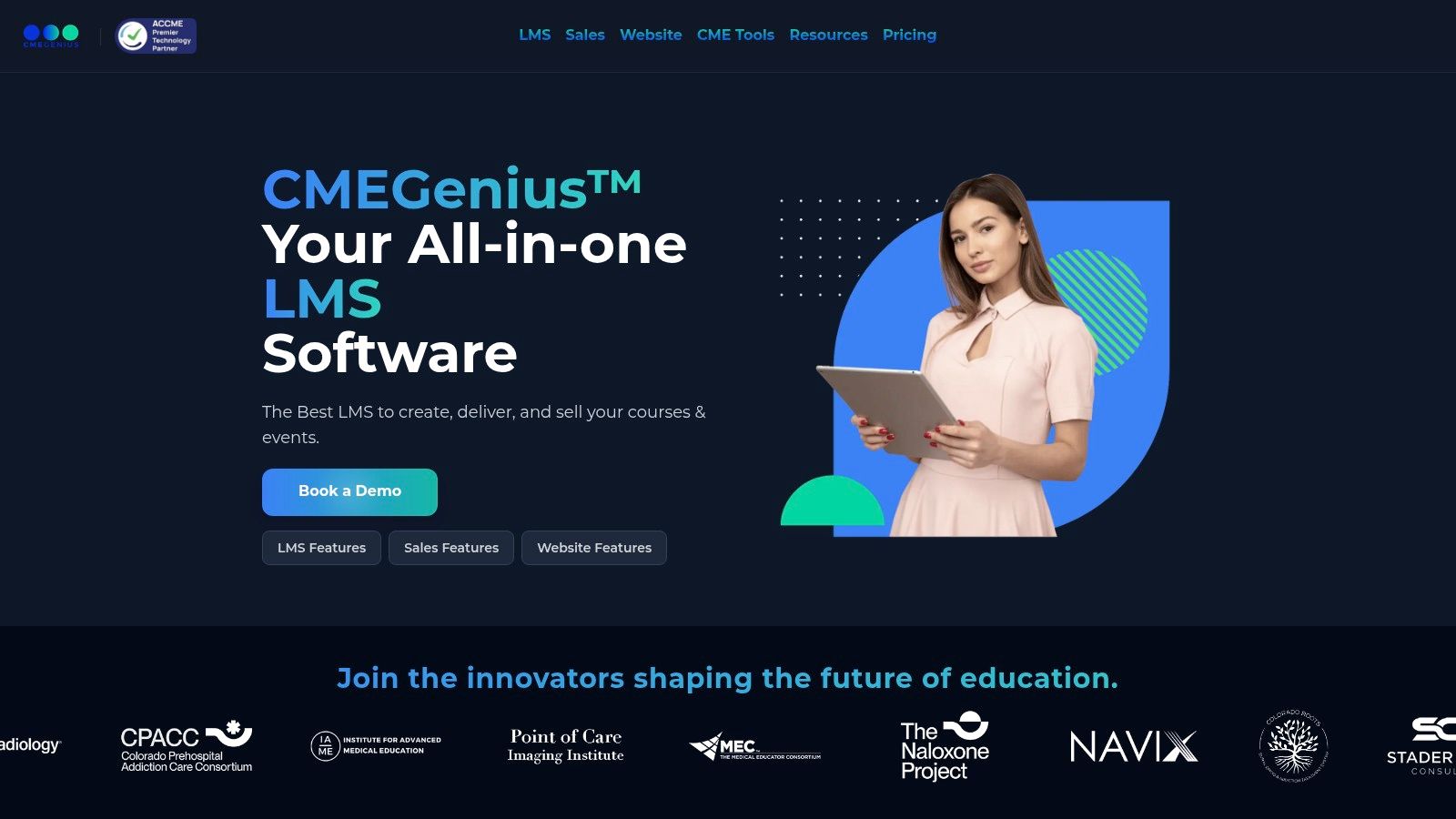
Selling education introduces requirements that an internal credit tracker doesn't address. CMEGenius combines a healthcare-focused SaaS LMS with branded course websites, assessments, commerce, credit tracking, and certificate generation.
The vendor lists course, webinar, and event creation, marketing analytics, and payment or integration options including Stripe, Zoom, and Salesforce. It also describes an AI quiz builder and automated learner-data reporting.
Review boundary: An AI-generated assessment should enter the same content review and approval process as an assessment written by faculty.
Evaluate the package, not just the feature list
CMEGenius says its packages include PARS/JA-PARS and certain other accreditation integrations. It also lists unlimited learners and courses, guided onboarding, a dedicated account manager, and ACCME Premier Technology Partner status.
The advantage is the combination of delivery, sales, and credit administration. An education provider launching a branded course business may value that combination more than an association with established website and commerce systems.
The disadvantage is potential duplication. Existing course hosting, payments, analytics, and CRM workflows can become harder to govern if the new platform introduces overlapping responsibilities.
Pricing is sales-led rather than publicly itemized. Have the vendor identify which reporting destinations, integrations, onboarding tasks, and support services the proposal includes.
For the demonstration, use a paid course with an assessment, a failed attempt, a successful retry, and a certificate claim. That sequence reveals more than a tour of the course-authoring screen.
8. OasisLMS
Multiple professions within the same activity make credit eligibility a central buying criterion. OasisLMS describes multiple credit types within an activity and configurable eligibility based on profession or learner status, alongside live, virtual, and enduring education delivery.
Its healthcare materials identify automated credit claiming, certificates, transcripts, evaluations, outcomes surveys, PI-CME, and MOC support. Listed reporting connections include PARS, CPE Monitor, BPS, CAPCE, and other systems.
Keep the credit taxonomy intact
ACCME's reporting guidance and data report describes learner-data reporting across multiple certifying boards, reinforcing why providers should preserve reporting destinations and credit categories separately.
A single credits-awarded field won't adequately describe an activity that supports different professions or certification pathways. Retain the learner identity, activity identifier, accrediting body, credit category, completion evidence, and reporting status.
- Advantages: Eligibility rules suit interprofessional programs, while delivery and compliance functions share an LMS environment. The ACCME partner listing provides evidence of a live reporting integration.
- Disadvantages: Broad LMS functionality requires configuration planning, and the healthcare page doesn't transparently itemize pricing.
- Verify in context: Demonstrate learners with different professional roles completing the same activity and receiving the appropriate credit options.
Don't assume every listed destination handles every activity type or correction automatically. Confirm identifier validation, rejected submissions, amended awards, and reconciliation before relying on a reporting connection operationally.
9. Path LMS by Momentive Software
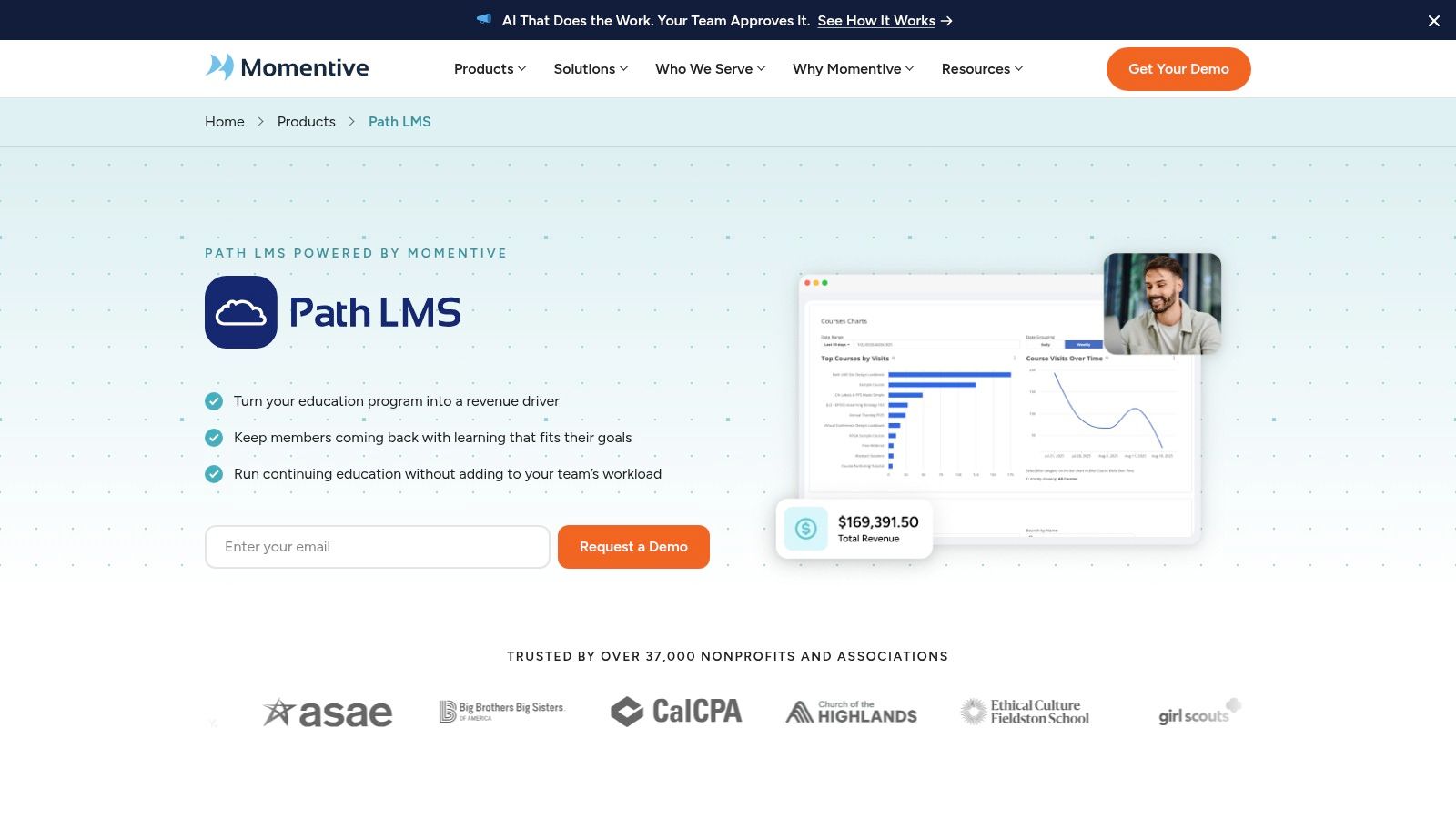
Membership pricing, course sales, certification, and continuing education often belong to the same association program. Path LMS by Momentive Software targets that broader association environment rather than CME administration alone.
Published capabilities include course authoring, assessments, learning paths, reporting dashboards, automated credit assignment, and certificates. Momentive also highlights AMS/CRM integrations, single sign-on, mobile-friendly access, and PARS integration with a learner-facing submission workflow.
Start with the member journey
A useful demonstration begins in the member system, not the course catalog. Follow a member through sign-on, member pricing, enrollment, completion, credit submission, and later transcript retrieval.
The advantage is alignment between education and association operations. Certification programs and course revenue can sit alongside continuing education, and the product lists ACCME Premier Technology Partner status.
The limitation is that association LMS breadth isn't a substitute for detailed CME workflow verification. Public descriptions don't establish how PARS submission will work for every credit type, activity format, or correction scenario.
- Membership changes: Check how learner access and pricing respond when membership status changes.
- Record ownership: Establish whether the AMS or LMS owns each identity and completion field.
- Administrative exceptions: Demonstrate merged accounts, refunded registrations, and amended credit claims.
Pricing requires a demo or quote. This option deserves consideration when member education is the central requirement, but it may be excessive when the only unmet need is activity administration or historical credit storage.
10. MapleLMS
If Salesforce already holds your member or learner data, architecture may narrow the shortlist before feature comparisons begin. MapleLMS presents a Salesforce-native LMS for association, healthcare, and life-sciences use cases.
Its offering includes CE/CME/CNE credit tracking, certificates, assessments, analytics, microsites, automated notifications, and multi-tenant delivery. It describes synchronization with connected CRM, HRMS, or AMS systems, and ACCME identifies it as a Premier Technology Partner with AMS and PARS integration support.
Salesforce fit needs an operational test
The advantage is architectural alignment, provided Salesforce is already an intentional part of your operating model. Multi-tenancy may also suit organizations maintaining separate branded audiences or program environments.
The trade-off is dependency. A Salesforce-native approach may be a poor fit when another system owns member identity and your team doesn't want additional Salesforce administration.
- Map synchronization: Identify which system creates learner records and how updates move between systems.
- Test separation: Check permissions and reporting across branded audiences or tenants.
- Confirm reporting scope: Establish precisely which CME submissions, statuses, and corrections the implementation supports.
Public pricing isn't listed, and a product-level integration statement doesn't establish the effort required for your configuration. Include your Salesforce or AMS administrator in evaluation so field mappings, permissions, duplicate handling, and support ownership receive the same scrutiny as course delivery.
MapleLMS is most compelling when its architecture matches an existing technology decision, not when Salesforce is being introduced solely to obtain a credit tracker.
How the ten options differ by core focus, buyer fit, public pricing, and reporting scope
| Item | Core focus | Best for | Public pricing | Reporting scope |
|---|---|---|---|---|
| Planstone (Recommended) | Configurable conference and continuing-education management | Associations and education teams managing complex programs | Not publicly listed | Configurable reports, credit tracking, and participant certificates |
| Coordinator's Choice CME Tracker | Modular CME-office administration and learner credit management | Education offices needing administrative and learner-facing workflows | Published module pricing | CME activity, learner credit, and administrative reporting |
| CME Tracker by cme-tracker.app | Member CME-record tracking | Osteopathic associations tracking member credits | Quote or demo required | Configurable state and cycle requirements, with custom reporting |
| CloudCME | Accredited education activity and learner-credit management | Healthcare and academic organizations managing CME/CE programs | Not publicly listed | Reporting connections include PARS, JA-PARS, CPE Monitor, NARS, and CE Broker |
| Rievent | CME/CE activity management across multiple formats | Organizations managing varied accredited activities | Not publicly listed | Automated accreditor reporting, activity data, and performance reporting |
| EthosCE by Cadmium | Healthcare-focused LMS and credit administration | Medical associations, hospitals, and academic health systems | Not publicly listed | Credit tracking and reporting for PARS, JA-PARS, CE Broker, and CPE Monitor |
| CMEGenius | Healthcare-focused course delivery, commerce, and credit tracking | Providers selling courses and events alongside CME administration | Sales-led; not publicly itemized | Learner-data reporting and listed accreditation integrations, including PARS/JA-PARS |
| OasisLMS | Configurable learning delivery and CME tools | Healthcare organizations with varied learner eligibility and credit types | Not transparently itemized | Accreditor reporting integrations, including PARS and CPE Monitor |
| Path LMS by Momentive Software | Association LMS for education, certification, and membership | Associations connecting member education with commerce and engagement | Demo or quote required | Credit and compliance reporting, including PARS integration |
| MapleLMS | Salesforce-native learning and certification management | Organizations using Salesforce for learner or member data | Not publicly listed | Credit and certification reporting, with AMS and PARS integration support |
Match the Tool to Your Program, Then Verify in a Demo
Start by deciding which workflows must stay together. Credit tracking alone, full program administration, and course delivery with learner credits are different requirements, even when vendors use similar terminology.
A focused member-record system may be sufficient for externally earned credits and reporting cycles. A conference platform is more relevant when abstracts, speakers, disclosures, and session preparation create the administrative workload. An LMS earns its place when your team must deliver instruction, assess learning, or sell courses.
Buy for the work your staff must complete, including corrections and exceptions, rather than the longest feature list.
Bring a written workflow to every vendor
Use the same scenarios across demonstrations so differences become visible. Bring actual credit rules, reporting destinations, integration needs, and anonymized examples of difficult records.
- Establish learner identity. Show account creation, imported participants, duplicate detection, and account merging.
- Prove completion and eligibility. Separate attendance, assessment, evaluation, profession, and credit-claim requirements.
- Generate accurate documentation. Confirm that certificates and transcripts reflect the learner's actual award.
- Submit and reconcile. Process a rejected submission, correct it, and preserve the reporting history.
- Retrieve older records. Test staff and learner access after the activity has closed.
Document retention deserves its own requirement. For example, the Alabama Board of Medical Examiners requires licensees to maintain personal CME records for three years following the year in which the CME was earned. That's a jurisdiction-specific licensee obligation, not a universal software retention rule.
Historical retrieval matters more than certificate styling. The AMA PRA booklet allows certificates, transcripts, or other documentation containing the required information, rather than mandating a single document format.
Compare the scoped cost
Most options don't publish pricing, so compare proposals against the same operating requirements. Separate software access from configuration, migration, integrations, training, reporting setup, and ongoing support, without assuming every vendor charges for each component separately.
Measure learner access as well as administrative coverage. When reviewing analytics intended to spot at-risk learners early, distinguish an unfinished activity from a failed assessment, missing evaluation, or unclaimed credit. Those situations require different follow-up.
The strongest choice is the system your staff can operate accurately and your learners can use without unnecessary assistance. A scripted demonstration and a scoped quote provide better evidence than an attractive dashboard.
Our configurable conference and continuing education software connects abstract submissions, speaker preparation, disclosures, evaluations, and credit administration. Visit Planstone to discuss your program's workflows, existing systems, and credit requirements with our team.