

NDSS received 694 submissions in 2024 and 1,311 in 2025, nearly doubling in a single cycle, and the organizers documented the operational strain in their account of managing higher submission volumes. Submission counts at other major security and AI venues have grown sharply over the same period. Volume at that scale rarely breaks the web form. It breaks the decision.
That reframe is worth carrying into any software evaluation. Call for papers software functions as the system of record carrying one abstract from publication of the call, through screening and review, into a decision, onto a session, and into whatever the work becomes after the meeting. When that record fragments across inboxes and spreadsheets, two things fail without warning. Schedules slip past the point where accepted authors can still prepare, and committee averages hide the fact that two reviewers disagreed completely about the same submission.
Table of Contents
- What Call for Papers Software Does and Who Uses It
- Review Timelines Your Software Must Protect
- How a Call Moves From Intake to Final Program
- Protecting Review Quality and Decision Records
- Required Data Fields, Disclosures and Authorship Records
- Comparing Platforms on Fit, Scale and AI Oversight
- Frequently Asked Questions About Call for Papers Software
- Confirm Your Requirements Before You Request a Demo
What Call for Papers Software Does and Who Uses It
Call for papers software manages a call for abstracts or papers from the day the call is published to the day accepted work appears in a finished program. It replaces the email threads, shared spreadsheets and attached PDFs that otherwise carry a submission through screening, review and scheduling.
Most platforms ship as a set of modules, and few organizations switch on all of them at once. That's a sensible buying pattern, as long as every module writes to one record.
| Module | What It Handles | Main Users |
|---|---|---|
| Call publishing | Deadlines, categories, required fields and branding | Program staff |
| Submission intake | Authors, co-authors, files and version control | Authors |
| Reviewer assignment | Conflict checks, reviewer load and scoring forms | Program committee |
| Decision and notification | Accept, reject or revise decisions and author emails | Organizers |
| Session building | Filtering abstracts, grouping into sessions and session-time limits | Session organizers |
| Speaker and disclosure tracking | Assigned tasks, presentation files and disclosures before the event | Speaker coordinators |
Why the shared record matters more than the feature list
Read the table again and count how many hands touch a single abstract. An author reorders co-authors at 11pm before the deadline. A committee member assigns three reviewers and checks for conflicts. An organizer records a decision and triggers notifications. A session organizer drops the accepted paper into a 90-minute slot. A speaker coordinator chases a disclosure form two weeks later.
If each of those people works in a different system, someone rekeys the same metadata five times, and the fifth version is the one that ends up in the printed program.
Planstone's submission management module keeps authors, reviewers and program organizers working from the same submission records, which is what allows a team to collect abstracts, manage reviews and build accepted work into sessions without exporting between tools. Teams that already run registration or an association management system don't have to replace it either. Individual modules can sit alongside existing systems, or submissions, speakers and continuing education administration can move onto one platform, each module configured around the organization's own process and branding.
Module test to run before any demo: write two columns, "needed for the next call" and "needed within 12 months". Ask the vendor to demonstrate and price both. A platform that can't show the second column working is a platform you'll outgrow in one cycle.
Review Timelines Your Software Must Protect
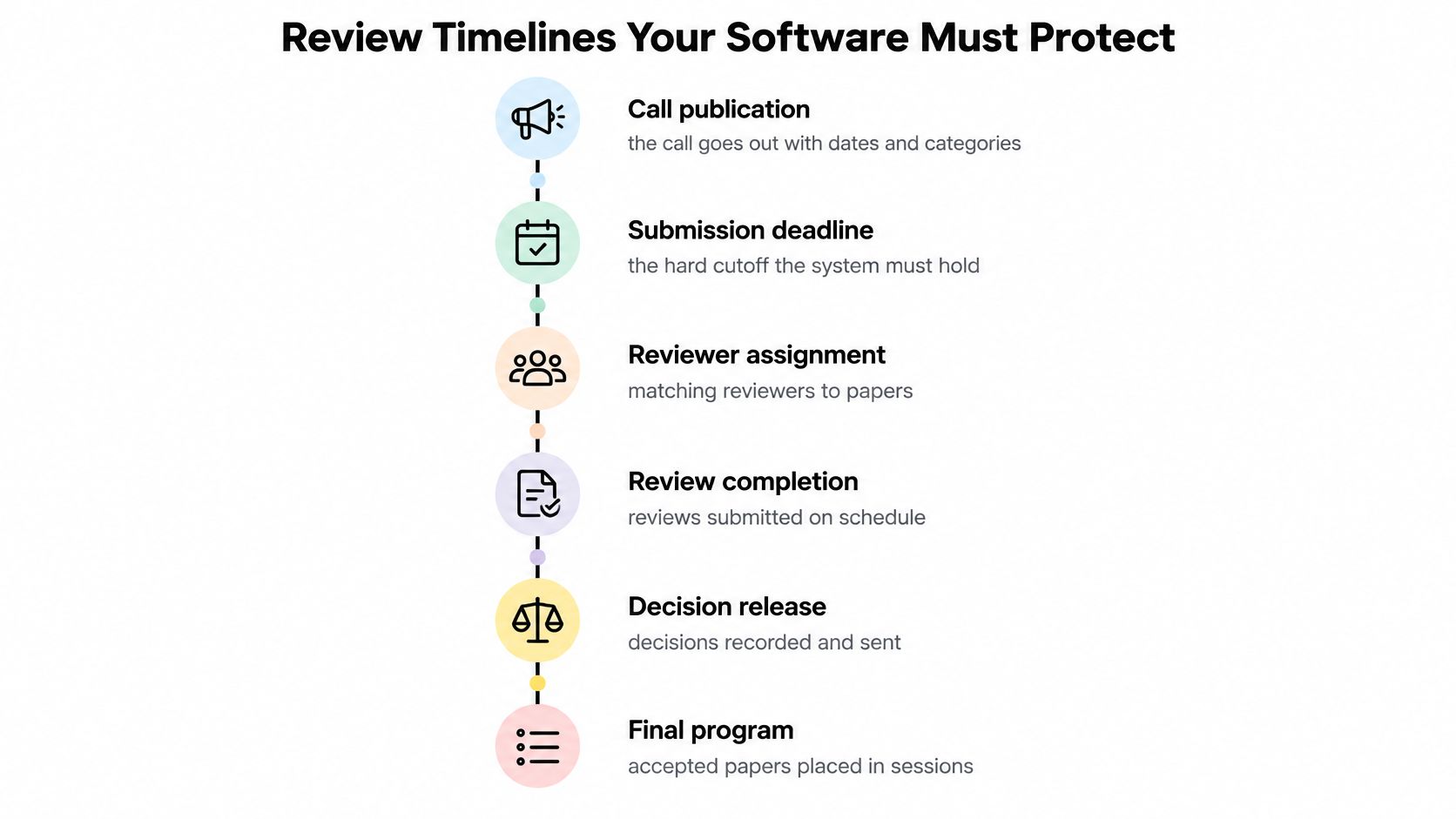
Peer-reviewed calls collected abstracts a median of 14 weeks before the event; calls without peer review collected them 6 weeks out, according to a recent Fourwaves analysis of academic conference submissions. Treat that as an intake signal. The protected window is the stretch from submission close to recorded decisions.
| Milestone | Peer-Reviewed Call | Non-Peer-Reviewed Call |
|---|---|---|
| Abstracts received | 14 weeks before event | 6 weeks before event |
| Reviews completed | 11 weeks before event | No formal review stage |
| Final decisions recorded | 10 weeks before event | About 4 weeks before event |
| Time left for program preparation | About 10 weeks | About 4 weeks |
| Reviews per abstract | One read can be enough; disputed scores pull extra reviewers | 0 |
| Abstracts per reviewer | Set an explicit cap; reminders carry the load | None assigned |
What each milestone asks of the software
The peer-reviewed column is unforgiving. Submission close, review completion and decision recording sit only a few weeks apart, while the program build runs for roughly the remaining ten weeks after decisions are recorded. A non-peer-reviewed meeting compresses the sequence, with submission and decision activity completing close to the event.
The workload rows are where schedules break. Averages hide reviewer disagreement: a clean abstract may need one read, while a borderline one pulls additional scores, conflict checks and a second look from the committee. Plan capacity against that spread, set an explicit assignment cap, and make reminders part of the record so a late review is visible before the decision date slips.
Set the windows before the call opens
Deadlines, reminder schedules and notification dates belong in the configuration, not in a follow-up email three weeks into the review period. If the call opens without a review close date positioned to leave room for consolidation and notification, the committee absorbs the difference by cutting author preparation time. Nobody decides to do that. It just happens when the dates were never scheduled.
Backward-planning check: start at the event date and subtract the decision window, the review window and the submission window. If the platform can't hold each of those dates as an automated milestone, you'll be managing the gap by hand.
For associations and scientific meetings, these milestones are the data model. Intake, reviewer workload, conflict handling, notifications and session development all key off the same dates. Planstone's abstract management module is built around that flow, keeping submission, review and session building in one record from the call for abstracts through the finished program.
How a Call Moves From Intake to Final Program
Eight stages carry an abstract from a published call to a finished session. Each one has a characteristic failure, and most of those failures are configuration problems rather than people problems.
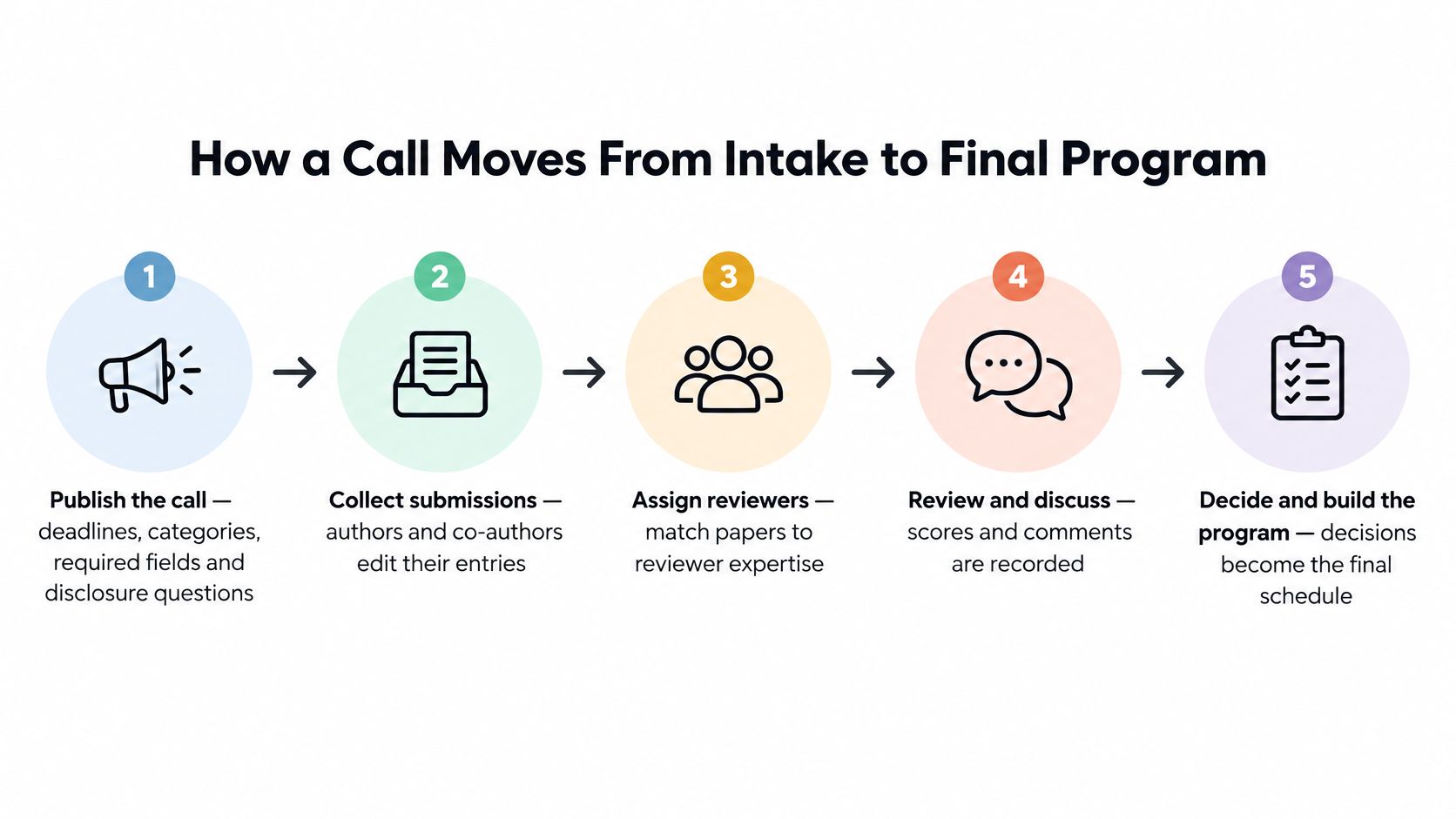
Run the stages in order and the record stays intact from start to finish. Skip one and the committee rebuilds it later from memory.
- Publish the call with everything reviewers will need. Deadlines, categories, required fields and disclosure questions belong in the first version. The common slip is adding a disclosure question after the call opens, which leaves early submitters with an incomplete record and reviewer guidance that no longer matches the form.
- Collect submissions and co-author edits in one record. Let every listed author confirm their details, then lock the version at the deadline. The slip is accepting emailed updates, which produces two versions of one abstract and no way to tell which one reviewers scored.
- Screen for completeness and scope before reviewers see anything. Flag missing fields, over-length abstracts and topic mismatches, then return them to authors with a firm date. The slip is routing everything to review because screening feels like editorializing, which spends scarce reviewer hours on submissions that were never eligible.
- Assign reviewers with conflict checks and load limits. Match on topic, cap assignments per person and record every conflict decision. The slip is assigning by enthusiasm, because overloaded reviewers return short comments and the committee later can't separate thin feedback from a weak paper.
- Collect scores and comments with automatic reminders. A structured score field, a narrative box and a confidence indicator cover most committee needs. The slip is a reminder schedule nobody configured, so half the reviews arrive in the final 48 hours or never arrive at all.
- Consolidate reviews and record the decision. Accept, revise or decline, with the decision date and the reasoning attached to the submission. The slip is a decision that lives in a committee chair's inbox, leaving nobody able to reconstruct six months later why a paper was rejected.
- Build sessions from accepted abstracts. Filter by topic, move submissions into sessions and stay inside each session's time limit. The slip is a spreadsheet assembled after the fact, which then disagrees with the acceptance list.
- Publish the program, handouts and archive records. Every presentation should carry its submission ID into the program guide and any downstream index. The slip is a program PDF that becomes the only surviving record, with no path back to reviews or decisions.
A healthy version of this workflow is easy to verify at the end. Every accepted abstract is attached to exactly one session and one presentation record, every author is attached to the abstract, and disclosure status travels with the speaker into the event. No duplicates, no orphaned presenters, no second spreadsheet. An abstract management module that runs submission, review and session building as one workflow keeps the record reviewers scored identical to the record that lands in the session.
The sequence is easier to follow when you watch it move. This short walkthrough covers the same path from a published call to a scheduled session.
Protecting Review Quality and Decision Records
A committee that reduces three reviews to one mean has made a decision about disagreement, whether or not anyone said so out loud. Recent research on reviewer agreement puts human–LLM reviewer agreement at Cohen's κ around 0.1 to 0.2, with some reviewer personas reaching moderate agreement near κ ≈ 0.5 and others sitting close to zero or turning negative (arXiv study of reviewer agreement). Low agreement isn't a scoring bug. It's what happens when reviewers weigh different things and the form doesn't capture the difference.

So don't let the software collapse feedback the moment it arrives. Keep each reviewer's structured scores, narrative comments, confidence indicator, conflict-of-interest status and review timestamp as separate fields. A record built that way can be re-aggregated when the committee changes its rule, audited when an author appeals, and analyzed after the meeting without anyone re-reading a stack of PDFs.
An averaged score is not a decision. It's a disagreement someone chose to stop looking at.
Aggregation rules a committee can choose
| Rule | Best When | Main Risk |
|---|---|---|
| Simple average | Reviewer pool is consistent and scores are comparable | One extreme score moves the result |
| Median | Pool has occasional strict or lenient outliers | Ignores information carried by the spread |
| Weighted scoring | Reviewer experience or confidence differs and weights are documented | Weights can look arbitrary without an audit trail |
| Threshold rules | Clear cutoffs drive accept or reject decisions | Borderline submissions need a tiebreak step |
| Adjudication above a set variance | Reviewers disagree sharply on some submissions | Adds area chair or secondary committee workload |
The strongest of these is the last one. Calculate score variance or inter-rater statistics per submission and route the outliers to an area chair or a second committee round. Disagreement gets caught while there's still time to resolve it, rather than being flattened into a number that looks settled.
Metrics worth tracking during review
Four numbers tell you whether the process is holding:
- Reviewer load per person: assignments per reviewer, visible to the committee before the deadline rather than after it.
- Time to first review: how long each submission sits unread before the first evaluation lands.
- Missing or non-substantive feedback: reviews that arrive with scores only, or with a single line of comment.
- Appeal and re-review outcomes: how often the committee reverses itself, which is the clearest signal about whether its decision rule fits its reviewer pool.
Blinded or double-blinded rounds, reviewer reassignment, rebuttal handling and post-decision analysis all sit on the same structure, and none of them require changing the submission record. Define how your peer review processes work before you configure them, because rebuilding a review round mid-cycle costs more than getting the setup right.
Required Data Fields, Disclosures and Authorship Records
An abstract record outlives the meeting that created it. A study of six major spine-specialty conferences tracked 5,722 abstracts presented over three years; 3,091 were later published in peer-reviewed journals, a 54% conversion rate, with individual conferences ranging from 44.5% to 66.3% (spine conference publication analysis). A platform that can't link a presentation to its later publication is discarding the most useful reporting an association owns.
| Record Field | Why It Matters |
|---|---|
| Immutable submission ID | Keeps one identity from call to publication and prevents duplicates |
| Ordered contributors | Preserves author order that all authors have agreed |
| Affiliations | Supports reporting and institutional attribution |
| Event ID and session link | Connects each accepted abstract to its program slot |
| Decision status and dates | Documents review outcomes and supports appeals |
| DOI or external identifier | Links the presentation to later publication records |
| Rights and license information | Clarifies how handouts and abstracts may be reused |
| Funding and conflict-of-interest disclosures | Attaches disclosure status to the abstract and presentation |
| Final approval confirmation | Shows that every listed author reviewed the submitted version |
Metadata that has to survive the meeting
Crossref's guidance for conference proceedings asks organizers to register a proceedings DOI and supply event metadata such as conference name, acronym, date, location, theme and sponsor, with contributor names, title and DOI required at paper level and abstracts, funding, licensing and relationship metadata encouraged (Crossref conference proceedings guidance). The practical test is record behavior after acceptance. Change the author order, the session assignment or the abstract text on an accepted submission and confirm the system updates one record rather than spawning a second. A platform that creates a new record on every edit will corrupt proceedings metadata downstream, and no export format will repair that.
Authorship and disclosure are record fields
The 2019 Good Practice for Conference Abstracts and Presentations expects listed authors to have made substantial contributions, helped develop the presentation and accepted responsibility for the findings, with author order agreed by all authors (GPCAP authorship guidance). Some meetings go further: the International AIDS Society's bacteriophage conference applies a four-part ICMJE-based test and requires the submitting author to confirm every listed author reviewed and approved the abstract, plus disclosure of financial relationships with ineligible companies over the preceding 24 months (IAS abstract guidelines). A single free-text author field carries none of that.
Disclosure has three locations of its own. GPCAP expects funding sources and conflicts to appear on posters and slides, on the conference submission site and, where space allows, on the abstract itself. Disclosure status therefore has to attach to the abstract, to each author and to the presentation file, and stay attached when the file moves. Structured financial disclosure forms handle collection; the record has to handle continuity.
Comparing Platforms on Fit, Scale and AI Oversight
Fit is a workflow question, not a feature count. Judge every platform against the modules you listed, the milestones you back-planned and the review rules you wrote down.
- Scale under volume. Ask how the vendor reports reviewer load, time to first review and decision variance as submissions grow. Red flag: the only number reported is submissions processed.
- Interoperability. Ask for a sample export and run the field-level mapping test on it. Red flag: PDF and spreadsheet only.
- Modularity. Ask whether submissions, speakers and education records can run separately from membership, registration or audiovisual systems. Red flag: every module must move together.
- AI oversight. Ask for configurable disclosure questions, an audit trail of when automated assistance was used, reviewer guidance on confidential abstracts and anomaly flags. Red flag: nothing beyond a generic terms statement.
- Cost. Pricing moves with module count, submission volume, reviewer count, integrations and support level, so request quotes against one identical scope. Red flag: a per-submission quote with no ceiling.
The AI question deserves its own test. A 2025 exploratory study submitted a single AI-authored proposal to 20 education conferences: 11 accepted it, 9 rejected it, and only 2 provided substantive reviewer feedback (study of AI-authored conference proposals). Acceptance alone says very little about whether anyone evaluated the work. Software can't fix that by itself, but it can make policy explicit and reviewable, which is the difference between a rule and a rumor.
Writing your requirements down first makes an event management RFP far easier to score. Planstone is one option to assess against that list, and its data API is what lets associations transform thousands of abstracts, presentations and ePosters into an EventPilot conference app. General academic meetings should hold other platforms to the same questions.
Frequently Asked Questions About Call for Papers Software
How early should a peer-reviewed call open
Roughly 14 weeks before the event, based on the median in the Fourwaves analysis. Set the review window and reminder schedule at the same time, because the decision date stops being negotiable once authors are booking travel.
How many reviews does each abstract actually need
Two is the median, but the spread is wider than most committees assume. 44% of abstracts received exactly two reviews, 27% received one, 18% received three and 11% received four or more. Plan capacity on the spread rather than the average, or a handful of abstracts will absorb a disproportionate share of your reviewers.
Do accepted abstracts later become journal articles
Usually not. A 2018 Cochrane Review put the average proportion of conference abstracts later published at 37.3%, ranging from 15.4% to 57.1% across fields (IDWeek abstract publication analysis citing the Cochrane Review). For IDWeek 2017 and 2018 abstracts, 236 of 887 sampled abstracts, or 26.6%, were published, with median publication times of 11.8 months and 8.6 months.
Is a PDF export enough for indexing or reporting
No. Register a proceedings DOI and supply structured event and contributor metadata, exported as machine-readable XML or JSON. Ask for a sample export before you sign.
Should submitters declare AI use
Make it an explicit, configurable disclosure question backed by a published policy. The 2025 education-conference study shows acceptance alone doesn't prove a proposal was evaluated, and a disclosure field at least creates a record you can act on.
Confirm Your Requirements Before You Request a Demo
A single planning session covers the work that makes a demo worth attending.
- List the modules you need now and within a year, and keep that second column visible in every vendor conversation. It's what separates a platform decision from a renewal decision.
- Count backward from your event date through the call, review and decision windows. If the arithmetic leaves no room for authors to revise before the program goes out, the schedule is the problem, not the software.
- Write your review rules down, including the aggregation method and the variance level that triggers adjudication. Committees that skip this rediscover the argument mid-round.
- Fix disclosure fields, authorship confirmation and the AI-use question before reviewers start. Changing forms mid-cycle creates two versions of the record and no clean audit trail.
- Run the vendor checklist against your own requirement list, not against a generic feature grid.
- Ask for a demonstration built on one of your own calls, using your categories, your review form and your session structure.
A conference consultation with us starts the same way. You share information about your program, your existing systems and your team's requirements, and we work through where the platform can help. The right platform protects your deadlines and your decision records. Feature lists don't.
Call for papers software earns its place when it holds the schedule, the review record and the program in one place, and Planstone configures that around your existing process rather than a fixed template. Submissions, reviews, speaker tasks, disclosures, handouts, evaluations and credit tracking can run in one configured platform, or as individual modules alongside the systems you already use, with a dedicated account manager who learns how your program runs. Visit Planstone to walk through your next call and see the workflow built around it.