
By 2013, electronic request-for-proposal technology was already being used globally to source hotels and meeting space for more than 1 million meetings a year, according to the Events Industry Council white paper on eRFP efficiency. That volume is the reframe. An event RFP isn't a courtesy note to three hotels. It's how buyers compare venues, availability, services, room blocks, pricing, and contract terms at a scale email can't hold.
RFP event management works when the document is a scored, evidence-based decision, not a narrative invitation. You name what must be true, you say how points are earned, and you refuse any bid that skips a mandatory control. The pages below are the specification, the weights, the proof to demand on access and environmental performance, and the cost lines headline prices leave out.
Table of Contents
- Requirements Every Event Management RFP Must Specify
- Weighting Criteria and Scoring Each Response
- Accessibility and Sustainability Evidence to Require
- How to Run the RFP From Issue to Shortlist
- Hidden Costs, Contract Terms and Selecting the Winner
- Frequently Asked Questions About Event Management RFPs
Requirements Every Event Management RFP Must Specify
An event management RFP is a written specification that tells qualified suppliers what the program requires and how proposals will be scored. It has to lock scope, room blocks, education workflow, integrations, accessibility, sustainability, total cost, and support, then separate pass-fail controls from weighted points.
A required sourcing process earns its keep. Meeting managers estimated average cost savings of 22% when they used a required venue-sourcing or RFP process, 73% said it helped them compare more venue options, and 73% said it helped them locate the best venues, while only 66% of meeting planners followed a required process for at least some meetings, in research summarized from the Global Business Travel Association and Cvent on Cvent's event statistics page. Recognized value and consistent execution are not the same thing.
For 2024, meeting planners expected to host an average of 6.4 live events and 4.5 hybrid events, from a BizBash survey of 479 U.S. meeting and event professionals. Put your own live and hybrid counts in the RFP. An industry average is context, not your scope.
What every row must contain
| Requirement area | What to specify | Evidence to request |
|---|---|---|
| Event scope and volume | Live and hybrid session counts, attendee count range, program calendar | Last year's agenda or anticipated schedule |
| Venue and room blocks | Night-by-night room block, preferred rate range, rooming list or individual booking | Availability and rates confirmed for the actual event dates |
| Abstract and speaker workflow | Submission, review, session-building and speaker task steps | Demonstration using a representative set of abstracts |
| Disclosures and compliance | Disclosure collection timing and faculty requirements | Sample completion-tracking report |
| Evaluations and continuing education | Credit rules, evaluation collection, certificate issuance | Test run of post-event credit administration |
| Integrations | AMS, CRM, registration, AV and mobile app connections | Reference from a comparable integrated program |
| Accessibility | Accessible venue, materials and accommodation workflow | Implementation plan with measurable outcome metrics |
| Sustainability | Emissions categories, waste measurement, comparable data file | Sample post-event data file |
| Total cost | Taxes, fees, AV, staffing, security, gratuities | Itemized cost sheet |
| Implementation support | Staff training, event preparation, ongoing technical support | Named contact and support service levels |
Scope without last year's agenda hides room turns and labor. A room block without night-by-night numbers and a booking method (organizational list or individual reservations) produces rates you can't compare. Education rows fail when they stay descriptive. Ask for a demo on real abstracts, a disclosure completion report, and a test of certificate rules after the meeting closes. Integrations should name the association system, registration, audiovisual, and the mobile app, with a reference from a program of similar shape.
If one supplier claims to cover submission through credits, test that claim against a vendor that says it does it all before you write the workflow as a single line. A missing row doesn't stay missing. It returns as a change order after you've lost bargaining power, so every row needs an answer before the RFP goes out.
Practical rule: If you can't score it from the response, it isn't specified yet.
Weighting Criteria and Scoring Each Response
A scorecard turns an RFP from an exchange of proposals into a documented decision. Set pass-fail requirements first, then score only the proposals that meet them. A low price cannot compensate for a failure to meet a required control.
Public guidance offers no universal weighting split. The UK government event management framework identifies quality, price, and social value as possible award criteria and recommends setting weights according to procurement complexity, risk, and outcomes. For a scientific meeting, give disclosure handling and credit administration meaningful weight. For a straightforward social program with a firm budget ceiling, price may carry more. Publish the weights in the RFP so bidders understand how responses will be judged.
One scoring pattern that holds up
For an education-platform bid, a sample weighting could be abstract-to-session workflow 25, speaker task completion 20, disclosure handling 20, credit administration 20, and total cost 15. Give every evaluator the same demonstration scenario: a representative abstract set, a late faculty disclosure, an evaluation file, and a certificate rule that conflicts with a no-show. Score usability, security, integration depth, and implementation support against the relevant workflow requirements, rather than inviting a free-form essay titled “approach.”
A benchmark of 6,006 RFP procurements at 278 organizations reported an average winning score of 87.9%, according to the GovLoop State of the RFP brief. Use the finding as context for documented, criteria-based competition, not as a target score for your committee.
Watch for these scoring failures:
- “Describe your capabilities” invites a brochure. Ask bidders to show the steps in your scenario.
- Price-only weighting ranks cost without showing whether the proposed service meets operational needs.
- Uncosted migration and configuration leave important parts of the bid outside the comparison.
- Untested credit administration leaves post-event education work out of the scored demonstration.
Score responses independently before discussing them. When two evaluators give sharply different scores to the same demonstration, identify which step or evidence they interpreted differently. Teams can draw on a structured peer review process to define consistent review steps and document the reason for each score change. Apply the same discipline to practical criteria for choosing suppliers: define comparable fields, specify acceptable proof, and record why a response earned its score.
Keep assumptions, clarifications, and final weights in one file. Reject any proposal that fails a mandatory control, regardless of its commercial score.
Accessibility and Sustainability Evidence to Require
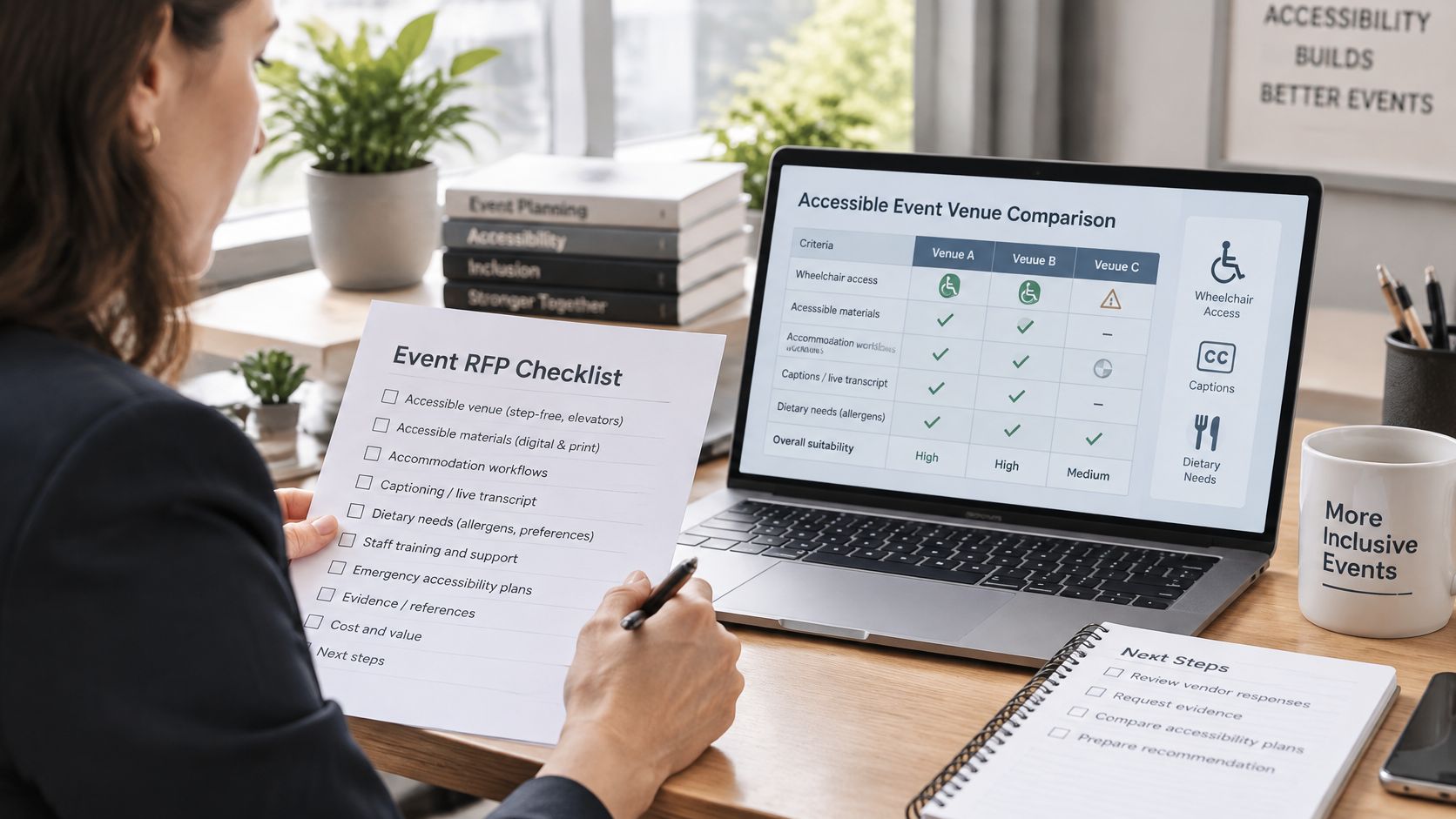
Accessibility is a delivery requirement across registration, content, the venue, and on-site support. A venue access audit cannot show whether a screen reader can complete registration, whether presentation files are usable, or who will handle an accommodation request.
An EU event-management tender requires physical and hybrid events to address accessibility and inclusion, including accessible venues, materials, and accommodations for participants with special requirements, as set out in the European Commission specifications for a professional conference organiser. Turn that principle into scored requirements: specify the evidence bidders must provide, the service levels they will meet, and the outcomes they will report.
Evidence, not a promise
Require an implementation plan, a workflow for attendee needs, a named accountable person, supplier checks, a contingency for an interpreter or captioner cancellation, and post-event outcome reporting. Score the bidder's evidence against the same criteria.
- Captioning accuracy: Require the method, a sample, and the person responsible for checking it.
- Presentation files: Specify accessible formats and when participants must be able to access them.
- Mobility routes, lactation facilities, and quiet spaces: Request mapped locations and distances, not a general assurance that they are available on request.
- Sign-language interpretation: Ask which sessions are covered and what lead time is required.
- Session access: Require a post-event count of sessions meeting your stated standard.
The practical checks in these wedding venue accessibility tips for couples also apply to conference venues. A compliant ballroom does not make an inaccessible badge flow usable.
Environmental claims you can line up next year
A policy or carbon-neutral badge does not show event performance. Ask bidders to define the baseline, calculation boundary, emissions categories, travel assumptions, waste measurement, verification method, and response if a target is missed. The UNDP guidance on sustainable hospitality and conference procurement recommends monitoring areas including energy, water, waste, climate action, accessibility, local economic benefits, and governance, with data that is public, comparable, and machine-readable. Published event sustainability reports show what measurable reporting looks like when they compare emissions and waste against a baseline year.
Require a post-event data file that supports year-on-year comparison and connects the results to registration, attendance, venue, travel, and program records. If a bidder cannot produce that file, do not score its sustainability claim as demonstrated. Define the file format and required fields in the RFP so every response can be judged on the same evidence.
How to Run the RFP From Issue to Shortlist
Leadership needs a four-stage picture. The project lead still runs eight actions. Post the short version where the committee can see it, then work the list.
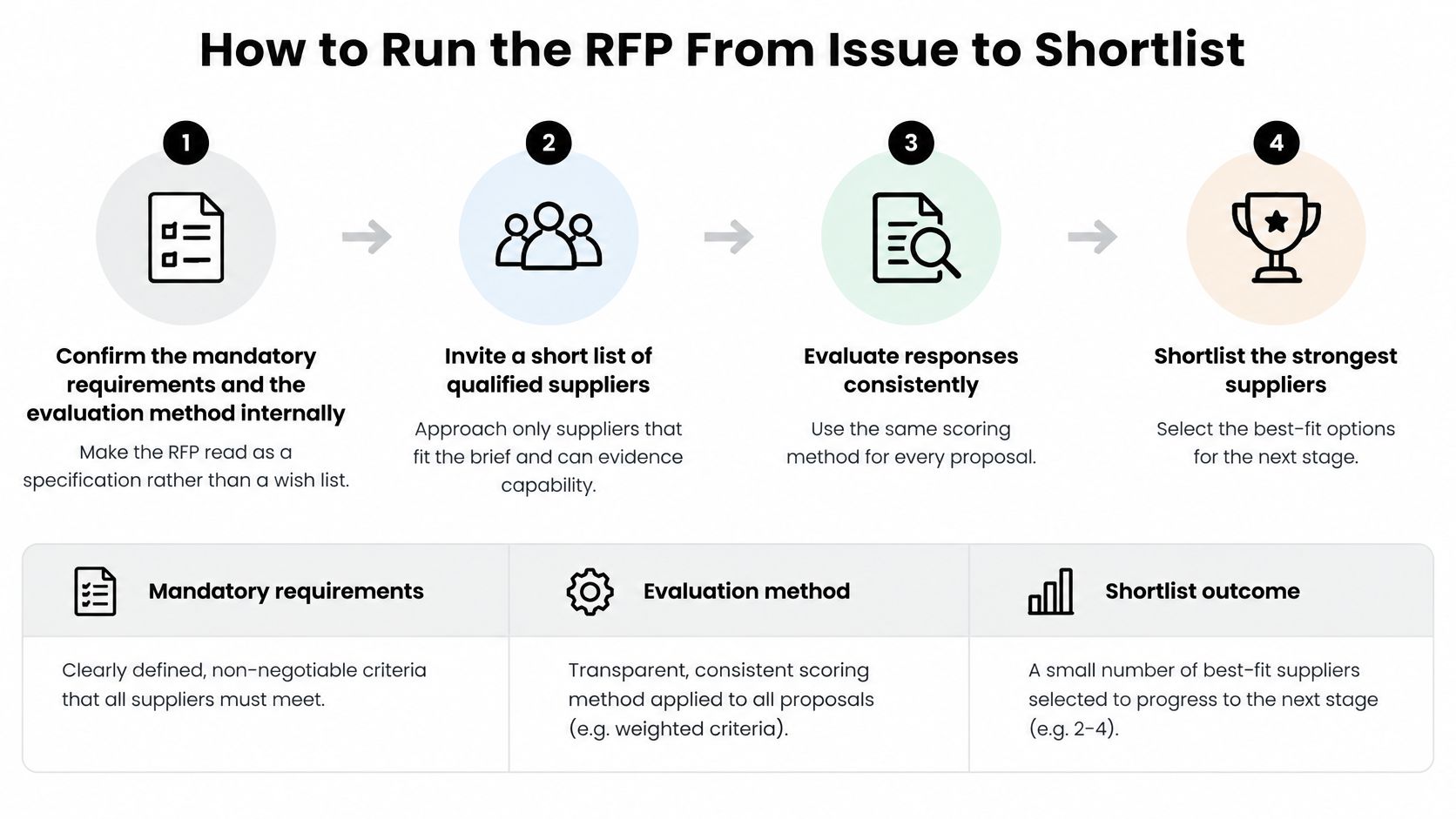
Confirm mandatory requirements and the evaluation method internally. The RFP should read as a specification. Skip this and bidders answer a wish list, each in a different shape.
Invite a short list of qualified suppliers. Broad distribution feels fair and produces responses you can't compare. Approach firms that fit the brief and can show the evidence you named.
Set the response deadline against real planner expectations. For 2025, 80% of responding planners said they wanted event-RFP responses within four days, in Cvent's 2025 Planner Sourcing Report as reported by BizBash. A room-block request can sit near that window. A hybrid program that includes workflow evidence needs a longer, stated timetable.
Publish a clarification deadline and share every answer with every bidder. Private replies create a second, secret specification.
Screen before any scoring. Mark each proposal acceptable, potentially acceptable if it could reasonably be made compliant, or unacceptable. One civic solicitation allowed that screen by the procurement officer or by a committee of that officer and at least two government employees, and it stated that issuing the RFP created no contract until the required approval, in the Wyandotte County event management RFP. Scoring bids you'll reject anyway burns the only hours your reviewers have.
Score compliant proposals on the weighted rubric, independently, and reconcile wide gaps before you rank anyone.
Shortlist two or three for the same demonstration script and reference calls. More than three and the committee stops comparing.
Record assumptions, clarifications, and the decision in one file. If it isn't in the file, it didn't happen.
A conference timetable
I would freeze requirements in two weeks, take questions for five business days, allow ten business days for a complex response, score in a week, and hold demos the week after. Issue on a Monday so a short venue track doesn't die over a weekend.
If the committee wants the buyer sequence in one sitting, this walkthrough covers specification through shortlist.
What a sound run delivers is a shortlist the evaluation team can defend without reconstructing the argument from a mailbox.
Hidden Costs, Contract Terms and Selecting the Winner
A venue quote can look lower because it excludes costs that appear later in the contract. Require every bidder to itemize the same services, fees, and assumptions before comparing totals.
One conference venue and hotel solicitation requested room availability and rates inclusive of taxes and fees such as parking, internet, and resort charges. It also asked for cut-off dates, attrition, check-in and check-out policies, and banquet costs for an estimated 130 guests, including service fees, taxes, and gratuities, in the South Carolina Legal Services conference venue RFP. The request covered audiovisual costs, staffing, security, utilities, signage, and other policies, with price assessed against the amenities offered.
Cost lines to request in writing
| Cost line | What to request | Common gap |
|---|---|---|
| Room rates | Rates inclusive of taxes and fees, including resort and parking charges | Quoted rate excludes fees |
| Attrition and cut-off | Cut-off dates and attrition provisions stated in writing | Penalty terms buried in the contract |
| Food and beverage | Banquet calculations for the estimated guest count with service fees, taxes and gratuities | Per-person price without service charge |
| Audiovisual | Costs for venue-supplied and outside-sourced equipment | Labor and setup billed separately |
| Staffing, security and utilities | Itemized costs for each service | Excluded from headline package |
| Signage and policies | Signage costs and all applicable policies | Discovered only after selection |
| Technology setup | Implementation, configuration and migration effort, costed | Configuration work left uncosted |
The RCMA RFP checklist asks buyers to specify the night-by-night room block, preferred rate range, and anticipated schedule or previous agenda. Use those details to check that bids price the same booking requirements.
Compare implementation and integration costs in the same currency and over the same period. Treat blank cost fields as unresolved, not as zero. Security estimates also depend on the requested hours, posts, and credentialing, so include what affects event security pricing in the cost review before accepting a quote that says “security included.”
How the winner actually gets picked
First confirm that each shortlisted proposal meets the mandatory requirements. If the top scores are close and evaluators disagree on the evidence, review the disputed criteria before ranking suppliers. A cheaper bid should not win by default when its costs or delivery assumptions remain unclear.
Call references from programs with a similar attendee load and continuing education requirements. Ask about implementation, event-week support, and whether the supplier met the stated workflow needs. For associations comparing systems, nonprofit event software is one relevant area to assess alongside the cost sheet.
State in the RFP whether clarifications or negotiations may follow submission, and explain how each will affect the award process. Bidders need to know whether the buyer may discuss proposals, negotiate terms, or proceed directly to selection.
For a conference consultation, clients provide information about their program, existing systems, and team requirements, then discuss where Planstone can help. Planstone offers dedicated support for conference management and account management. Specify any required training, event preparation, and ongoing support in the contract, alongside the event's cut-off dates, attrition terms, and itemized costs.
Approve the scored shortlist in writing, then begin contract discussions with the selected supplier while the booking remains available.
Frequently Asked Questions About Event Management RFPs
Do small events need a formal RFP
A full RFP pays off when several suppliers can meet the need and the spend justifies a documented comparison. For a simpler booking, a written requirements list and comparable written quotes still capture most of the benefit without a scoring committee.
What if only one supplier responds
Check the mandatory controls before you talk price. If the proposal is potentially acceptable, use clarification to make it compliant. Judge the price against your requirements list, not against bids you never received.
Can we award on price alone
Price sits beside quality and social value as an award criterion. A price-only decision skips the evidence you need to compare whether the supplier can deliver the program, the credits, and the week-of support.
How long should suppliers have to respond
For a straightforward venue request, build the window around the short turnaround planners now expect. Extend it when the program is multi-venue or hybrid and the response has to include workflow evidence, not only rates.
How often should the RFP be reissued
Reissue when requirements, event volume, or the supplier pool changes in a material way. Otherwise rebuild this year's rubric from last year's scoring file so the comparison stays consistent and you're not grading a new personality each cycle.
Planstone configures conference and continuing education software so associations can run abstract submissions, speaker tasks, disclosures, evaluations, and credit administration in one workflow, with account management through implementation and the meetings that follow. If your RFP is meant to test that chain with evidence rather than collect another brochure, bring your program, current systems, and team requirements to a consultation. Visit Planstone when you're ready to scope that conversation.