
Your program committee has 200 survey responses after its annual meeting, yet nobody can explain why attendance dropped. Attendees liked the speakers, the overall rating looks respectable, and the comment file contains conflicting requests. You still have to decide whether to keep a track, change the venue, or redesign next year's education program.
The problem isn't necessarily survey length. It's that the questions didn't connect to decisions, or the people who answered weren't the people whose absence needs explaining. The best audience survey questions identify what attendees experienced, what they learned, and what your team should change.
Question design matters as much as question selection. AAPOR's survey-quality guidance explains that wording, question order, placement, and collection mode can affect findings. Asking whether someone enjoyed a session isn't interchangeable with asking whether its content was relevant to their work.
Choose questions by the decision they support:
- Engagement and satisfaction: Decide what to preserve, investigate, or repair.
- Future programming: Identify relevant topics, formats, and audience groups.
- Education outcomes: Separate perceived learning from intended application.
- Education compliance: Confirm that evaluation and credit workflows match your program's requirements.
These ten questions give committees usable signals, not automatic proof of success. Pair each answer with an owner, an interpretation rule, and a next step before you send the survey.
Table of Contents
- 1. Net Promoter Score (Likelihood to Recommend)
- 2. Session Relevance Rating (Likert Scale)
- 3. Learning Objective Achievement Question
- 4. Intent to Change Practice Question
- 5. Overall Satisfaction Rating (CSAT)
- 6. Speaker Effectiveness Rating
- 7. Professional Role and Specialty Question
- 8. Open-Ended Improvement Question
- 9. Future Topic Interest Question
- 10. Evaluation Completion and Credit Eligibility Question
- How the ten audience survey questions compare by goal, format, and limitation
- Turning Survey Answers Into Program Decisions
1. Net Promoter Score (Likelihood to Recommend)
Decision supported: whether the overall experience warrants investigation before the next registration cycle.
Ask attendees how likely they are to recommend the conference or education program to a colleague. Use the standard Net Promoter Score, or NPS, response scale from zero to ten.
For scoring, classify nine and ten as promoters, seven and eight as passives, and zero through six as detractors. Subtract the percentage of detractors from the percentage of promoters. Treat that calculation as a summary of recommendation intent, not a forecast of registrations.

Turn the score into an investigation
Add an optional follow-up asking for the main reason behind the rating. Without that explanation, the committee can't tell whether to revise the program, improve venue logistics, or clarify who the meeting serves.
Say a medical association changes venues and recommendation scores decline. Code the explanations by topic, then compare venue-related concerns with content-related concerns before assigning responsibility.
- Keep placement consistent: Put the question near the end, after specific session ratings, and preserve that sequence across comparable meetings.
- Compare like with like: Don't treat a virtual workshop and an annual congress as interchangeable benchmarks.
- Investigate movement: Check respondent composition before attributing a change to program quality.
Use the recommendation item alongside other post-event survey questions, rather than making it the entire evaluation.
2. Session Relevance Rating (Likert Scale)
A popular session isn't necessarily a relevant session. An engaging overview may delight attendees while offering little they can use in their professional work.
Decision supported: which tracks, abstract categories, and session formats deserve space in the next program.
Ask participants to indicate their agreement with a specific statement: the session content was relevant to their professional practice or research. Use a consistently worded agreement scale, with a separate option for people who didn't attend or can't judge relevance.

Report differences, not just averages
AAPOR's survey-methods task-force report explains that small wording and ordering changes can alter estimates. Pilot-test the statement with representatives of your audience, then retain its wording across sessions.
For example, a scientific committee might find that methods sessions receive strong relevance ratings from researchers but mixed ratings from clinicians. That doesn't automatically justify removing the track. It may justify clearer audience labeling or separate introductory and advanced sessions.
- Show the distribution: A middle average can conceal sharply different audience experiences.
- Filter by attendance: Don't ask participants to evaluate sessions they didn't attend.
- Connect results to planning: Use recurring relevance gaps to revise abstract-call language and speaker instructions.
Keep relevance separate from speaker quality. Otherwise, a charismatic presenter can obscure a mismatch between the session and the intended audience.
3. Learning Objective Achievement Question
Decision supported: whether the activity delivered its stated educational outcomes and where assessment needs strengthening.
Ask participants whether they achieved each published learning objective. A useful prompt repeats the actual objective, such as whether the learner can describe the screening criteria addressed in the session.
Write objectives before faculty develop their presentations. Each should describe a distinct outcome that participants can understand and your education team can evaluate.
Interpretation rule: A learner's report that they achieved an objective measures perceived achievement. It isn't, by itself, evidence that they can perform the task correctly.
Match the question to the evidence needed
An agreement response can identify where learners feel uncertain. If your decision requires evidence of knowledge or competence, add an assessment aligned with that objective, such as a case question or an interpretation task.
Say a continuing education provider evaluates a session on screening decisions. Participants may report that they understand the criteria, while their responses to a case reveal confusion about when those criteria apply.
- Separate outcomes: Don't combine identifying a condition and selecting treatment in the same achievement item.
- Review disagreement: Ask the education lead and speaker whether the problem was unclear wording, insufficient coverage, or an overly ambitious objective.
- Check applicable standards: Confirm your accrediting body's current evaluation and documentation requirements before finalizing the form.
Keep the objective, participant response, and any associated assessment identifiable in your reporting. That lets administrators explain what was measured without overstating what the evaluation proves.
4. Intent to Change Practice Question
Satisfaction describes a reaction. Intent to change practice describes a possible next step.
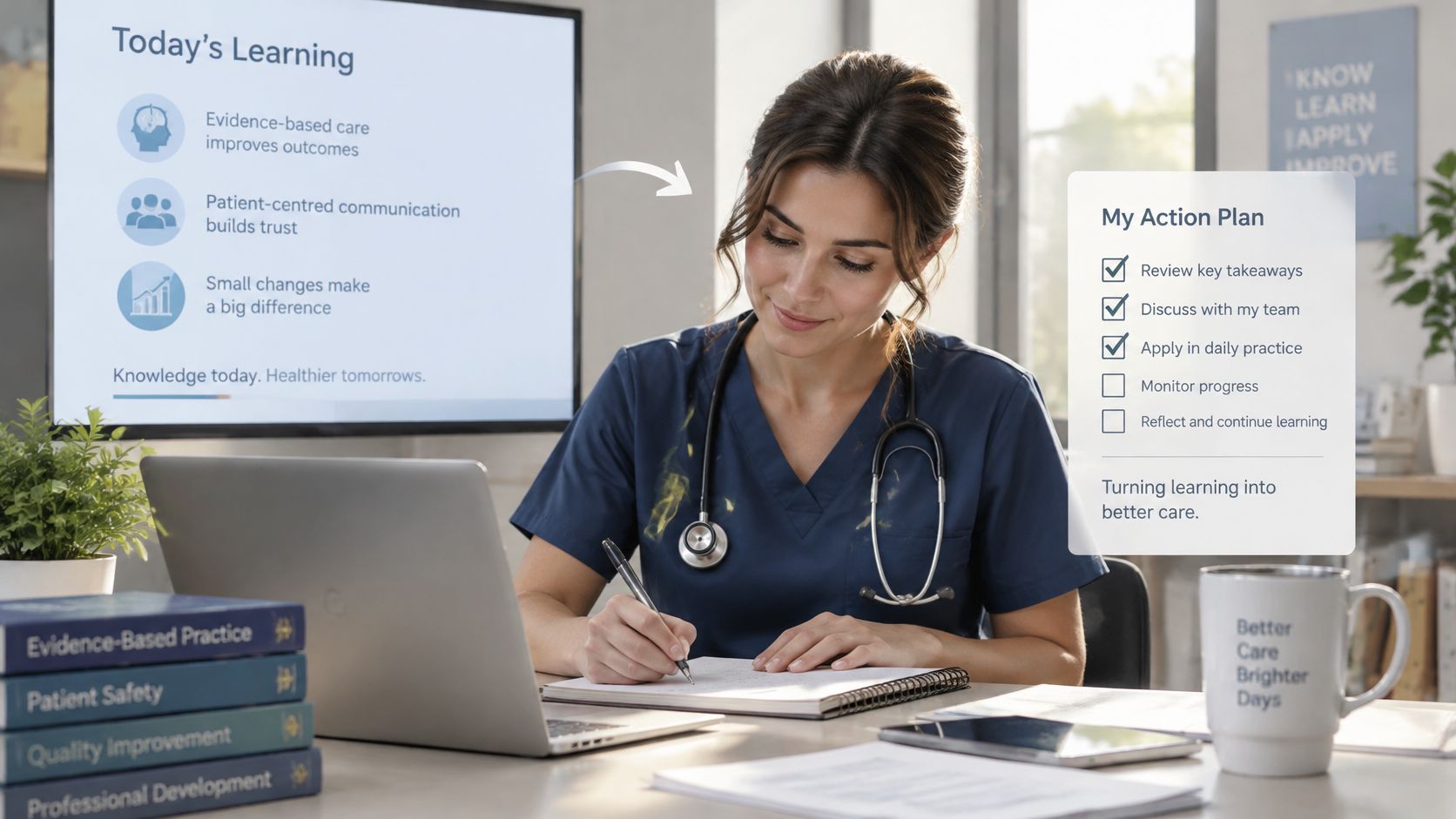
Ask participants what, if anything, they intend to change in their clinical approach, research method, or workflow because of the activity. Offer a route for those whose current practice already aligns with the content, as well as those who need more evidence or lack authority to make a change.
Decision supported: whether to provide implementation support, additional education, or a follow-up assessment.
Ask for the action and the obstacle
A specific response is more useful than a yes-or-no declaration. Ask participants to describe the intended change and, where relevant, the main barrier to making it.
For example, a symposium participant might intend to introduce a screening checklist but need departmental approval. The education team can distinguish that implementation barrier from a lack of understanding.
- Code intended actions: Group responses into changes to assessment, treatment, communication, research, or administration.
- Plan follow-up: Choose a follow-up point that gives participants a realistic opportunity to act.
- Label evidence clearly: Report intended changes separately from later self-reported changes and independently verified outcomes.
Don't classify every intention to maintain current practice as educational failure. A participant may have gained confidence that an existing approach is appropriate, and that deserves a different interpretation from learning nothing useful.
5. Overall Satisfaction Rating (CSAT)
Decision supported: where leadership should look more closely at the attendee experience.
Ask how satisfied participants were with the activity overall, using a balanced scale from very dissatisfied to very satisfied. Customer satisfaction, commonly shortened to CSAT, provides a headline measure, but it shouldn't substitute for questions about the causes of that rating.
Define the calculation before reviewing results. If you report the share selecting satisfied or very satisfied, state that rule and identify the valid-response denominator.
Put the headline in context
AAPOR's response-rate overview cautions that a high response rate doesn't automatically establish representativeness and recommends examining nonresponse bias. Report how you calculated participation rather than presenting a favorable satisfaction percentage alone.
Say an education provider compares satisfaction between live and online courses. Before redirecting production spending, the team should examine whether the courses served similar audiences and whether dissatisfied participants completed the evaluations.
- Segment carefully: Compare first-time and returning attendees, delivery formats, or professional groups when response volume permits.
- Preserve neutral responses: Don't count them as satisfied.
- Investigate causes: Use content, delivery, and logistics feedback to identify the appropriate action.
A useful event evaluation report places the satisfaction result beside participation information and concrete recommendations.
A strong overall rating can coexist with a serious problem affecting a smaller attendee group. Don't let the headline erase that group's experience.
6. Speaker Effectiveness Rating
A speaker can know the subject thoroughly and still leave participants unsure how to apply it. Evaluate delivery separately from content relevance so faculty coordinators know what support to offer.
Decision supported: whether to reinvite a presenter, adjust the assignment, or provide preparation support.
Ask participants how clearly the speaker explained the material. If you also need to assess organization or opportunities for participation, use separate items rather than combining every desirable trait into a single score.
Give faculty feedback they can use
For example, a scientific committee might receive strong relevance ratings but weak clarity feedback for a technical presentation. The appropriate response could be a revised slide structure, clearer definitions, or a case-based rehearsal, not removing the topic.
- Set a reporting threshold: Agree on a minimum response count before publishing individual results, and flag sparse feedback.
- Review context: Consider session format, technical difficulty, timing, and equipment problems before judging delivery.
- Share privately: Give speakers a constructive summary with specific preparation actions, rather than an unfiltered comment export.
Don't rank faculty on small differences without examining the response distributions and audience mix. A specialist session and a broad introductory lecture present different teaching challenges.
Use the following video as a discussion prompt during your team's review of evaluation practices.
Keep coaching recommendations tied to observable feedback. Ask a speaker to simplify terminology or make transitions clearer, rather than telling them to be more engaging.
7. Professional Role and Specialty Question
Decision supported: whether the program reaches its intended audience and how results differ across professional groups.
Ask which option best describes the participant's primary professional role. Collect specialty, practice setting, or career stage separately only when each will inform a real decision.
Pew Research Center's question-writing guidance recommends answer options that cover reasonable responses and don't overlap. A list mixing clinician, researcher, trainee, and hospital employee needs careful design because a participant could reasonably fit several categories.
Reuse registration information carefully
If registration already captures reliable role information, don't ask attendees to enter it again without a reason. Explain whether their evaluation will be linked to that record, and don't describe linked responses as anonymous.
For example, a planner may discover that early-career researchers are underrepresented among registrants. That finding supports a different outreach decision from discovering that they attended but rarely answered the survey.
- Define the category: Specify primary role if only a single selection is allowed.
- Provide an alternative: Include another role and prefer not to answer where appropriate.
- Protect small groups: Avoid publishing combinations of specialty, institution, and career stage that could identify individuals.
Professional role can help route participants toward relevant credit information, but it shouldn't independently determine credit eligibility. Apply the program's documented rules and required participation evidence.
Collect only what you'll use. Extra demographic fields create analysis work and privacy considerations without necessarily improving the committee's decision.
8. Open-Ended Improvement Question
Ask participants what change would most improve a future meeting. This focused prompt gives people room to identify a problem your fixed-choice questions missed.
Decision supported: which operational or programming improvement should receive an owner and resources.
SurveyMonkey's audience-survey guidance recommends using open-ended questions selectively and placing optional text opportunities toward the end. Don't add a comment box after every rating unless someone will review and use those responses.
Code comments into actionable themes
Say an association receives requests for more case-based sessions, easier venue navigation, and clearer certificate instructions. Assign each comment to a theme, retain its context, and send the theme to the person who can act on it.
- Separate issue types: Distinguish educational design, venue operations, technology, and credit administration.
- Record consequences: Note whether a problem caused inconvenience, missed participation, or inability to access an activity.
- Close the loop: Tell attendees which changes you made and explain constraints where you couldn't act.
Accessibility deserves particular attention. A TTGmice report on event accessibility describes barriers involving layouts, sensory conditions, staff preparedness, facilities, and missing information.
Don't rely on an optional comment box as your only accessibility measure. Where relevant, add targeted, privacy-conscious questions about finding support information, requesting accommodations, and receiving support in time.
Review priority: A comment describing exclusion from participation deserves investigation even when few people mention the issue.
9. Future Topic Interest Question
Topic requests should influence the program, not become an automatic popularity contest. Ask which subjects participants would prioritize for a future activity, then keep preferred delivery formats in a separate question.
Decision supported: which themes belong in the next abstract call, invited program, or education calendar.
Present a concise set of clearly differentiated topics. If the list becomes difficult to scan, organize it by track or use an initial category choice followed by more specific options.

Distinguish interest from commitment
Selecting a topic is easier than registering for a meeting. Use interest results to guide planning, then weigh them against educational needs, faculty availability, and the association's mission.
For example, a scientific committee might receive strong interest in a specialist method. Before creating a full track, it could assess whether a workshop or focused session better fits the audience and available submissions.
- Ask for priorities: An unrestricted checklist won't reveal trade-offs when participants select everything.
- Allow another topic: Review free-text suggestions for needs the committee overlooked.
- Include non-attendees: Ask people who skipped the meeting about unmet needs and barriers, rather than assuming attendees represent them.
Compare responses by professional role and career stage. A smaller group's high-priority need may justify a targeted session even if it doesn't top the overall ranking.
Then show the connection: explain how member input influenced the next call for abstracts or session format.
10. Evaluation Completion and Credit Eligibility Question
Decision supported: whether participants understand the remaining steps for obtaining the appropriate certificate or credit.
This is an administrative confirmation, not a measure of educational quality. Ask whether participants understand how to complete the credit process, and provide the actual instructions beside the prompt.
Don't use evaluation completion as a universal credit requirement. Confirm the requirements that apply to your activity before configuring a mandatory step or promising certificate release.
Explain the complete path
Your completion message should identify what remains, where participants can find their record, and when the certificate will become available. If additional attendance verification or assessment is required, make that distinction explicit.
For example, an education team can test a participant's path from session selection through evaluation submission to certificate access on a mobile device. That test should include incomplete records and participants eligible for different credit types.
- Separate statuses: Evaluation submitted, participation verified, and credit issued aren't necessarily the same event.
- Name the requirement: Replace vague completion warnings with the specific outstanding action.
- Provide support instructions: Tell participants what information to include when reporting a missing record.
Keep explanations of continuing education credit hours consistent with your program documentation. Participants considering external education, including CME training from ProMed Certifications, should also review the relevant activity's eligibility and completion requirements.
Never interpret a completed credit-related evaluation as proof of enthusiasm. Participants may complete it to finish an administrative requirement, so assess program value through their substantive answers.
How the ten audience survey questions compare by goal, format, and limitation
| Item | Primary goal | Response format | Scoring method | Main limitation |
|---|---|---|---|---|
| Net Promoter Score (Likelihood to Recommend) | Measure attendee loyalty and recommendation potential | Single 0–10 question, often with a “Why?” follow-up | Percentage of detractors subtracted from percentage of promoters; range −100 to +100 | Does not explain scores without follow-up; can be affected by factors outside the program |
| Session Relevance Rating (Likert Scale) | Assess how relevant sessions are to attendees' professional needs | Five- or seven-point agreement scale, sometimes with “not applicable” | Numeric averages and response distributions | Averages can hide polarized views and do not measure changes in practice |
| Learning Objective Achievement Question | Check whether participants achieved stated learning outcomes | Yes/no or agreement-scale questions tied to each objective | Summarize responses for each objective | Immediate self-reports may overstate achievement |
| Intent to Change Practice Question | Assess whether participants plan to apply learning in their work | Intent question, often with an open-ended description | Summarize stated intent and planned changes | Stated intent does not guarantee actual behavior change |
| Overall Satisfaction Rating (CSAT) | Provide a headline measure of attendee satisfaction | Typically a five-point satisfaction scale | Often reported as the percentage selecting the top two options | Too general to identify specific problems or professional value |
| Speaker Effectiveness Rating | Evaluate speaker communication and presentation skills | Ratings per speaker on qualities such as clarity and engagement; optional comments | Summarize ratings by speaker and quality | Scores may reflect topic popularity; small audiences reduce reliability |
| Professional Role and Specialty Question | Identify attendee roles and assess audience reach | Multiple-choice list, often with “Other” | Segment results by role or specialty | Long or outdated categories can lead to inaccurate answers or gaps |
| Open-Ended Improvement Question | Collect suggestions for improving future meetings | Optional free-text response | Qualitative coding by themes or keywords | Manual analysis takes time; responses may be brief or unrepresentative |
| Future Topic Interest Question | Guide future program topics and formats | Topic checklist or ranked list, often with a write-in option | Tally selections or rank topics | Stated interest may not translate into attendance |
| Evaluation Completion and Credit Eligibility Question | Confirm evaluation completion and clarify credit or certificate requirements | Confirmation statement or checkbox | Completion status or required-field check | Requirements vary, and technical problems can block credit access |
Turning Survey Answers Into Program Decisions
Start with two or three audience survey questions that match your next decision. If the committee must decide whether to retain a track, prioritize relevance, professional role, and future topic interest. If the problem is unclear credit documentation, focus on objective achievement and the participant's completion path.
Add other questions only when the answers could change an action. A longer survey isn't more rigorous just because it collects more fields, and a short survey isn't useful if nobody has defined how to interpret it.
Establish who answered and who didn't
Review results by meaningful segments and report response rates with every score. State the eligible invited audience, valid responses, collection period, recruitment method, and calculation used, while keeping skipped questions separate from negative answers.
The Scottish Government's work on survey nonresponse explains that low response rates can still yield high-quality information, while high response rates can still produce biased results. The practical question is whether respondents and nonrespondents differ in ways relevant to the outcome you're measuring.
Compare respondents with registration and attendance records where permitted. Look for gaps by profession, career stage, delivery format, or other planning-relevant characteristics, and don't assume weighting will resolve differences you haven't investigated.
- Investigate missing perspectives: Ask a focused follow-up about why people didn't respond or didn't attend.
- Keep outcomes distinct: Report satisfaction, perceived learning, intended change, and demonstrated achievement separately.
- Document uncertainty: Flag small groups, missing responses, and changes in survey wording or recruitment.
Assign an action before closing the report
For each important finding, record the interpretation, decision owner, proposed action, and evidence you'll review next time. A relevance concern might go to the scientific program chair; a certificate-access issue belongs with education administration.
Tell attendees what changed because of their input. Be specific about revised session formats, clearer accessibility information, or updated completion instructions, and explain when a request couldn't be implemented.
For organizations that want evaluations, learning assessments, and credit records within a coordinated workflow, Planstone's evaluations module supports reviewing programs and informing future-event decisions, alongside its credit-tracking module.
The measure of a useful survey isn't the size of the response file. It's whether your committee can explain what it learned, whose perspective may be missing, and what it will do differently.
Planstone provides configurable conference and continuing education management software connecting participant evaluations with credit administration and the broader program workflow. Visit Planstone to discuss your evaluation questions, existing systems, and credit requirements, and identify where a coordinated setup could support your team's next program decisions.