
Your call for abstracts is nearly ready, but the intake form still has a large text box, an author list, and a disclosure attachment. Before you launch, someone asks how reviewers will identify preliminary work, whether affiliations will support conflict checks, and where presenters should request accommodations.
A usable abstract submission template answers those questions before contributors start typing. Build it as a compliance and accessibility specification, with explicit fields, conditional requirements, and validation rules, not just a writing outline.
Table of Contents
- Core Fields Every Abstract Submission Template Needs
- Body Sections and What Each One Must Say
- Adapting the Template for Preliminary and Non-Traditional Work
- Word Limits and Character Counts by Event
- Author, Presenter and Identifier Fields
- Disclosure and Conflict Rules for CME and Review
- Inclusive Language, Accommodations and Plain-Language Summaries
- Audit Your Abstract Against the Call Before Submitting
Core Fields Every Abstract Submission Template Needs
An abstract submission template is a reusable set of required fields, length limits, and validation rules that every contributor completes in the same order.
As documented in this history of structured abstracts, Haynes and colleagues proposed sectioned clinical abstracts in 1987 to support faster appraisal, fuller reporting, better peer review, and more precise electronic searching, and major medical journals soon adopted structured formats.
Core abstract submission template fields
| Field | Completed by | Required | Purpose |
|---|---|---|---|
| Title | Author | Yes | Indexing and program listing |
| Abstract body | Author | Yes | Structured review and scheduling |
| Study identifier | Author | When applicable | Links the conference record to later publications |
| Presenting author | Author | Yes | Contact point and speaker assignment |
| Coauthors and author order | Author | Yes | Credit and reviewer conflict checks |
| Affiliations | Author | Yes | Conflict checks and program listings |
| Funding source | Author | Yes | Searchable provenance record |
| Disclosures | Author and faculty | Yes for CME programs | Compliance with accreditation rules |
| Keywords | Author | Per call | Search and session grouping |
| Category or session topic | Author | Yes | Routing to the right committee |
Start with title and abstract body because authors need to understand the submission's content requirements immediately. Place the study identifier next, with a not-applicable option when appropriate.
Then collect the presenting author, coauthors in publication order, and affiliations. Don't make staff infer the presenter from the first name listed. Funding should accept an explicit unfunded response, while disclosure requirements should follow the program's accreditation and faculty rules.
Finish with keywords and category selection. Organizers should supply a controlled category list rather than asking authors to invent session topics that committees must later reconcile.
Practical rule: Require an answer where completeness matters, not a fabricated value where the field genuinely doesn't apply.
If you're also building a document output from these records, APITemplate.io's first template setup guide provides a starting point for creating the output template. Keep document layout separate from the intake rules.
This field set is a data-quality control, not merely formatting. Copy the table into your intake specification and mark every row required, conditional, or optional before launch so accepted records are searchable, comparable, and ready for scheduling.
Body Sections and What Each One Must Say
Replace a single unrestricted text box with prompts that capture context, purpose, participant or data-source selection, setting, measurements, analytical methods, findings, and conclusions. Structured intake lets reviewers locate evidence without reconstructing the study from an uneven narrative.
The ICMJE recommendations identify context, purpose, basic procedures, and principal conclusions as core abstract elements, with procedures explaining selection, setting, measurements, and analysis. They also call for specific effect sizes and statistical and clinical significance where possible.
Use this structure to distinguish the questions authors must answer.
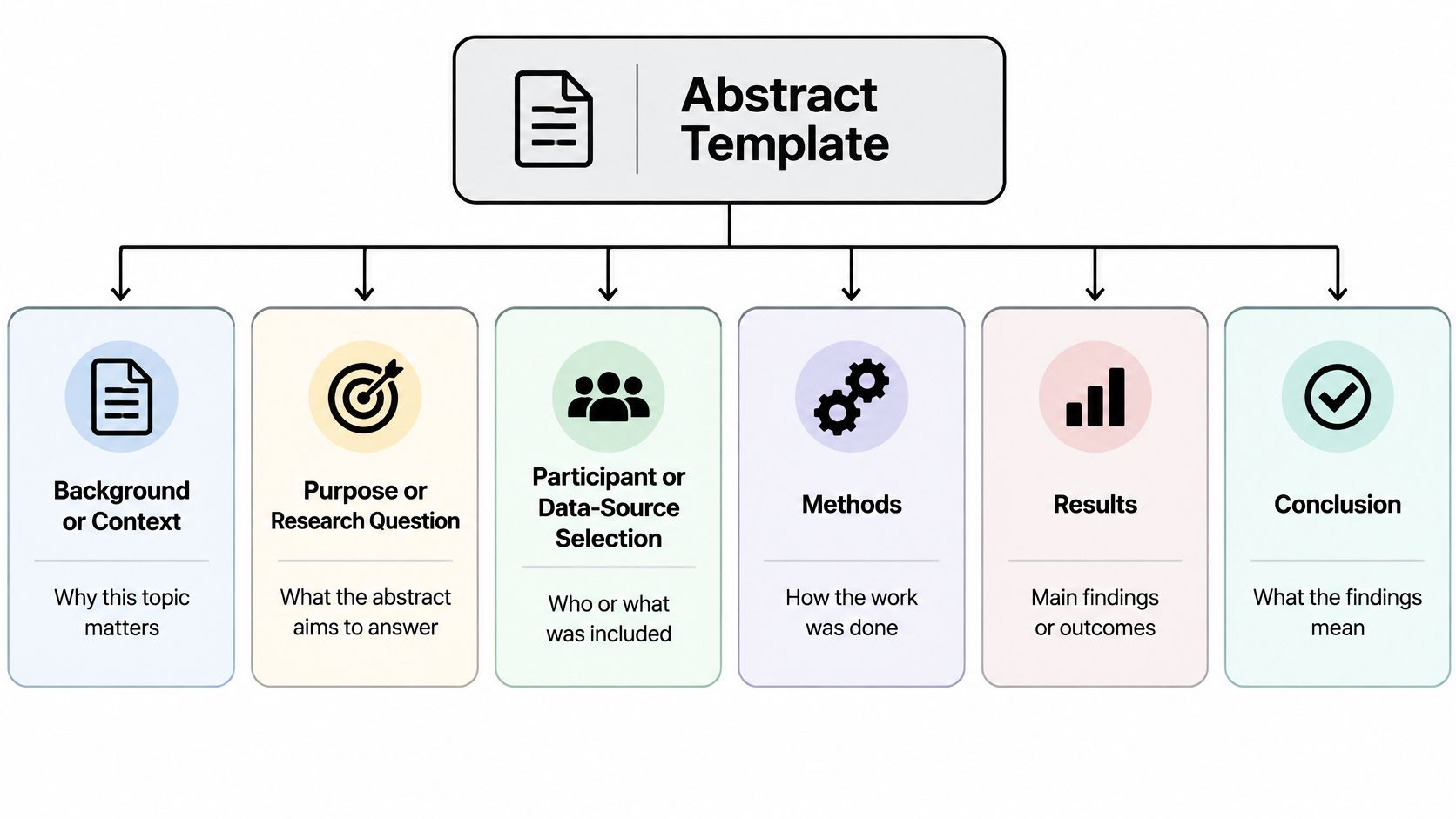
Structured body sections, prompts and common gaps
| Body section | Prompt for authors | Common gap |
|---|---|---|
| Background or context | State the problem and why it matters to this audience | Generic opening that could describe any study |
| Purpose or question | State the research question or aim in a sentence | Aim written as a topic rather than a question |
| Participants or data source | Who or what was studied, with numbers | Sample size missing |
| Setting | Where and over what period the work took place | Omitted for multicentre or registry data |
| Methods | Design and the analytical approach used | Methods named without the test applied |
| Results | Main findings with specific effect sizes and significance where possible | Vague significant improvement claim with no numbers |
| Limitations | Identify the real constraints on the findings | Limitations left out entirely |
| Conclusions | What the findings mean, no more | Conclusions broader than the data |
Write prompts that expose missing evidence
Background should establish the problem, not provide a miniature literature review. Purpose should identify what the work answers, rather than merely naming a subject.
For participants or data sources, ask authors to identify the population, records, specimens, or materials included and give the relevant numbers. Keep setting explicit so reviewers can distinguish local experience from work across institutions or registries.
The methods prompt should request study design, measurements, and analytical approach. A design label alone doesn't explain how the authors assessed an outcome.
For results, require the finding itself. Authors shouldn't substitute a promise that findings will be discussed, or call an improvement significant without reporting supporting values.
Clinical trials need the applicable CONSORT abstract elements, consistent with ICMJE manuscript-preparation guidance. Event headings may differ, so configure labels and required status to match the call rather than imposing this table unchanged.
Finally, make limitations an explicit prompt, even when the event combines them with conclusions. The conclusion must remain within the population, setting, measures, and evidence reported.
Adapting the Template for Preliminary and Non-Traditional Work
A conventional empirical-study layout isn't suitable for every submission. Pilot projects, implementation work, quality improvement, case reports, literature reviews, qualitative studies, and educational innovations need prompts that match their evidence.
Keep the work-type choice visible while contributors draft.
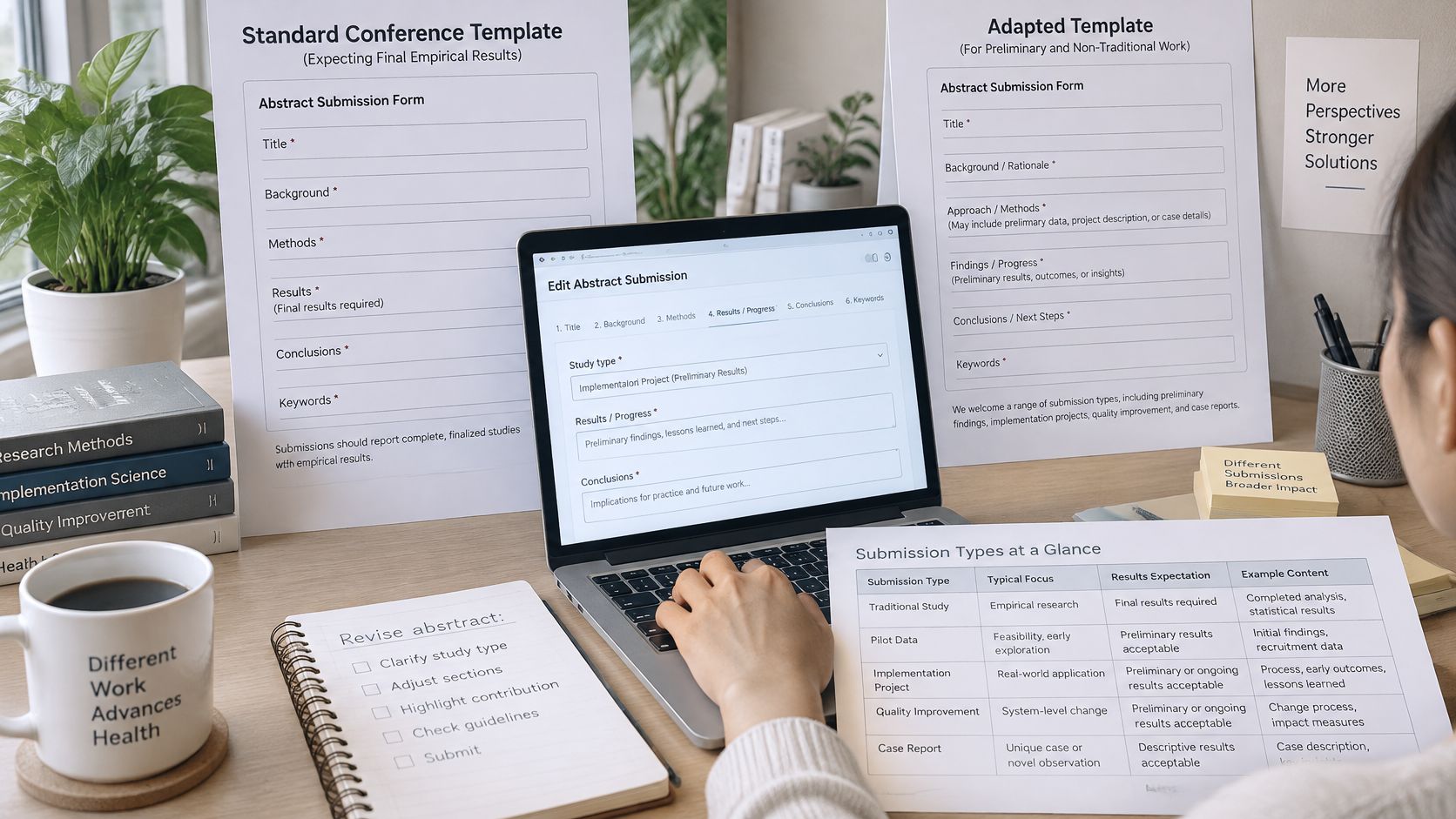
The CCLG abstract-writing guidance accommodates preliminary findings. Translate that flexibility into conditional prompts rather than forcing practitioners and early-career researchers to describe work as a completed trial.
Work-type selector and status labels
| Work type | Core prompts | Status label | Blocked error |
|---|---|---|---|
| Empirical study with final results | Context, purpose, procedures, main findings, conclusions | Completed | Planned analysis presented as a finding |
| Pilot or preliminary data | Context, approach, evidence available, limitations, practical implications | Preliminary | Preliminary results stated as final |
| Implementation or quality improvement | Context, intervention, implementation outcomes, limitations, practical implications | Completed or preliminary | Generalizing beyond the setting |
| Case report | Clinical context, single learning point, what was done, limitations | Completed | Implying generalizability from one case |
| Educational innovation | Learning objective, design, evidence available, practical implications | Preliminary or completed | Claiming outcomes that were not measured |
| Planned work | Context, aim, planned methods, expected evidence | Planned | Planned work stated as completed |
Require authors to select completed, preliminary, or planned, with planned work available only when the call permits it. Across work types, preserve prompts for objective or context, approach, available evidence, limitations, practical implications, and results status.
For a case report, ask for the single clear learning point, not merely a claim of rarity. The abstract must make sense without the presentation.
An appropriate preliminary statement might read: Preliminary pilot results suggest a trend; the full sample has not yet been analyzed.
Use that wording only when the available findings support it. Don't turn planned analyses into results or imply that a single case establishes a general effect.
For contributors who prefer video guidance, provide a separate writing resource alongside the field instructions.
A universal IMRaD-style layout improves consistency but can reduce fairness unless organizers support different evidence types. Preserve comparable review questions while changing the prompts authors use to answer them.
Word Limits and Character Counts by Event
There is no universal abstract length. Treat these published examples as historical configuration references, not as substitutes for the current call.
Abstract length limits by event
| Event | Year | Abstract limit |
|---|---|---|
| World Congress of Epidemiology | 2024 | 350 words for research and programmatic abstracts |
| NOSCOS, University of Helsinki | 2024 | 250 words |
| Society of Geriatric Oncology (SIOG) | 2024 | 1,700 characters of text; titles 200 characters |
The spread matters more than any single figure. One call counts words, another counts characters and caps the title on a separate limit, and some events prescribe the body's section headings inside the total. A template hard-coded to last year's unit misleads contributors the moment the unit or the title cap changes.
Length controls must coexist with completeness checks. In a case study of systematic-review conference abstracts, 73% of eligible abstracts, 66 of 90, had missing or insufficient information for 15 of 25 data-extraction items, according to the Cochrane conference abstract.
The gap is a prompting problem, so the form has to enforce completeness alongside length. A short submission can satisfy a counter while omitting the information reviewers need.
Configure the counting rules deliberately:
- Choose the unit. Define whether the body uses words or characters, and whether the limit applies across all body sections.
- Clarify spaces and headings. State whether spaces, pasted headings, and other included text count toward the total.
- Display live counters. Show field-level counts and the shared body total where applicable.
- Block over-limit submission. Preserve the draft and explain the error. Do not trim text after the deadline.
- Set the title rule separately. A valid body doesn't make an overlong title compliant.
Operational check: Paste the same draft into the form and the preview, then confirm that both report the same count.
For another event-specific preparation example, use the SfN abstract submission guide when organizing contributor instructions. Publish each limit beside its field. A limit that lives only inside a downloadable call document reaches contributors too late, after they have already drafted to the wrong count.
Author, Presenter and Identifier Fields
Collect authors as individual records, with names, affiliations, and publication order. Mark the presenting author separately from coauthors, and capture contact details without assuming that the presenter is also the submitting author.
Enter affiliations per author, not as an undifferentiated paragraph. Otherwise, staff can't reliably identify which institution belongs to which contributor during conflict checks or program preparation.
The good-practice guidance for conference abstracts recommends dedicated study identifiers and publishing them with abstracts to connect conference records with subsequent presentations and publications. Suitable identifiers include a clinical-trial registration number, protocol number, study name, or grant number.
Configure provenance and presenter controls
- Require the applicable identifier. For trial or registry submissions, show the relevant identifier field and distinguish the identifier type. Don't use a generic mandatory box that encourages meaningless entries.
- Validate recognized formats. Apply registry-specific patterns where available, but provide a staff-reviewed exception route for legitimate identifiers outside those patterns.
- Enforce a single presenter flag. For a program using a single-presenter model, prevent submission with missing or multiple presenter selections.
- Store funding independently. Capture funder names and grant details as searchable metadata, with an explicit unfunded option.
If your process includes a fillable document, the PDFWix guide to creating PDF forms is useful for building named inputs. A PDF can support an offline preparation step, but staff still need a defined method for transferring its values into the submission record.
At Planstone, we configure our platform to each program's review criteria, faculty requirements, and credit rules, from the forms contributors complete to the reports staff rely on.
Before opening intake, test an author with multiple affiliations and a presenter who isn't first author. Confirm that every author appears once and that exactly one presenter is named under the program's chosen rule.
Disclosure and Conflict Rules for CME and Review
For ACCME-accredited activities, organizers must collect all financial relationships with ineligible companies held by planners, faculty, and others controlling educational content during the prior 24 months, with no minimum financial threshold, under the ACCME accreditation requirements. Individuals must report those relationships regardless of whether they consider them relevant.
Build required disclosure inputs around:
- Company name: Identify the ineligible company, rather than accepting only a general conflict statement.
- Relationship type: Offer employment, research, consulting, advising, speaking, independent contracting, royalties or patents, executive roles, and ownership interests.
- Applicable period: Display the required reporting window clearly.
- Explicit negative response: Require a no-relationships answer when applicable so staff can distinguish completion from silence.
Keep these records separate from the scientific narrative. Collection alone isn't the full compliance process; staff need a defined workflow for evaluating and addressing relevant relationships, supported by financial disclosure management.
Check reviewer eligibility before access
COPE's ethical guidelines for peer reviewers prohibit disclosure or personal use of confidential submission information and identify financial interests, personal relationships, and academic rivalries as potential conflicts. COPE says reviewers should generally decline when they share an author's institution or have been that author's mentor, mentee, close collaborator, or joint grant holder within the past three years.
Operationalize that guidance before releasing materials:
- Collect a conflict declaration for each assignment, not just a general profile acknowledgment.
- Compare the reviewer's affiliations against every author's affiliations.
- Ask about the relationship categories and lookback period described in the reviewer policy.
- Require a confidentiality acknowledgment before access.
- Log declarations, document staff decisions, and reassign conflicted submissions.
Institution matching is a screening tool, not a complete conflict assessment. Personal and academic relationships won't necessarily appear in affiliation records.
Check current accreditor requirements before launch, then test assignment rules against a past call containing known conflicts. Confirm that staff can stop access and reassign work without losing the decision history.
Inclusive Language, Accommodations and Plain-Language Summaries
A complete submission form collects operational requirements without making them part of scientific scoring. An accommodation request, an inclusive-language check, and a public-facing summary serve different purposes and need different handling.
Accommodation requests should ask presenters about access or format needs for the session. Keep this field outside the reviewer view, restrict staff access to those coordinating arrangements, and explain who will respond. Don't ask contributors to place personal access information in the abstract body.
For inclusive language, provide a short prompt directing authors to the terminology specified in the call and asking them to define abbreviations at first use. Make the expectation actionable: identify the applicable guidance rather than presenting an unexplained acknowledgment checkbox.
Separate publication content from operational information
When the call requires a plain-language summary, give it its own field, length limit, and audience description. Ask authors to explain the problem, what they did, what they found, and why it matters without assuming specialist knowledge.
Don't label the scientific abstract as plain language just because an author removed a few technical terms. Review the summary independently for understandable wording and claims consistent with the scientific submission.
Use this configuration sequence:
- Inventory non-writing requirements. Include presentation preferences, access needs, acknowledgments, and requested supporting materials.
- Assign each requirement to a named field, with a staff owner and a clear purpose.
- Flag empty required entries. Use conditional requirements so contributors don't complete irrelevant questions.
- Record whether each item is reviewed, published, used for scheduling, or stored for administration.
Keep accommodation information out of merit review. Ask only for what staff need to arrange participation.
The trade-off is form length. Use conditional display to reduce unnecessary questions, but don't hide requirements until contributors reach the final submission screen. Document accessibility needs its own final check, separate from whether the author completed these fields.
Audit Your Abstract Against the Call Before Submitting
Confirm compliance before the deadline because a nonconforming submission can be rejected before reviewers assess its scientific quality. Separate writing requirements from submission-system requirements, then verify both.
The American Academy of Neurology's 2025 abstract guidelines require five specified body headings and a 300-word body limit. Historical examples help with planning, but the current call must govern the live form.
Use the checklist to organize the final review.
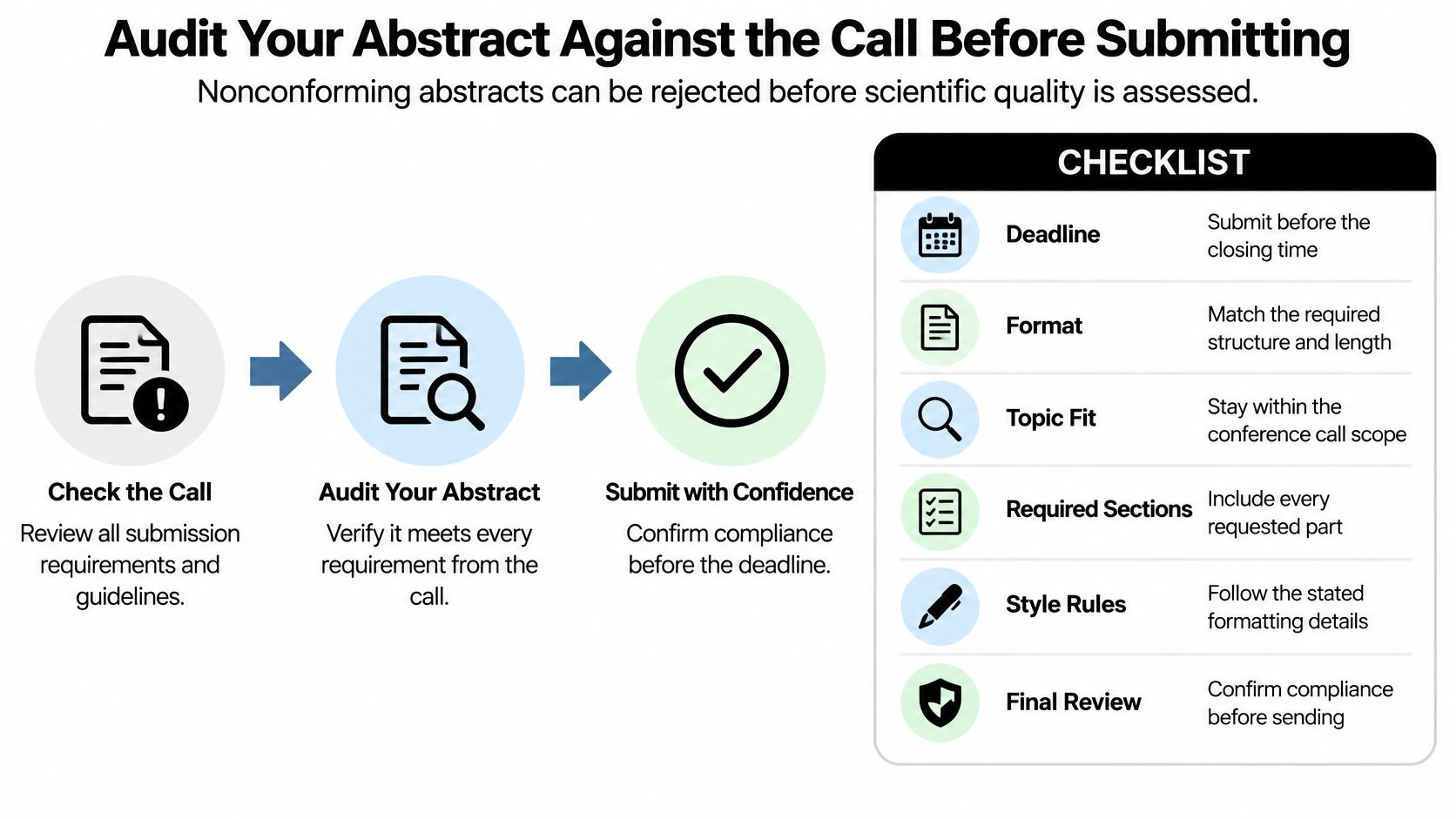
Run the pre-submission audit
- Load the current call. List every requirement, including topic scope, deadlines, presentation eligibility, and supporting materials. Use the call-for-abstracts guide to organize the operational requirements.
- Map each requirement to an intake field, validation rule, acknowledgment, or staff check. Anything without a destination remains an unresolved launch issue.
- Run completeness checks. Test missing required answers, conditional branches, author order, category selection, and incomplete declarations.
- Check word and character counts using the call's counting rules. Include pasted text and the final preview in testing.
- Review accessibility. Check heading structure, readable typography, color contrast, reading order, and screen-reader compatibility. For uploaded documents, confirm that text is selectable and meaningful images have alternative text.
- Verify that disclosures, funding, and identifiers appear in their dedicated records, not merely in attachments.
- Save the version record. Retain the template version, call date, approved rules, and change log so staff can compare the next cycle against an authoritative baseline.
- Submit with margin before closing time and confirm receipt. For organizers, test confirmation messages and the contributor's submitted-record view.
Annual rules change. A version record prevents staff from copying an outdated form and assuming that unchanged wording means unchanged requirements.
Documentation and troubleshooting matter alongside configuration. Alex Cannon of the American Physical Society said:
"Planstone was very helpful in the way the templates were documented with all the information, and creating a new type of 'Ready Set Go' call for this and being on call to troubleshoot anything with this new tool."
Planstone's abstract management module brings submission, review, and session building into one workflow, from the call for abstracts through to the finished program.
Planstone offers configurable conference and continuing education management software for teams coordinating abstract intake, review, speakers, and disclosures. Bring your current call, field inventory, and review rules to a conversation about building a submission workflow around your program. Visit Planstone to discuss your requirements.