
Most conference abstracts never become journal articles. A Cochrane methodology review that tracked 307,028 studies first presented as conference abstracts estimated that only 37% were later published in full in peer-reviewed journals (95% CI, 35% to 39%). For randomized controlled trials the rate was 60% (95% CI, 52%–67%), which still leaves roughly two in five conference-presented trials without a full paper. That gap is why a call for abstract is a screening document, not a flyer for the meeting.
If you run the program, the call decides what reviewers can judge and what authors can deliver. The sections below cover the statements that belong in the call, the calendar after acceptance, word limits by study type, disclosure collection, and a usable policy on generative AI.
Table of Contents
- What a Call for Abstract Is and Why It Matters
- Required Elements Every Call for Abstract Should State
- Submission Timeline and Post-Acceptance Rules
- Word Limits and Review Criteria by Study Type
- Disclosure Rules for Speakers and Content Controllers
- Using AI in Abstracts and Review
- Frequently Asked Questions About Calls for Abstracts
- Pre-Publication Check and Next Steps
What a Call for Abstract Is and Why It Matters
A call for abstract is the public invitation asking researchers, clinicians, or practitioners to submit summarized work for review, selection, and presentation at a conference, meeting, or education program.
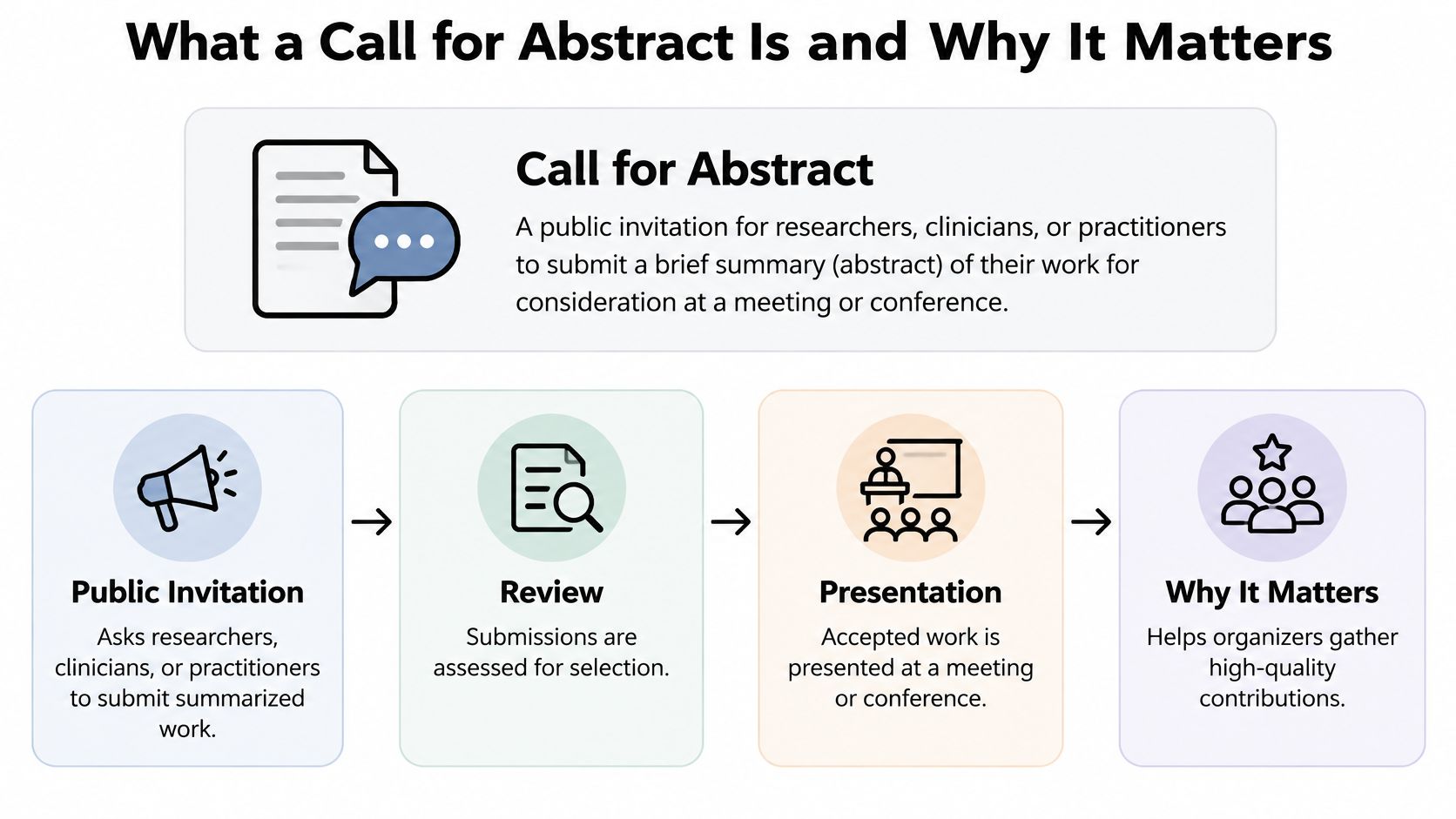
Authors and reviewers both start from this document. What it asks for is what reaches the program. A vague invitation produces vague files, and a scientific committee then has to score claims it cannot verify. Because so much presented work never appears later as a full article, the oral or poster slot may be the only public record a professional audience ever sees. Later journal publication is where methods, data, limitations, and interpretation get checked. The call is the gate in front of that first public record.
What every call has to settle
Three statements do most of the work.
- Eligible work. Name the contribution types, the fields of study, and any rule on prior publication or duplicate submissions.
- How submissions are judged. State the dimensions the committee scores, and say plainly that this is program screening, not journal-style peer review.
- What happens after acceptance. Cover registration, edits, presenter changes, withdrawal, and whether the abstract appears if nobody attends.
Practical rule: If an author cannot find the answer in the call, the committee will answer it one email at a time after the deadline.
A precise call produces a program that is easier to verify, easier to trust, and easier for authors to deliver. Submission records, review decisions, and presentation formats then become a historical trail you can defend, rather than a folder of free-text files nobody can compare.
Required Elements Every Call for Abstract Should State
Treat the table as a sign-off checklist. Read the draft call against every row before you open submissions. If a row is blank, authors will invent a rule and reviewers will apply another.
| Element | What the call must state | Why it matters |
|---|---|---|
| Contribution types | Oral paper, poster, panel, or topic session, each with its own fields | Different formats need different reviewers and time slots |
| Submission deadlines | Principal deadline and any later rounds, with time zone | Authors cannot plan drafts without fixed dates |
| Eligibility | Who may submit and how many abstracts per author | Prevents duplicate or overloaded submissions |
| Study identifier | Registry, protocol, or grant number captured in a dedicated field | Links the abstract to later full publication |
| Structured fields | Objective, design, participants, primary outcome, results, precision, funding, conflicts | Enables comparable review and clean program metadata |
| Word limits | Limit for each field, not only for the whole abstract | Stops authors omitting denominators or effect estimates |
| Review criteria | Dimensions the committee scores, such as relevance and scientific soundness | Sets expectations for reviewers and authors alike |
| Disclosure requirements | Relationships to collect, look-back period, and company categories | Required for accredited education |
| Presenter registration | Date by which the presenter must register | Prevents accepted abstracts without a deliverable presenter |
| Late-breaking results | Whether incomplete or late results are allowed | Avoids rejections for a rule nobody stated |
| AI policy | Permitted uses, disclosure wording, and reviewer rules | Protects authorship, accuracy, and confidentiality |
| Post-acceptance changes | Edit window, presenter substitution, and format conversion rules | Defines what authors can change after acceptance |
Formats, identifiers, and fields
Name every contribution type in the call. An oral paper, a poster, a panel, and a topic session do not share one form. A panel needs convenors, speaker names, and a session aim. A research abstract needs results. Sending both through one free-text box forces reviewers to hunt, and it breaks any later export into the program.
Capture a study identifier in its own field and carry it into the published program. A ClinicalTrials.gov number, an EudraCT number, a PROSPERO record, a protocol, a grant, or a study number ties the abstract to the presentation and to any later paper. Reporting-guideline research points to the same minimum scientific pieces across frameworks such as CONSORT, STROBE, and PRISMA: objective or hypothesis, design, eligibility, counts, primary outcome, results, precision, interpretation, funding, and conflicts of interest. Conditional fields help. A randomized trial should open trial-specific items. A systematic review should ask for databases, search dates, risk-of-bias methods, and effect estimates.
The rows teams skip
Three rows stay blank more often than the scientific ones. Presenter registration needs a date, not a hope that someone will show up. The AI policy needs permitted uses and a disclosure line, covered later in this article. Post-acceptance changes need an edit window, a substitute-presenter rule, and a yes or no on converting a poster to an oral slot. A configurable submission form is the practical way to hold those fields apart. Our notes on building an abstract submission form walk through how field design affects what reviewers see.
Mark every row your own call does not state. Those blanks are the questions your inbox will answer after the deadline.
Submission Timeline and Post-Acceptance Rules
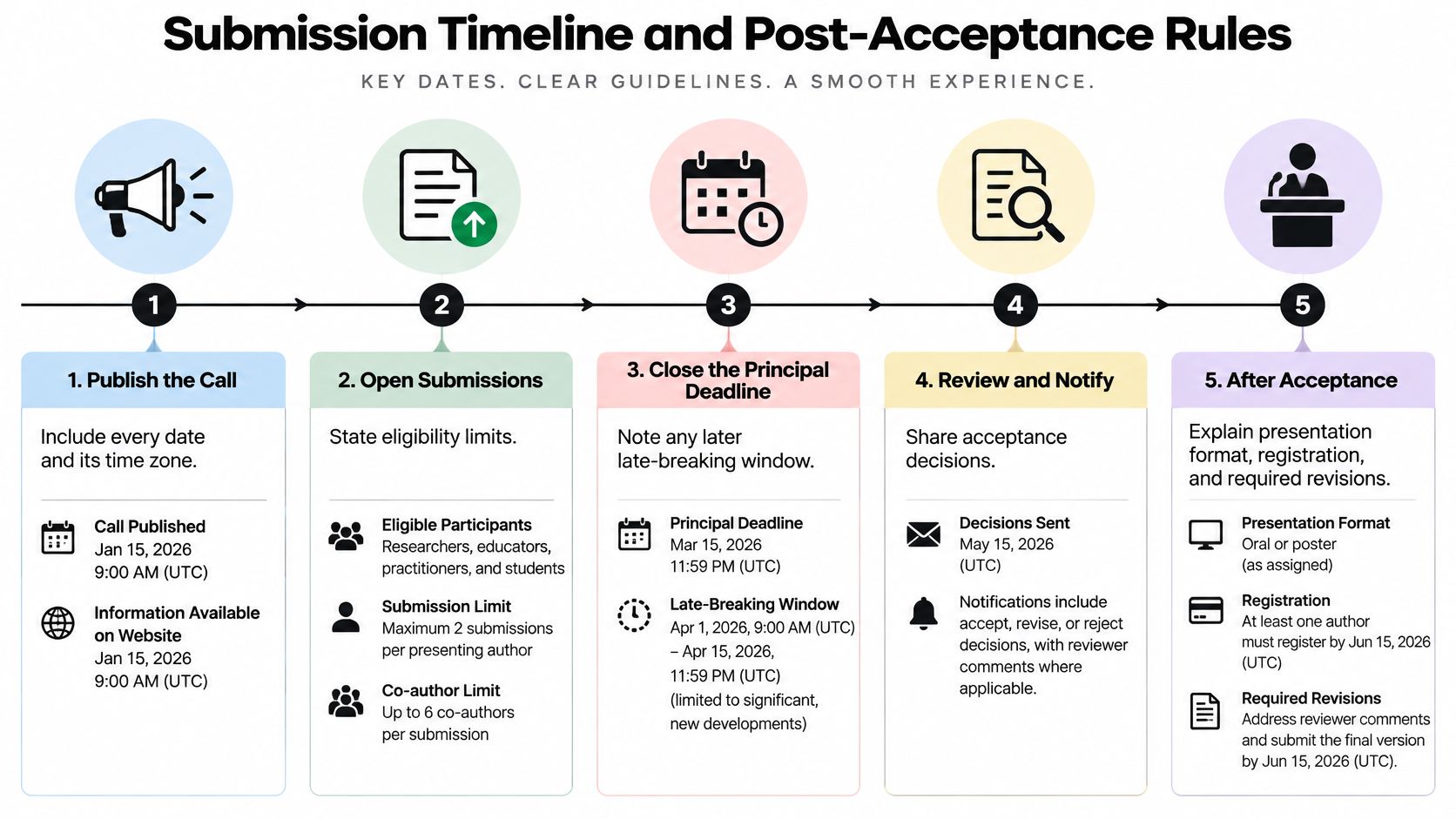
Dates only work when they are linked. A missed notification date makes the registration date meaningless, and an open edit window after the program is locked creates two versions of the same abstract.
Milestones in order
- Publish the call with every date and its time zone. A deadline of "1 February" without a zone is a different hour in every country you recruit from.
- Open submissions and state eligibility limits, including how many abstracts one author may submit.
- Close the principal deadline, then close any later round for posters or late-breaking work on its own date.
- Review against the published criteria. Do not add a scoring dimension after files are in.
- Send acceptance or rejection inside a window you already printed.
- Require presenter registration by a fixed date. An accepted abstract without a registered presenter is not a session.
- Close the edit window for accepted files. After that, author-list fixes go through staff, not the form.
- Build presentations and publish the program from the accepted record, not from a side spreadsheet.
Staggered rounds are an old pattern, not a modern trick. An American Statistical Association archive for the 2011 Joint Statistical Meetings shows contributed papers, posters, topic-contributed papers, topic-contributed posters, and panel sessions under a principal deadline of 1 February 2011. A separate CDC Symposium on Statistical Methods set a submission deadline of 7 February 2011, accepted work for oral or poster presentation, and scheduled notifications for 18 February, an 11-day decision window, with a later poster-abstract deadline of 18 April. That split lets you protect speaking time while still filling poster capacity. The trade-off is real. A second round needs its own reviewers, or the first-round authors wait while a thinner file jumps the queue.
Questions authors ask after the letter
Edits. Allow them only inside the window, and only in fields you named, such as typos or a corrected affiliation. Scientific results should not be rewritten after review.
Presenter substitution. Permit a co-author already on the abstract, require written notice before the registration date, and say whether the substitute must meet the same disclosure rules.
Poster to oral. Allow a conversion only if the call states it. Otherwise the answer is no, because oral slots were allocated against a fixed program.
Registration. Name the date and the fee status. "The presenter must register" is incomplete if you never say by when.
State what a missed deadline means. Either late files are not reviewed, or they enter a named late-breaking track. Silence reads as negotiable.
Word Limits and Review Criteria by Study Type
A word cap determines what evidence a reviewer can assess. Match the limit to the study design, and set field-level requirements so authors can report the methods and results needed to judge the work.
| Context | Word guidance | Required structured content |
|---|---|---|
| Randomized clinical trial (CONSORT for Abstracts) | About 300 words | Design, participants, interventions, primary outcome, results with precision, conclusions |
| Systematic review | Allow enough space for the search approach, selection and characteristics of included studies, findings with uncertainty, and limitations | Search approach, study selection, included-study characteristics, findings with uncertainty, limitations |
| German Federal Statistical Office, 15th Scientific Conference (2024) | Maximum 500 words | State the fields your own call requires; the 500-word limit alone does not establish a required structure |
BMJ guidance on conference abstracts notes that about 300 words may be required to report a randomized clinical trial adequately under CONSORT for Abstracts. A systematic review needs space to explain its search and selection methods, describe included studies, report findings with uncertainty, and acknowledge limitations. A trial-style cap may leave reviewers without enough information to judge that evidence. The German Federal Statistical Office's 2024 conference call set a maximum of 500 words. That limit is an example, not a substitute for specifying the fields authors must complete.
Why a short cap fails the committee
When the limit is too tight, authors may omit methods, denominators, effect estimates, or precision. Reviewers are left scoring claims without enough context. Set limits for each structured field, require the primary result and a measure of uncertainty where the design supports one, and check submissions for missing fields before review begins. A short impact statement or synopsis can serve the program guide, while the main abstract carries the evidence reviewers need.
Screening is not journal peer review
Conference abstracts are commonly assessed by a scientific committee for relevance and interest. They generally do not receive the depth of review given to a full journal article. State that distinction in the call, then publish the criteria reviewers will apply:
- Relevance to the program and session themes.
- Soundness of the methods as described.
- Results and uncertainty, where the study design supports an estimate.
- Fit to format, including suitability for a poster or oral presentation.
Define how those criteria will be used before submissions open. Clear rubrics help reviewers apply consistent standards; peer review process guidance offers a useful comparison between program screening and journal review. A rubric available only in the reviewer portal can surprise authors after they submit.
Disclosure Rules for Speakers and Content Controllers
For accredited continuing education, financial relationships are not optional color on a slide. They are a record you must be able to show.
The Accreditation Council for Continuing Medical Education requires providers to collect all financial relationships that planners, faculty, and other people who control educational content have had with ineligible companies during the previous 24 months. The rule applies whether or not the person thinks the relationship is relevant, and there is no minimum dollar threshold. Each record names the ineligible company and the nature of the relationship, such as employment, consulting, research, speaking, royalties, an executive role, or an ownership interest. A yes-or-no checkbox does not meet that standard.
A collection routine that survives an audit
- Build the form with two fields per entry, company name and relationship type. Free text such as "various industry ties" cannot be reviewed.
- Set the window at 24 months before the person takes a role in the activity. A shorter look-back under-collects.
- Assign a reviewer who was not the submitter to decide which relationships are relevant to the content.
- Record the mitigation you applied, such as a change of topic, an independent review of slides, or removal from planning.
- Keep the file with the event, not in a personal inbox, so a later question has an answer.
Collection is only the first state. You still review, mitigate where needed, and tell learners what they need to know. Learners should see the person's name, the company, the nature of a relevant relationship, and confirmation that mitigation occurred. They should also be told when planners and faculty have no relevant financial relationships. Tie the disclosure deadline to the presenter registration date in the call. A speaker who registers but never files the 24-month record should not be confirmed on the program. Our disclosure tools are built for that handoff between faculty requirements and the rest of conference preparation.
Using AI in Abstracts and Review
An abstract call is the first screening point in the research lifecycle. Its AI policy should tell authors what assistance they may use and explain how reviewers will handle confidential submissions. Leaving those rules unstated gives authors and reviewers no shared standard.
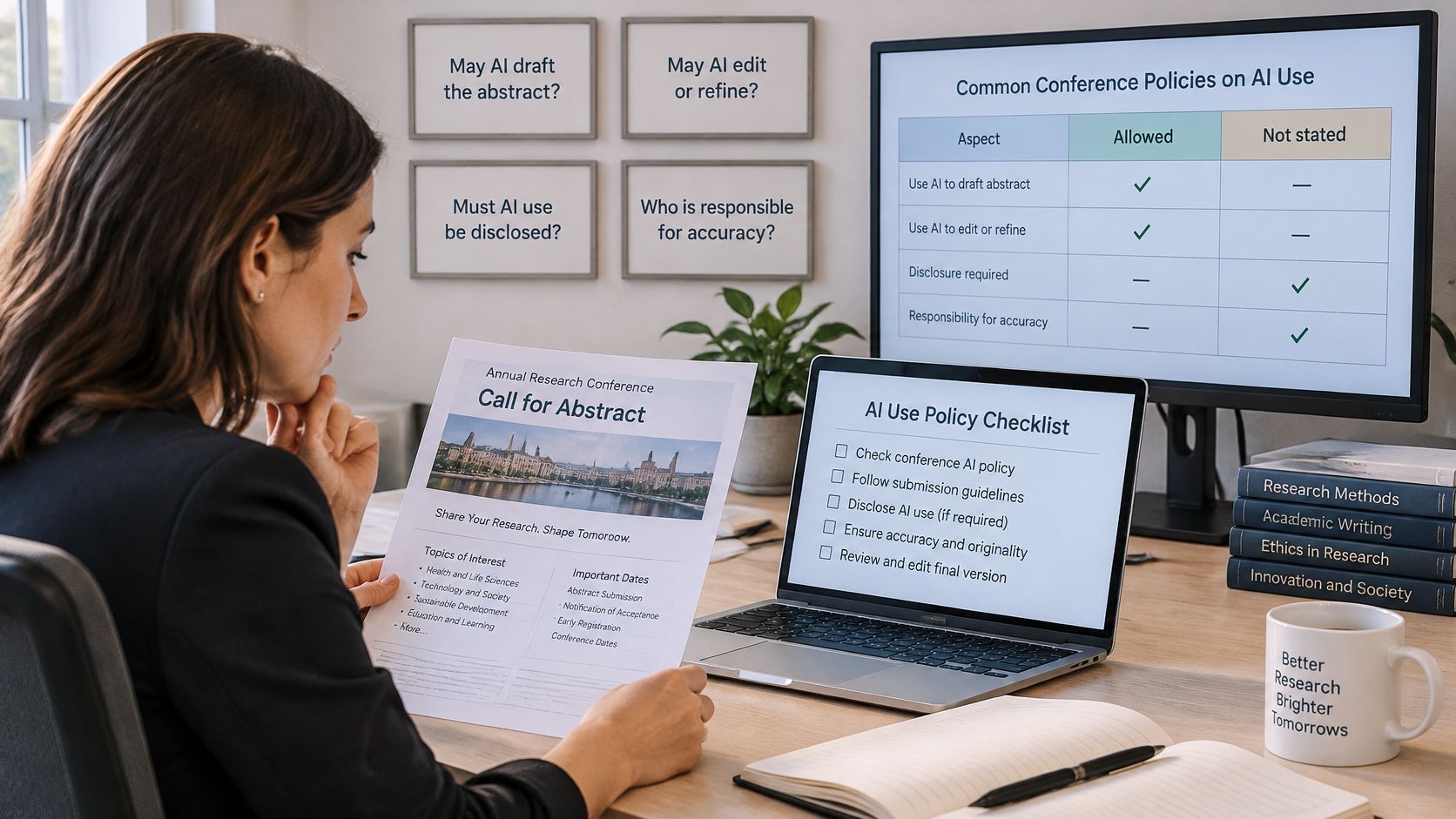
Recent recommendations on AI in medical publishing workflows identify four questions for submission guidelines: May authors use generative AI to draft, translate, edit, or create figures? Must they disclose that use? Will organizers use AI to triage abstracts? Is author consent required? Set out the answers in the call, including whether consent is needed before organizers use submitted content in AI-assisted evaluation.
Editing language is not writing the science
Language editing, translation, and grammar checks may be allowed, but authors should disclose them if the call requires it. Generating results, effect estimates, patient details, or conclusions raises a different issue: authors remain responsible for every scientific claim and must verify it. AI tools cannot be listed as authors.
Set explicit rules for copyright, confidentiality, accuracy, and approval. A fabricated number, exposed patient detail, or figure used without permission can undermine the abstract and the proceedings. For a plain-language account of honest writing, see a student's guide to honest writing.
Reviewer-side rules need equal clarity. State whether reviewers may upload confidential submissions to external AI tools. A safer default is to prohibit it: the review portal already contains the file, and using a third-party tool can expose content beyond the review process.
A model disclosure line:
The authors used a generative AI tool for English language editing only. All data, claims, and conclusions were written and verified by the authors.
The short video below can help brief a program committee that is drafting its AI policy.
Frequently Asked Questions About Calls for Abstracts
Can I use an AI tool to improve my abstract?
Language editing is usually acceptable when the call allows it and you disclose it. The scientific claims still have to be yours and checked by you. Look at the AI rules in the call before you paste a draft into any external tool.
How long should my abstract be?
Follow the limit for your study type, set field by field, rather than one number for every abstract. A trial and a review do not need the same space, and a cap that is too short pushes out the result.
Why does the call ask for a registry or grant number?
That identifier links the abstract to the presentation and to a later full publication when several outputs come from one study. Put it in the dedicated field, not in the acknowledgements where reviewers cannot see it.
Is abstract review the same as journal peer review?
No. Committees usually screen for relevance and interest. They do not re-check full methods the way a journal does. Acceptance means the work fits the program.
What happens if my presenter changes after acceptance?
Only what the call allows. Check the substitution rule and the registration date. A change after that date often needs staff approval, and some meetings require withdrawal instead.
Can I switch from a poster to an oral presentation?
Only if the call states a conversion rule. If it does not, ask the organizers in writing before the edit window closes. Do not assume a preference ranking is a promise.
Pre-Publication Check and Next Steps
Run this check with the people who will answer author email, not only with the person who drafted the call.
- Sign off against the element list and mark every row the draft leaves blank. A blank row is a decision you have postponed.
- Submit a sample abstract through the live form and confirm each field exports into the program record, including the study identifier and the disclosure entries.
- Have a colleague who did not write the call read it as an author. Note any deadline, word limit, or AI rule they cannot find in one pass.
- Match the cross-references. The disclosure look-back, the AI wording, and the presenter registration date should say the same thing everywhere they appear.
- Publish only when every row is complete. If you must correct the call later, post the new file with a visible change date so early submitters are not held to a rule they never saw.
If your team still splits submissions, reviews, speakers, disclosures, and credits across several systems, start with a consultation rather than another spreadsheet. Tell us about the program, the systems you already use, and what the team needs to finish. We offer dedicated support for conference management and account management, and that conversation is where we confirm which parts of the work fit our services and which details still need checking on your side. For many associations, the abstract path is the piece that benefits first. Our abstract management module brings submission, review, and session building into one workflow, from the call through to the finished program, so the rules you publish are the rules the form enforces.
Planstone connects abstract submissions, speaker tasks, disclosures, and continuing education credits for associations that need the call and the program to match. If your next meeting still depends on separate inboxes for reviews and faculty records, bring the program, your current systems, and your team's requirements to a working conversation. Visit Planstone to start that discussion.