

For abstract submission to SfN's 2026 regular call, submissions opened May 27 and close June 10 at 5 p.m. Eastern, with a $175 fee. The late-breaking call runs September 8 to 15, 2026, costs $260, and closes at 2,500 abstracts if the cap is reached.
If you're working on a submission now, the practical challenge is more than polishing the science. You need to choose the right call, complete the required fields, calculate the character count correctly, and know which changes remain possible after finalization. Treat the submission as a locked data record, not a document you can keep revising indefinitely.
Table of Contents
- Regular and Late-Breaking Deadlines and Fees
- Who Can Submit and Which Call Fits
- Counting Characters, Figures and Required Fields
- Writing the Scientific Content Within the Limit
- How to Submit Your Abstract Step by Step
- Errors That Block Acceptance or Lock Your Abstract
- Plan Your Poster Once Your Abstract Is Accepted
- Frequently Asked Questions About SfN Abstract Submission
Regular and Late-Breaking Deadlines and Fees
The two SfN calls lock differently, and that difference matters more than the four months between them. The regular call closes June 10 at 5 p.m. Eastern for a $175 fee, then allows a brief extension and a separate editing cutoff, so a submitted abstract can still be reopened and corrected. The late-breaking call runs September 8 to 15 for $260 with no editing period and no extension, so the version you submit is the version that reaches review. Dates, fees, and rules are as stated in SfN's 2026 call for abstracts.
| Milestone | Regular call | Late-breaking call |
|---|---|---|
| Submission window | May 27 to June 10, 2026, 5 p.m. Eastern | September 8 to 15, 2026 |
| Submission fee | $175 | $260 |
| Abstract cap | No stated maximum | 2,500 abstracts; site may close earlier |
| Deadline extension | Brief window past the published close | None offered |
| Editing cutoff | Separate cutoff shortly after the close | No editing period; record locks at submission |
| Acceptance decision | Early August | Late September |
| Presentation timing notice | Mid-October | Mid-October |
The extension and the editing cutoff are two milestones, not one. Getting the abstract in during the extension window puts it into the system; it does not keep the record editable afterward. Once the editing cutoff passes, a missing field or an unresolved co-author detail stops being fixable, and the abstract goes to review exactly as it stands.
Fees also move between meeting years. An abstract-handling charge you remember from an earlier call is not a budget line you can carry forward, so confirm the current amount on the call page before you request reimbursement or charge it to a grant.
The late-breaking cap is the tighter constraint of the two. SfN closes the site once 2,500 abstracts arrive, so a plan anchored on September 15 assumes the window stays open that long. If the data are ready, submit in the first days of the window rather than the last.
Put the regular editing cutoff and the early-closure risk on a shared calendar, and store the payment and submission confirmations beside it. A reminder only earns its keep when it fires with enough time left to fix a missing field or clarify a co-author detail before the record locks. For running this deadline alongside lab, co-author, and grant milestones, the Pretty Progress deadline guide keeps separate tasks and cutoffs visible in one place.
Who Can Submit and Which Call Fits
Under SfN's regular-call rules, each member may submit one scientific abstract in Themes A–J and/or one Theme K abstract, which covers History, Education, and Society. The late-breaking call allows one scientific abstract or one Theme K abstract per eligible member. Check your membership status and count your eligible submissions before starting. SfN's regular-call rules also describe placement preferences and linking groups for related work.
| Criterion | Regular call | Late-breaking call |
|---|---|---|
| Who may submit | Each SfN member | Each eligible member |
| Abstracts allowed | One scientific abstract in Themes A–J and/or one Theme K abstract | One scientific abstract or one Theme K abstract |
| Placement options | Nanosymposium, poster, or Theme K poster; preference can be stated | Poster only |
| Linking groups | Available for related abstracts | Not stated as available |
For a regular submission, you can indicate a nanosymposium preference, poster-only placement, or no preference. SfN may place eligible scientific abstracts in a nanosymposium or poster session, while Theme K work is placed as a poster. A preference informs the process; it doesn't guarantee a particular format.
Linking groups let authors signal that related abstracts should be considered together for a poster or nanosymposium session. Use them when the submissions form a connected scientific story, rather than because the authors share a lab. That gives the program committee useful information without asking it to infer relationships from similar titles or author lists.
Choose the regular call if the work is ready by early June and you're comfortable with the available placement options, including possible nanosymposium consideration. Choose late-breaking if the results are newer and a poster presentation suits the work. Researchers coordinating writing, literature review, and related research tasks may also find these AI tools for researchers useful, but the submitted scientific claims and author details still need to be checked by the authors.
Decision rule: Choose the call based on when the research is ready and which presentation formats you can accept, not just on which deadline feels more convenient.
Counting Characters, Figures and Required Fields
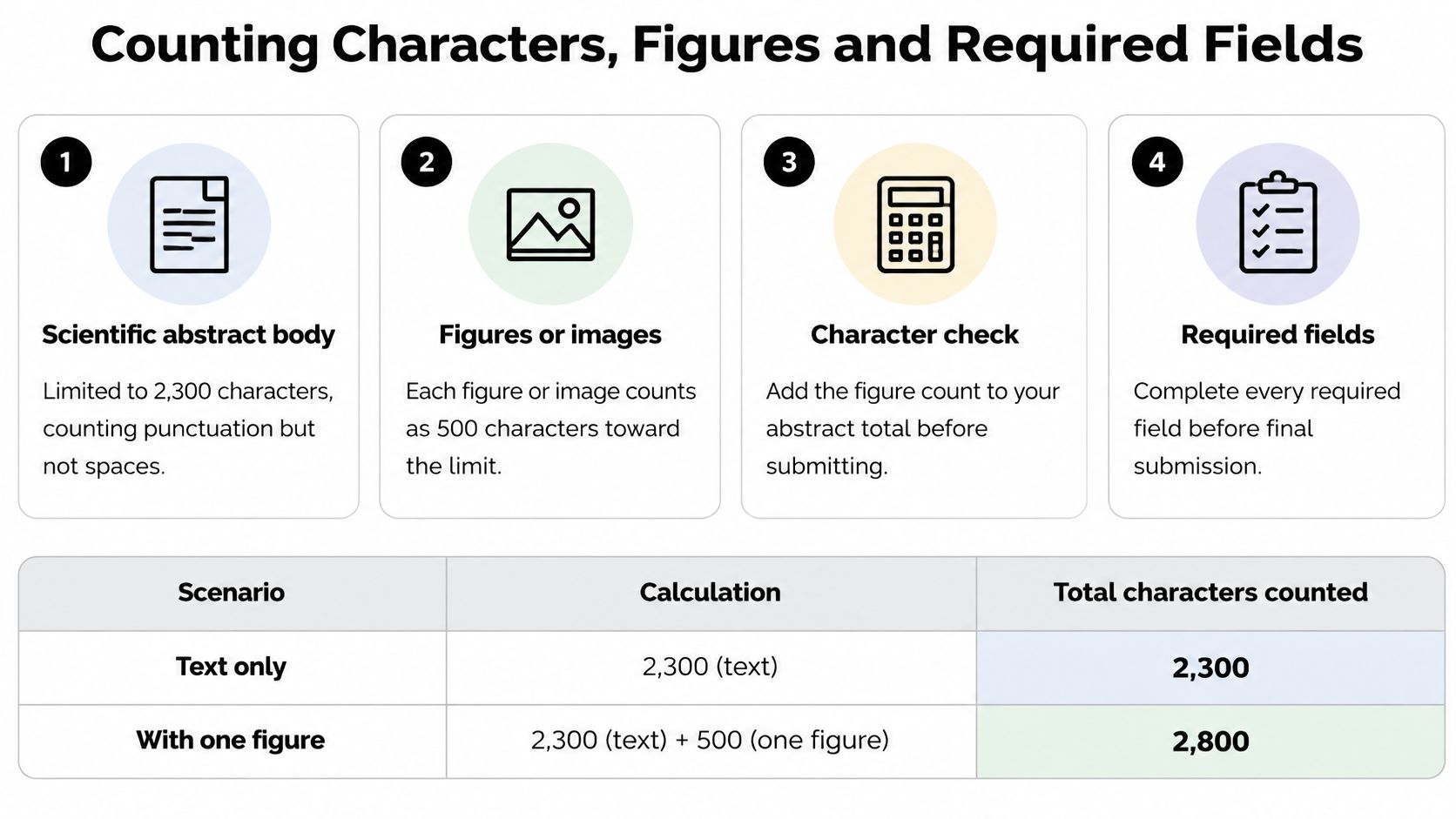
SfN limits the scientific abstract body to 2,300 characters, counting punctuation but excluding spaces. Each figure or image counts as 500 characters toward that ceiling, so the available text space changes when you add figures. SfN's submission guidance also specifies the information the submission record must capture.
A quick calculation makes the figure allowance concrete. One figure leaves 1,800 characters for text; two leave 1,300. A 1,500-character body plus one figure totals 2,000 counted characters and passes. The same body with two figures totals 2,500, so it exceeds the limit by 200 characters. Remove a figure or trim at least 200 counted characters.
A counter that includes spaces will return a higher total than SfN's space-excluding method. If that count is within 2,300, your space-excluding count will also be within the limit. Close to the ceiling, use a counter that excludes spaces, then add 500 characters for every figure or image. Standard word processors don't automatically apply SfN's figure allowance.
Keep required information in its own fields
Complete the submission record as a structured set of fields, rather than hiding required details in the abstract body:
- Title.
- Every author's name and affiliation.
- Each author's conflict-of-interest information, including relevant real or perceived financial relationships.
- Funding or grant support.
- Selected research theme and topic.
- Presenting author's contact details, because that author receives correspondence and notifications.
Keep a clean checklist of these components while preparing the record. This guide to formatting lists across work documents can help make a multi-author checklist easier to scan. For a structured drafting starting point, use Planstone's conference abstract template. Recheck the remaining character count after each text or figure change, including removing an image, because the available allowance shifts with the figure count.
Writing the Scientific Content Within the Limit
Reviewers need to understand the research objective and rationale, what methods and results support the claim, what the results mean, and whether the work is exploratory or confirmatory. A compact structure helps them follow that reasoning without making them hunt for the purpose or the main finding.
For a 2,300-character body, a practical draft budget is:
- Objective: about 250 characters.
- Rationale: about 350 characters.
- Methods: about 500 characters.
- Results: about 800 characters.
- Conclusions and significance: about 300 characters.
- Buffer: the remaining space for transitions and necessary detail.
Treat those allocations as a drafting aid, not fixed SfN limits. Results deserve the largest share because a reviewer needs to see what you measured and what you found. Name the measure, the sample or condition, the direction and size of the effect, and the comparison. “Results were significant” tells the reader little about the actual evidence.
For example, a vague sentence might say, “Treatment changed neural activity in the animals.” A stronger hypothetical version would name the measure, sample, and direction: “In the treated group, firing rate in the target region decreased relative to controls across the recorded animals.” If the actual study supports a numerical effect, include it accurately and identify the comparison. Don't add a number just to make a sentence sound more convincing.
State whether the analysis is exploratory or confirmatory in a direct sentence. That distinction gives reviewers context for interpreting the analysis and the strength of the conclusions. Avoid claiming a mechanism the results don't establish, and don't promise results you expect to have later. A conclusion should follow from the reported findings, not from what the next experiment might show.
The title also does practical work. A precise title that matches the body helps the committee classify the submission under the right theme. If the title highlights one mechanism but the abstract focuses on a different outcome, reviewers have to resolve that mismatch themselves.
Draft complete, plain sentences first, then trim repeated context and unnecessary qualifiers. Don't cut the method or the comparison just to preserve broad claims about significance. Keep a little room under the ceiling so co-authors can make a final, necessary correction without forcing a wholesale rewrite.
How to Submit Your Abstract Step by Step
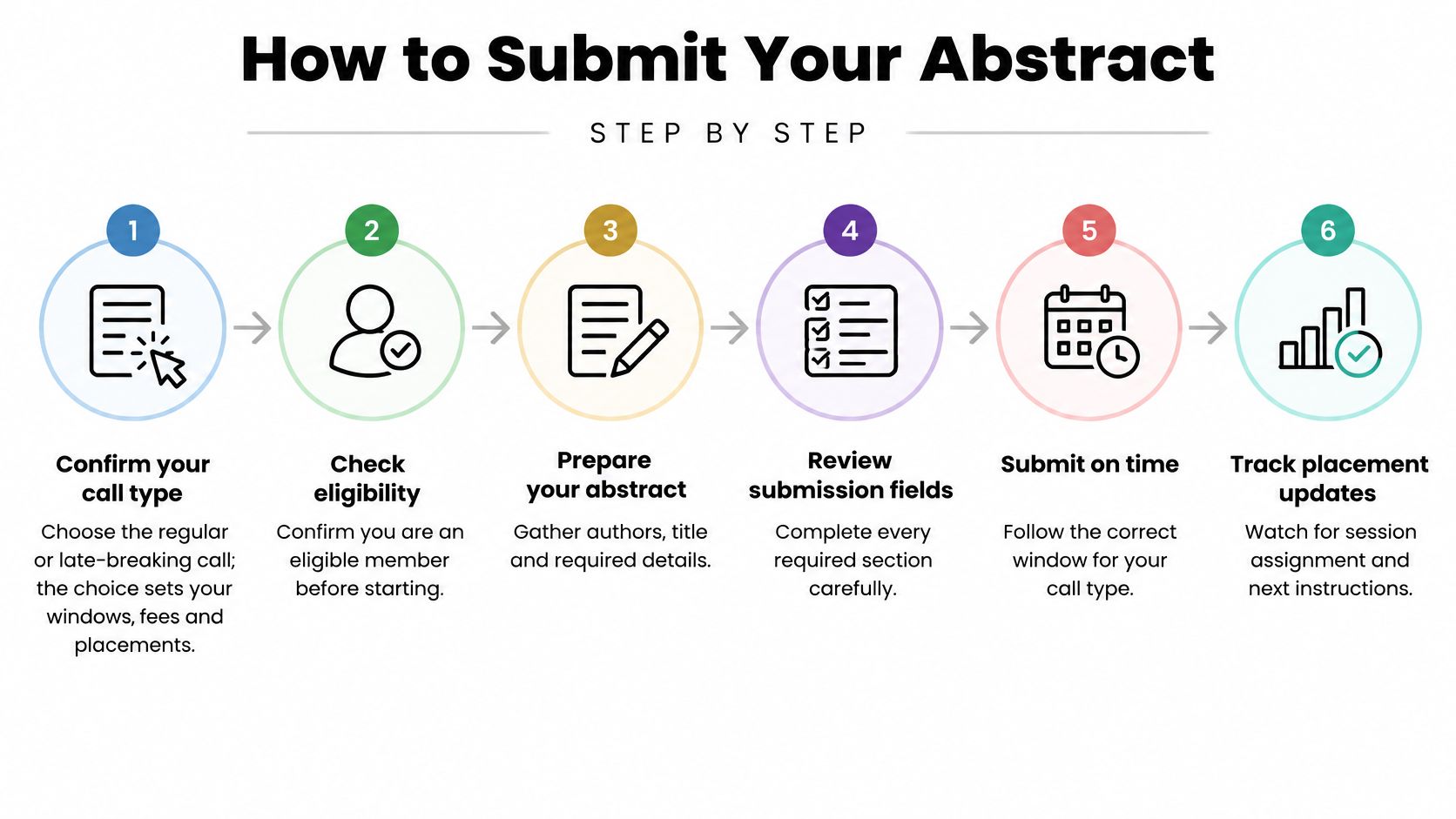
Confirm the call type first. The regular and late-breaking calls have different windows, fees, and placement rules, so choosing the wrong workflow can lead to a submission that doesn't fit your timeline or presentation needs. This conference abstract submission guide can also help teams organize their preparation.
- Confirm eligibility and choose the call. Check that your membership and abstract count fit the rules, then select regular or late-breaking. That decision sets your deadlines and available placements.
- Pay the submission fee. The regular fee is $175, and late-breaking costs $260. Keep the payment confirmation with your submission records so you can resolve an administrative issue without searching through email.
- Enter the title and author block. Add every author's name and affiliation, identify the presenting author, and verify that person's contact details. The presenting author receives correspondence, so an incorrect email can leave them without important notices.
- Write the body and add any figures. Apply the character-count method that excludes spaces, account for the figure allowance, and check the remaining count after each change. Don't rely on a general word processor counter near the limit.
- Select the theme, topic, and preferences. Choose the best-fit research classification, state the placement preference where available, and add a linking group if related abstracts should be considered together.
- Preview, save, and finalize. Read the full record as one submission, not as separate form fields. Regular submissions have a published editing cutoff, while late-breaking submissions have no revision period after the deadline.
Before finalizing, check that the preview shows the intended title, complete author list, disclosures, funding details, theme, topic, and body. Make sure the presenting author is clearly identified and can receive email. A complete preview should read like a finished scientific record, not a draft with fields left for someone else to fill in.
Errors That Block Acceptance or Lock Your Abstract
Finalization isn't just a save button. It's a binding workflow milestone: SfN's rules give regular submissions a defined editing window, but late-breaking abstracts have no revision period after the deadline. SfN's abstract-submission rules state that every late-breaking element, including the author block, must be final by the deadline. For regular abstracts, edits are available only through the published cutoff; afterward, the record is locked.
| Error | Typical cause | Consequence | Prevention |
|---|---|---|---|
| Body rejected as too long | Spaces counted or figure allowance missed | Record can't be finalized until trimmed | Count without spaces and add 500 characters per figure |
| Incomplete author block | Co-author disclosure or funding left blank | Required fields are missing | Collect each author's disclosure and funding details before entry |
| Late-breaking change after deadline | Assumption that a revision period exists | No edits allowed after finalization | Finalize only a fully checked record before the deadline |
| Regular edit after cutoff | Editing attempted after June 12, 2026, 2 p.m. EDT | Record is locked | Complete all changes before the editing cutoff |
| Late-breaking submission after cap | Waiting until the final days | Site may already be closed at 2,500 abstracts | Submit early in the window |
A dependable routine is to finish a complete draft a day before the deadline, keep a copy of the submitted text, and check the final count with a space-excluding counter. That gives co-authors time to spot missing disclosures or a misplaced figure without turning final submission into a last-minute scramble. Clear review responsibilities can help teams catch errors before finalization; this overview of peer-review processes provides useful context for organizing feedback.
SfN also requires the presentation's title, authorship, and scientific content to remain substantively identical to the submitted abstract. Presenters may update results and add new details in the poster, but shouldn't treat acceptance as permission to replace the central claim or change the author record. If a locked record contains an error, contact the meeting office promptly rather than assuming an edit is still possible.
Before you finalize: Check the author block, disclosures, funding, figure count, and presenter contact in the same pass as the scientific text.
Plan Your Poster Once Your Abstract Is Accepted
Acceptance turns the abstract into a closed record. SfN's annual estimate is nearly 14,000 abstracts a year, not a count for one particular meeting, and its presentation-format information explains how the Program Committee sorts accepted work into thematically relevant poster sessions and nanosymposia, with a smaller number selected for dynamic-poster formats.

For Neuroscience 2026, regular decisions are scheduled for early August, late-breaking decisions for late September, and presentation timing notices for mid-October. When the notice arrives, work through this checklist:
- Match the locked record. Check the title, author list, and accepted scientific claim against the abstract you submitted. The poster can carry updated results and new detail; it cannot replace the accepted work.
- Log the assigned format and time. Note whether the notice places you in a poster session or nanosymposium and when the presentation runs. If the placement creates a real conflict, contact the meeting office early with the reason.
- Verify presenter contact. Confirm the presenting author can receive meeting correspondence and is the person the program will contact about timing or format changes.
- Set a production deadline. Work backward from the presentation date and leave room for co-author review, printer turnaround, and a final proof. A poster that misses the session time is late no matter how strong the science.
- Use the notice's file requirements. Follow the timing and file instructions that accompany the presentation information rather than reusing a prior year's template.
The scale of the program means an abstract passes through review, classification, and session scheduling before it becomes a presentation. Keep one shared folder with the submitted abstract, decision notice, and poster draft. The abstract in that folder is the locked version; the poster draft is the file that changes after acceptance. Compare all three against the timing notice before sending the poster for production.
The video below offers additional preparation context for presenters.
Frequently Asked Questions About SfN Abstract Submission
Can I edit my abstract after finalizing it?
A regular abstract finalized by the June 10, 2026 deadline may be revised through the editing cutoff of June 12, 2026, at 2 p.m. EDT. Late-breaking abstracts have no revision period, so every element, including the author block, must be correct when finalized.
How many abstracts can one member submit?
Under the regular call, a member may submit one scientific abstract in Themes A–J and/or one Theme K abstract. Under the late-breaking call, an eligible member may submit one scientific abstract or one Theme K abstract.
Is late-breaking submission open-ended?
No. The late-breaking call has a 2,500-abstract cap, and the site may close before September 15, 2026, if the cap is reached.
Can a late-breaking abstract request a nanosymposium?
No. Late-breaking submissions are limited to poster presentations.
Are figures counted in the character limit?
Yes. Each figure or image counts as 500 characters toward the 2,300-character body limit.
Are the fees the same every year?
No. SfN published a $145 abstract-handling fee for 2022, so confirm the current call's fee and dates before budgeting.
Planstone provides configurable conference management software that connects abstract submissions, review workflows, and accepted work as it develops into conference sessions. If your team is coordinating a scientific meeting and wants to see how those processes can work together, visit Planstone.