
A financial disclosure report is a structured record of the financial relationships that people who control content, research, or program decisions have with companies, including relationships from the previous 24 months where that lookback applies. The organization uses that record to determine relevance, mitigate conflicts, and disclose relevant relationships to learners or regulators.
The most common advice you'll hear is simple. Send a form, collect the signatures, and file the responses. That advice misses the point. A self-reported form tells you what a person chose to write down. It doesn't show how your organization reviewed the answer, decided whether it mattered, or acted before the person planned a session or joined a study team. Treat the report as an auditable decision record, not as routine paperwork, and the fields, timing, and review steps all start to make sense.
Table of Contents
- What a Financial Disclosure Report Is and Why It Matters
- Core Fields and Relationship Categories in a Disclosure Record
- Determining Whether a Relationship Is Relevant
- Disclosure Rules for Clinical Research Investigators
- Reviewing and Documenting Disclosures Step by Step
- Who Uses Disclosure Reports and for What Purpose
- Comparing Approaches to Managing Disclosures
- Taking the Next Step with Disclosure Management
What a Financial Disclosure Report Is and Why It Matters
A financial disclosure report records financial relationships in a consistent format so someone other than the person reporting can evaluate them. The individual supplies facts about a relationship. Your organization then determines what those facts mean for the activity, study, or filing. That separation between reporting and deciding is the core idea, whether you're working in securities, continuing education, or clinical research.
Consider the difference in plain terms. A speaker may write that she consulted for a device company last year. That's a reported fact. Whether that relationship is relevant to the session she's teaching, and what you'll do about it, is your organization's decision. If you store only the first part, you've collected a form. If you store both parts, with a reviewer and a date attached, you've created a record you can defend.
Where the Disclosure Framework Came From
The modern U.S. system didn't appear because companies volunteered extra paperwork. After the 1929 Wall Street Crash, Congress passed the Securities Act of 1933 and the Securities Exchange Act of 1934, creating the Securities and Exchange Commission (SEC) and requiring standardized financial information in registration statements and prospectuses, as Harvard's history of corporate financial disclosure explains. The 1933 Act addressed the primary market, where companies first issue securities. The 1934 Act extended recurring obligations to secondary markets, including annual Form 10-K reports and quarterly Form 10-Q reports.
Later reforms widened the scope and shortened the timeline. The Williams Act of 1968 required reporting of cash tender offers that could change ownership by more than 10% of a company's stock, and 1970 amendments lowered that threshold to 5% and added product-line disclosure, per the same Harvard resource cited above. The Sarbanes-Oxley Act, signed on July 30, 2002, generally moved annual reports to 60 rather than 90 days and quarterly reports to 35 rather than 45 days, while strengthening executive certification and audit oversight.
A disclosure report is not merely an accounting document. It's part of a legal transparency system built to give readers comparable, timely information.
Why the History Matters for Program Administrators
You may never file a 10-K. The underlying design lessons still apply to your work. Standardized fields make records comparable across people. Deadlines make information timely enough to act on. Certification and review make someone accountable for accuracy.
In continuing education and clinical research, the stakes sound different but work the same way. Learners need to know if a faculty member has a relationship with a company whose products the session covers. Regulators need to know if an investigator could benefit from a study outcome. In each setting, incomplete or misleading information creates risk because the reader can't judge independence for themselves. Your report exists to close that gap, and the sections that follow show you how to build it field by field.
Core Fields and Relationship Categories in a Disclosure Record
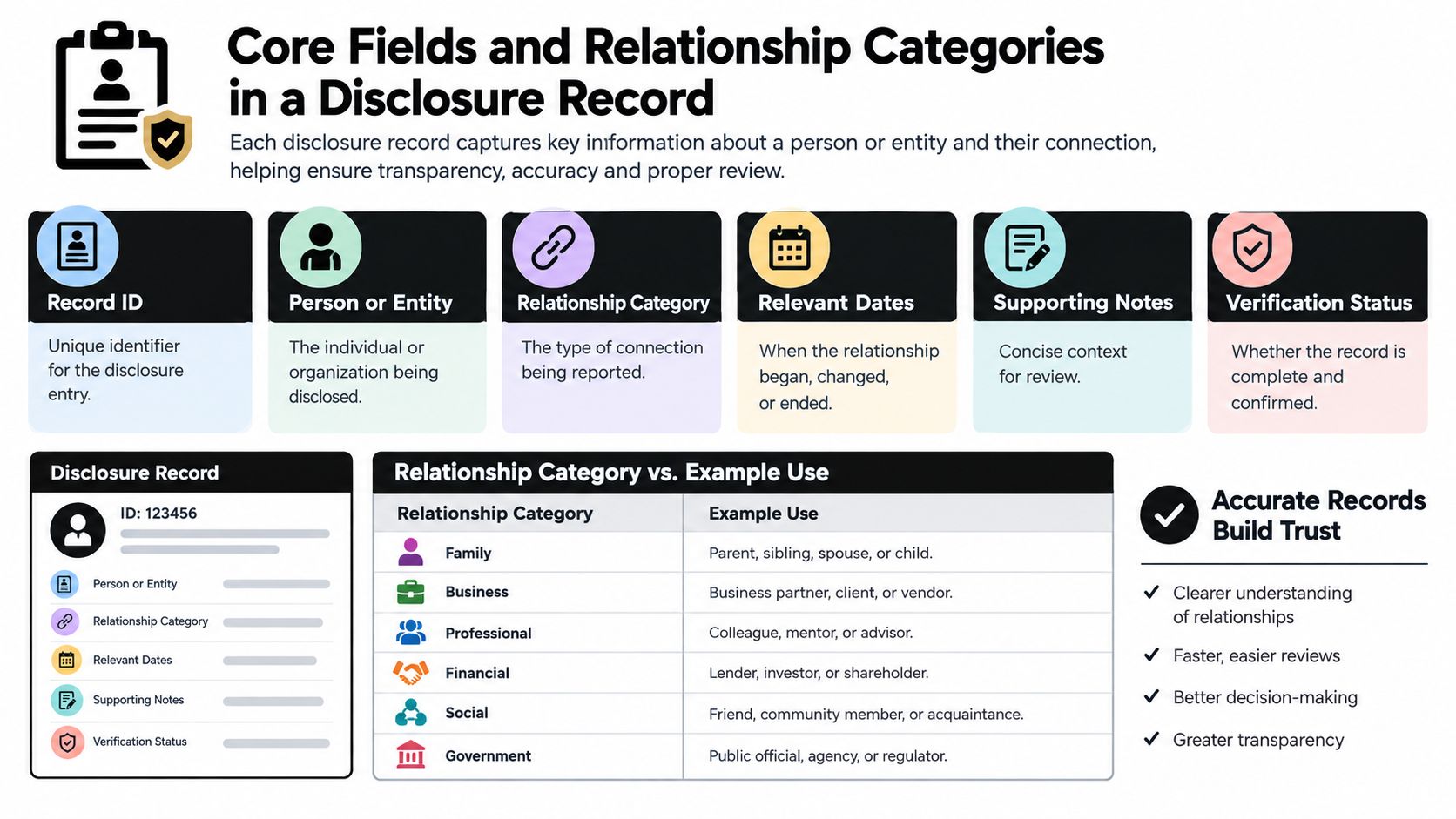
Start with one person and one relationship. That's the unit you're building. For medical continuing education, you need a structured record for every planner, faculty member, author, reviewer, and anyone else who controls educational content, covering all financial relationships with ineligible companies during the previous 24 months with no minimum dollar threshold, as the ACCME rule on identifying, mitigating, and disclosing relevant financial relationships requires. An ineligible company, in this context, is the type of commercial entity whose relationships ACCME requires you to collect and review. If a person has relationships with three companies, you'll typically hold three relationship entries tied to that person, not one paragraph describing all three.
The Minimum Fields and What Each One Does
Work through the record in the order a reviewer reads it. Each field answers a specific question, and skipping one usually creates follow-up work later.
- Individual's identity: Who is reporting? For example, Dr. Maya Lee, listed with the role she holds in your activity.
- Company name: Which company is involved? Record the full company name, not an abbreviation only your team recognizes.
- Relationship type: What's the nature of the connection, such as consultant or speaker? This field drives much of your later sorting.
- Dates or lookback period: When did the relationship occur, and does it fall inside the applicable window? A start date alone won't help if you can't tell whether it ended.
- Content area controlled: What will this person influence? For example, a planner shaping the agenda controls different content than a reviewer checking slides.
- Relevance determination: Has your organization decided this relationship is relevant to the content, yes or no? Leave this blank and the record isn't finished.
- Mitigation action: What did you do about a relevant relationship before the person took on the role? Record the action, not just a checkbox.
- Reviewer: Who made or confirmed the determination? A name here creates accountability.
- Completion timestamp: When was the record submitted and completed? You'll need this to prove timing and to flag expirations.
Why Relationship Categories Must Be Normalized
Normalized means you choose from a fixed list of terms instead of typing whatever comes to mind. ACCME examples include employee, researcher, consultant, adviser, speaker, independent contractor, royalties or patent beneficiary, executive role, and ownership interest. If one person writes "advisory board," another writes "advisor," and a third writes "consulting, advisory," you can't reliably count, filter, or report those entries.
Free text still has a place for brief context. It shouldn't carry the category itself. Think of the category as the label on a folder and the note as a sentence inside it. The label has to match your filing system, or you'll lose track of what's inside once you have many faculty across many sessions. This is the same reason a well-designed abstract submission form structure uses defined fields rather than asking contributors to email unstructured documents.
The Institutional Funding Detail People Miss
Here's where new administrators often get tripped up. Research support counts even when money is paid to or administered by the individual's institution instead of going directly to the person, and ACCME identifies research funding that a principal or named investigator should disclose in its Standards for Integrity and Independence information package. A form that asks only about personal payments will miss an institution-managed grant.
Your record should therefore show the company, the investigator's role, and whether funding was routed through an institution. For example, "Company A, researcher, grant administered by university" tells a reviewer far more than "no personal payments." Keep that relationship in the record for the full review period so your relevance decision rests on complete facts, not on how the payment happened to travel.
Determining Whether a Relationship Is Relevant
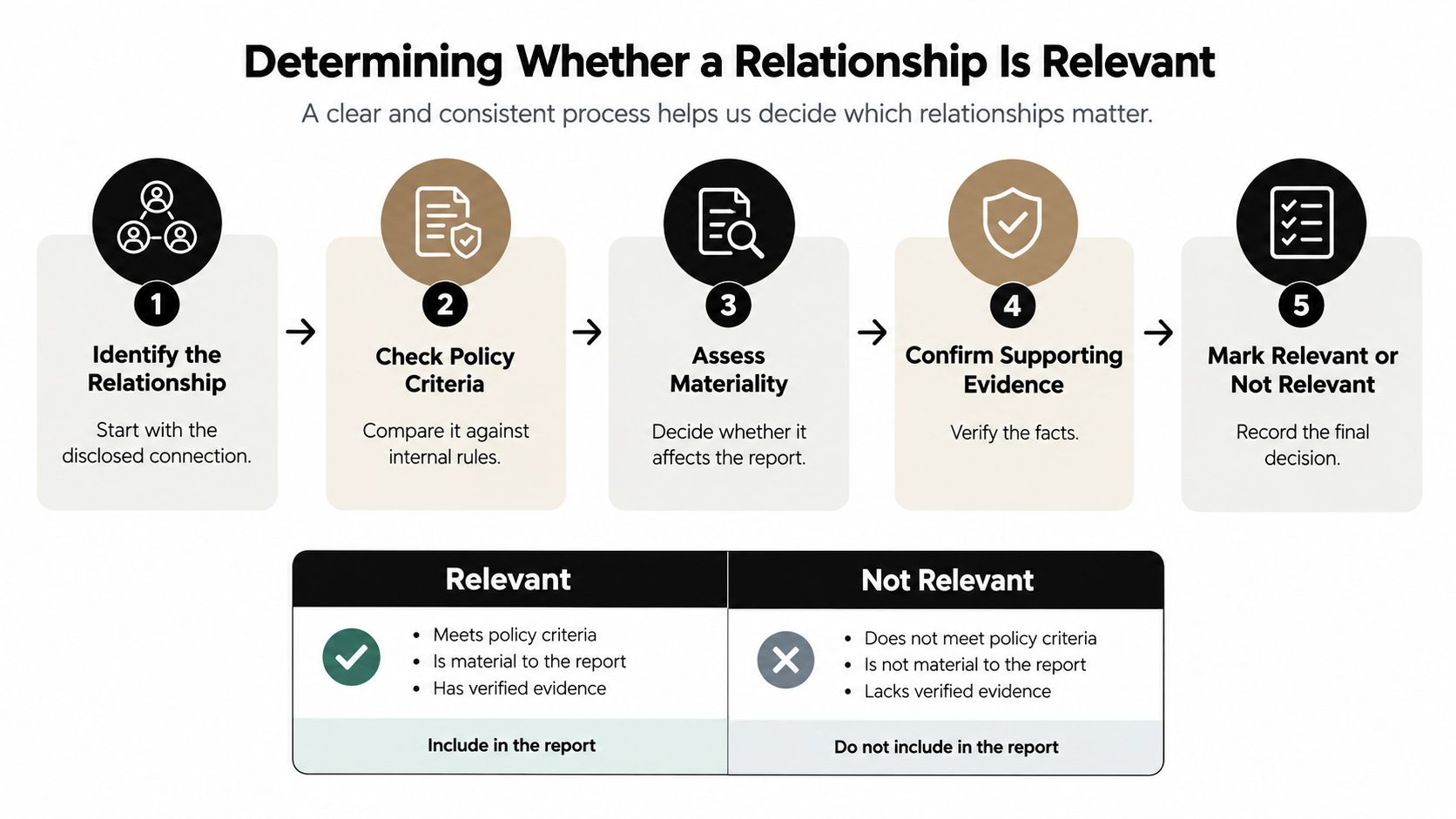
Collecting a relationship and judging it are two different tasks. The speaker reports facts. The provider, meaning your accredited organization, decides relevance. Don't reverse those roles. If you accept a speaker's own "not relevant" checkbox as the final answer, you haven't performed the review your program is responsible for.
The Three Conditions for Relevance
Under the ACCME framework described in the Standards toolkit for accredited continuing education, a relationship becomes relevant when three conditions are all true. First, a financial relationship exists in any amount. There's no small-payment exception at the collection stage. Second, it occurred during the prior 24 months. Third, the education concerns the business lines or products of the company involved.
Apply them in order and write down the result. If any condition fails, the relationship isn't relevant under this test. If all three hold, it is relevant, and you move to mitigation. The decision must happen, and relevant relationships must be mitigated, before the person assumes the controlling role. A planner who has already shaped your agenda can't be reviewed retroactively in any meaningful sense.
Practical rule: Preserve enough structured detail at submission so you can determine relevance afterward, rather than relying solely on the speaker's initial self-assessment.
A Worked Example With Two Relationships
Suppose Dr. Lee will teach a session on diabetes devices. She reports consulting for a company that makes glucose monitors, ending eight months ago. A relationship exists, it's inside the lookback window, and the session concerns that company's product area. All three conditions hold, so the relationship is relevant.
She also reports a speaker role for a company in an unrelated clinical area, also recent. A relationship exists and it's inside the window, but the education doesn't concern that company's business lines or products. The third condition fails, so that relationship is not relevant to this activity. Notice that relevance attaches to the pairing of relationship and content. The same consulting role could be irrelevant to a different session and relevant to this one. That's why the content area field exists.
Mitigation and What Learners See
Mitigation means taking a step to reduce the risk that a relevant relationship influences the education, and recording that step in the record. The specific action depends on the person's role and your program's process. What's not optional is documenting that it happened before the person controlled content.
Learners then receive a disclosure that names the individual, names the ineligible company, identifies the nature of the relationship, and states that all relevant relationships were mitigated. Your internal record supports that public statement. If a learner or reviewer asks how you reached it, you point to the determination, the mitigation action, the reviewer, and the dates. Without those fields, the learner-facing sentence is an assertion you can't substantiate.
Disclosure Rules for Clinical Research Investigators
Clinical research runs on a separate track, so don't carry continuing education rules into it by habit. The FDA framework in 21 CFR Part 54 concerns covered clinical studies, meaning studies an applicant relies on when submitting an application to FDA. The central distinction here is between certification and affirmative disclosure. Those are two different outcomes, and your record must show which one applies to each investigator.
Certification Versus Affirmative Disclosure
For each clinical investigator who isn't a sponsor employee, the applicant must provide either certification that specified disqualifying interests or arrangements don't exist, using Form FDA 3454, or disclosure of those interests using Form FDA 3455, under the text of 21 CFR Part 54 on financial disclosure by clinical investigators. Certification isn't an empty file. It's a positive statement that the listed interests are absent. Disclosure is the opposite path, used when such an interest or arrangement does exist and must be described.
This is also where record design meets broader compliance discipline. If you're new to structuring regulated information, background reading on understanding data compliance requirements can help you see why validation, access control, and retention aren't optional extras. In your system, that translates into a simple rule. An investigator record shouldn't be submittable until it clearly lands on one path or the other.
What Counts as Reportable
The regulation's reportable categories focus on arrangements that could affect study reliability. They include outcome-dependent compensation, where payment is tied to the study result. They also include significant payments of other sorts, such as research grants, equipment, retainers, or honoraria, and significant equity interests in the study sponsor. Equity interest means an ownership stake, so think shares or similar holdings rather than a fee for work performed.
Disclosure also requires describing the steps taken to minimize potential bias. That requirement parallels mitigation in continuing education, but it belongs to the FDA record and the specific study. Don't assume a mitigation note from a conference file satisfies a study obligation. Each context asks its own question, and each record should answer the question its regulator posed.
Data Elements a Compliant Record Should Hold
Build the record around the study, not just the person. At minimum, hold the sponsor, the study identifier, the investigator's identity and role, and employment status, since sponsor employees are treated differently under this framework. Add the certification-versus-disclosure status, the arrangement category, monetary or equity details where applicable, and the bias-minimization measures. Finish with the submission date, the responsible certifier, and retained supporting documentation.
Records must be retained and made accessible to FDA personnel for inspection and copying at reasonable times. Practically, that means your files can't live in one staff member's inbox. Use immutable versioning so edits don't overwrite history, role-based access so only authorized people see sensitive details, and exportable, regulator-ready reports. Add validation rules that block submission when required certification or disclosure fields are missing. If FDA asks for a record, you should be retrieving it, not reconstructing it.
Reviewing and Documenting Disclosures Step by Step
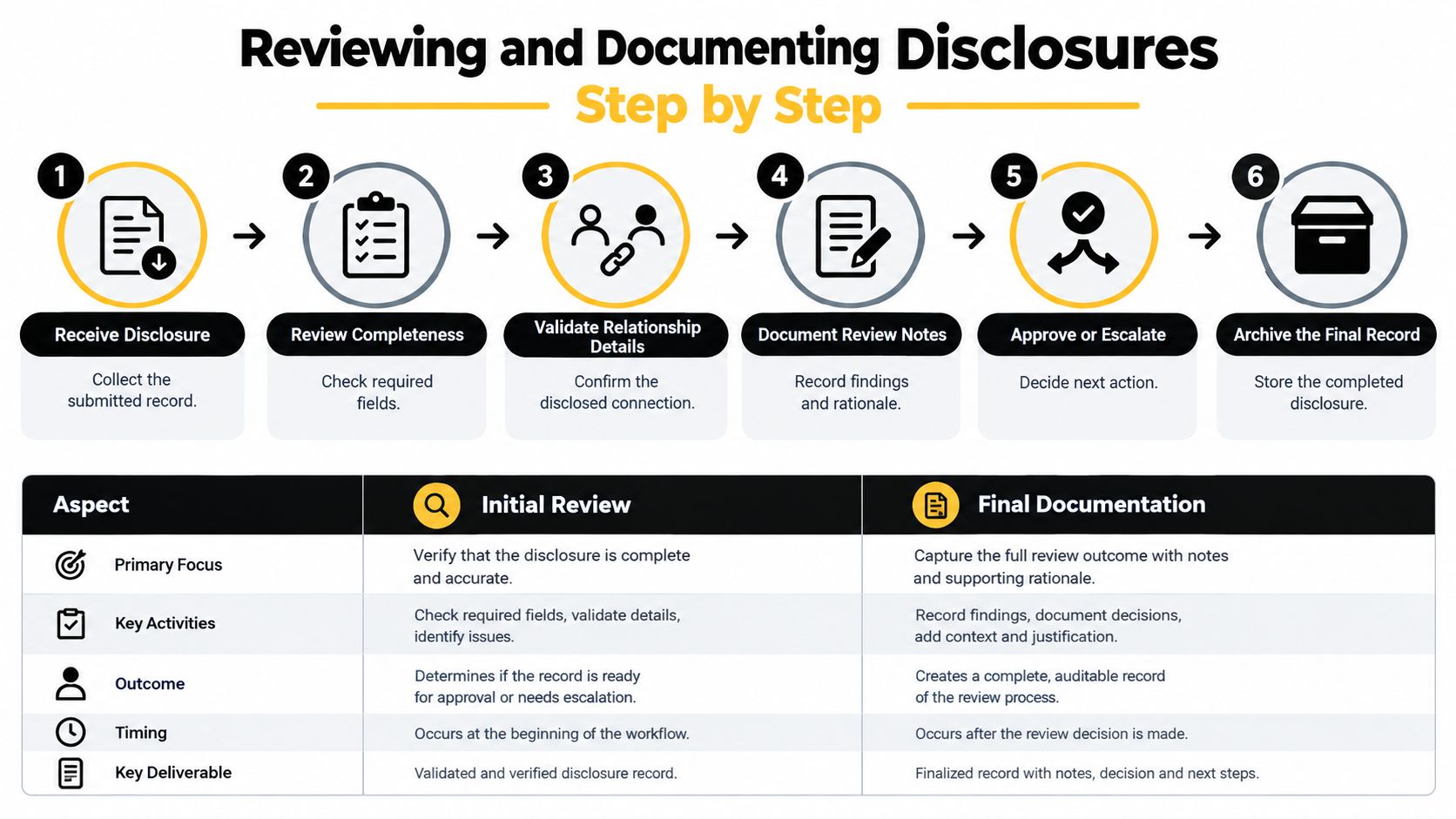
You now know what a record contains and how relevance is decided. The workflow below puts those pieces in order. Follow the sequence, because later steps depend on earlier ones. A final report built on unverified submissions only looks complete.
The Review Sequence From Collection to Final Report
- Collect the initial submission: The person submits relationships through your structured form. The step is complete when you hold a timestamped original. The common error is accepting details by email, where they'll never match your field structure.
- Verify completeness: Check the submission against your required fields. You're done when identity, company, category, dates, and content area are all present. Missing end dates cause the most rework here, so check them first.
- Determine relevance: Apply your criteria to each relationship and record the decision and reviewer. This step is complete when every relationship carries a documented determination, not when the speaker says it looks fine.
- Record the mitigation decision: For relevant relationships, document the action taken before the person assumes the role. A blank mitigation field next to a relevant flag should stop your process.
- Lock and version the record: Preserve the original submission and an auditable decision history. Editing a record without versioning is the error that hurts most, because you can no longer show what changed or when.
Two ongoing tasks run alongside those steps. Flag expired or missing disclosures so they surface before your event, not during it. Schedule annual or event-specific re-attestation, meaning you ask the person to confirm or update their record on a defined cycle. Relationships change, and a disclosure from a past program may no longer describe the person's current situation.
Generating the Final Report and Using It
The last stage produces a report showing disclosure status by session and role. That's the view your team works from. A program chair doesn't need 200 individual forms. She needs to see that Session 4 has three faculty, two cleared, and one still missing a mitigation record. That view directly supports speaker-completion monitoring and pre-event quality control, because outstanding items become visible while there's still time to fix them.
If your review notes live outside the record, they might as well not exist when someone asks for proof.
Treat documentation habits seriously across your compliance work. The same discipline behind keeping psychology CPD reflections audit-ready applies here, since contemporaneous notes with clear rationale are what an auditor can test. Write the reason for each decision when you make it. Six months later, you'll remember the outcome but not the reasoning, and the reasoning is what demonstrates that your determination was considered rather than automatic.
Who Uses Disclosure Reports and for What Purpose
Picture the week before your annual meeting. Your program lead opens the disclosure status report to clear faculty session by session. Most names show complete records with relevance decisions logged. One invited speaker shows a submitted form but no determination. Because your report separates those states, she knows exactly what's missing and who owns the next step. The speaker doesn't take the podium until the review is done.
That scenario shows the first audience clearly. Program staff use the report operationally, to confirm that everyone controlling content has been reviewed before the event. They need status, ownership, and exceptions at a glance. They don't need narrative detail unless a record gets flagged.
Learners, Reviewers, and Regulators
Learners see a different slice of the same record. Before a session, they receive the disclosure naming the person, the company, and the relationship, with the statement that relevant relationships were mitigated. They're not auditing your process. They're deciding how much weight to give what they're about to hear, and context about spotting conflicts in private medical care shows why that judgment matters to audiences well beyond accredited education.
Accreditation and compliance reviewers go deeper. They examine whether you collected relationships for everyone controlling content, whether determinations were made by your organization, and whether mitigation preceded the activity. They're testing your system, not just your forms. In clinical research, regulators may inspect investigator records directly, comparing certification or disclosure status against each covered study. Each audience reads the same underlying record at a different depth, which is why the record must serve both a one-line learner statement and a detailed inspection.
Why Scale Forces Structure
If you think careful structure is excessive for your program size, consider the securities world. The SEC's EDGAR system processes approximately 4,700 filings per day, provides about 3,000 terabytes of data annually, and accommodates an average of roughly 40,000 new filers each year, according to the SEC EDGAR filing count data page. At that volume, unstructured documents would be unusable. Records must be standardized, searchable, and consistently identified, and historical data since 1993 lets readers compare information over time.
Your program is smaller, but the failure mode is identical. Imagine an audit request asking which faculty had relevant relationships for last year's meeting and how each was mitigated. With structured records, you filter and answer in minutes. With scanned forms named "final_v2" in a shared drive, you're reading documents one by one and hoping nothing's missing. The difference isn't effort during collection. It's whether you designed the record for the questions you'll eventually be asked.
Comparing Approaches to Managing Disclosures
You have three realistic ways to manage these records, and none is right for every program. Judge each option against the criteria your workflow demands. Those criteria are field consistency, audit trail, relevance decision logging, re-attestation tracking, reporting, access control, and integration with registration or membership systems. A tool that handles collection but can't log decisions only solves half your problem.
Spreadsheets are where most small programs start, and there's nothing wrong with that at low volume. You control the columns, and staff already know the software. The limits appear when several people edit the same file, categories drift between rows, and you can't show who changed a determination or when. Version history in a spreadsheet tells you a cell changed. It rarely tells you why.
Manual document collection with email follow-up feels familiar because speakers already use email. In practice, it's the weakest option for structure. Forms arrive in different formats, follow-ups scatter across threads, and your status picture lives in one person's memory. It can work for a handful of faculty, but it doesn't scale, and it produces almost no audit trail without extra manual effort.
Dedicated conference or continuing education disclosure platforms are built for the full sequence, from collection through decision logging to reporting by session and role. They enforce required fields, normalize categories, and track re-attestation. They cost more and require setup, so they're hard to justify for a single small event. For organizations managing many speakers, multiple sessions, and continuing education credits, that trade usually reverses. You can review how one such system structures the task in the disclosure management overview.
Disclosure Management Approaches Compared
| Approach | Strengths | Limitations | Best Fit |
|---|---|---|---|
| Spreadsheet | Low cost, familiar, flexible columns | Weak audit trail, category drift, manual reporting | Very small programs with few faculty |
| Manual documents and email | No new system to learn, works anywhere | Scattered records, no status view, hard to audit | Occasional events with minimal review needs |
| Dedicated disclosure platform | Enforced fields, decision logging, reporting, access control | Cost, setup, and configuration effort | Multi-session programs with credits and many speakers |
Read the table against your own constraints. If you run one workshop a year with five faculty, a disciplined spreadsheet with fixed category lists can be defensible. If you're tracking hundreds of contributors across sessions and credit types, manual methods consume staff time on chasing and reconciling instead of reviewing. Be honest about volume, because the wrong fit usually fails through missing determinations rather than loudly. The approach matters less than whether it reliably produces a complete, versioned decision record for every person, every time.
Taking the Next Step with Disclosure Management
Start with an audit of what you already hold. Pull a sample of recent disclosure records and check them against the fields and relevance conditions covered earlier. You're looking for specific gaps, so make a short list as you go. Note any missing fields, free-text relationship categories, undocumented mitigation decisions, and records where the speaker's self-assessment stands in for your determination.
That exercise tells you whether your problem is design or discipline. If your form never asks about institution-routed research funding, no amount of careful reviewing will recover that information. If your fields are sound but relevance decisions aren't logged, your workflow needs a decision step with a named reviewer. Fix the design first. Process fixes built on incomplete fields just produce tidier incomplete records.
What a Configured System Should Support
If your audit points toward dedicated tooling, evaluate it against your actual workflow rather than a feature list. You need collection with enforced fields, status tracking so outstanding items surface early, and reporting that shows status by session and role. You also need configuration, because your review criteria, faculty requirements, and credit rules won't match another organization's exactly.
That's the gap Planstone is built to fill. Planstone supports financial relationship disclosure collection, status tracking, and reporting, and it configures its platform to each program's review criteria, faculty requirements, and credit rules, from the forms contributors complete to the reports staff rely on. Because Planstone's platform manages abstract submissions, speaker tasks, disclosures, and continuing education credits in a single configured platform, your disclosure review sits alongside the rest of speaker preparation instead of in a separate file someone has to reconcile by hand.
Begin by auditing your current records. The gaps you find will tell you whether you need better fields, a stricter process, or a different system.
Be proportionate about the decision. A team with a few speakers and one annual session may not need a dedicated platform, and buying one won't substitute for making determinations carefully. Technology enforces structure and preserves history. It doesn't decide relevance for you, and it shouldn't. That judgment belongs to your organization, recorded by a named reviewer, before the person controls content.
If your audit shows scattered records, free-text categories, or decisions you can't reconstruct, that's your starting point for change. Map your current workflow against the review sequence in this guide, identify the first step that breaks down, and address that step first. Then contact Planstone to review your current workflow and see how a configured disclosure process would fit your program's sessions, faculty, and credit requirements.
If your disclosure records are scattered across forms, inboxes, and spreadsheets, Planstone can help you collect financial relationship disclosures, track completion status, and report on them alongside speaker tasks and continuing education credits in one configured platform. Visit us to review your current workflow and see how your review criteria and faculty requirements would carry through from contributor forms to staff reports.