

Your abstract is ready, but a coauthor hasn't approved the author list, the submission portal still shows a draft, and the call lists a date without an obvious closing time. The immediate question isn't just when the abstract submission deadline falls. It's whether you can complete every required step before the system stops accepting changes.
For conference teams, that same moment determines which submissions can enter review and when program development can proceed. A workable deadline plan therefore needs three things: the exact closing instant, a schedule counted backward from it, and a published rule for anything arriving afterward.
Table of Contents
- Abstract Submission Deadlines at a Glance
- Cutoff Times and Time Zones Authors Must Check
- How Organizers Set the Deadline Window
- Working Back From the Deadline
- Late Submissions, Extensions and Late-Breaking Windows
- Deadline Failures and How to Prevent Them
- Publishing a Deadline Announcement That Works
- Frequently Asked Abstract Deadline Questions
- Confirm Your Deadline Plan Before the Cutoff
Abstract Submission Deadlines at a Glance
An abstract submission deadline is the published closing point for a call. Once it passes, the organizer applies the stated rules to determine which submissions remain eligible for review. The exact cutoff also determines whether authors can still edit, withdraw, or submit work through another route.
Deadline labels signal different kinds of access. A regular or general deadline closes the standard intake. An early-bird milestone offers an earlier submission opportunity, while a late-breaking window may be limited to findings that became available after the general deadline. A separate site-close date may lock edits or author information.
Published abstract deadlines and what happens after
Published schedules show how organizers define the cutoff and any route that remains afterward. The dates below are announced schedules, not guarantees that a call will remain unchanged.
| Conference | Deadline type | Closing time | After the deadline |
|---|---|---|---|
| AACE 2027 Annual Meeting | Regular abstracts | December 1, 2026, 11:59 p.m. Eastern Time | No exceptions; submission-site access closes |
| MDA 2027 | Standard abstracts | December 14, 2026; closing hour not stated in the cited guidance | Late-breaking portal scheduled to open January 18, 2027 |
| MDA 2027, same published guidelines | Late-breaking abstracts | February 18, 2027; closing hour not stated in the cited guidance | No submissions afterward; eligible data must have become available after the general deadline |
| DDW 2027 | Abstract site | December 2, 2026, 9:00 p.m. Eastern Time | No edits to abstracts or author strings |
| SCAR 2026 Open Science Conference | Abstracts | February 28, 2026, 23:59 UTC | Fixed UTC cutoff; exception policy not stated in the cited notice |
| Tree of Life Web Project 2026 | Abstracts | May 26, 2026; closing hour not stated | Post-deadline eligibility not stated in the cited instructions |
| Purdue PBM2025 | Abstracts | April 28, 2025; closing hour not stated | Post-deadline eligibility not stated in the cited dates page |
The schedules distinguish a hard closure from a staged intake. For example, MDA's published guidance lists a late-breaking window after its standard deadline, with eligibility limited to data that became available later. That route does not imply that standard abstracts can be submitted late.
When a notice gives a date but no closing hour, the cutoff remains unclear. “Not stated” does not establish a midnight deadline or an extension. Authors should seek clarification before relying on a particular closing time, while organizers should publish the cutoff and any remaining submission route together.
Cutoff Times and Time Zones Authors Must Check
A submission due at 9:00 p.m. Eastern Time may close after midnight for authors elsewhere. The organizer's stated time zone determines eligibility, not the clock on an author's computer.
The DDW 2027 submission guidelines state that submissions close December 2, 2026, at 9:00 p.m. Eastern Time. They also say abstracts and author strings cannot be edited afterward. The closing moment is therefore both the submission cutoff and the editing cutoff.
Read the time-zone convention literally
Check the convention in the notice before converting the deadline:
- Local civil time: Apply the location's time-zone rules for the deadline date. A summer-time abbreviation may not apply in winter.
- Eastern Time: Use the offset in effect on the specified date, rather than assuming a fixed offset year-round.
- UTC: Treat the stated time as the reference point, then convert it to the author's location.
- Anywhere on Earth: Use the convention's defined end-of-day cutoff, not your own local midnight.
Keep the organizer's original wording beside the converted time. That makes it easier to resolve differences between calendar displays and the published rule.
A worked conversion
DDW's stated cutoff of 9:00 p.m. Eastern Time on December 2, 2026 converts to 2:00 a.m. UTC on December 3, 2026. At a fixed offset of UTC+2, that same instant is 4:00 a.m. on December 3. Central European winter time is UTC+1, so the local time there is 3:00 a.m. on December 3.
The instant is identical worldwide; the calendar date can differ. Authors should set reminders using the time zone and date that apply to their location.
Plan to submit at least a day early. That buffer is an internal safeguard, not an extension or grace period. Work backward from the converted cutoff, leaving time for approval and a final check that the submission is complete.
Finally, confirm what must happen before the cutoff. Starting an upload may not count as a completed submission; look for the required confirmation and whether the deadline includes the stated closing moment. If the call gives a date but no hour or time zone, ask the conference office for the exact cutoff in writing before setting the team's final approval schedule.
How Organizers Set the Deadline Window
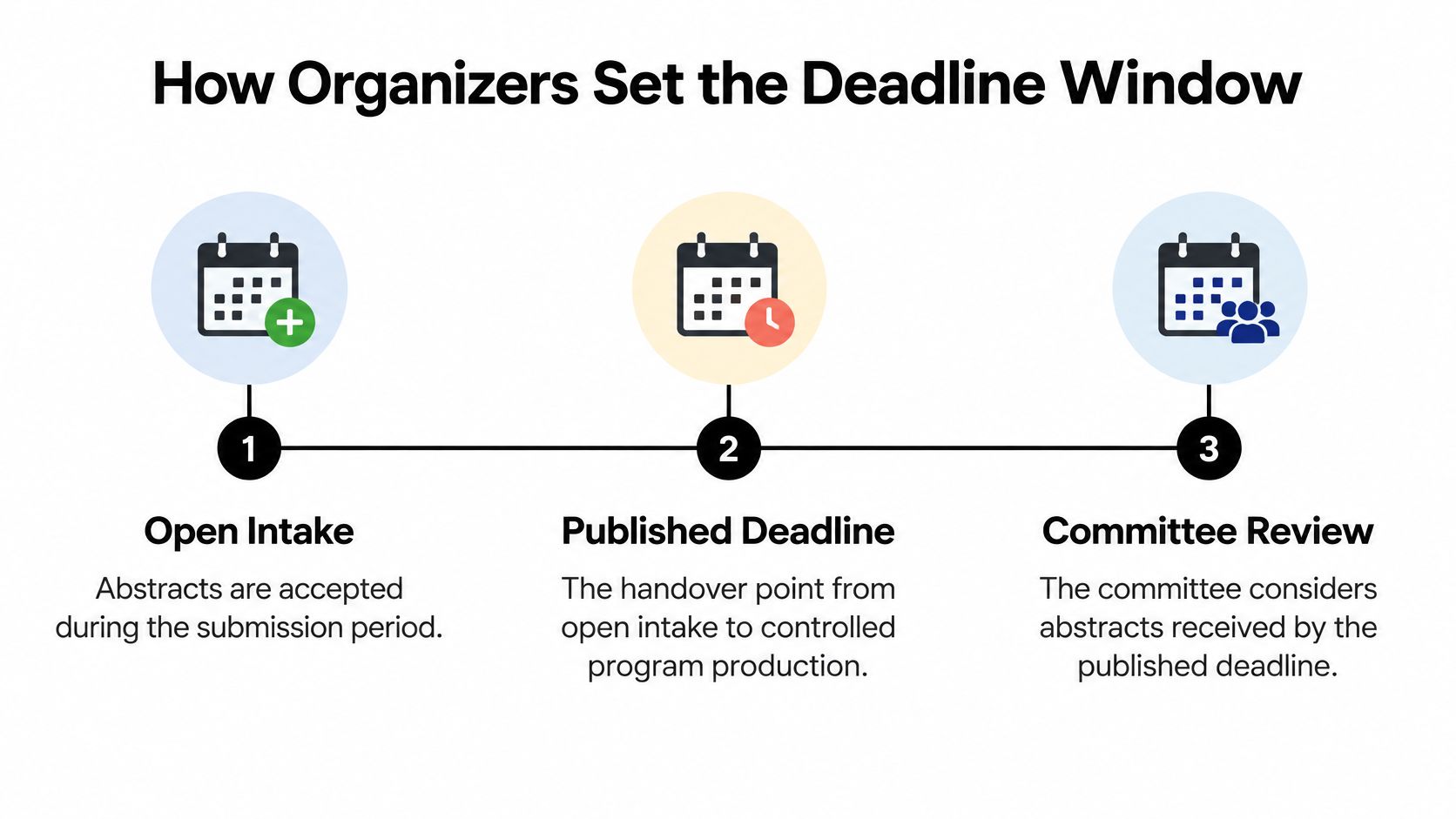
An abstract call closes at a specific point: the handover from accepting submissions to producing the program. Before then, authors can submit under the call's rules. Afterward, organizers work with the submissions received to assess relevance, conduct reviews, and build the program.
The Academic Conferences and Publishing International submission guidance says the conference committee considers abstracts received by the published deadline when deciding whether proposed contributions are relevant. The cutoff therefore defines which submissions fall within the call.
Build the window around downstream work
A deadline window connects the call to the work that follows:
- Call opens: Authors receive the requirements and can prepare submissions.
- Early milestone: Organizers may use an earlier date for preferential registration or an early review stage.
- Final cutoff: Ordinary intake ends according to the published eligibility rules.
- Review and notification: Reviewers assess submissions, and organizers communicate decisions.
- Registration and preparation: Accepted contributors complete participation and presentation requirements before the event.
The Asian Conference on Education FAQ lists July 31, 2026 as its final abstract deadline. That date marks the end of the published submission window; it does not, by itself, specify when decisions will be sent or how much time accepted authors will have to prepare.
Balance participation against production certainty
An earlier cutoff gives committees more time to resolve review disagreements, confirm presenters, and build sessions. A later cutoff gives authors longer to prepare, while leaving organizers less time for those tasks after submissions close.
An early-bird milestone can accommodate both interests without changing the final cutoff. The announcement should state what the earlier date affects, such as review timing, registration, or eligibility.
Set the window by working back from the event's program requirements. Check that the time between opening, each submission milestone, decisions, speaker requirements, and the event supports the work assigned to each stage. The right window is the one that gives authors a clear route to submit and leaves organizers time to complete the promised process.
Working Back From the Deadline
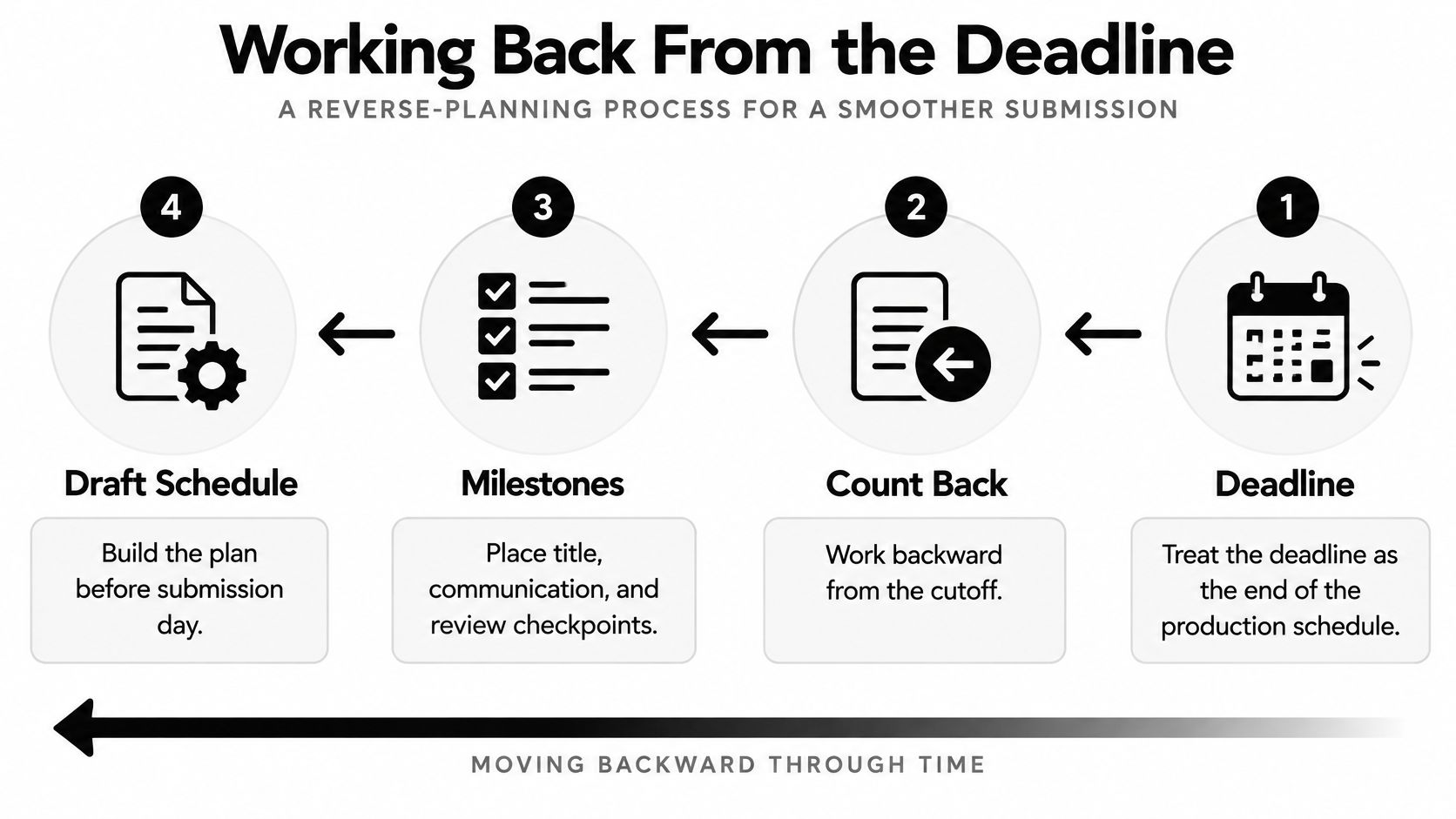
A submission deadline is a fixed closing instant; the work needed to meet it should be scheduled in reverse. Authors need time to draft and revise, while reviewers and approvers need clear handoff points before the final upload.
The European Centre for Disease Prevention and Control abstract guide sets out a sample schedule: agree on the title and a single communication objective eight weeks before submission, prepare a first draft six weeks before, revise from six weeks to one week before, and complete internal approval in the final week. The guide allows up to five working days for routine coordinator comments and 48 working hours during the final week.
Assign decisions, not just dates
- Set the external closing instant. Record the organizer's stated time zone and convert it to the author's local time. Use the actual cutoff as the endpoint.
- Fix internal milestones. Schedule author confirmation, coauthor review, compliance checks, and any institutional or committee approval. Complete scientific review before the final formatting check, so substantive changes do not invalidate an approved upload.
- Name the reviewer for each stage. Assign a person and a response deadline. A shared inbox can distribute messages, but someone must own the decision about readiness.
- Record versions and approvals. Keep timestamps, reviewer assignments, unresolved comments, and approval status together. Tie each approval to the version it covers.
- Freeze the approved content. After approval, allow only controlled corrections with a named owner. Changes to findings or interpretation require renewed approval.
Reverse-planned abstract production schedule
The ECDC schedule can be translated into a working calendar. Add actual dates based on the published cutoff.
| Milestone | Timing before the deadline | What is finalized |
|---|---|---|
| Title and single overriding communication objective | Eight weeks | Scope agreed before drafting |
| First full draft | Six weeks | Methods, findings, and conclusions available for review |
| Iterative revision | From six weeks to one week | Coordinator comments addressed within the agreed turnaround |
| Final internal approval | Final week | Approval recorded and remaining comments resolved |
| Post-deadline exception | After the published cutoff, only if permitted | Limited to urgent or newly available findings |
The ECDC exception provisions concern urgent or newly available public-health findings, not ordinary unfinished drafting. That distinction helps organizers assess whether new findings arose late or an existing abstract missed an approval step.
For the broader submission process, see Planstone's guide to conference abstract submission. A separate perspective on conference planning examines making conference spend deliver real engagement.
Use this accompanying video as an additional planning resource.
Before circulating the schedule, confirm that each reviewer can meet the assigned turnaround. A milestone is useful only if the person responsible can act by its date.
Late Submissions, Extensions and Late-Breaking Windows
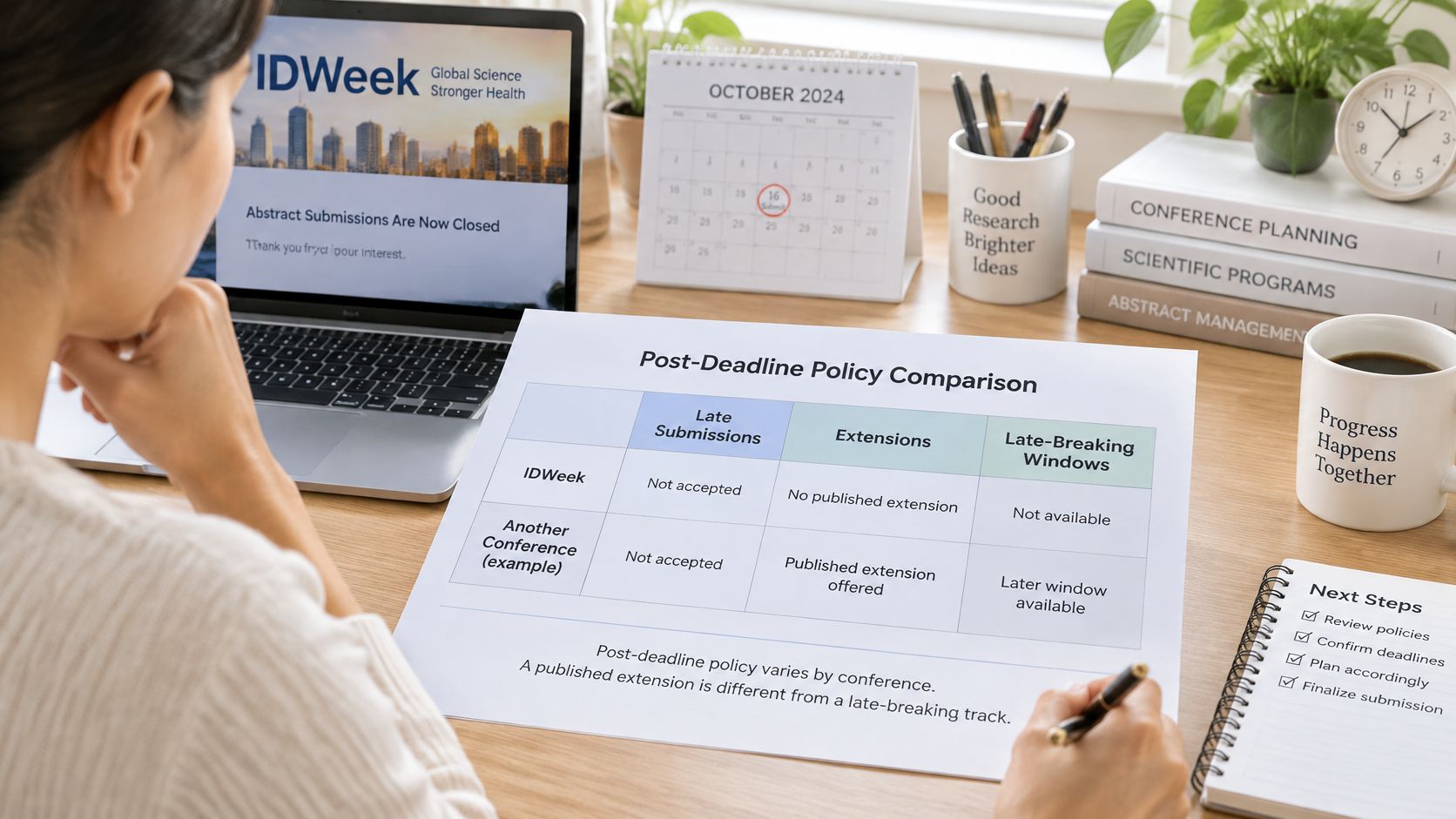
A submission portal still open after the announced cutoff does not, by itself, give authors extra time. A formal extension changes the deadline. Discretionary consideration leaves the decision to the organizers. A late-breaking track has its own eligibility rules.
Post-deadline routes by conference
IDWeek's abstract guidance says it will not accommodate completion after the deadline and requires coauthor approval before submission. The sourced examples below show how formal extensions differ from a separate late-breaking intake.
| Conference | Published rule | After the deadline |
|---|---|---|
| IDWeek | Regular abstract deadline | No completion afterward; coauthor approval is required before submission |
| MDA 2027 | Standard deadline followed by a separate late-breaking intake | New-data requirement applies; work already presented, published, or accepted elsewhere is excluded |
| TECO-2024 | Extended to May 12, 2024 | Formal extension of the regular deadline |
| INFORMS 2024 International Conference | Extended to March 20, 2024, 11:59 p.m. EST | Formal extension of the regular deadline |
A formal extension changes the closing moment for authors who remain eligible under the call. A late-breaking track instead limits who can submit, often through conditions on when findings became available or whether the work has appeared elsewhere. Check the relevant edition's full call before relying on either route.
An extension can also shift work for organizers. Additional submissions may affect reviewer assignments, notifications, and program preparation. If the deadline changes, publish the resulting schedule alongside the new cutoff.
Check eligibility before requesting an exception
- Is there a formal extension, or only a late-breaking track? An extended general call may accept ordinary eligible abstracts. A restricted track may not.
- Did the relevant data become available after the regular deadline? Record when the findings became available and explain which results could not have been included earlier.
- Has any part of the work been presented, published, or accepted elsewhere? Check the track's restrictions before asserting eligibility.
A portal that accepts an upload does not necessarily mean the committee will accept the abstract for review.
If no published route applies, contact the conference office without assuming an exception will be granted. Include the submission category, data-availability date, prior-presentation status, and reason for the request.
For organizers, an exception policy should name the decision-maker, the evidence authors must provide, and the possible outcome. State whether eligible late work can receive ordinary consideration, restricted presentation consideration, or no consideration.
Deadline Failures and How to Prevent Them
A finished document can still become an incomplete submission. The preventable problem is leaving the upload, author verification, disclosures, or final submission action until the portal is about to lock.
Technical compliance also requires more than a word count. The Prevention Research 2026 submission guidelines permit 2,800 characters including spaces, approximately 400 words, prohibit tables and figures, require relevant conflict disclosures, and require abstracts to omit identifying information for blind review.
Deadline failures, causes and prevention
| Failure | Likely cause | Prevention |
|---|---|---|
| Submission locked at the deadline | Uploads and author details left until the final hour | Complete uploads and author details before the final submission day |
| Abstract rejected before review | Word or character count exceeds the applicable limit | Count characters including spaces in the portal, not only in the drafting document |
| Abstract rejected for disclosures | Required conflicts not declared for contributors | Collect disclosures alongside author details |
| Blind review failure | Author or discussant names remain in the text | Remove identifying information before uploading |
| Wrong author string locked | Contributors assume author details can be edited later | Verify spelling, order, affiliations, and presenting-author designation at internal approval |
| Missed internal approval | No approval recorded for the submitted version | Record version-specific approval status and timestamps |
Use the conference's actual counting rules. A word processor's displayed word total won't resolve a character limit, and a character count that excludes spaces won't satisfy a limit that includes them.
For comparison, DDW's published rules distinguish the title field from the abstract body and exclude tables and images from the text allowance. That doesn't make those exclusions transferable to another conference, especially one that prohibits those elements entirely.
Check compliance in the right place
Prevention Research requires real or perceived conflicts to be disclosed for chairs, organizers, discussants, presenting authors, and coauthors. Collecting only the presenting author's declaration therefore won't satisfy that call.
Blind review creates a separate requirement. Contributor identities may belong in designated author fields while remaining prohibited in the abstract text. Don't remove required administrative information from the whole submission because the review copy must be anonymous.
Planstone's abstract submission form guide is a useful companion when deciding which requirements belong in structured fields. Keep author information, disclosures, scientific content, and file instructions distinct so staff can check each requirement deliberately.
Final submission check: Compare the portal preview with the approved draft, confirm the submission status, and save the receipt before leaving the system.
A saved draft isn't proof of submission. An uploaded file isn't enough if required fields remain incomplete, and an approval email doesn't prove that the approved version reached the portal.
The practical protection is a complete, compliant submission accepted by the site before closure, supported by its confirmation record. Starting early provides time to correct problems; it doesn't replace the final status check.
Publishing a Deadline Announcement That Works
A deadline announcement must explain what authors need to complete, not just when intake ends. The BMJ guide to conference abstracts notes that deadlines can fall as much as six months before an event, that some systems don't permit edits after submission, and that review decisions may take several months.
Publish a single authoritative specification:
- Closing instant: State the exact time and time zone alongside the date.
- Abstract type: Identify permitted categories and any category-specific windows.
- Length limits: Explain whether spaces, headings, tables, or captions count.
- Required fields: Identify information needed for a complete submission.
- Authorship and disclosures: Explain approvals, contributor details, and declarations.
- File rules: State permitted formats and whether attachments are allowed.
- Correction policy: Explain editing, withdrawal, and post-submission amendment rules.
- Notification timing: Give the expected decision date or published review timeframe.
Make completeness checkable
For medical and scientific programs, require a self-contained objective, methods, findings, and conclusions. Reviewers should be able to identify what the authors investigated, how they investigated it, what they found, and what they concluded.
Use the call for abstract guide to connect the announcement with the submission requirements. Keep policy wording consistent across the call page, reminder emails, and portal instructions.
Add automated reminders, validation at entry, and confirmation receipts. If amendments are permitted, define the scope and authorization process so corrections don't become an unannounced reopening of the call.
Frequently Asked Abstract Deadline Questions
Can I edit my abstract after I submit it?
Only if the conference's system and policy allow it. DDW prohibits changes after site closure. AACE closes submission-site access at its deadline with no exceptions, so treat the submitted version as final unless the call says otherwise. Other systems may stop editing as soon as an abstract is submitted.
Check the correction policy before uploading. A successful submission does not guarantee that you can replace or amend it later.
How long until I hear whether my abstract was accepted?
Follow the notification timetable in the call. Vienna publishes a relatively short review turnaround, while BMJ warns that some decisions take months.
If the organizer gives no notification date, ask before making commitments that depend on acceptance.
If a deadline is extended, does it apply to everyone?
A published extension applies to the call or categories named in the announcement. It does not automatically change deadlines for other submission tracks, editing windows, or speaker requirements.
Rely on the official notice rather than a verbal assurance or an unchanged portal display. Keep the announcement with your submission records.
Can a regular abstract still be submitted after the deadline?
Don't assume so. A hard closure can end ordinary eligibility, while a separate late-breaking route may accept only qualifying new findings.
Check the extension, data-availability, and prior-presentation rules before requesting consideration. An unfinished regular abstract does not qualify as late-breaking because its authors missed the cutoff.
Confirm Your Deadline Plan Before the Cutoff
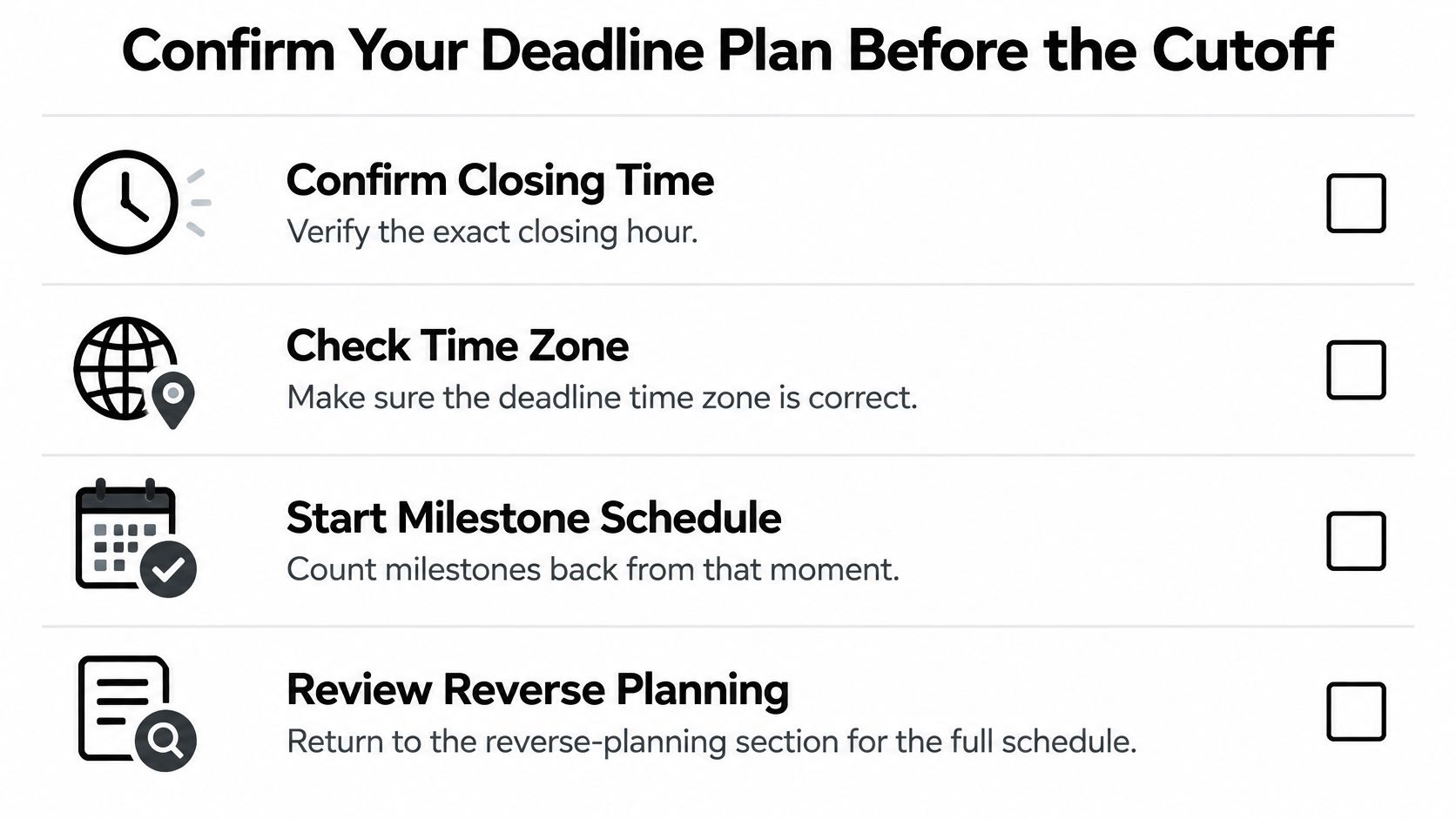
Confirm the closing time and time zone today, then start the milestone schedule counted backward from that instant. Assign someone to verify the final portal status and preserve the confirmation receipt with the submitted content.
Use the reverse-planning schedule for approvals, the cutoff-time guidance for conversion, and the late-submission eligibility checks if new findings arrive after ordinary intake closes. Keep the organizer's original policy wording with those records.
Use this checklist when assigning the final preparation tasks.
For teams coordinating multiple calls, our abstract management module brings submission, review, and session building into one workflow. We configure the platform around each program's review criteria, faculty requirements, and credit rules. Compare the current service details with your call's specific requirements before relying on any particular feature or workflow.
Planstone offers configurable abstract management that connects collection, review, and development of accepted work into sessions. Visit Planstone to discuss how your published deadlines, review criteria, and program requirements can fit into a coordinated conference workflow.