
Abstract submission is the formal, deadline-bound transfer of a short standalone study summary, plus author, format, and declaration data, into a conference review process. If the summary is ready but the required fields, presentation choices, or declarations aren't, is the submission really complete?
For association staff, that question separates collecting documents from managing a scientific program. For first-time authors, it explains why a strong study can still need corrections before reviewers assess its scientific merit.
Table of Contents
- What Abstract Submission Is For
- Word Limits and Fields Reviewers Expect
- How to Submit an Abstract Step by Step
- How Committees Screen, Score, and Keep Review Fair
- How Accepted Abstracts Become Sessions
- Acceptance Rates and Later Publication
- Set the Call Before Authors Start Writing
- Abstract Submission Questions Authors Ask
What Abstract Submission Is For
Abstract submission means sending a short account of a study, proposal, award entry, or grant application, together with the information needed to evaluate and administer it. It isn't the same as uploading a manuscript. Reviewers may never receive the full paper, so the abstract must explain the question, approach, findings, and significance without depending on another document.
Say a clinical team has evaluated a change in patient care. The submitting author enters the summary, adds collaborators and affiliations, names a presenter, and requests consideration for either an oral presentation or a poster. What looks like a writing task is also the creation of a record that different people will use for different decisions.
The relationship between the summary and its supporting information is easier to see as a connected record.
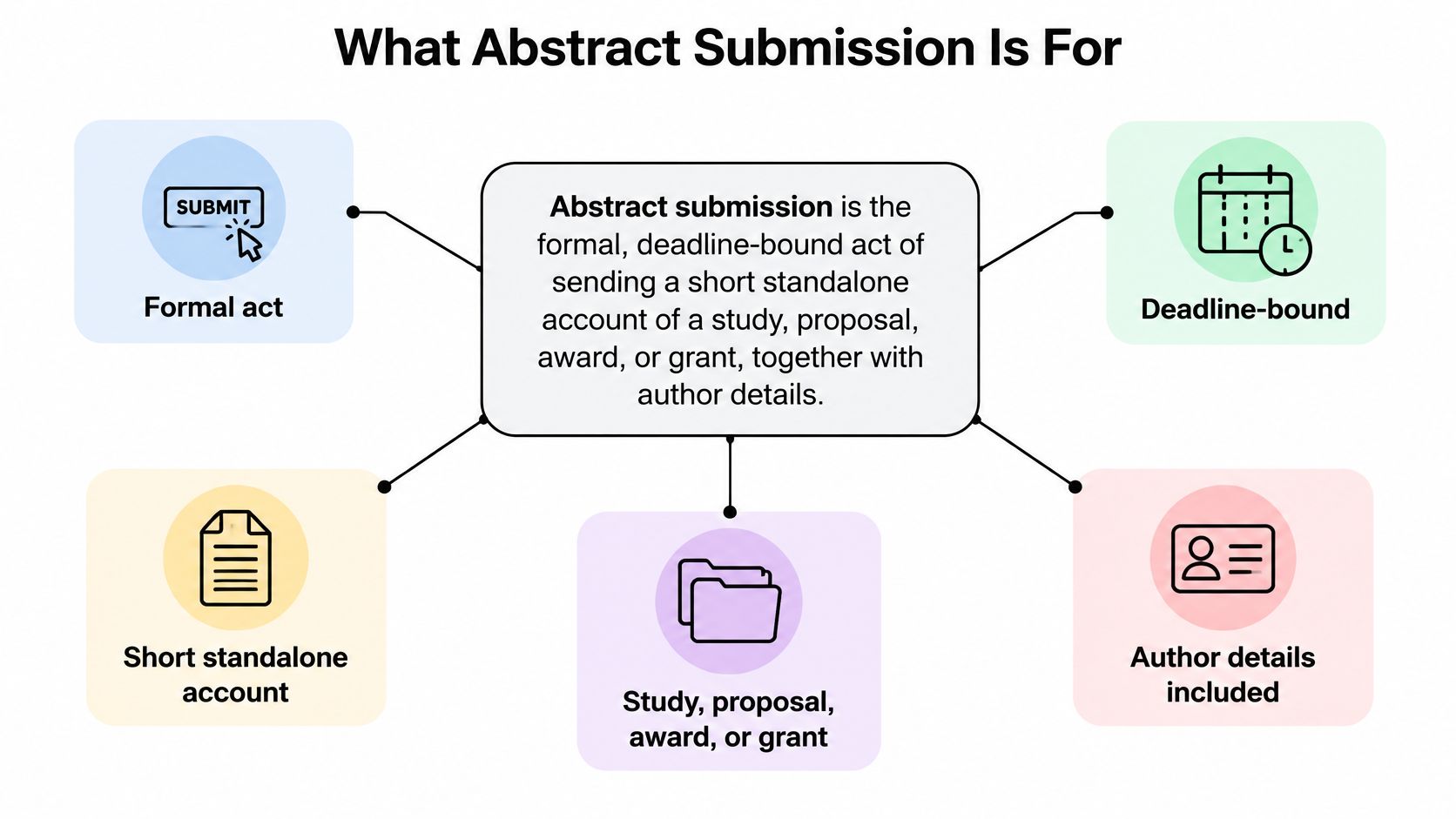
One record serves different people
The author is asking for an opportunity to share work. The presentation preference matters because the team may need to prepare slides, produce a poster, or arrange for a colleague to present.
The reviewer needs comparable evidence. A polished conclusion isn't enough if the summary leaves out how participants were selected or what the study found.
The organizer needs information that can become a program. Staff use the accepted record to group topics, plan rooms, identify presenters, prepare correspondence, and connect faculty requirements to the appropriate educational activity.
Treat the abstract as a scientific summary inside an operational record, not as an attachment that staff must repeatedly re-enter.
The record changes status, not identity
A well-designed process preserves that record as it moves through the meeting. The call establishes the requirements, staff screen for compliance, reviewers assess eligible work, and the committee assigns decisions and presentation formats.
Accepted work then needs a place in a timed session. Author identities, presenter details, reviewer decisions, and program information should remain connected without exposing information to people who shouldn't see it.
The conference outcome also needs a boundary. Rejection doesn't necessarily end the research, and acceptance doesn't mean a journal has published it. Authors and organizers should treat later manuscript publication as a separate milestone.
Before anyone drafts an abstract or opens a call, the most useful starting point is the event's actual length and formatting rules.
Word Limits and Fields Reviewers Expect
Abstract limits and format gates vary by call
| Call | Length | Structure rules | Author choices and gates |
|---|---|---|---|
| ASA Conference on Statistical Practice 2024 posters | 800–1,200 characters | Poster abstract | Character window, not a word cap |
| IASC-ARS Interim Conference 2024 | Maximum 300 words | Event-specific form | Hard word maximum |
A call sets the boundaries for the abstract as a structured record. Check the live instructions for the length limit, required fields, formatting restrictions, and presentation options. A word limit and a character limit are different gates: the ASA poster call sets a character window, while the IASC-ARS call sets a maximum word count. A draft can be strong and still fail a format check if it exceeds the limit or uses a prohibited structure.
The accepted format also shapes how reviewers read the work. Some calls use separate fields; others ask authors to provide continuous prose. Follow the call's own directions rather than assuming a familiar abstract template applies.
Capture evidence in predictable places
Reviewers need enough information to judge the work. The reporting guidance on informative abstracts identifies six core elements across study types and describes PRISMA's 12-item abstract checklist for systematic reviews.
Those core elements are:
- Study design: Identify what kind of investigation was conducted.
- Objectives: State the question the investigators intended to answer.
- Eligibility: Explain who or what could be included.
- Participant or study counts: Report the scope of the evidence.
- Primary results: Give the main outcome with a measure of precision.
- Interpretation: Explain what the findings support.
A form can collect these elements separately even when the abstract must appear as continuous prose. Structured collection and structured presentation aren't the same thing. Think of the form as a set of labeled compartments: it helps authors supply each kind of information, while the final display may combine those answers into a narrative.
Conditional questions can make the record fit different study types. A trial submission may call for information about allocation, blinding, interventions, and adverse events. A review submission may instead ask about databases, search dates, bias-assessment methods, synthesis details, and limitations. Authors should answer the fields relevant to their work rather than forcing every project into identical prompts.
Keep completeness separate from merit
Before submission, check required fields, prohibited formatting, and the correct count. Make any error message specific, such as identifying a missing results field, so the author knows what to fix.
A completeness indicator can help reviewers spot missing reporting, but it is not a scientific-quality score. A fully completed form can describe weak methods; an incomplete one can describe promising work that needs correction.
Format gate: Return a noncompliant submission for correction under the published policy before assigning scientific scores.
How to Submit an Abstract Step by Step
What turns a draft into a submission reviewers can assess? Treat the abstract as a structured record: its text, author details, declarations, and selected track all need to match the live call. Follow these steps in order, and save the submitted version.
Confirm the live call. Check the deadline and time zone, eligible categories, word or character limit, and presentation formats before drafting. Track deadlines may differ, so check the live call for each track rather than relying on a saved calendar entry.
Create the submitter account. Enter the title, authors, presenter, and affiliations as requested. Have collaborators confirm their names and institutional details before submission.
Choose the category and presentation preference. Match the category to the work's methods and findings. A format request is a preference unless the call says otherwise.
Enter the text and check the count. Complete the required fields, then review the system preview. Symbols, formatting, and paragraph breaks can change when text is pasted.
Complete required declarations. Address originality, publication status, permissions, and financial disclosures where the form requires them. Confirm these details with the relevant coauthors before the deadline.
Inspect the reviewer-facing version. Check for identifying names, figures, headings, or references that the call prohibits. Make sure results and conclusions remain intact after trimming.
Submit and save evidence. Keep the confirmation and an exact copy of the submitted version. A saved draft does not confirm that the submission went through.
Use the permitted revision window. Check whether edits require resubmission or staff approval. Keep ethics documentation and authorship agreements with the project record.
A deadline checklist can help coordinate author approvals, account access, and the final submission instead of relying on a calendar reminder alone. Use this abstract submission deadline checklist to organize those steps.
Acceptance is not the same as publication. Keep the submitted record and any later revisions distinct, and check the call for what acceptance includes.
How Committees Screen, Score, and Keep Review Fair
A fair decision starts with a clear record of how an abstract moved from eligibility checks to scientific review and program selection. Keeping these stages distinct helps staff find errors and explain decisions to authors.
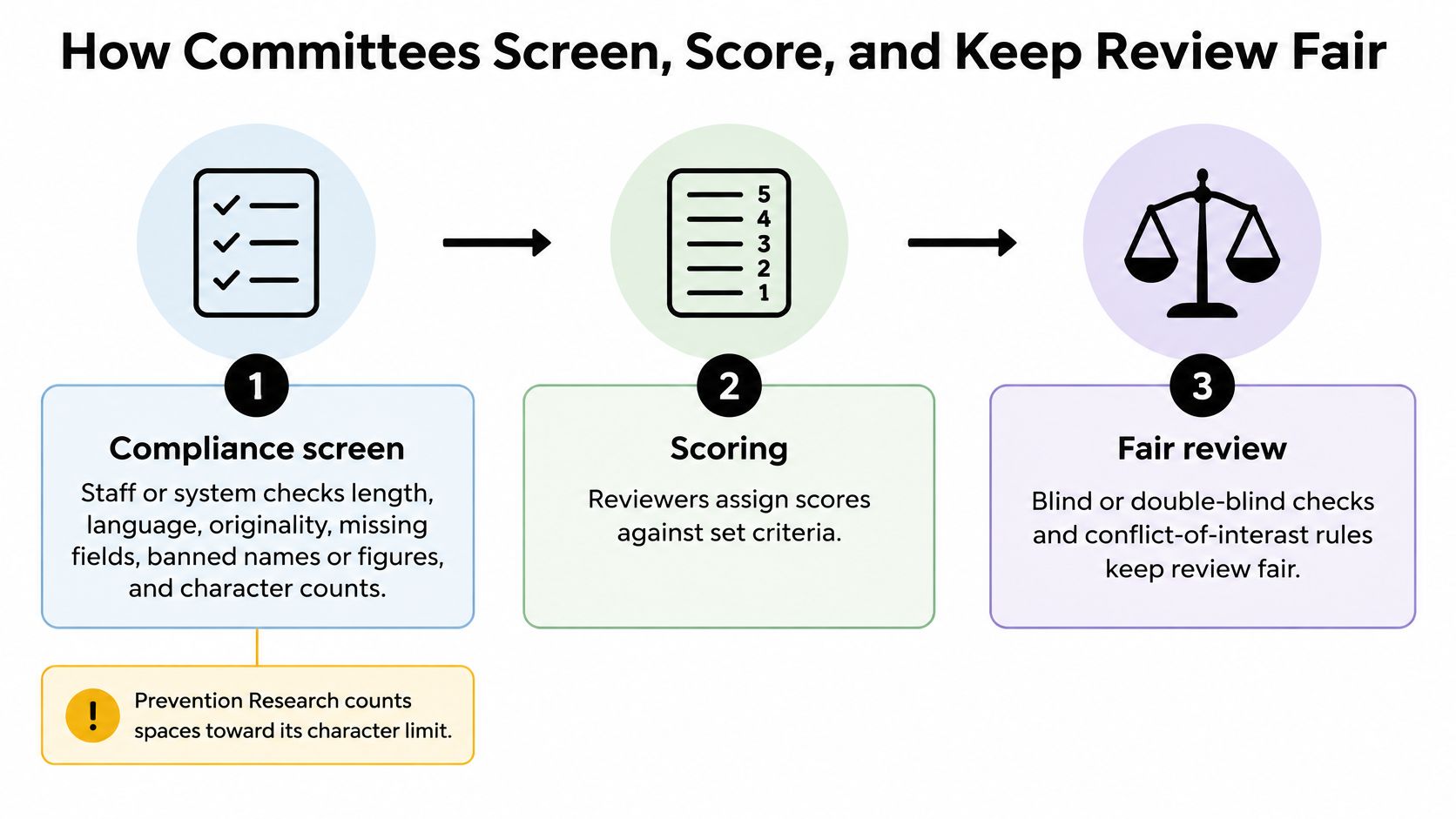
Separate the review stages
Compliance screen. Staff or the submission system check the published call's length limit, required fields, language rules, originality declarations, and formatting restrictions, such as bans on tables or figures. They should also remove names from the reviewer-facing record when blind review is required. A format gate is like checking a form before it reaches the committee: it catches incomplete or ineligible records without confusing those issues with research quality.
Blinding. Keep author and presenter identities available to authorized organizers but out of the reviewer-facing record. Check exported files and attachments as well as form fields, since an uploaded document may still reveal a name.
Scoring. Assign qualified reviewers to defined criteria. Manipal MQCon uses novelty, scientific rigor of methodology, translational value, and clarity of presentation. Explain what strong and weak performance mean for each criterion before reviewers begin, so scores refer to shared standards rather than personal expectations.
Reconciliation. Resolve conflicting assessments and record the reason for accepting, rejecting, or redirecting an abstract. A wide score gap calls for discussion and examination of the comments, not automatic averaging.
Notification. Tell authors the decision, assigned format, response requirements, and next action. Track acceptance separately from the author's confirmation that they will present.
A documented peer review process can set out how the committee handles conflicts of interest, reviewer reassignment, and escalation when assessments disagree.
Blinding isn't a complete equity policy
Removing names reduces one source of bias, but it does not erase differences in access to mentoring, language support, fieldwork, travel funding, or reliable internet. The Oxford repository paper on bias in scientific communities discusses bias alongside structural concerns such as parachute science and unequal access to fieldwork.
Ask reviewers to distinguish difficult writing from weak methods. A small, carefully designed study should be assessed on its methods, not penalized because another team had more resources.
Publish language policies before the call opens, including whether plain-language summaries or multilingual text are allowed. Plan accessible presentation options early. For remote presenters, provide a moderated question channel and meaningful visibility, rather than relying only on a broadcast feed.
Private monitoring can help staff spot patterns without exposing individual authors:
- Review-score gaps: Examine differences across reviews and investigate where assessments diverge.
- Acceptance by region and career stage: Look into patterns rather than setting tokenistic quotas.
- Accessibility fulfillment: Record whether requested accommodations were delivered.
- Format allocation: Review oral and poster assignments alongside topic and capacity.
Publish only appropriately aggregated results, with privacy protections for small groups.
How Accepted Abstracts Become Sessions
Acceptance produces a pool of work, not a finished program. Staff still need to turn that pool into sessions that fit rooms, time blocks, presenter availability, and the meeting's educational purpose.
That transition requires more than arranging titles on a page.
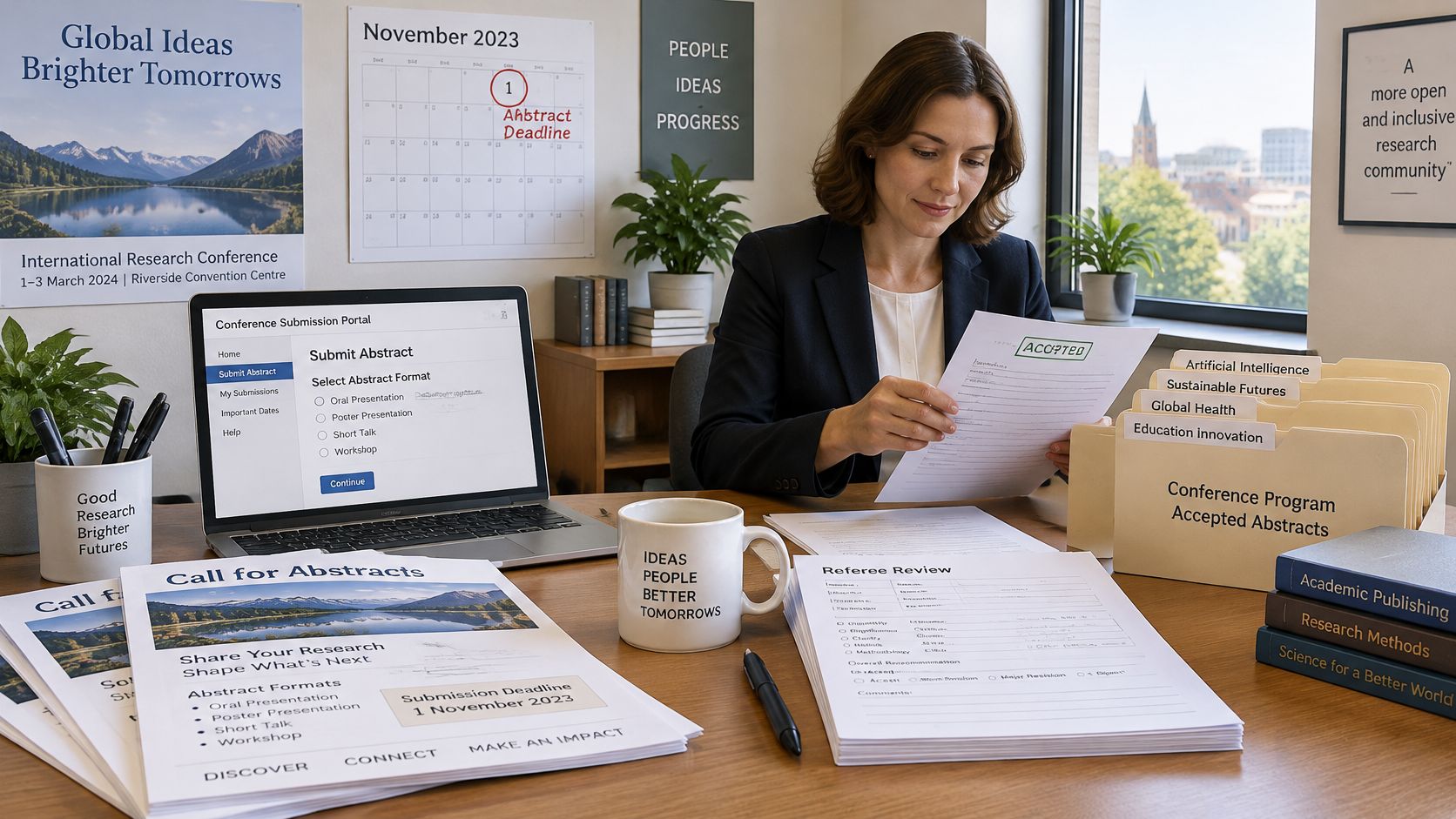
Different calls establish different scheduling inventories. The ASA Women in Data Science and Statistics 2024 call accepted concurrent, panel, and speed-session abstracts from March 1 through April 19, 2024. The CFE-CMStatistics 2024 important dates set September 11, 2024, as the extended deadline for contributed abstracts.
These labels matter operationally. Panels require coordination among several people, while speed sessions need tightly controlled transitions. A late submission extension also affects when staff can finalize the accepted pool.
Build around the available time
A sorter filters accepted records by topic, groups related work, and assigns presentations until the session's available time is filled. That calculation must include questions, chair introductions, transitions, and any planned discussion.
| Format | Scheduling concern | Confirmation needed |
|---|---|---|
| Oral presentation | Fixed room block and presentation duration | Presenter availability and timing |
| Poster | Hall capacity, viewing periods, and topic grouping | Poster requirements and attendance |
| Lightning or speed talk | Short slots with little transition tolerance | Concise presentation instructions |
| Panel | Coordinated participants and shared discussion | Panelists, moderator, and running order |
A strong abstract can receive a poster assignment because the oral program has no suitable space left. Poster status isn't automatic evidence of weaker science. Committees should explain whether format reflects reviewer assessment, capacity, topic balance, or a combination.
A usable conference program also avoids preventable presenter conflicts and gives attendees enough information to choose between simultaneous sessions.
The following video offers another way to consider the conference workflow.
Turn assignments into preparation tasks
Once a slot exists, send the presenter a clear task list: confirm participation, review the assigned title and format, provide materials, and meet presentation requirements. Keep correspondence attached to the correct speaker and session rather than scattered across inboxes.
Decide when presentation materials will become accessible and who may open them. The program guide, attendee handouts, and internal audiovisual files may need different release rules.
Authors should retain the underlying dataset, ethics approvals, and authorship agreement. Conference discussion can reveal useful questions for the manuscript, but it doesn't replace the documentation needed to develop and submit that manuscript.
Acceptance Rates and Later Publication
An accepted abstract is a conference outcome, not proof that the work is a finished paper. Acceptance and later full publication measure different stages, and neither should be substituted for the other.
Historical acceptance and abstract-to-paper rates
| Body of work | Acceptance | Full publication | Practical reading |
|---|---|---|---|
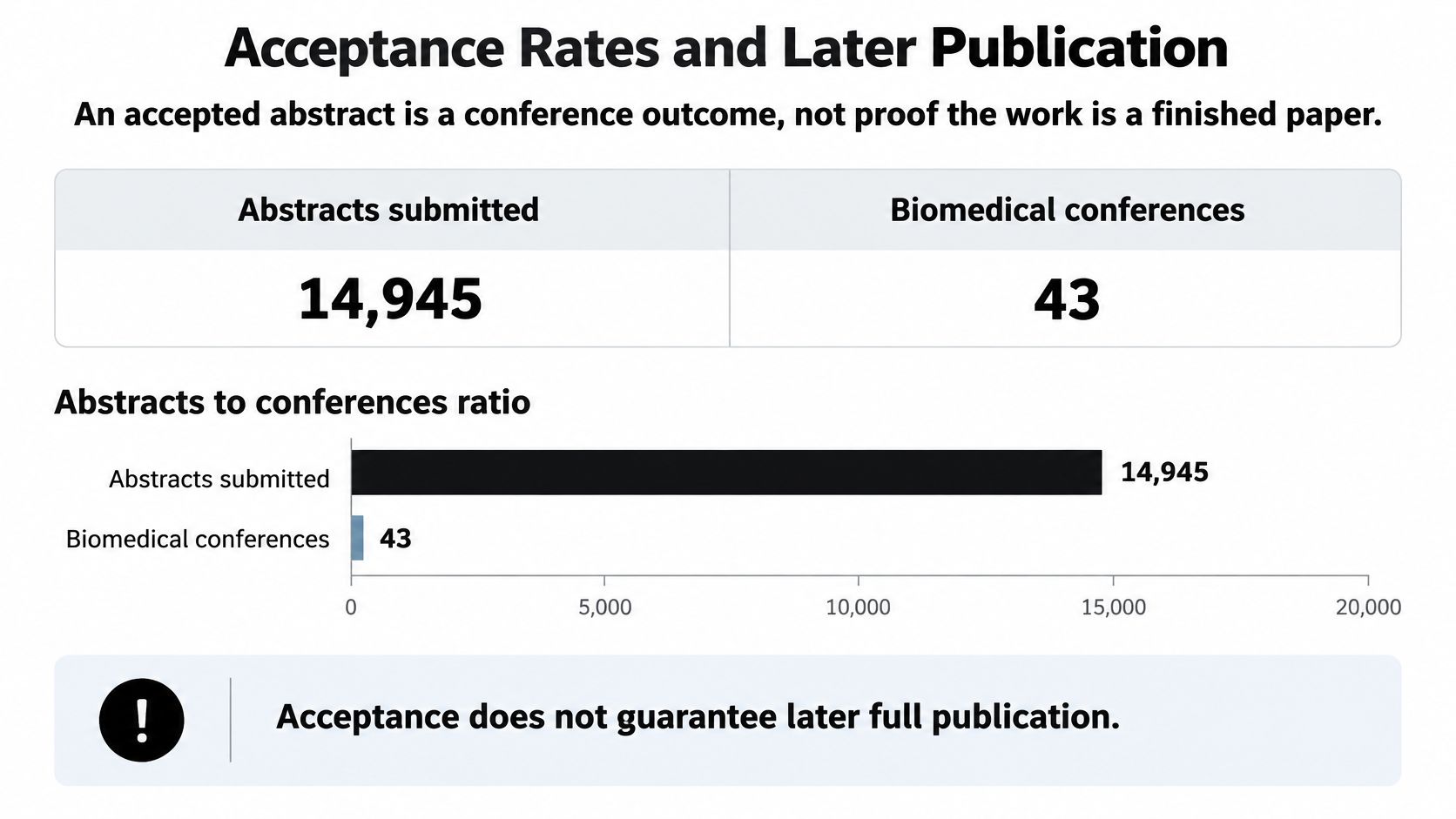
| Systematic review of 14,945 biomedical abstracts submitted to 43 meetings, 1957–1999 | 46% accepted, 54% rejected | About 35% of all submissions eventually published; 27% of a separate sample of 2,412 rejected abstracts still published | Rejection doesn't always end dissemination |
| Presented biomedical abstracts in that review, 19,123 at 234 meetings | Not an acceptance figure | Approximately 27% after two years, 41% after four, and 44% after six | Most presented work hadn't become a full paper within follow-up |
| ACC, AHA, and ESC cardiology meetings | About 30% accepted; earlier AHA reports 26–30%, ESC 35–38% | About 30% of presented abstracts published within two years | At those rates, 1,000 submissions imply about 300 presentations and about 90 papers |
| Emergency-medicine conferences, as discussed in the abstract-to-publication article | Cohort of 10,055 presented abstracts, not an acceptance rate | 8.2% published | Low conversion is field-specific |
| Endocrine-surgery congresses discussed in the same article | Multicenter presented cohort, not an acceptance rate | 62.2% published | High conversion is also field-specific |
| One professional association, 2025 analysis discussed in the same article | Cohort of 1,220 abstracts, not an acceptance rate | 32% published; oral 47%, poster 29% | Presentation format alone doesn't establish quality |
These benchmarks need their original denominators. A percentage of submitted abstracts accepted can't be compared directly with a percentage of presented abstracts later published. The cardiology calculation is an illustration using the reported rates, not a forecast for another association, and accepted presentations aren't necessarily oral talks.
The historical biomedical review also isn't a current acceptance target. Its value is in showing why organizers need distinct submission, presentation, and publication records.
The scale of that historical submission cohort is shown below.
Measure the outcome you actually mean
Committees should store submission status, assigned format, presentation completion, and later publication separately. For publication follow-up, record the journal citation, identifier, and follow-up date so staff can distinguish unpublished work from work that hasn't been checked.
Don't describe acceptance counts as research impact when you've measured only selection for the meeting.
Authors can make the transition more deliberate. Choose a plausible target journal, identify what the full manuscript requires, preserve the analysis files, and agree who will draft each part while the study details are still clear.
Use conference questions to improve explanation and identify limitations, not to retrofit the study's original objectives. A poster can provide useful discussion with specialists, while a rejected abstract may still support a journal submission after appropriate development.
The practical goal isn't to turn every meeting into a journal gatekeeper. It's to avoid treating the conference decision as the last meaningful event in the research record.
Set the Call Before Authors Start Writing
A clear call prevents staff from inventing policy while authors are already submitting. Before launch, settle the scientific scope and the operational decisions that determine what happens next.
- Define eligible work. State the questions, study types, and categories the meeting will consider.
- Lock the format rules. Specify length, language, prohibited formatting, and available presentation choices.
- Design the fields. Add study-specific questions and keep completeness checks separate from merit scores.
- Prepare reviewers. Establish the reviewer pool, scoring scale, conflict rules, and blinding method.
- Reserve session time. Set presentation and discussion allowances before deciding how much work to accept.
- Connect education requirements. Make disclosure collection part of the faculty assignment process.
For accredited continuing education, the ACCME financial-relationship rule requires information from everyone controlling educational content about relationships with ineligible companies during the prior 24 months, with no minimum financial threshold, including company names and the nature of each relationship. Learners must receive the required information about relevant relationships and their mitigation; people without relevant relationships must also be identified individually or as a group.
Attach that information to the speaker assignment rather than maintaining an unrelated spreadsheet. Decide who checks completion and who resolves outstanding requirements before faculty materials are released.
At Planstone, we configure submission forms, review criteria, faculty requirements, credit rules, and reports around each program, with abstract management connecting submission, review, and session building. Teams can use individual modules alongside existing systems rather than replacing a stage that already works.
Abstract Submission Questions Authors Ask
Can I submit the same study to more than one call?
Only if each call permits it. Check duplicate-submission, originality, prior-presentation, and publication policies separately, because those terms don't necessarily mean the same thing.
Does my requested format bind the committee?
Not unless the call explicitly says so. Read the decision notice carefully and confirm whether you can meet the assigned presentation requirements before accepting.
What if my abstract is rejected?
Review the reason, improve the work where needed, and consider another appropriate dissemination route. Conference rejection isn't a journal decision, and it doesn't by itself establish that the study is unsuitable for publication.
Why does my text fail the length check?
The form may count characters, spaces, or particular fields differently from your writing software. Check the displayed error and the call's counting rule before deleting scientific information.
Can I edit after submitting?
Use the revision window the call allows and check whether editing returns the record to draft status. After that window closes, contact the organizers rather than assuming an emailed replacement will update the official record.
Who sees my name?
In blind review, assigned reviewers should receive the anonymized record. Authorized organizers still need identity and contact information to administer decisions and presentations.
Is there a submission fee?
Check the specific call for submission charges, registration obligations, and withdrawal conditions. Don't assume that submitting an abstract and registering to present are the same transaction.
Planstone offers configurable abstract management that connects submission, review, and session building with speaker preparation and continuing education workflows. Visit Planstone to discuss your call requirements, review criteria, and session-building process, including where a module could fit alongside your existing systems.