

What does a program committee score when it reads your abstract? Most authors answer by pointing at the prose: the hook in the opening line, the confident conclusion, the tidy keyword list. Then the decision arrives with two lines of feedback, and nothing in the rejection letter maps to anything they wrote.
The mismatch comes from a wrong mental model. Committees don't read an abstract for conference as a blurb to be admired. They read it as a record to be compared against dozens of others, scored on defined fields, and later reused as a program entry, a review artifact, and sometimes the only published trace of the work.
Once you see the abstract that way, the writing advice changes. You stop polishing sentences and start completing fields.
Table of Contents
- What an Abstract for Conference Is and Why It Matters
- Parts Every Abstract Must Include
- A Complete Abstract Built Piece by Piece
- How Reviewers Score Completeness
- Disclosure, AI Use, and Preliminary Results
- Acceptance Rates and Later Publication
- Track the Abstract After Acceptance
- Frequently Asked Questions About Conference Abstracts
What an Abstract for Conference Is and Why It Matters
An abstract for conference is a short structured record, usually a few hundred words under a cap the meeting sets, that a program committee uses to decide whether a submission fits the call and that attendees later use to choose a session.
It does three jobs at once.
- It screens fit. Reviewers check topic, study design, and the format the call allows, whether oral, poster, or symposium. A brilliant study pitched in the wrong track gets declined for reasons that have nothing to do with quality.
- It becomes the program entry. Title, authors, and keywords have to stand alone on a website and in a printed guide, because that's all most attendees will ever see.
- It may be the only lasting public record. Plenty of presented work never reaches a journal, which makes the abstract itself the citation of record.
The form has a longer institutional history than most authors assume. The Royal Society's account of where abstracting came from records that authors were first explicitly asked to submit abstracts alongside their papers in 1892, partly to ease the workload of society secretaries, and that by 1914 the Society wanted every communicated paper to include one. By the 1948 International Scientific Information Conference, indexes and abstracts drew attention comparable to or greater than the journals themselves. Standardized fields and deadlines descend from that century of effort, not from administrative fussiness.
So an abstract isn't a teaser, a miniature paper, or evidence that a journal will take the study. A journal abstract summarizes a finished manuscript under a stable reporting standard. A conference abstract often gets drafted before the analysis is final and has to clear a deadline and a word cap. Read the call for abstracts the way a program chair reads it, as a specification, not an invitation.
Parts Every Abstract Must Include
Seven parts carry the decision. Build all seven before you write prose, and the draft usually falls into place in an afternoon.
| Part | What it must state | Usual failure |
|---|---|---|
| Title | Population, question, and intervention or exposure in under 20 words | Slogan or theme with no study signal |
| Objective | One sentence the data can answer | Background that never states an aim |
| Methods | Design, setting, sample size, and main measures | Methods replaced by results will be presented |
| Results | Numbers, denominators, and direction of effect | Claims with no data |
| Conclusions | A claim limited to the results shown | Advice beyond the sample |
| Presentation fit | Oral, poster, or the session type the call allows | Format the evidence cannot support |
| Disclosures | Relevant financial relationships, or none | Conflict statement missing |
A Word Split That Survives a Tight Cap
Inside a typical limit of 250 to 300 words, this split keeps the evidence visible. Roughly 15 to 20 percent goes to background and objective, 25 to 30 percent to methods, 30 to 35 percent to results, and about 15 percent to conclusions.
That allocation surprises people. Background feels important because it's the part everyone can write. Results feel cramped because they're the part that decides whether a reviewer trusts you. Give results the largest share and let the background shrink to two sentences.
Two mechanical points trip up first-time submitters. Some meetings count the author line inside the limit and some don't, so check the call rather than assuming. And when the call publishes a keyword list, take three to five terms from it, in the spelling the list uses, because the program search runs on those exact strings.
When the Results Aren't Ready
Plenty of legitimate submissions describe work still in progress. Say the analysis is ongoing, state the sample collected so far, and describe what you will report. What you can't do is write that results will be presented and stop there, since many calls screen that line out as an incomplete submission. Equally, you can't invent a number to fill the gap.
Practical rule: If you can't state a denominator and a direction of effect, your abstract isn't ready for a results-based track. Look for a work-in-progress or poster category in the same call.
A Complete Abstract Built Piece by Piece
Here's the whole thing assembled in order. The study is invented, and every number in it is invented too. Swap in your own.
- Title. Weekend discharge huddles and 30-day readmission after heart-failure admission. Population, exposure, outcome, under 20 words, no slogan.
- Objective. Test whether a pharmacist-nurse huddle on Friday and Saturday lowered unplanned readmission compared with usual discharge teaching. One sentence, answerable.
- Methods. Single-center before-after study of adults discharged with heart failure, 412 patients before and 398 after, with unplanned readmission at 30 days prespecified as the primary outcome. Design, setting, sample, measure.
- Results. Readmission was 18.4 percent before (76 of 412) and 14.1 percent after (56 of 398), an absolute difference of 4.3 points with a 95 percent confidence interval of 0.2 to 8.4. Numerators, denominators, direction, uncertainty.
- Conclusions. The huddle was associated with fewer readmissions at one hospital and does not prove cause. The claim stops where the design stops.
- Limitations. No control hospital and possible seasonal change, stated in the conclusion or a closing line. Reviewers look for this even when the form doesn't ask.
- Keywords from a clinical list. Heart failure, readmission, discharge planning. Three terms, spelled as the list spells them.
The flow below runs the same seven steps on a differently sized invented cohort, a 12-hospital retrospective group, to show that the shape holds when the design changes.
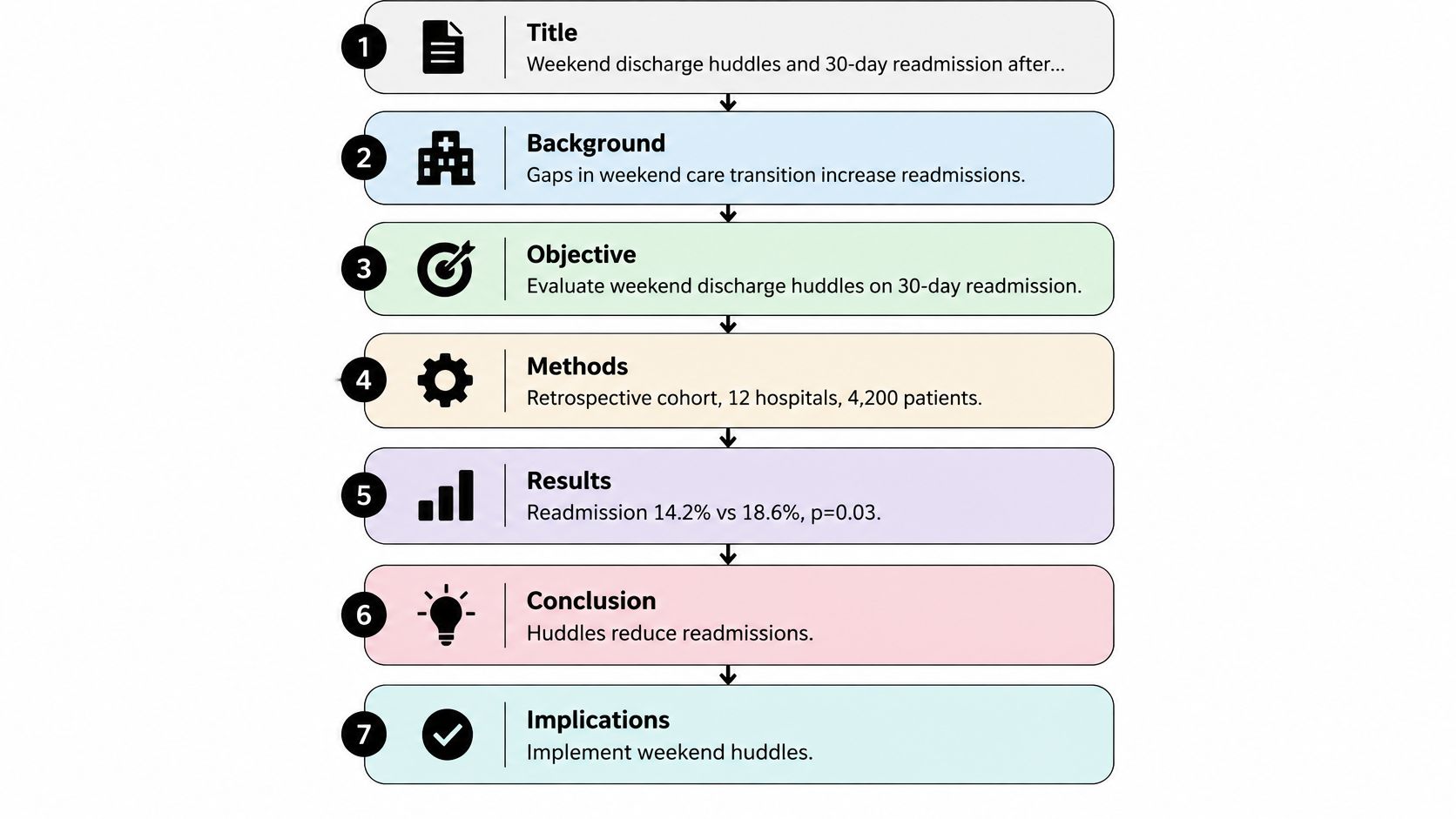
Now the same study broken in three lines, which is what a rushed draft usually looks like.
- "Results will be presented at the meeting." No data, no denominator, nothing to score, and many calls treat it as incomplete.
- "Weekend huddles should become national discharge policy." A one-hospital before-after design can't support a policy claim, and reviewers flag exactly this overreach.
- "Readmission fell by 4.3 points." True but unanchored. Without the 76 of 412 and 56 of 398, a reviewer can't tell what the 4.3 points are 4.3 percent of.
Notice what the broken version loses. Not elegance. Evidence.
How Reviewers Score Completeness
Start with the cause. A reviewer opening the fortieth abstract in a batch isn't reading for pleasure. They're comparing it against the other thirty-nine and against a scoring sheet, and a single free-text box hands them nothing comparable. Missing fields don't make the science look modest. They make merit impossible to judge, so the abstract gets scored on impressions.
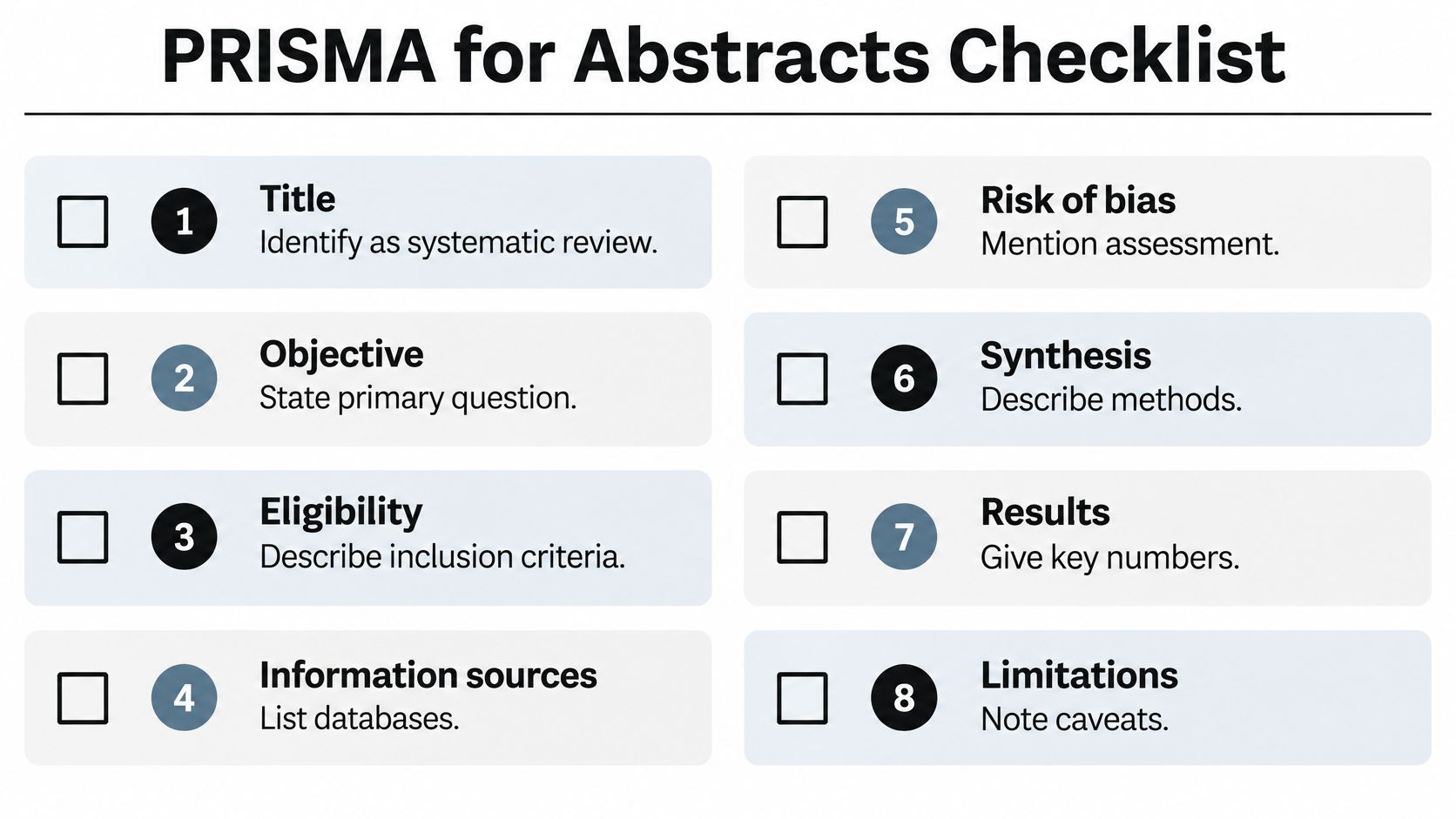
Systematic reviews have a defined answer to this. PRISMA for Abstracts asks for the objective, the eligibility approach, data sources, synthesis method, principal results, and, when a meta-analysis is used, the effect estimate and confidence interval. The checklist below shows the items a reviewer expects to find.
Trial abstracts often fall well short. Among randomized controlled trial abstracts presented at major international cardiothoracic conferences, mean adherence to CONSORT for Abstracts items was only 35 percent, a median of 6 of 17 items, and trial registration, a multicentre-design disclosure, and abstracts over 300 words were all associated with better reporting, as the CONSORT-A adherence study reports. That's a striking gap for a field that has had a reporting standard for years.
Score Four Things Separately
One vague "scientific quality" score hides the useful signal. Four separate scores tell an author exactly what to fix.
| Criterion | Full credit requires | Flag when |
|---|---|---|
| Methodological completeness | Design, population, intervention or exposure, comparator, outcomes, sample size, and limitations all stated | Any required field absent |
| Quantitative results | Effect size, denominators, and confidence interval reported | Claims given without numbers or denominators |
| Registration or identifier | Trial registration or study identifier named | None stated |
| Limitations | At least one design-specific limitation named | Limitations missing or generic |
The same discipline serves grant writing, where a reviewer with a scoring rubric asks much the same questions about a question, a method, and a deliverable. If your next submission is a funding pitch rather than a meeting, the guidance on how to write a winning proposal covers that scoring logic in more depth.
Two labelling habits carry most of the weight. Mark exploratory findings apart from confirmatory ones, and say so in the objective. Mark interim analyses as interim, name the prespecified outcomes, and state the sample size reached rather than the target. For the mechanics of assignment, blinding, and score reconciliation that sit behind a rubric, this overview of peer review processes explains how the workflow pieces fit.
Structured prompts make abstracts comparable. Missing design and outcome fields invite reviewers to overread preliminary claims, and they usually do.
Disclosure, AI Use, and Preliminary Results
Two stacks of folders land on the same desk every cycle, and the split between them isn't always about quality. Before drafting, check what the meeting expects you to declare.

Better prose is not better evidence, and a study in the ERIC record of the AI-proposal experiment shows how far apart practice and policy currently sit. One AI-authored proposal was submitted to 20 education conferences. 11 accepted it, 9 rejected it, and only 2 provided substantive reviewer feedback. The same proposal, in front of committees reading the same field, produced opposite decisions.
That inconsistency cuts two ways. It means an acceptance says something about a particular committee on a particular day. It also means polished drafting can disguise weak methods, fabricated citations, overstated claims, or a project the author hasn't done.
What to Disclose and What to Verify
Policies differ by meeting and by discipline, so generic writing advice creates real compliance risk. Three habits keep authors out of trouble.
- Read the AI rule before you draft. Some calls require disclosure of AI assistance in drafting or analysis, some prohibit uploaded text entirely, and some say nothing at all.
- Keep methods, data, and citations human-verified. Every reference should resolve. Every number should trace to a dataset the author can produce on request.
- Don't paste confidential or unpublished data into a public tool. Disclosure requirements don't protect data you've already sent somewhere you can't control.
Labelling is the other half. Write "preliminary" where findings are preliminary, mark interim analyses as interim, state the sample size behind any percentage, and name prespecified outcomes where the study had them. Selective reporting is not a hypothetical worry: in a Cochrane methods review of publication bias, studies with positive results were more likely to reach full publication, with a risk ratio of 1.31 (95 percent CI 1.23 to 1.40) when positivity meant statistical significance. A positive-sounding abstract deserves a check against the full data before anyone repeats it.
The video below walks through the drafting choices that hold up under that kind of scrutiny.
Acceptance Rates and Later Publication
Acceptance and publication are separate events, often years apart, and the table makes the gap visible.
| Meeting set | Volume | Rate | What the rate measures |
|---|---|---|---|
| Six spine conferences, three years | 5,722 abstracts presented | 54% (range 44.5–66.3%) | Later peer-reviewed publication |
| AHA, ACC, and ESC | Meeting-specific, not pooled | 30.6% by two years (AHA 34.5%, ACC 29.6%, ESC 27.0%) | Journal publication; five-year rates 49.7%, 42.6%, 37.6% |
| ConsEuro, 2003–2019 | 1,426 abstracts | 33.5% (478 papers) | Publication; median time 12 months |
| Historical systematic-review evidence | Multiple specialties | 27% / 41% / 44% | Published within 2, 4, and 6 years |
| ICLR 2024 main track (full-paper submissions) | 7,404 submissions | 30.5% accepted | Conference acceptance, not abstract publication |
| Applied statistics meeting, 2024 | 98 submissions, 88 reviewed, 53 accepted | 54.1% accepted | Conference acceptance |
Read the right-hand column first, because the rates measure different things. A 54 percent publication rate over three years has nothing in common with a 30.5 percent acceptance rate, even though both are percentages attached to conferences.
The spine evidence comes from a bibliometric analysis of six major spine-specialty conferences, which identified 5,722 abstracts presented over three years and found that 3,091, or 54 percent, were subsequently published in peer-reviewed journals, with conference rates from 44.5 to 66.3 percent (the bibliometric analysis). In cardiovascular medicine, only 30.6 percent of abstracts from the American Heart Association, American College of Cardiology, and European Society of Cardiology meetings were published within two years, rising to 49.7, 42.6, and 37.6 percent at five years. Publication continues, then slows sharply.
Reading the Table Without Misreading Your Odds
Older systematic-review evidence found that 27 percent of meeting abstracts were published within two years, 41 percent within four, and 44 percent within six, with basic-science topics and positive outcomes associated with both acceptance and later publication (BMC Medical Research Methodology).
Acceptance itself swings by field. ICLR 2024 received 7,404 main-conference submissions and accepted 30.5 percent of them, per the authors of a 2024 arXiv study of conference review. A 2024 applied statistics, modeling, and advanced algorithms meeting received 98 submissions, sent 88 for review, and accepted 53, a 54.1 percent rate, as reported in the Journal of Physics: Conference Series.
None of these numbers describe your abstract. They describe populations of submissions, and they're most useful for one thing: deciding how much of your program's effort belongs in tracking what happens after the session. When you're ready to turn accepted work into a schedule, this guide to building the program of the conference covers the sequencing.
Track the Abstract After Acceptance
For a scientific or medical association, an accepted abstract starts the program rather than closing a form. Five steps keep that record usable.
- Map every call field to one submission record before the next cycle opens: authors, review decision, presentation type, disclosures, and the session it might join.
- Keep the submission identifier and version history. When a title changes between submission and program guide, you want to see who changed it and when.
- Link the record to later outputs. A poster, a protocol, a registry entry, or a journal article all belong on the same record rather than in someone's inbox.
- Compare the abstract with the paper on sample size, author list, effect estimates, and conclusions. These fields shift between presentation and publication, and the comparison is how a program learns what its reviewers missed.
- Review the cycle before the next call. Which abstracts were accepted, which were presented, which reached a journal, and which required fields reviewers kept flagging as absent.
Compliance work runs alongside those steps. ACCME guidance states that accredited continuing-education providers must ensure decisions about planning, faculty selection, delivery, and evaluation are made without influence or involvement from owners or employees of an ineligible company, and providers are expected to evaluate impact on learners' knowledge, strategies or skills, performance, or patient outcomes when awarding Maintenance of Certification credit (ACCME accreditation requirements). An accepted abstract establishes none of that on its own.
Keeping submission, review, and session building in one workflow is what our abstract management module is built for, from the call through the finished program. We developed a session-building workspace with the American Physical Society, where sorters filter abstracts, drag submissions into sessions, and work within session-time limits, refined through a pilot meeting.
"We rely on the platform to manage our annual conference's abstract submission, review & speaker management processes, and it helps us keep a complex, multi-step process organized from start to finish.", Jacki Weiglein, National Association for Healthcare Quality
Acceptance settles the program question. It doesn't settle the science question, and the record you keep is what lets anyone tell the difference two years later.
Frequently Asked Questions About Conference Abstracts
Does the word limit include the title and author line?
The call decides. Some meetings count the author line inside the limit and some exclude it, and the difference can cost you a sentence of methods. Check the submission instructions before you trim, not after the form rejects you.
Can I submit before the analysis is finished?
Yes, if you state that the analysis is ongoing and label the finding as preliminary. Never invent figures, and don't write only that results will be presented, since many calls screen that phrasing out.
Can I reuse an accepted abstract in a journal paper?
Usually yes, but check the meeting's policy on prior presentation first. Then keep the two documents consistent on sample size, denominators, and effect estimates, because reviewers compare them and discrepancies invite questions you'd rather not answer.
Must I disclose AI assistance?
Follow the rule in that meeting's call. Disclose where it's required, and keep methods, data, and citations human-verified regardless. Policies vary widely across conferences and disciplines, so generic writing advice won't keep you compliant.
What if my abstract is rejected?
Check whether the call provides reviewer feedback, then revise the weak fields your completeness rubric flagged. A missing denominator or design detail is fixable in a week. Then look for a meeting whose call fits your study design and stage.
If your call for abstracts still runs on spreadsheets and email threads, Planstone connects submission, review, and session building in one configured platform, alongside modules for speaker tasks, disclosures, evaluations, and credit tracking that you can adopt together or one at a time. We've supported conference and education teams since 2003, and a dedicated account manager learns your process before configuration begins. Visit Planstone to talk through your next abstract cycle with our team.